





Understanding the Dito Di Prova Articolato: CEI 23-50 Fig. 2 Compliance and Applications
Introduction to Articulated Test Fingers in Safety Standards
The evaluation of electrical equipment safety against accidental contact with live or hazardous moving parts constitutes a fundamental pillar of product compliance engineering. Among the suite of standardized test probes defined in international regulations, the articulated test finger, known in Italian standards as the “Dito Di Prova Articolato,” holds a critical position. Specifically, its dimensional and functional specifications, as detailed in CEI 23-50 Figure 2—a standard harmonized with IEC 61032, IEC 60529 (IP Code), and other global norms—serve as a universal benchmark for assessing protection against access to hazardous parts. This technical article examines the design philosophy, compliance requirements, and multifaceted applications of this test device, with a focus on the implementation and advantages of the LISUN Test Finger, Test Probe, and Test Pin product series in validation laboratories and manufacturing quality assurance processes.
Anatomizing the Dito Di Prova Articolato: Design and Dimensional Tolerances
The articulated test finger is not a simple probe but a sophisticated simulation of a human finger, designed to replicate the size and joint articulation of a child’s finger. Its geometry is meticulously specified to challenge the protective enclosures of equipment. According to CEI 23-50 Fig. 2 and its international counterparts, the probe consists of three main sections: a cylindrical palm simulation, two articulated joints, and a distal finger simulation. The critical dimensions—a total length of 100 mm, a finger diameter of 12 mm, a palm diameter of 50 mm, and a joint radius of 20 mm—are non-negotiable for compliance testing. The joints allow for a 90° ±5° articulation in both directions, parallel to the palm axis, enabling the probe to “feel” for openings in complex geometries. The standard mandates a test force of 10 N ± 1 N, applied without deliberate leverage, to simulate casual probing. The LISUN Test Finger (Model LS-JF-01) is manufactured from high-strength, insulating materials such as anodized aluminum and engineering-grade polymers, ensuring dimensional stability within ±0.1 mm tolerances and dielectric integrity to prevent false test results due to material deflection or conductivity.
The Underlying Testing Principle: Simulating Real-World Hazard Scenarios
The core principle of the articulated test finger test is to verify that an enclosure provides adequate “protection against access to hazardous parts,” classified as Protection against electric shock and Protection against mechanical hazards. The test is conducted under two distinct conditions, often corresponding to the IP Code’s first numeral for protection against solid objects:
- Probe Access Test: The articulated test finger is introduced into every conceivable opening in the enclosure with the specified 10 N force. It must not contact live parts, internal hazardous moving parts (like fans or gears), or parts that could become live under fault conditions.
- Withstand Test (if contact occurs): In some standards, if the probe does contact a live part, the equipment may be subjected to a subsequent dielectric strength or leakage current test to ensure no hazardous energy transfer occurs, though prevention of contact is the primary goal.
This dual-pronged approach ensures that products are safe not only during normal operation but also during foreseeable misuse, such as a child inserting a finger into a ventilation grille or a gap around a control panel. The LISUN probe’s precise articulation and consistent application force ensure repeatable and reproducible test outcomes, which are paramount for certification bodies like TÜV, UL, and Intertek.
Cross-Industry Applications and Compliance Imperatives
The universality of the articulated test finger test makes it a non-negotiable requirement across a vast spectrum of industries. Its application ensures user safety from low-voltage household items to high-complexity industrial systems.
- Electrical and Electronic Equipment & Household Appliances: For devices like power supplies, smart home hubs, and kitchen appliances (blenders, coffee makers), the test verifies that live terminals and high-voltage capacitors are inaccessible through service doors, vents, or seams. A toaster’s crumb tray opening, for example, must prevent access to heating elements.
- Automotive Electronics: In-vehicle infotainment systems, charging ports, and control units must prevent finger contact with PCB-mounted components, especially as these systems are installed in accessible areas like dashboards and center consoles.
- Lighting Fixtures: Both indoor and outdoor luminaires, particularly those with removable diffusers or access panels for lamp replacement, are tested to ensure live lamp holders or driver components cannot be touched.
- Industrial Control Systems & Telecommunications Equipment: Enclosures for PLCs, routers, and server racks are validated to protect service personnel from contact with backplane connectors or power distribution units when doors are ajar or covers are partially removed.
- Medical Devices: Patient-connected equipment (monitors, infusion pumps) and laboratory analyzers must prevent any possibility of finger-mediated electric shock to vulnerable patients or operators, a critical requirement under IEC 60601-1.
- Aerospace and Aviation Components: Cockpit panels, in-flight entertainment units, and galley equipment are subjected to rigorous finger probe testing to ensure absolute reliability and safety in the unique environmental and operational stresses of aviation.
- Electrical Components: Switches, sockets, and circuit breakers are primary candidates for this test. A standard wall socket must be designed so that the articulated finger cannot make contact with live pins when a plug is partially inserted or when probing from oblique angles.
- Cable and Wiring Systems: Connectors and junction boxes must be designed with shrouds or recesses that defeat the probe’s articulation, preventing contact with crimped terminals.
- Toy and Children’s Products Industry: This is a paramount application. Battery compartments on electronic toys must be securely enclosed, requiring a tool for opening, or designed so that the test finger cannot bridge the battery terminals, preventing short circuits and thermal hazards.
The LISUN Test Finger System: Specifications and Technical Advantages
The LISUN series of compliance test probes, including the articulated test finger, is engineered to meet the exacting demands of modern testing laboratories. The system is characterized by several key advantages that translate to operational reliability and audit confidence.
Specifications (Representative Model – LS-JF-01):
- Standard Compliance: Fully conforms to CEI 23-50 Fig. 2, IEC 61032 Test Probe B, IEC 60529, GB/T 4208, UL 507, and other major national derivatives.
- Dimensional Accuracy: Critical features machined to within ±0.1 mm, with joint articulation of 90° ±1° for superior precision.
- Construction: Joints utilize low-friction, wear-resistant bushings (e.g., POM) to ensure smooth, consistent articulation over thousands of test cycles without binding or slop.
- Force Application: Optional calibrated spring mechanism or digital force gauge interface (LS-FG-02) for precise application and documentation of the 10 N ± 0.5 N force.
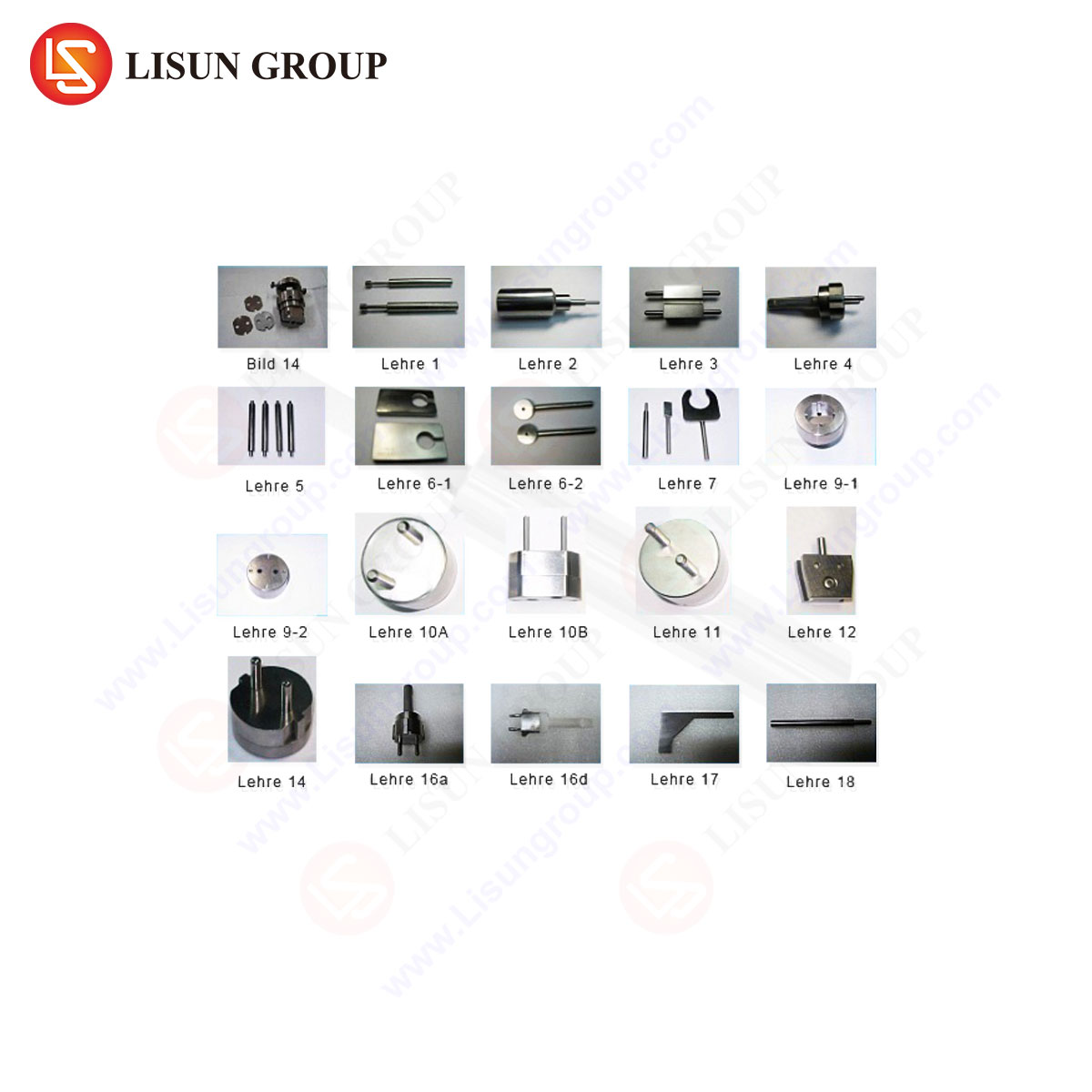
- Accessory Kit: Often supplied as part of a comprehensive set (LISUN LS-ST-01) including test pins (IEC 61032 Probe 13), test hooks, and other probes for complete IP1X-IP8X and hazard protection testing.
Competitive Advantages:
- Metrological Traceability: Each LISUN probe can be supplied with a calibration certificate from an accredited lab, providing the documentary evidence required for ISO/IEC 17025 accredited testing facilities.
- Durability and Consistency: The use of aerospace-grade aluminum and advanced polymers resists deformation and wear, ensuring the probe’s geometry remains within specification far longer than inferior cast or sintered metal versions, reducing long-term cost and recalibration frequency.
- Ergonomic and Repeatable Operation: The design includes features for consistent hand positioning and force direction, minimizing operator-dependent variables—a common source of inter-laboratory test disparity.
- Comprehensive Ecosystem: Integration with LISUN’s force gauges and test fixtures allows for semi-automated testing sequences, improving throughput in high-volume QA environments, such as those found in consumer electronics or appliance manufacturing.
Integrating Articulated Finger Testing into a Robust Safety Engineering Workflow
Effective safety engineering mandates the integration of probe testing early in the product development cycle. The use of a precise tool like the LISUN Test Finger enables design verification through rapid prototyping iterations. By identifying failure points—such as a gap that becomes prob-able when a plastic housing flexes under force—engineers can implement corrective actions like adding internal baffles, reducing opening sizes, or strengthening ribs before tooling is finalized. This proactive approach, supported by reliable test equipment, prevents costly post-production redesigns and recall risks. Furthermore, in production quality assurance, periodic audit testing with the same calibrated probe ensures manufacturing consistency, guarding against tolerance creep in injection-molded parts or assembly misalignments that could compromise safety.
Conclusion: The Uncompromising Role of Precision in Safety Validation
The Dito Di Prova Articolato, as codified in CEI 23-50 Fig. 2 and its global equivalents, represents a fundamental, performance-based safety requirement. Its application transcends industry boundaries, enforcing a consistent level of protection for end-users. The fidelity of the test results, however, is intrinsically linked to the precision, durability, and traceability of the physical test probe employed. Investing in a high-quality, fully compliant test system, such as the LISUN Test Finger and associated probes, is not merely a procurement decision but a strategic commitment to product safety, regulatory compliance, and brand integrity. It ensures that the critical barrier between the user and inherent hazards is validated with uncompromising scientific rigor.
Frequently Asked Questions (FAQ)
Q1: Can the LISUN articulated test finger be used for both IP Code testing (e.g., IP2X) and general hazard protection testing per IEC 61032?
A1: Yes, absolutely. The LISUN Test Finger (Probe B) is designed as a universal tool that satisfies the requirements of IEC 60529 for IP2X protection (protection against fingers) and simultaneously serves as Test Probe B in IEC 61032 for the assessment of protection against access to hazardous parts across all product safety standards that reference it.
Q2: How often should a test finger be calibrated, and what does LISUN recommend?
A2: Calibration frequency depends on usage intensity and accreditation body requirements. For laboratories operating under ISO/IEC 17025, annual calibration is typical. LISUN recommends an annual calibration cycle for active test equipment to ensure ongoing dimensional and functional integrity. Each probe is serialized and can be returned with its calibration fixture for traceable recertification.
Q3: Our product has a flexible rubber seal around an access panel. How is the 10 N force applied during testing on such a surface?
A3: The standard requires the force to be applied perpendicularly to the opening or surface in question, without deliberate wedging or leverage. When testing a flexible seal, the probe should be pushed straight against it. The seal’s design must prevent the articulated joint from maneuvering through the gap created by the deflection. The consistent application force of the LISUN system is crucial for reliably testing such scenarios.
Q4: We manufacture industrial connectors. Do we need the full articulated finger or just the test pins?
A4: Both are likely required for comprehensive safety evaluation. The articulated test finger assesses protection against accidental contact by a finger when handling or approaching the connector housing. The test pins (like the LISUN Test Pin per IEC 61032 Probe 13) are used to verify that live conductive parts are not accessible through openings intended for tools, representing a different, often higher-level, of protection. A full test suite covers all foreseeable access scenarios.