

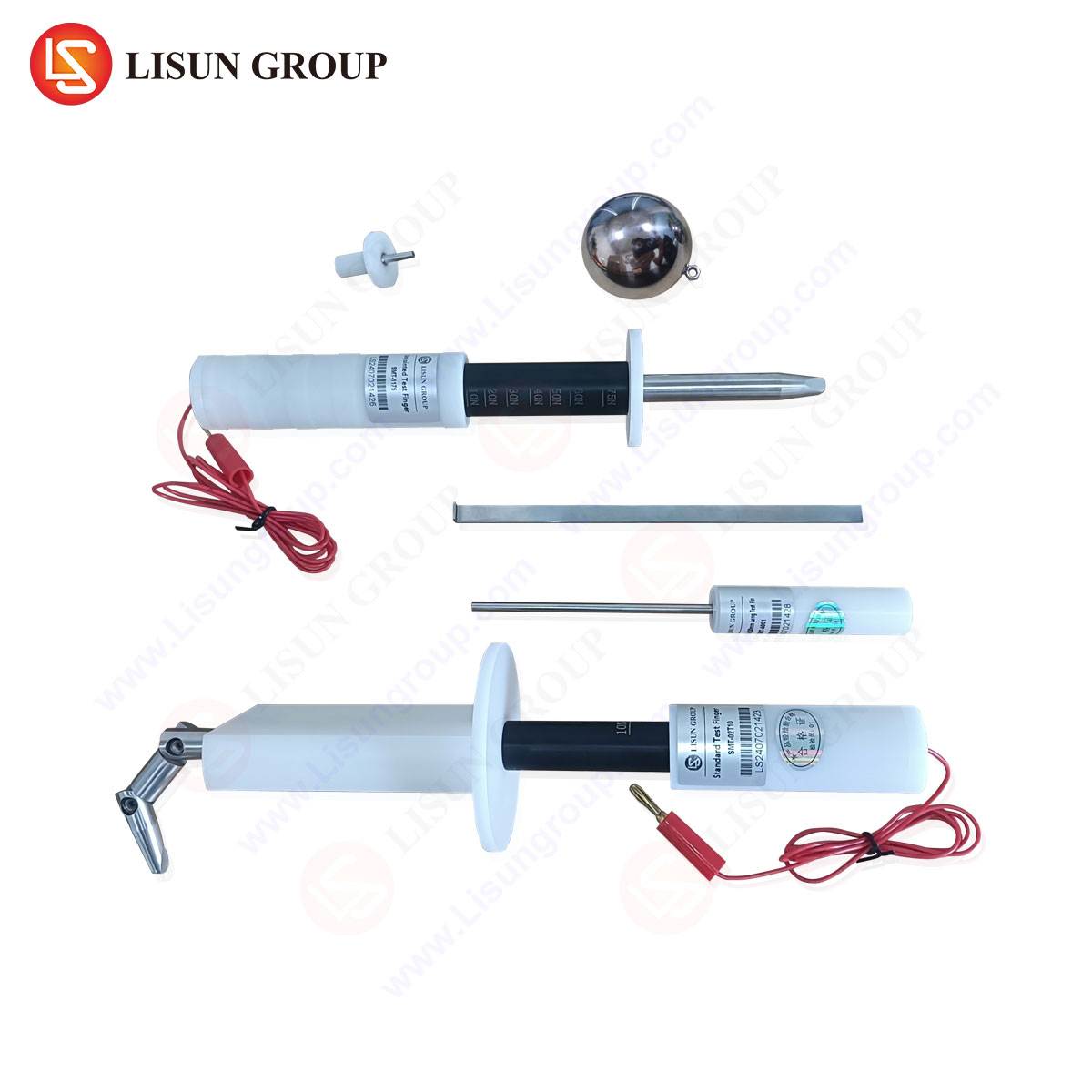







Defining the Uninsulated Live Parts Probe in Product Safety Evaluation
The imperative to safeguard users from electrical hazards is a foundational principle governing the design and manufacture of electrified equipment. Among the most critical tests in this domain is the verification of protection against accessible live parts, a procedure for which the Uninsulated Live Parts Probe is an indispensable instrument. This device, often colloquially referred to as a test finger or test probe, is not a simple tool but a precisely engineered apparatus defined by international safety standards. Its primary function is to simulate the possibility of human contact, either intentional or accidental, with hazardous live electrical components under normal or single-fault conditions. The probe’s design meticulously replicates the dimensions and articulations of a human finger or a probing object like a pin, allowing test engineers to apply a standardized mechanical force to enclosures, openings, and joints. The objective is unequivocal: to determine whether a hazardous live part, which carries a voltage sufficient to cause electric shock, can be touched during prescribed test conditions. The consequences of failure in this evaluation are severe, ranging from non-compliance with regulatory mandates to the tangible risk of user injury or electrocution, underscoring the probe’s role as a critical gatekeeper in product safety certification.
Anatomic and Mechanical Specifications of Standardized Probes
The efficacy of an Uninsulated Live Parts Probe is contingent upon its adherence to strict dimensional and material specifications as outlined in standards such as IEC 61032, which provides a comprehensive catalogue of probes for various protection tests. The most common probes for this application are the Model B Test Finger (resembling a finger) and the Model 13 Test Pin (a slender, rigid probe). The LISUN Test Finger, a representative example of a compliant device, is typically constructed from jointed, heat-resistant material like brass or stainless steel, ensuring it does not deform under test forces or temperatures. Its dimensions are anthropometrically derived; the finger section has a diameter of 12mm, a length of 80mm, and a radius of 10mm at the tip, connected to a pivot that simulates the knuckle joint. This joint allows for a range of motion, typically 90° from the straight position in both directions, enabling it to explore openings and crevices as a human finger might.
In parallel, the LISUN Test Probe, conforming to the Model 13 specification, is designed to simulate tools, wires, or other rigid objects. It is a straight, unjointed pin with a specified diameter, often 2.5mm or 3mm, and a hemispherical tip. The application of force is standardized; for the test finger, a force of 10 N ± 1 N is typically applied, while for the test pin, a force of 3 N ± 0.3 N or 1 N ± 0.1 N may be specified depending on the standard and product family. The LISUN Test Pin is machined to exact tolerances to prevent false positives or negatives—a deviation of even a few tenths of a millimeter could allow an unsafe product to pass or, conversely, fail a safe design. The materials are selected for their electrical conductivity and mechanical integrity, ensuring the probe itself does not become a source of measurement error.
Table 1: Representative Specifications for Common Uninsulated Live Parts Probes
| Probe Type | Standard Reference | Typical Dimensions | Test Force | Simulated Object |
| :— | :— | :— | :— | :— |
| Test Finger (e.g., LISUN Model B) | IEC 61032 Figure 2 | 12mm diameter, 80mm length, 10mm tip radius | 10 N ± 1 N | Adult finger |
| Test Probe/Pin (e.g., LISUN Model 13) | IEC 61032 Figure 13 | 3mm diameter, 100mm length | 3 N ± 0.3 N | Tool, wire, or small object |
The Underlying Electromechanical Testing Principle
The testing procedure employing an Uninsulated Live Parts Probe is an electromechanical verification. The principle is to apply the probe to every potential access point on an equipment’s enclosure—including openings for ventilation, seams between panels, gaps around knobs or buttons, and slots—while the equipment is energized or in a state that could become energized due to a single fault. A crucial component of the test setup is the electrical detection circuit. The probe itself is connected to a low-voltage supply, typically 40V to 50V, in series with a voltage indicator such as a signal lamp. This circuit is isolated from the equipment under test (EUT).
During the test, the probe is manipulated into and around access points. If the probe makes contact with a live part inside the enclosure, it completes the detection circuit, causing the signal lamp to illuminate. This positive indication signifies a failed test, as it demonstrates that a user could potentially make similar contact, resulting in an electric shock. The test is conducted from all angles and positions that are reasonably foreseeable, including with the probe jointed to simulate a curling finger. For the test pin, the objective is to verify that smaller openings, which might be deemed to provide adequate protection, cannot be used to directly contact a hazardous part. The rigor of this test ensures that protection is not circumvented by seemingly innocuous design features.
Application Across Diverse Industrial Sectors
The application of Uninsulated Live Parts Probe testing is ubiquitous across all industries producing electrical and electronic goods. The specific requirements may be detailed in product-family standards, but the underlying safety goal remains consistent.
In the Household Appliances sector, products like washing machines, blenders, and ovens are tested to ensure that live mains connections or internal capacitors cannot be touched through ventilation grilles, service panels, or the gaps around control panels. The Automotive Electronics industry employs these probes to validate the safety of in-vehicle infotainment systems, power converters, and charging ports, ensuring that even in the harsh vibrational environment of a vehicle, no live parts become accessible. For Lighting Fixtures, both consumer and industrial, probes check the accessibility of live parts through lampholders, diffuser retainers, and body seams.
Industrial Control Systems and Telecommunications Equipment, often housed in metal cabinets with multiple access points, require rigorous probing around cable glands, connector ports, and cooling fan openings. The Medical Devices industry imposes exceptionally high safety margins; probes are used to verify the integrity of insulation and enclosures for patient-connected equipment, where a failure could be catastrophic. In Aerospace and Aviation Components, the probes help ensure that avionics systems remain safe despite pressurization cycles and extreme operating conditions that could compromise enclosure integrity.
The foundational nature of this test extends to Electrical Components like switches, sockets, and circuit breakers, where the probe ensures that live terminals are not accessible when the device is properly installed. Cable and Wiring Systems are tested for the security of their terminations. Even in the Toy and Children’s Products Industry, where safety is paramount, probes are used to ensure that battery compartments or internal low-voltage circuits are inaccessible to a child’s probing fingers or objects, with some standards specifying even smaller probes to simulate a child’s finger.
Compliance and Standardization Frameworks
The use of Uninsulated Live Parts Probes is not discretionary but is mandated by a global framework of safety standards. IEC 61032, “Enclosures for electrical equipment – Probes for verification,” is the core standard that defines the geometry, dimensions, and application of the various test probes. This standard is then referenced by a multitude of product-specific standards. For instance, IEC 60335-1 for household appliances, IEC 60950-1 for IT equipment (now largely superseded by IEC 62368-1 for audio/video, information, and communication technology equipment), and IEC 60601-1 for medical electrical equipment all contain clauses that mandate accessibility testing using the probes specified in IEC 61032.
These standards delineate the classification of live parts, the conditions under which the test is performed (e.g., with doors open, covers removed with a tool, or under single-fault conditions like a failed grounding connection), and the acceptable outcome (typically, no contact with live parts as indicated by the detection circuit). Compliance with these standards is often a prerequisite for obtaining certification marks like the UL mark, CE marking, or CCC mark, which are essential for market access in North America, Europe, and China, respectively.
Comparative Analysis of Probe Design and Manufacturing Quality
Not all Uninsulated Live Parts Probes are created equal. The market offers a range of products, from low-cost imitations to precision-engineered instruments like the LISUN Test Finger and Test Probe. The competitive advantages of high-quality probes are rooted in their manufacturing precision, material selection, and ancillary features. A primary differentiator is dimensional accuracy. A probe that is even slightly undersized could fail to detect a hazardous opening, creating a false sense of security and potentially allowing an unsafe product to be certified. High-quality manufacturers use precision CNC machining and rigorous quality control to ensure every probe meets the exacting tolerances of the relevant standards.
Material selection is another critical factor. Probes must be made from durable, corrosion-resistant, and electrically conductive materials. The joint mechanism of a test finger must offer smooth articulation without any play or slack, which could affect the angle and force of application. Furthermore, competitive products often include ergonomic handles, integrated force gauges for accurate application of the specified Newton force, and clear labeling to prevent misidentification. The LISUN Test Probe, for example, may be offered as part of a comprehensive kit with interchangeable tips and a calibrated push-pull gauge, providing a complete, traceable solution for a testing laboratory. This level of integration and assurance reduces test uncertainty and enhances the reproducibility of results across different technicians and laboratories.
Mitigating Design Flaws Through Proactive Probing
Beyond its role in final product certification, the Uninsulated Live Parts Probe is a powerful tool in the design and prototyping phases. By integrating probe testing early in the product development lifecycle, engineers can identify and rectify potential accessibility issues before tooling is finalized, avoiding costly redesigns and production delays. A common finding might be that a ventilation slot, while necessary for thermal management, is just wide enough to allow the test pin to contact a PCB trace. The mitigation could involve redesigning the slot pattern, adding an internal baffle, or improving the PCB layout and insulation.
This proactive approach fosters a culture of safety-by-design. It forces engineers to consider the end-user’s interaction with the product from a safety perspective, questioning every seam, opening, and serviceable part. In complex systems like industrial control panels or telecommunications base stations, where modules from different suppliers are integrated, probe testing verifies that the final assembled state maintains the required degree of protection. It is a tangible, practical check that complements computational modeling and theoretical analysis, providing empirical evidence of a product’s safety integrity.
Frequently Asked Questions (FAQ)
Q1: What is the difference between a “Test Finger” and a “Test Probe,” and when should each be used?
The Test Finger (e.g., Model B per IEC 61032) simulates an adult human finger and is used to test for accessibility through larger openings, gaps, and flexible seams. The Test Probe or Test Pin (e.g., Model 13) simulates a rigid object like a tool or wire and is used for smaller openings where a finger cannot fit but a slender object could penetrate. The applicable product safety standard will specify which probes are required for testing a particular piece of equipment, and often both are used for a comprehensive assessment.
Q2: How is the electrical detection circuit configured during a test?
The probe is connected to one terminal of a low-voltage (e.g., 40-50V) AC or DC power source. The other terminal of the source is connected in series to a voltage indicator, such as a signal lamp, and then to the reference point of the equipment under test, which is usually the protective earth terminal. If the probe contacts a live part, it completes the circuit, and the lamp illuminates. The use of a low voltage ensures the safety of the test operator.
Q3: Can a product fail the test if the probe touches an insulated wire or a component with functional insulation?
Yes. The test is designed to check for contact with “hazardous live parts.” A part is considered hazardous live if its voltage exceeds safety extra-low voltage (SELV) limits, typically 60V DC or 42.4V peak AC. Functional insulation, which is insulation merely necessary for the correct operation of the equipment but not sufficient for safety protection, is not considered adequate to prevent electric shock. Therefore, if the probe can contact a conductor that is only functionally insulated and is at a hazardous voltage, the test is failed.
Q4: What are the consequences of using a non-compliant or out-of-specification test probe?
Using a non-compliant probe can lead to significant compliance and safety risks. An undersized probe might not detect a hazardous opening, leading to a false pass and the certification of an unsafe product. An oversized probe might cause a safe product to fail, resulting in unnecessary and costly design changes. Furthermore, regulatory bodies and certification laboratories require the use of calibrated, standards-compliant equipment. Test results obtained with non-compliant probes are not valid and can lead to certification being denied or revoked.