




A Comprehensive Guide to Waterproof Test Chambers: Principles, Standards, and Application
Introduction to Enclosure Protection Testing
The ingress of solid particulates and liquids represents a primary failure mode for a vast array of electrical and electronic equipment. To quantify and validate a product’s resistance to these environmental challenges, standardized testing within controlled laboratory conditions is imperative. Waterproof test chambers, also known as IP (Ingress Protection) rating test equipment or drip/spray test chambers, serve as the critical apparatus for this validation. These chambers simulate a spectrum of environmental conditions—from vertically falling droplets to powerful water jets—allowing manufacturers to assign a definitive IP code as per IEC 60529, ISO 20653, and other derivative standards. This guide delineates the technical principles, operational methodologies, and application-specific considerations for waterproof testing, with a detailed examination of a representative advanced system.
Fundamental Principles of Ingress Protection (IP) Testing
The IP code, defined by international standard IEC 60529, provides a systematic classification of the degrees of protection offered by enclosures. The code format is IPXY, where ‘X’ denotes protection against solid foreign objects (ranging from 0 to 6) and ‘Y’ indicates protection against harmful ingress of water (ranging from 0 to 9K). Waterproof test chambers are engineered to verify the ‘Y’ digit with precision and repeatability.
Testing principles are based on controlled simulation. For lower IP levels (e.g., IPX1 and IPX2), the test involves a drip rain apparatus that delivers water at a calibrated flow rate and angle for a specified duration. Mid-range protections like IPX3 and IPX4 utilize oscillating tube or spray nozzle assemblies to generate a spray from various directions. IPX5 and IPX6 tests employ high-pressure water jets from a specified nozzle distance and pressure. The most rigorous tests, IPX7 (temporary immersion) and IPX8 (continuous immersion under specified pressure), often require separate tank systems, while IPX9K utilizes high-temperature, high-pressure water jets for cleaning resistance validation.
The core scientific objective is not merely to expose the device to water but to do so under parameters—water pressure, flow volume, spray angle, exposure time, and sample orientation—that are rigorously defined and reproducible. This ensures that test results are comparable across different laboratories and manufacturing batches, providing a reliable benchmark for product durability.
Architectural Design and Core Subsystems of a Modern Test Chamber
A sophisticated waterproof test chamber is an integration of mechanical, hydraulic, and control subsystems. The primary enclosure is typically constructed from stainless steel (e.g., SUS304) for corrosion resistance, with a transparent viewing window of tempered safety glass for observational integrity. Internally, a rotary table, driven by a servo or stepper motor, provides programmable rotational speed and positioning to ensure uniform exposure during spray tests.
The water delivery system is the heart of the apparatus. It consists of a reservoir, filtration units, pumps, pressure regulators, flow meters, and the specific nozzle assemblies mandated by the standard. For IPX5/6 testing, a high-pressure pump maintains steady-state pressure, typically at 100 kPa (≈14.5 psi) for IPX5 (12.5 L/min) and 1000 kPa (≈145 psi) for IPX6 (100 L/min). Temperature control subsystems may be integrated to maintain water at a stable temperature, as per standard requirements (usually within 5K of the sample temperature to prevent internal condensation).
The control system, increasingly digital and programmable, orchestrates all parameters. It allows the operator to input test standards, set duration, control table rotation, monitor water pressure and flow in real-time, and log all test data for audit trails. Safety interlocks, leak detection, and water recovery or drainage systems are integral to operational safety and environmental compliance.
The JL-XC Series: A Paradigm of Integrated Testing Flexibility
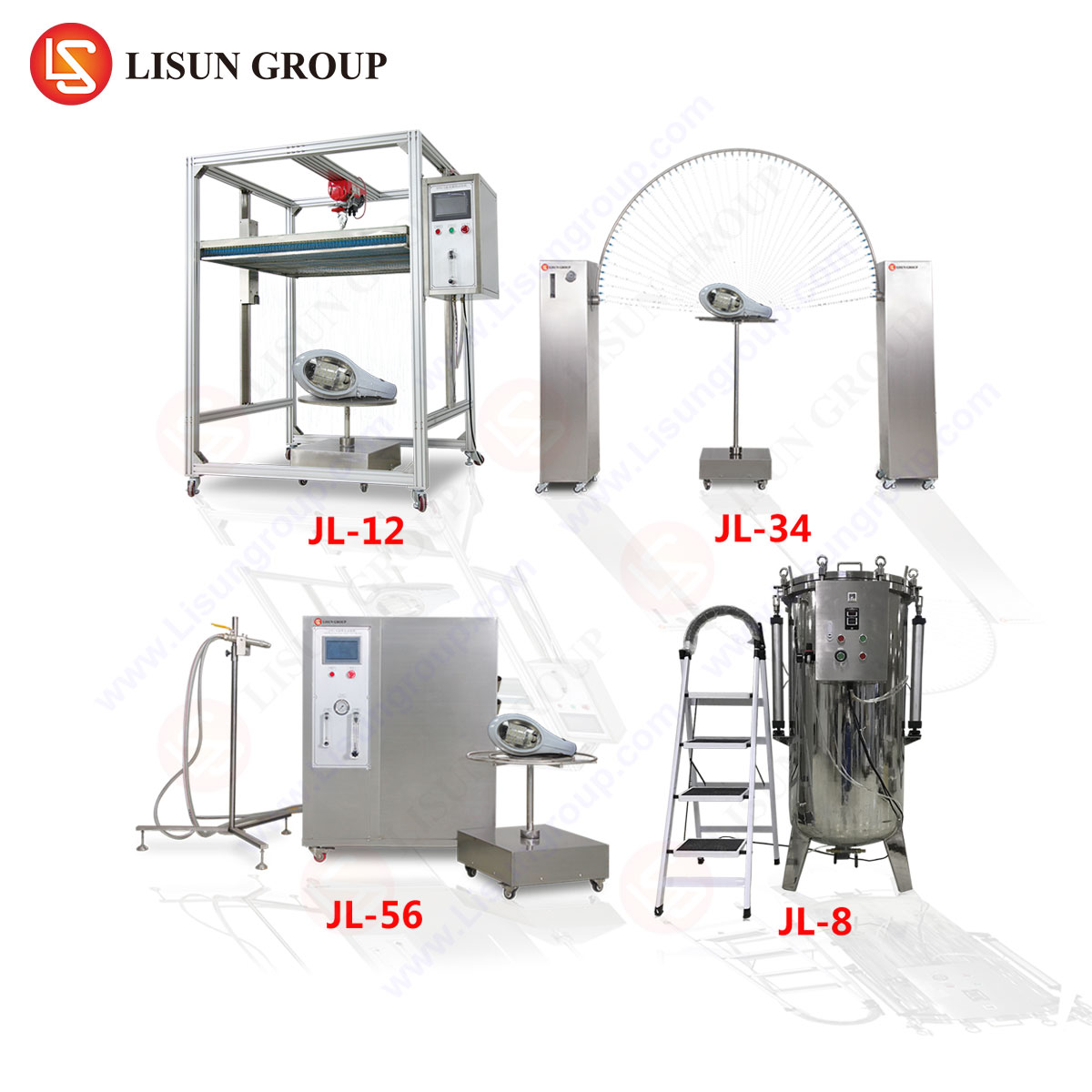
The LISUN JL-XC Series waterproof test chamber exemplifies the integration of multiple testing capabilities into a single, unified platform. Designed for compliance with IEC 60529, it consolidates testing for IPX1 through IPX6 ratings, and with optional accessories, can extend to IPX7/8/9K, thereby covering the full spectrum of waterproof validation needs within one footprint.
The chamber’s design centers on a modular spray system. A centrally mounted oscillating tube mechanism with precisely drilled nozzles fulfills IPX3 and IPX4 testing requirements. For IPX5 and IPX6, the system seamlessly switches to a handheld or fixed-position jet nozzle connected to the integrated high-pressure pump. The JL-XC Series features a large test area, accommodating samples such as automotive headlight assemblies, industrial control cabinets, or large household appliances. Its rotary table is programmable for intermittent or continuous rotation, with adjustable speed to meet the precise revolutions per minute stipulated in testing protocols.
Key specifications of the JL-XC Series include:
- Test Capability: IPX1, IPX2, IPX3, IPX4, IPX5, IPX6 (IPX7/8/9K with optional accessories).
- Inner Chamber Dimensions: Customizable, with standard models offering substantial volume (e.g., 1000mm diameter x 1000mm depth).
- Water Temperature Control: Optional system to regulate water temperature.
- Control Interface: Touchscreen HMI (Human-Machine Interface) with pre-set program modes for major IP ratings and custom parameter storage.
- Water System: Stainless steel construction with filtration; separate circuits for drip/spray and jet tests.
- Compliance: Engineered to meet IEC 60529, ISO 20653, GB 4208, and other equivalent national standards.
The competitive advantage of such an integrated system lies in laboratory space optimization, reduced capital expenditure compared to purchasing separate devices for each IP level, and streamlined workflow. Calibration and maintenance are simplified when dealing with a single, multi-functional system rather than multiple specialized units.
Industry-Specific Applications and Testing Protocols
The application of waterproof testing is cross-industrial, with each sector imposing unique requirements on the test sample and interpretation of results.
- Automotive Electronics & Lighting: Components like electronic control units (ECUs), sensors, and LED headlamps must withstand high-pressure jet washes (IPX5/6) and exposure to weather. ISO 20653, the automotive-specific adaptation of IEC 60529, is paramount. Testing often involves powering the device during the test to monitor for immediate failure and performing functional checks post-test.
- Household Appliances & Consumer Electronics: Outdoor speakers, smart garden devices, kitchen appliances near sinks, and waterproof smartphones require testing from IPX3 (spray) to IPX7 (immersion). For devices like electric toothbrushes or shavers, IPX7 is a common requirement to ensure safety during cleaning.
- Lighting Fixtures: Outdoor, industrial, and marine lighting must be validated for their specific environment. A pedestrian streetlight may require IPX3, while a fixture for a car wash tunnel would mandate IPX6 or IPX9K.
- Telecommunications & Electrical Components: Outdoor cabinets, fiber optic splice closures, and industrial switches/sockets are tested to prevent moisture ingress that could cause short circuits or signal degradation. Cable glands and connectors are frequently subjected to IPX6 or higher tests.
- Medical Devices & Aerospace: Portable medical monitors used in field hospitals or surgical tools requiring sterilization may need IPX4 or IPX7 ratings. Aerospace components, particularly those in exterior or non-pressurized zones, undergo rigorous waterproofing tests per standards like DO-160, which includes water spray and immersion sections.
In all cases, the test chamber must accommodate not just the sample size but also its operational state. Fixturing the sample in its intended use orientation is critical, as a device may be waterproof when upright but vulnerable if mounted at an angle.
Calibration, Validation, and Adherence to Metrological Standards
The credibility of IP test results is wholly dependent on the metrological integrity of the chamber. Regular calibration is non-negotiable. Key parameters requiring traceable calibration include:
- Water Flow Rate: Measured in liters per minute for each nozzle type (drip, spray, jet).
- Water Pressure: Critical for IPX5, IPX6, and IPX9K tests.
- Oscillation Angle and Speed: For IPX3 and IPX4 tests.
- Rotary Table Speed: Must be consistent and accurate.
- Water Temperature: If a controlled temperature system is used.
Calibration should be performed annually or per the laboratory’s quality manual, using instruments traceable to national standards. Furthermore, method validation through the use of reference samples or inter-laboratory comparisons ensures the entire testing process—from sample mounting to final assessment—is under control.
Interpreting Test Results and Failure Analysis
A test is deemed a failure if ingress of water occurs in a harmful quantity. The standard defines harmful ingress as water entering in such a manner as to interfere with safe operation, impair insulation, or accumulate in live parts. Post-test examination is meticulous. The sample is inspected internally for any traces of moisture. For electrically active tests, real-time monitoring for current leakage or functional interruption is conducted.
Failure analysis is a diagnostic tool. Water ingress at a specific seam or seal under IPX4 conditions, for instance, informs a redesign of the gasket or the fastener spacing. Patterns of failure across multiple samples can indicate a systemic manufacturing flaw rather than a design weakness. The test chamber, therefore, is not merely a pass/fail gatekeeper but a vital instrument in the iterative design-for-reliability process.
Future Trends in Enclosure Protection Testing
The evolution of waterproof testing is being shaped by several trends. The proliferation of Internet of Things (IoT) devices deployed in harsh environments is driving demand for efficient, high-throughput testing. Integration of test chambers with factory automation systems and Industry 4.0 data analytics platforms is becoming more common, allowing for real-time statistical process control. Furthermore, as materials science advances, with new hydrophobic coatings and sealants, test protocols may evolve to assess not just mechanical sealing but also surface property durability after UV exposure, thermal cycling, and abrasion—leading to more combined environmental test sequences.
Frequently Asked Questions (FAQ)
Q1: Can the JL-XC Series test a product for both IPX6 and IPX7 ratings in one sequence?
A: The standard JL-XC platform is engineered for IPX1-IPX6 testing. While the core chamber can perform the IPX6 (powerful water jet) test, the IPX7 (temporary immersion) test requires a separate immersion tank accessory. The tests are distinct and sequential; a product would typically undergo the IPX6 test, be thoroughly dried and inspected, and then be placed into the optional immersion tank for the IPX7 test, following the specific duration and depth parameters.
Q2: How is the water quality maintained in a recirculating test system, and does it affect test results?
A: Maintaining water quality is critical. Recirculating systems, like that in the JL-XC Series, incorporate filtration units—often sediment filters—to remove particulates that could clog nozzles or alter spray patterns. For rigorous testing, especially where residue could influence electrical performance, deionized water may be used, and the system may be designed with purging cycles. The standards often specify that water used should be of “clean” quality, and any deviation (e.g., scaling, biological growth) can invalidate results by changing droplet dynamics or causing blockages.
Q3: For a large, wall-mounted industrial control cabinet, how is testing conducted in a chamber?
A: Testing large, fixed-installation products presents a challenge. In such cases, the test chamber itself is often a walk-in or drive-in room-sized facility, or a portable test rig is brought to the product. For chamber testing of smaller cabinets or critical sub-assemblies, the product is placed inside on the rotary table. The key is that the test replicates the product’s in-situ exposure. If the cabinet is intended for vertical wall mounting, it is tested in that same orientation within the chamber, with spray nozzles positioned to simulate the direction of environmental exposure (e.g., rain from above, incidental spray from the front).
Q4: What is the significance of the “K” in IPX9K, and how does it differ from IPX6?
A: The “K” in IPX9K denotes a test defined initially in German standard DIN 40050-9, which was later incorporated into IEC 60529. It is distinct from IPX5/6. While IPX6 uses a 12.5mm nozzle at 1000 kPa and a flow of 100 L/min from 2.5-3 meters away, IPX9K uses four specific, smaller nozzles (0.8mm) spraying water at 80°C, at a pressure of 8000-10000 kPa (80-100 bar), from a distance of 0.1-0.15 meters. IPX9K simulates high-pressure, high-temperature wash-down procedures used in industrial cleaning (e.g., food processing, agriculture, military vehicles), testing both water ingress and resistance to cleaning processes. It is a more severe and targeted test than IPX6.
Q5: How often should the nozzles and filters in a waterproof test chamber be inspected or replaced?
A: Nozzle and filter inspection should be part of a routine preventive maintenance schedule, conducted before each critical test series or at minimum monthly under frequent use. Nozzles are inspected for wear, erosion, or blockage that would alter the spray pattern, flow rate, or droplet size. Filters are checked for clogging. Calibration of flow and pressure, performed annually, will often reveal issues with these components. The manufacturer’s operational manual provides specific guidance, but a log of inspections is essential for maintaining the quality management system of any test laboratory.