





Methodologies and Standards in Waterproof Testing for Modern Electronics
The relentless drive towards miniaturization, increased functionality, and ubiquitous connectivity in electronic and electromechanical devices has precipitated a parallel demand for enhanced environmental resilience. Among these demands, protection against the ingress of water and particulate matter stands as a critical determinant of product reliability, safety, and longevity. Waterproof testing, more formally categorized as Ingress Protection (IP) testing, is not a singular procedure but a suite of standardized methodologies designed to simulate and quantify a product’s defensive capabilities under controlled laboratory conditions. This technical examination delves into the principles, standards, and practical applications of waterproof testing, with a specific focus on the role of advanced testing instrumentation in validating product integrity across diverse industrial sectors.
The IP Code: Deciphering the Framework of Ingress Protection
The foundation of systematic waterproof testing is the International Electrotechnical Commission (IEC) standard 60529, which establishes the Ingress Protection (IP) rating system. This alphanumeric code provides a concise, internationally recognized summary of a product’s effectiveness in sealing against foreign bodies (solids) and moisture (liquids). The code structure, IPXY, is definitive: the first numeral (X) denotes protection against solid objects, ranging from 0 (no protection) to 6 (dust-tight). The second numeral (Y) specifies protection against liquids, scaling from 0 (no protection) to 9K (protection against high-pressure, high-temperature water jets). It is crucial to note that these ratings are sequential but not cumulative; an IP67 rating, for example, confirms dust-tightness and protection against temporary immersion, but does not automatically guarantee performance against the high-pressure jets specified in IPX6.
The testing prescribed by IEC 60529 and its regional equivalents (e.g., DIN 40050, ISO 20653) is highly specific. For liquid ingress, tests range from dripping water (IPX1, IPX2) and spraying water (IPX3, IPX4) to powerful jets (IPX5, IPX6), temporary immersion (IPX7), continuous immersion (IPX8), and high-pressure/high-temperature cleaning (IPX9K). Each test requires precise control over variables including water pressure, flow rate, nozzle distance and angle, test duration, and sample orientation. The post-test evaluation involves a thorough internal inspection for any trace of water ingress, often coupled with functional testing to ensure no degradation in performance has occurred.
Instrumentation for Precision: The LISUN JL-XC Series Waterproof Test Chamber
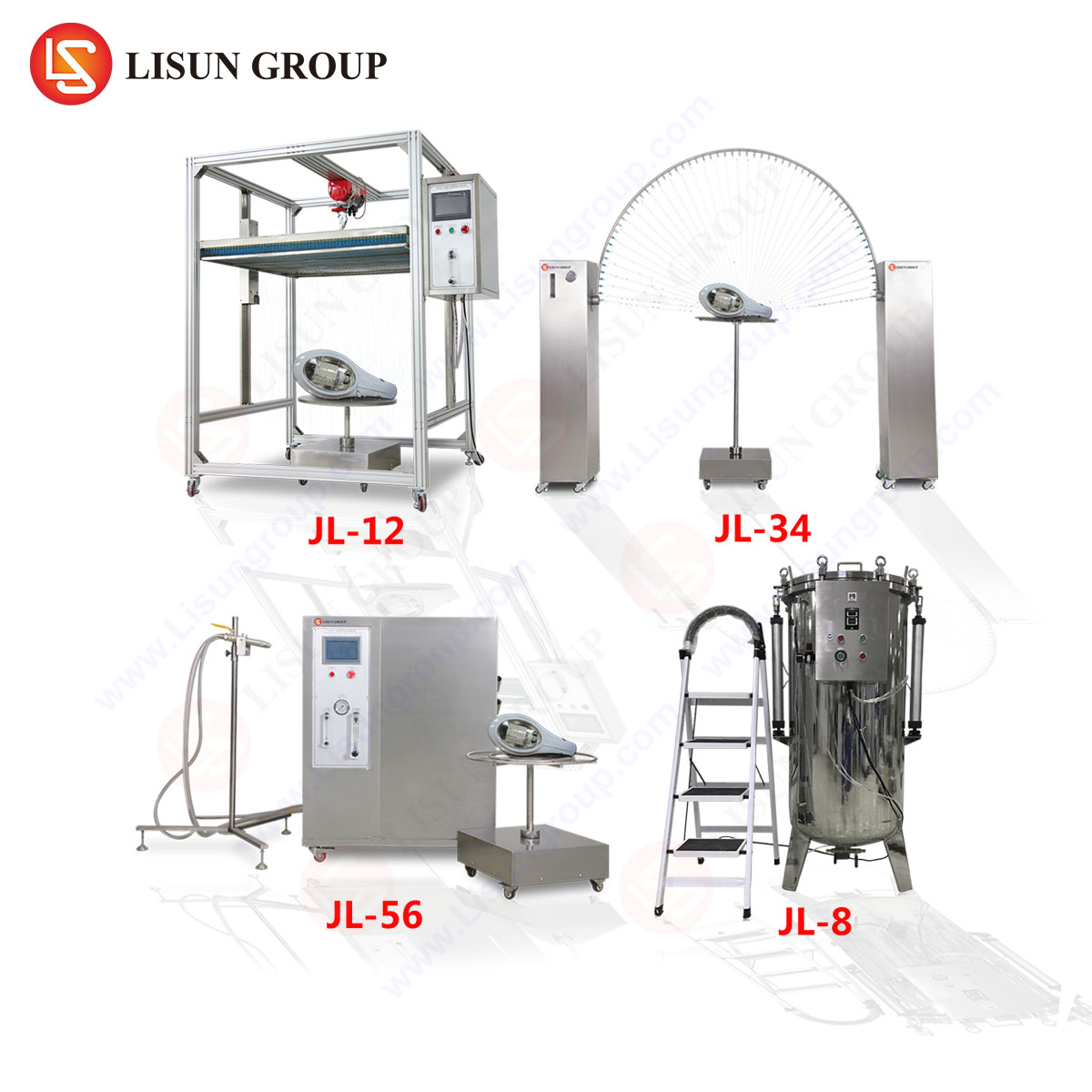
Achieving reproducible, standards-compliant results necessitates instrumentation that offers exceptional control, flexibility, and reliability. The LISUN JL-XC Series Waterproof Test Chamber exemplifies the engineering required to meet this need. This system is engineered as a comprehensive solution for performing IPX1 through IPX9K tests within a single, integrated platform, thereby eliminating the need for multiple, discrete test setups and enhancing laboratory efficiency.
The core principle of the JL-XC Series involves the precise orchestration of water delivery systems within a sealed test chamber. The system integrates multiple water circuits, each calibrated for specific test standards. A rotary table, with programmable speed and positioning, ensures the test sample is exposed to water spray from all required angles as per the relevant IP code. For IPX7 and IPX8 immersion tests, the chamber can be configured with a water tank, with depth and duration controlled via the central human-machine interface (HMI).
Key Technical Specifications of the LISUN JL-XC Series:
- Test Scope: Full compliance with IPX1 to IPX9K per IEC 60529, ISO 20653, and other major standards.
- Water Jet System: Features separate pumps and pressure gauges for low-pressure (IPX3/IPX4) and high-pressure (IPX5/IPX6) tests, with pressures adjustable from 30 to 1000 kPa.
- IPX9K High-Pressure/High-Temperature Jet: Incorporates a dedicated high-pressure pump (8-10 MPa) and a water heating system capable of delivering 80°C ±5°C water at a flow rate of 14-16 L/min.
- Rotary Table: Diameter typically ≥ Ø600mm, with variable speed control (1-5 rpm) and automatic oscillation for nozzle alignment.
- Control System: A programmable logic controller (PLC) and touch-screen HMI allow for the storage of pre-set test programs, real-time monitoring of all parameters (pressure, temperature, flow, time), and data logging for audit trails.
- Construction: The chamber is fabricated from stainless steel (SUS304) for corrosion resistance, with a tempered glass viewing window and internal LED lighting for observation.
The competitive advantage of such a system lies in its integration, accuracy, and data integrity. By consolidating multiple test regimes into one automated platform, it reduces transitional error, improves testing throughput, and provides unassailable documentation for compliance certification. This is particularly vital for manufacturers serving global markets, where adherence to IEC, UL, JIS, and other standards may be concurrently required.
Sector-Specific Applications and Testing Imperatives
The application of waterproof testing is dictated by the operational environment and failure consequences within each industry.
Automotive Electronics and Aerospace Components: In these sectors, reliability is non-negotiable. Electronic control units (ECUs), sensors, lighting assemblies, and cockpit avionics are routinely subjected to IPX6 (powerful water jets) to simulate driving through heavy rain or high-pressure washing. IPX7 (immersion) may be required for underbody components. The IPX9K test is specifically critical for automotive parts, simulating the high-temperature, high-pressure wash cycles encountered in commercial vehicle cleaning bays. The precise temperature and pressure control of the JL-XC Series is essential here.
Medical Devices and Telecommunications Equipment: For portable patient monitors, handheld diagnostic tools, or outdoor telecommunications cabinets, protection against dripping and spraying water (IPX3, IPX4) is common. Surgical devices may require full immersion testing (IPX7/IPX8) for sterilization validation. The test chamber’s ability to execute low-flow, multi-angle spray tests with perfect repeatability ensures these life-critical and infrastructure-critical devices perform under duress.
Lighting Fixtures and Industrial Control Systems: Outdoor LED luminaires for street lighting or industrial high-bay fixtures must withstand prolonged weather exposure, necessitating IP65 (dust-tight and jet-protected) or IP66 ratings. Control panels for factory automation, often exposed to washdown environments in food processing or pharmaceutical plants, require similar high jet protection. The JL-XC’s rotary table ensures an even, standardized distribution of water jets across the entire surface of such fixtures.
Consumer Electronics and Electrical Components: The proliferation of waterproof smartphones, wearables, and outdoor speakers has made IP67 and IP68 ratings a key market differentiator. Similarly, outdoor electrical sockets, switches, and junction boxes require robust sealing. Testing for these products often involves a sequence—first IP5X/6X for dust and jets, followed by IPX7/8 for immersion—a workflow efficiently managed by a unified system like the JL-XC Series.
Beyond Compliance: The Engineering and Quality Assurance Workflow
Integrating waterproof testing into the product development lifecycle is a strategic quality function. It begins in the design phase, where gasket selection, seal geometry, and venting strategies are modeled. Prototypes then undergo design verification testing (DVT) using equipment such as the JL-XC to identify failure modes early, when remediation costs are lowest. During production, quality assurance (QA) sampling provides ongoing surveillance of manufacturing consistency, ensuring that assembly line processes do not compromise seal integrity. Finally, certification testing by an accredited laboratory provides the formal IP rating for product datasheets and regulatory submissions.
The data captured during these tests—exact pressure curves, temperature stability logs, and visual evidence from internal inspections—forms a critical corpus of evidence. It is used not only for certification but also for root-cause analysis in the event of a field failure, feeding directly back into design improvements for future product generations. The programmability and data-logging features of modern test chambers are therefore not mere conveniences but essential tools for continuous improvement and risk mitigation.
Challenges and Future Trajectories in Sealing Validation
The evolution of technology presents ongoing challenges for waterproof testing. The increasing use of porous membranes for pressure equalization in ruggedized devices requires new test methods to validate their long-term water resistance without clogging. The miniaturization of devices pushes the limits of seal design, demanding even more precise test equipment to detect minute ingress. Furthermore, the industry is moving towards testing for real-world environmental combinations, such as simultaneous thermal cycling and humidity exposure with water spray, to better simulate the stresses devices encounter over their operational lifespan.
Future advancements in test instrumentation will likely focus on greater sensor integration, perhaps using internal humidity sensors within the test sample for more direct ingress detection, and enhanced simulation software to correlate lab test results with field performance data. The goal remains constant: to provide engineers with the most accurate, reliable, and efficient means possible to breach their products’ defenses in the lab, so those defenses never fail in the world.
FAQ: Waterproof Testing and the JL-XC Series
Q1: Can the JL-XC Series test for both IPX6 and IPX7 ratings on the same product sample sequentially?
Yes, the JL-XC Series is designed for sequential testing. A common validation sequence for a device rated IP67 would involve first performing the IPX6 (powerful water jet) test, followed by a thorough external drying period (if specified by the standard), and then the IPX7 (temporary immersion) test—all without removing the sample from the test environment. The system’s programmable controllers allow such multi-stage test protocols to be automated.
Q2: How is the water quality managed for tests like IPX9K that involve high-temperature water?
Water quality is a critical factor for test repeatability and equipment maintenance. For all tests, especially IPX9K, the use of deionized or distilled water is strongly recommended to prevent mineral scaling in the heating elements, pumps, and nozzles. The JL-XC system typically includes filtration recommendations and is constructed from corrosion-resistant materials, but adherence to a strict water quality and system maintenance schedule, as outlined in the operational manual, is essential for long-term accuracy.
Q3: Our product is a large automotive sensor module. Does the size of the rotary table limit what we can test?
The standard rotary table is suitable for a wide range of components. However, for large or irregularly shaped units like certain automotive assemblies or industrial control cabinets, the test parameters can often be adapted. The IEC 60529 standard provides guidance for testing equipment too large for a standard rotary table, which may involve manually repositioning the sample or using multiple stationary spray nozzles. The core jet pressure, flow rate, and distance criteria remain governed by the standard. It is advisable to consult the test chamber specifications and potentially discuss custom configurations with the manufacturer for oversized items.
Q4: What is the importance of data logging in waterproof testing for medical device certification?
For medical devices, regulatory submissions to bodies like the FDA (under ISO 13485) or the EU’s MDR require comprehensive design history files and objective evidence of verification testing. The data logging capability of the JL-XC Series provides an immutable record of every test parameter—pressure, temperature, duration, sample orientation—for each unit tested. This creates a defensible audit trail that proves the test was conducted exactly as required by the standard, which is indispensable for regulatory audits and quality system compliance.
Q5: Does achieving an IP rating guarantee my product will never fail in wet conditions?
It is crucial to understand that an IP rating is a laboratory test under controlled, standardized conditions. It certifies a specific level of performance against the test criteria but does not constitute an unlimited warranty for all real-world scenarios. Factors like long-term seal degradation from UV exposure, chemical contact, mechanical wear, or extreme thermal cycling outside the test scope can affect field performance. The IP rating is a vital benchmark of inherent design robustness, but it should be complemented with other environmental stress tests and a well-considered product use case definition.