




Comprehensive Methodologies for Validating Enclosure Integrity in Modern Manufacturing
The proliferation of electronic and electromechanical systems across diverse operational environments has rendered ingress protection (IP) testing a non-negotiable phase in product development and quality assurance. From the humidity-laden atmosphere of a kitchen to the high-pressure washdowns in an automotive setting, the ability of a device’s enclosure to resist the intrusion of water and particulate matter directly correlates with its functional longevity, safety, and compliance. Waterproof testing, therefore, transcends mere quality control; it is a fundamental engineering discipline that validates design assumptions, material selections, and manufacturing consistency against internationally recognized benchmarks.
Defining the Ingress Protection (IP) Code and Its Testing Implications
The IP Code, standardized under IEC 60529 and its regional equivalents (e.g., ISO 20653 for automotive), provides a systematic classification for the degrees of protection offered by enclosures. The code is denoted as IPXY, where ‘X’ signifies protection against solid foreign objects (ranging from 0, no protection, to 6, dust-tight), and ‘Y’ indicates protection against harmful ingress of water (from 0 to 9K). It is critical to understand that the IP rating is not a linear scale but a series of discrete, specific tests. For instance, an IPX7 rating (immersion up to 1 meter for 30 minutes) does not automatically imply compliance with IPX5 (powerful water jets) or IPX6 (strong water jets). Each test simulates a distinct environmental challenge.
The selection of an appropriate IP rating is dictated by the product’s intended use case. A medical device designed for operating rooms may require IPX4 (splash resistance) to withstand sterilization procedures, while an outdoor telecommunications cabinet must withstand IPX5/6 jet sprays from any direction. Automotive electronics, particularly those in wheel wells or underbodies, often require IP6K9K testing, which combines dust-tight validation with high-pressure, high-temperature steam jet cleaning simulations. This specificity necessitates equally specialized testing apparatus capable of reproducing these conditions with high fidelity and repeatability.
Core Principles of Waterproof Testing: Simulation and Measurement
Effective waterproof testing hinges on two pillars: the accurate simulation of water ingress conditions and the precise measurement of the outcome. Simulation involves controlling key variables: water pressure, flow rate, nozzle diameter, distance from specimen, water temperature, and test duration. These parameters are meticulously defined in the relevant standards. For example, the IPX3 and IPX4 oscillating tube and sprinkler tests use specific water flow rates (0.07 L/min per hole for IPX3, 10 L/min for IPX4) and oscillation angles to simulate rain and splashing.
Measurement of ingress is typically binary for lower ratings (pass/fail based on visible water inside) but can involve more sophisticated diagnostics for higher assurance levels. Post-test inspection includes visual examination for water droplets, functional testing of the device, and potentially the use of moisture-sensitive indicators or electrical leakage tests. For IPX7 and IPX8 (continuous immersion under specified pressure), the test specimen is often weighed before and after testing to detect any mass increase due to water absorption, a more sensitive metric than visual inspection alone.
The JL-XC Series: A Modular Platform for Comprehensive IP Validation
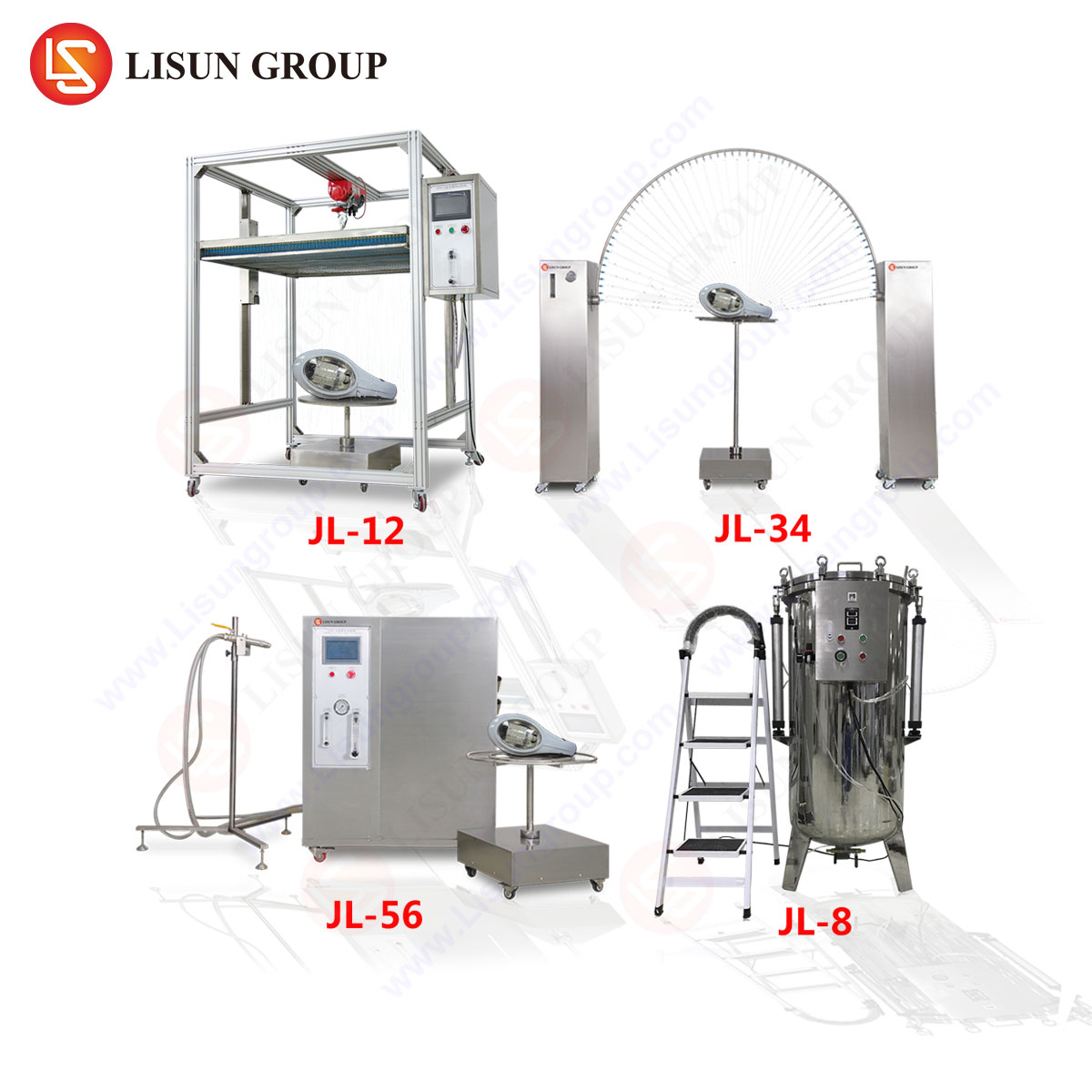
To address the broad spectrum of IP testing requirements across industries, advanced testing solutions like the LISUN JL-XC Series waterproof test chambers offer a modular, standards-compliant platform. The JL-XC Series is engineered to perform a wide range of tests, from IPX1 and IPX2 (dripping water) through IPX3 and IPX4 (spraying water) to IPX5 and IPX6 (powerful jet sprays), and up to IPX7, IPX8, and IPX9K (high-pressure, high-temperature spray). Its design philosophy centers on configurability, precision, and user safety.
The system’s core is a robust test chamber constructed from stainless steel, with a transparent observation window and integrated water circulation and filtration system. A critical component is its programmable logic controller (PLC) and touch-screen human-machine interface (HMI), which allows for the storage of pre-configured test profiles corresponding to various IP codes and industry standards. This eliminates manual parameter setting errors and ensures test reproducibility. The water pressure and flow are regulated by precision pumps and valves, with real-time feedback displayed on the HMI. For IPX9K testing, the system integrates a high-temperature water heating unit and the specific fan-spray nozzle mandated by the standard, capable of delivering 14-16 L/min at 80±5°C and 8-10 MPa pressure from a distance of 0.10-0.15 meters.
Specifications and Competitive Advantages of the JL-XC Series:
- Modular Nozzle System: Interchangeable, calibrated nozzles for IPX3/4 (oscillating tube/sprinkler), IPX5/6 (6.3mm/12.5mm jet), and IPX9K (fan-spray) tests, all within a single unified frame.
- Precision Control: Closed-loop servo control of water pressure (0-1000 kPa for jets) and temperature (ambient to 80°C for IPX9K), with flow meters providing verification.
- Automated Test Sequencing: The PLC can execute complex multi-stage tests (e.g., IPX5 followed immediately by IPX7) without operator intervention, simulating sequential real-world exposures.
- Enhanced Safety Features: Electrical interlocks, leak detection sensors, emergency stop buttons, and corrosion-resistant construction protect both the operator and the equipment.
- Data Logging and Traceability: All test parameters—pressure, flow, temperature, duration—are logged with timestamps, providing auditable evidence for compliance reports.
Industry-Specific Applications and Compliance Imperatives
The application of rigorous waterproof testing is ubiquitous in modern manufacturing. The JL-XC Series facilitates compliance across a complex landscape of sector-specific requirements.
In Automotive Electronics, components must endure harsh underhood conditions and high-pressure vehicle washes. The IP6K9K test, replicating a car wash with 80°C water, is essential for sensors, connectors, and control units. The JL-XC’s ability to perform both IP6K (dust) and IP9K (hot spray) in a controlled sequence is a significant efficiency gain.
For Lighting Fixtures, both indoor and outdoor, ratings from IP23 (protected against vertically falling drops) to IP66/67 (for roadway or underwater lighting) are common. The precise calibration of the JL-XC’s oscillating tube ensures the 60° or 180° spray coverage required by IPX3 and IPX4 tests for outdoor wall sconces or industrial bay lighting.
Medical Device manufacturers must validate that enclosures for bedside monitors, portable diagnostic tools, or surgical handpieces can withstand cleaning and disinfection protocols. A splash-proof (IPX4) or even jet-proof (IPX5) rating may be required, and testing must be documented under strict quality management systems like ISO 13485.
Telecommunications Equipment, such as 5G small cells or outdoor broadband units, are deployed in exposed locations. They frequently require IP55 or IP65 ratings to ensure reliable operation during storms. The JL-XC’s powerful jet spray simulation validates the integrity of gaskets and seals on antenna ports and cable glands.
In Aerospace and Aviation, components for both cabin and external use are tested against environmental conditions including condensation and pressurized spray. While often governed by specialized standards like RTCA DO-160, the fundamental spray and immersion principles align with IP code tests, making a versatile platform like the JL-XC valuable for sub-assembly validation.
Integrating Testing into the Product Development Lifecycle
Waterproof testing should not be a final gate before shipment but an integrated activity throughout the product development lifecycle. During the design and prototyping phase, testing identifies weaknesses in seal geometry, material compatibility, or assembly methods. Early failures are less costly and inform rapid design iterations. In the production validation phase, testing on pre-production units verifies that manufacturing processes (e.g., torque on sealing screws, adhesive application) yield consistent results. Finally, in ongoing quality assurance, periodic sampling from the production line provides statistical process control, ensuring that the validated quality level is maintained over time. The JL-XC Series, with its programmable profiles and data logging, supports this full spectrum by providing consistent, comparable test conditions from the lab to the factory floor.
Navigating Standards and Future Trends in Enclosure Testing
The regulatory landscape for ingress protection is dynamic. While IEC 60529 remains the cornerstone, industry-specific adaptations continue to emerge. Furthermore, the rise of the Internet of Things (IoT) and the deployment of electronics in increasingly aggressive environments—from deep-sea exploration to agricultural robotics—are pushing the boundaries of required protection. Future trends may involve testing with contaminated fluids (e.g., salt spray, cleaning chemicals), combined environmental testing (vibration plus spray), and more sophisticated internal sensing to detect minute ingress before it causes failure. Testing platforms must therefore be adaptable. The modular architecture of systems like the JL-XC Series, which can be reconfigured with different nozzles, pressure ranges, and auxiliary systems, positions them to meet not only today’s standards but also the evolving challenges of tomorrow’s engineered products.
Frequently Asked Questions (FAQ)
Q1: Can a single JL-XC test chamber validate a product for multiple IP ratings, such as IP65, IP67, and IP69K?
A: Yes, the modular design is a key feature. With the appropriate nozzle set and configuration, the JL-XC Series can perform the discrete tests required for IPX5, IPX6, IPX7, IPX8, and IPX9K. A product seeking a combined rating like IP66/IP67/IP69K would undergo sequential testing for jet (IPX5/6), temporary immersion (IPX7), and high-pressure hot spray (IPX9K) in the same chamber, though specific conditions for each test must be met independently.
Q2: How is test water quality managed, especially for IPX9K testing at high temperatures?
A: The JL-XC Series incorporates a closed-loop water circulation and filtration system. Water is typically deionized to prevent mineral scaling, especially in the high-temperature heater and precision nozzles. The system includes filters to remove particulates, and the water reservoir is designed for easy drainage and cleaning to maintain consistent water purity, which is critical for repeatable results and equipment longevity.
Q3: What is the primary difference between IPX8 and IPX9K testing, as both involve high pressure?
A: They simulate fundamentally different phenomena. IPX8 is for continuous immersion under specified pressure greater than 1 meter (e.g., for underwater devices), with pressure being static. IPX9K simulates close-range, high-impact cleaning with high-temperature water and steam (80°C, 8-10 MPa), using a specific fan-spray nozzle pattern. It is a dynamic, high-energy spray test, not an immersion test.
Q4: For automotive applications, what does the “K” denote in IPX9K, and is it required?
A: The “K” in IPX9K originates from the German standard DIN 40050-9, which was later integrated into ISO 20653 for road vehicles. It specifies the use of a high-pressure, high-temperature (80°C) spray nozzle at very close range (0.10-0.15m). It is a distinct and more severe test than the standard IPX9 (which is not commonly used). For automotive components subject to high-pressure washer cleaning, testing to IPX9K (or IP6K9K for dust and water) is often a mandatory requirement.
Q5: How critical is fixture design for waterproof testing, and what support does the JL-XC provide?
A: Fixture design is paramount. The specimen must be mounted in its intended use orientation, and the fixture must not create artificial seals or leak paths. The JL-XC chamber includes a motorized turntable (for even spray distribution in IPX5/6/9K tests) and a robust mounting structure. However, the design of the product-specific fixture—which holds the product and often includes ports for power and signal during functional testing—is typically the responsibility of the user, guided by the standard’s requirements for mounting.