




Abstract
In the rigorous world of electrical accessory compliance testing, accurately simulating real-world load conditions is paramount. The LISUN DFX series Externally Ballasted Fluorescent Lamp Test Load Cabinet serves as a critical instrument for manufacturers and testing laboratories. This specialized equipment provides a precise, programmable, and stable simulated load for validating the performance and safety of switches, sockets, and other accessories under standardized fluorescent lamp ballast conditions. Its core capabilities enable engineers to conduct endurance, temperature rise, and abnormal condition tests in full alignment with international IEC and GB standards, ensuring product reliability and regulatory compliance before market release.
1.1 The Critical Role of Realistic Load Simulation
Electrical accessories like switches and socket-outlets are not designed for purely resistive loads in practice. Fluorescent lighting circuits, with their inductive or capacitive ballasts, present a significantly more challenging electrical environment characterized by inrush currents, non-unity power factors, and potential arcing. Testing accessories with only simple resistive loads fails to replicate these stresses, leading to field failures. The DFX series load test cabinet addresses this gap by providing a standardized, repeatable simulated load that mimics the electrical characteristics of externally ballasted fluorescent lamps, as mandated by international safety standards.
1.2 Product Overview and Core Functionality
The LISUN DFX series is a dedicated, programmable AC load simulation system. Its primary function is to replace physical fluorescent lamp and ballast combinations during the testing of wiring accessories. The cabinet can be configured to present specific resistive (R), inductive (L), or capacitive (C) load components at defined power factors. It features precise digital setting and measurement of voltage, current, power, and power factor. Key operational modes include continuous endurance testing, programmable ON/OFF cycling with counters, and the simulation of abnormal conditions like locked rotor or short-circuit scenarios for comprehensive accessory validation.
2.1 Key International Standard References
The design and application of the DFX cabinet are directly tied to specific clauses within global compliance standards. It is engineered to fulfill the externally ballasted fluorescent lamp load requirements stipulated in:
- IEC 60669-1 (Switches for household and similar fixed-electrical installations): Clause 19.2, “Temperature rise test,” and Clause 20, “Normal operation.”
- IEC 60884-1 (Plugs and socket-outlets for household and similar purposes): Clause 20, “Temperature rise of accessories,” and Clause 21, “Normal operation.”
- GB/T 16915.1 & GB/T 2099.1: The Chinese national standards technically aligned with the aforementioned IEC standards.
- IEC 61058-1 (Switches for appliances): Relevant clauses for switch endurance testing under specified loads.
2.2 Translating Standards into Test Parameters
These standards precisely define the test load characteristics. For instance, a switch rated for 10A 250V AC must be tested with a load that simulates a fluorescent lamp circuit having a power factor between 0.8 and 0.9 lagging. The DFX load test cabinet allows engineers to digitally set the exact current (e.g., 10A) and adjust the L/C components to achieve a compliant power factor (e.g., 0.85 lagging). This eliminates the variability and maintenance issues associated with physical ballasts and lamps, ensuring every test cycle is performed with identical, traceable load parameters as required for auditable certification.
3.1 Core Performance Specifications
The DFX series delivers high precision and flexibility. Typical performance data includes a current output range from 0.5A to the model’s maximum (e.g., 20A), with a setting resolution of 0.01A. Power factor is adjustable from 0.3 leading to 0.3 lagging. Measurement accuracy is high, with voltage and current typically within ±0.5% of reading. The integrated load capacitance can simulate cable capacitance effects, often adjustable in steps (e.g., 0.01uF to 0.1uF). An internal cycle counter tracks operations up to 999,999 cycles, automating endurance tests.
3.2 DFX Series Model Comparison
The series offers multiple models to suit different laboratory capacities and testing requirements, from single-channel benchtop units to multi-channel systems for high-throughput testing.
| Model | Max. Current Output per Channel | Number of Test Channels | Typical Input Power | Primary Application Scope |
|---|---|---|---|---|
| DFX-20 | 20A | 1 Channel | 220V, 50/60Hz | Standard single-item endurance & temp rise tests. |
| DFX-20-3CH | 20A | 3 Independent Channels | 220V, 50/60Hz | High-efficiency testing of multiple samples simultaneously. |
| DFX-40 | 40A | 1 Channel | 220V, 50/60Hz | Testing of higher-current accessories or grouped samples. |
| DFX-60 | 60A | 1 Channel | 220V, 50/60Hz | Industrial-grade switches and heavy-duty applications. |
| DFX-80 | 80A | 1 Channel | 380V, 50/60Hz | Maximum capacity testing for specialized, high-power circuits. |
4.1 Synergy with LISUN Testing Systems
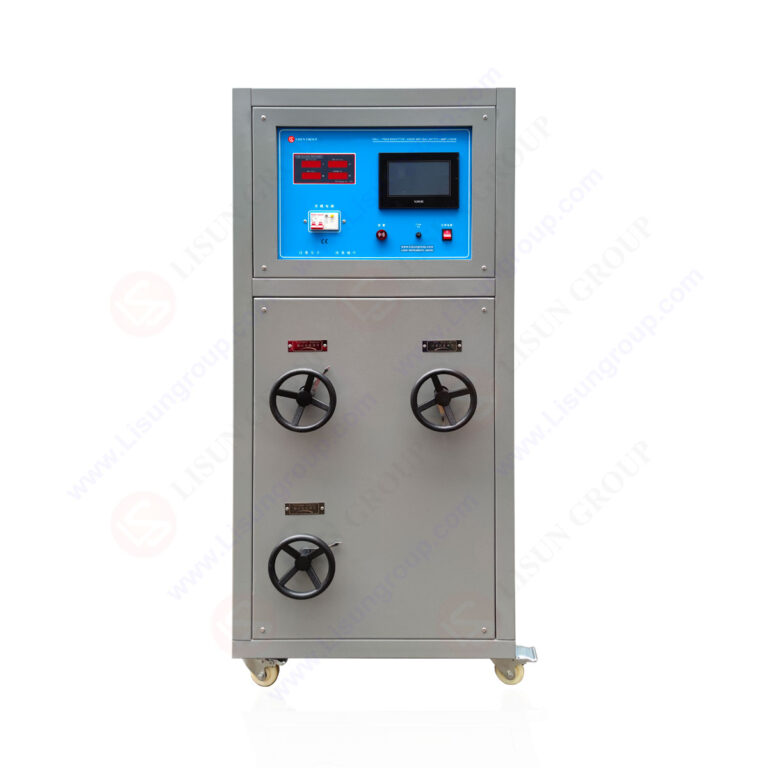
The DFX cabinet is not a standalone instrument but a core component of a comprehensive accessory testing ecosystem. It is designed for seamless integration with other LISUN equipment to automate complex test sequences. Most notably, it can be directly controlled by or synchronized with the LISUN CZKS Series Multi-Station Life Tester. In this setup, the CZKS automates the mechanical actuation (ON/OFF cycling) of multiple switches or sockets, while the DFX supplies and monitors the precise electrical load for each station, creating a fully automated endurance test system.
4.2 Complementary Equipment for Holistic Validation
Beyond life testing, a complete accessory validation lab utilizes the DFX alongside other specialized testers. The SW-6 Bending Tester evaluates the flexibility and durability of connecting cords. The SAS Socket Cover Safety Tester assesses protection against shock. The HD-302 Ball Pressure Tester checks material heat resistance. By employing the DFX for electrical stress simulation within this broader framework, laboratories can execute all critical tests—mechanical, electrical, and thermal—required for full IEC/GB certification, ensuring a product is robust in every aspect.
5.1 Normal Endurance and Temperature Rise Testing
This is the primary application. The externally ballasted lamp load simulator is set to the accessory’s rated current and a standard-compliant power factor (e.g., 0.85 lagging). In continuous mode, it facilitates the temperature rise test by supplying the steady-state load. In cyclic mode, it works with an actuator to perform the “normal operation” test, where the accessory is switched ON and OFF for thousands of cycles. The DFX’s internal counter records the number of electrical operations, while its meters allow for real-time monitoring of electrical parameters throughout the test duration.
5.2 Abnormal Condition and Robustness Testing
To assess safety under fault conditions, the DFX can simulate scenarios beyond normal operation. This includes setting the load to simulate a locked rotor current (typically 6x rated current) for motor-controlled accessories or other high-inrush conditions. It can also be used to test the breaking capacity of switches by closing a switch onto a defined load. The ability to program these extreme but standardized conditions allows engineers to verify that an accessory will fail safely without presenting fire or shock hazards.
6.1 Precision, Repeatability, and Stability
Traditional testing racks using physical electromagnetic ballasts and fluorescent tubes suffer from inherent variability. Ballast characteristics drift with temperature, and lamps age, altering the electrical load profile over time. The DFX electrical accessory load tester uses solid-state components and digital control to provide a load that is precise, stable, and perfectly repeatable from test to test, and from lab to lab. This eliminates a major source of uncertainty in compliance testing, ensuring that results are solely indicative of the sample’s performance.
6.2 Enhanced Safety and Operational Efficiency
A rack of dozens of physical fluorescent lamps generates significant heat, consumes more space, and poses a higher fire risk during prolonged unattended endurance tests. The DFX cabinet is a compact, efficiently cooled unit. It removes the ongoing cost and logistical burden of procuring, storing, and replacing physical lamps and ballasts. Furthermore, its digital interface allows for rapid setup and changeover between different test specifications, dramatically improving laboratory throughput and operator productivity.
7.1 Exceeding Baseline Compliance Demands
While standards define the minimum load characteristics for testing, the DFX series is engineered to not only meet but exceed these requirements in terms of control, measurement, and flexibility. The following table illustrates this enhancement of capabilities.
| Feature | Minimum Standard Requirement | LISUN DFX Series Capability | Benefit to the User |
|---|---|---|---|
| Load Type | Simulated externally ballasted fluorescent lamp load. | Programmable R, L, C components to create compliant lagging/leading PF loads. | Can test to exact standard specs and explore boundary conditions. |
| Current Control | Apply rated current at specified voltage. | Digitally set from 0.5A to model max (20A-80A) with 0.01A resolution. | Unparalleled precision and range for various product ratings. |
| Power Factor | Typically 0.8-0.9 lagging for fluorescent simulation. | Adjustable from 0.3 lead to 0.3 lag with digital readout. | Verifies load profile accuracy and allows for other PF-specific tests. |
| Measurement | Verify current and voltage are applied. | Integrated digital meters for V, A, W, PF, Hz with high accuracy. | Real-time monitoring and data logging for comprehensive test records. |
| Test Automation | Perform required number of cycles. | Programmable cycle counting up to 999,999; remote control capability. | Enables fully automated, unattended endurance test sequences. |
The LISUN DFX series Externally Ballasted Fluorescent Lamp Test Load Cabinet represents a fundamental advancement in the methodology for validating electrical accessories. By transitioning from unpredictable physical ballasts to a solid-state, digitally controlled simulator, it injects critical precision, repeatability, and safety into the compliance testing process. Its direct alignment with specific clauses in IEC, GB, and related standards provides engineers with a trustworthy tool to conclusively demonstrate that switches, sockets, and other accessories can withstand the real-world demands of fluorescent and similar reactive loads. For manufacturers, this means reduced risk of field failures and streamlined certification. For testing laboratories, it translates to higher throughput, lower operational costs, and unambiguous, defensible test results. As the industry continues to prioritize reliability and safety, the DFX series stands as an essential instrument for ensuring that electrical accessories perform not just adequately, but robustly, throughout their intended service life.
Q1: Can the DFX-20 simulate loads for both inductive (lagging PF) and capacitive (leading PF) ballast types?
A: Yes, the DFX series is designed with this flexibility. While the classic externally ballasted fluorescent lamp load for standards like IEC 60669-1 is inductive (0.8-0.9 lagging PF), the cabinet’s programmable reactive components allow it to also simulate capacitive loads. By adjusting the internal inductance (L) and capacitance (C) settings, users can achieve a power factor range from 0.3 leading to 0.3 lagging. This capability is essential for testing accessories used with a wider variety of lighting technologies, including some LED drivers or electronic ballasts that may present a leading power factor, ensuring comprehensive validation beyond just traditional fluorescent circuits.
Q2: How does the DFX cabinet integrate with an automated life test system, and what are the benefits?
A: The DFX load test cabinet integrates seamlessly via remote control terminals (start/stop signals) or communication interfaces (like RS-232 or RS-485, depending on model) with automated life testers such as the LISUN CZKS series. In this configuration, the CZKS tester controls the mechanical actuation (ON/OFF) of the switch or socket under test. Simultaneously, it sends a trigger signal to the DFX to apply the precise electrical load at the exact moment of contact closure. The DFX then removes the load upon opening. This synchronization creates a fully automated, unattended test station that accurately replicates both the mechanical and electrical stress of real operation for tens of thousands of cycles, drastically improving testing efficiency and consistency.
Q3: What is the significance of the “load capacitance” setting on the DFX, and when should it be used?
A: The load capacitance function simulates the distributed capacitance present in long cables or specific types of loads connected to an accessory. This is a critical parameter for testing according to certain standard clauses that assess performance under worst-case conditions. For example, it can be used to evaluate the breaking capacity or endurance of a switch when interrupting a capacitive current, which can cause contact arcing and wear. By adding a defined parallel capacitance (e.g., 0.05µF) to the primary resistive/inductive load, the DFX allows laboratories to conduct these specialized tests without needing external capacitor banks, providing a more complete assessment of an accessory’s robustness against various electrical stress types.