







The Critical Role of 4mm Diameter Test Pin Compliance in Product Safety Evaluation
Introduction to Accessibility Probe Testing in Product Safety
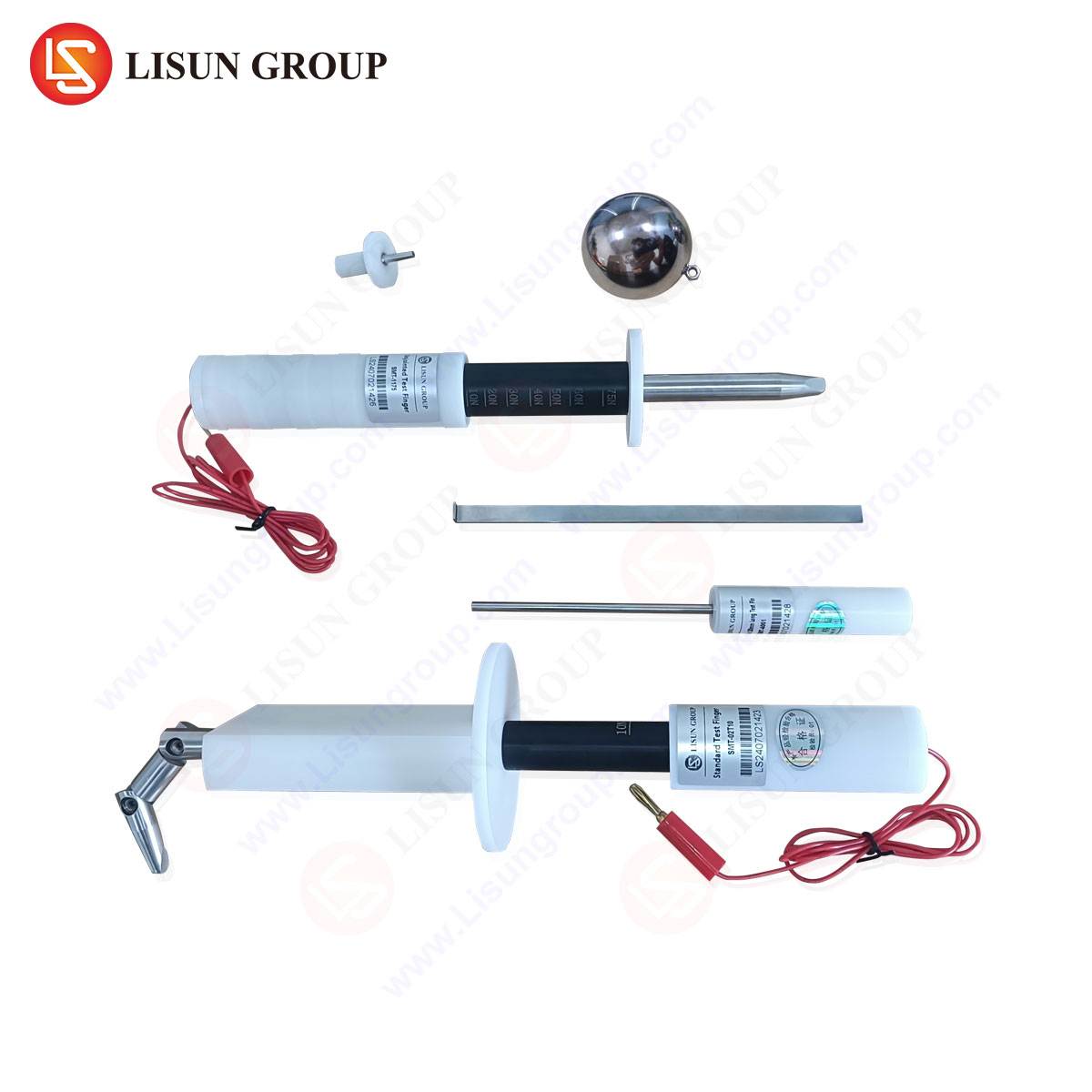
The evaluation of a product’s safety against accidental contact with live or hazardous parts constitutes a fundamental pillar of modern electrical safety engineering. This assessment transcends simple visual inspection, requiring a methodical, physically-simulated investigation of a product’s accessibility. Central to this process is the use of standardized test probes, commonly referred to as test fingers or test pins, designed to replicate the dimensions and probing action of human body parts, tools, or foreign objects. Among these, the 4mm diameter test probe represents a critical benchmark for assessing protection against access by small objects, a requirement pervasive across global safety standards. This article provides a comprehensive technical examination of 4mm diameter test pin compliance, detailing its specifications, underlying testing principles, application across diverse industries, and the instrumental role of precision testing equipment such as the LISUN Test Finger, Test Probe, and Test Pin system in ensuring rigorous and repeatable safety verification.
Specification and Geometrical Tolerances of the 4mm Test Probe
The 4mm test probe is not a generic pin but a precisely defined instrument whose geometry is codified within major international safety standards, including IEC 61032, IEC 60529 (IP Code), and UL 60950-1 (now superseded by IEC 62368-1). Its primary function is to verify that hazardous parts are not accessible through openings in an enclosure. The probe typically consists of a rigid cylindrical rod with a hemispherical end, though specific standards may dictate slight variations.
The defining characteristic is its diameter of 4.0 mm ±0.05 mm, a tolerance critical for ensuring consistent test severity. The length is sufficient to probe openings to a depth of 100 mm or more, as required. The probe is applied with a standardized force, often 1 N ±0.1 N, to simulate gentle probing without deformation of the product under test. For tests requiring a “jointed test finger” to simulate articulation, the 4mm diameter may be applied at the distal end of a multi-jointed apparatus, but the fundamental dimension remains unchanged. The material is typically hardened steel or another rigid, non-conductive material (like phenolite) for electrical applications, ensuring it does not bend or compress during application, which would invalidate the test by failing to adequately probe an opening.
Underlying Testing Principles and Simulated Hazards
The application of the 4mm probe is governed by a clear physical principle: if the probe, under defined conditions of force and angle, can penetrate an opening and make contact with a hazardous part, the product fails the compliance test. A “hazardous part” is context-dependent but generally includes live electrical conductors at hazardous voltage, moving parts like fans or gears, hot surfaces exceeding prescribed temperature limits, or sharp edges.
The 4mm dimension is specifically chosen to represent a “small object” as referenced in protection class IP codes (e.g., IP4X) and safety standards. It simulates threats such as small tools (e.g., screwdrivers, jewelry), wiring fragments, or rigid foreign bodies that could be inserted by a user, either intentionally or accidentally. The test is not merely about static fit; it involves a systematic probing procedure. The technician must attempt to insert the probe into every opening, grill, slot, or gap in the enclosure from all feasible directions, often while the probe is electrically monitored for contact. In articulated finger tests, the joints are manipulated to simulate the natural movement of a human finger, searching for paths to internal hazards. The pass/fail criterion is binary: no electrical contact shall be established, and for IP4X, the probe shall not fully penetrate the opening.
Industry-Specific Applications and Regulatory Imperatives
The mandate for 4mm probe testing is ubiquitous, cutting across virtually all sectors that manufacture electrically powered or mechanical consumer and industrial goods.
- Electrical and Electronic Equipment & Industrial Control Systems: For industrial control panels, programmable logic controller (PLC) housings, and power supplies, the 4mm probe ensures that terminal blocks, busbars, and live circuitry are inaccessible during normal operation and maintenance, preventing arc flash incidents or short circuits.
- Household Appliances and Consumer Electronics: From food processors and blenders to gaming consoles and routers, the probe verifies that users cannot insert objects into ventilation slots or service openings to contact mains-voltage components or high-speed blades.
- Automotive Electronics: In-vehicle infotainment systems, electronic control units (ECUs), and charging ports for electric vehicles must prevent ingress of tools or metallic debris that could cause short circuits in the harsh automotive environment, directly relating to functional safety standards like ISO 26262.
- Lighting Fixtures: Both indoor and outdoor luminaires must protect against access to live parts through seams or lens attachments. The 4mm probe is key for IP rating verification (e.g., IP44) for fixtures used in damp or outdoor locations.
- Telecommunications Equipment: Data center switches, routers, and base station units require robust enclosures. Probe testing ensures network integrity and fire safety by preventing metallic objects from bridging high-current distribution boards.
- Medical Devices: Patient safety is paramount. Devices from MRI scanners to bedside monitors must prevent any possibility of a conductive object being inserted, which could compromise electrical isolation or create a fire risk in oxygen-rich environments.
- Aerospace and Aviation Components: Avionics boxes and in-flight entertainment systems are subject to extreme vibration. Probe testing validates that gaskets and fasteners maintain integrity, preventing loose hardware inside the enclosure from contacting critical circuits.
- Electrical Components: Switches, sockets, and circuit breakers are tested to ensure that live contacts are inaccessible when the device is in the “off” position or when a plug is partially inserted.
- Cable and Wiring Systems: Connectors and junction boxes are probed to verify that live pins are recessed or shrouded sufficiently to prevent accidental contact.
- Toy and Children’s Products Industry: This is a particularly sensitive area. Standards like EN 62115 mandate strict probe tests to ensure battery compartments and any openings are inaccessible to small objects that children might insert, preventing choking hazards or electrical risks.
The LISUN Test Finger, Test Probe, and Test Pin System: Engineering Precision for Compliance
Achieving reliable and standardized test results is wholly dependent on the accuracy and repeatability of the test equipment. The LISUN series of test probes, including their 4mm diameter test pin, are engineered to meet and exceed the exacting specifications of international standards. These instruments are not simple machined rods but calibrated tools designed for laboratory and production line use.
Key Specifications and Design Features:
- Material Integrity: Probes are manufactured from high-strength, dimensionally stable materials. The 4mm pin is typically crafted from hardened steel, polished to a precise spherical tip with a surface finish that prevents snagging, ensuring the test evaluates the opening geometry, not friction.
- Dimensional Fidelity: Each probe undergoes metrological verification to confirm the 4.0 mm diameter is maintained within the ±0.05 mm tolerance across its entire length and tip. This eliminates false passes/fails due to tool variance.
- Integrated Force Application: Advanced LISUN systems often incorporate a calibrated spring mechanism or digital force gauge to apply the exact 1 N force specified in standards, removing operator variability.
- Electrical Contact Detection: Many systems are supplied with or are compatible with a sensitive electrical circuit indicator (e.g., a contact alarm or LED). When the metallic probe touches a live part, the circuit closes, providing an unambiguous, objective failure signal.
- Articulated Test Finger Configurations: For simulating human finger access, LISUN provides jointed test fingers where the distal joint can be fitted with interchangeable tips, including the standard 4mm probe, allowing a single apparatus to perform multiple compliance checks.
Competitive Advantages in Practical Application:
The primary advantage lies in metrological traceability and repeatability. In a regulatory audit or quality assurance process, the use of a certified, calibrated LISUN probe provides defensible data. Its robust construction withstands daily use in QA labs without degradation. Furthermore, the ergonomic design and clear operational guidelines reduce technician training time and minimize human error, increasing throughput in production testing environments. For manufacturers serving global markets, using equipment like the LISUN system that is recognized and accepted by testing bodies worldwide (e.g., TÜV, UL, Intertek) streamlines the certification process.
Interpretation of Results and Common Compliance Challenges
A successful test result, where the 4mm probe cannot contact a hazardous part, validates the design of the enclosure, including its vents, seams, and covers. A failure necessitates a design revision, which may involve adding internal baffles, reducing grill slot dimensions, improving the interlock design of a cover, or adding insulating barriers.
Common failure modes include:
- Ventilation Slot Design: Linear slots often pass a “finger” test but fail a 4mm probe test if the slot width is incorrectly calculated. The standard often references a “slot width” as the diameter of the smallest probe that can penetrate, requiring careful design of cross-bracing or mesh patterns.
- Seam and Gap Inconsistency: Gaps between a housing and a removable cover can vary with fastener torque. Testing must be performed under worst-case assembly conditions.
- Flexible Component Deformation: Rubber seals or flexible membranes must be tested while deformed by the probe force, as they may stretch or peel back, revealing an opening.
Integration with Broader Testing Regimes and Standards
4mm probe testing is rarely performed in isolation. It is a component of a comprehensive safety evaluation that may include:
- IP Code (Ingress Protection) Testing: The 4mm probe is explicitly the test tool for the first numeral “4” (protection against solid objects >1.0mm). It is applied before water spray tests.
- Mechanical Hazard Assessment: Used alongside articulated test fingers (simulating adult and child fingers) and other probes (e.g., 1.0mm “wire” probe for IP5/6X dust protection).
- Dielectric Strength Verification: Following probe testing, a hi-pot test is performed to verify the insulation system’s integrity, confirming that even if the probe theoretically could reach a part, sufficient insulation withstands voltage stress.
Table 1: Relevant Standards Specifying 4mm Test Probe Use
| Standard Number | Title | Primary Application |
| :— | :— | :— |
| IEC 61032 | Protection of persons and equipment by enclosures – Probes for verification | The umbrella standard defining test probe geometries, including Figure 13 (4mm probe). |
| IEC 60529 | Degrees of protection provided by enclosures (IP Code) | Specifies use for IP4X and IP5X (with force) testing. |
| IEC 62368-1 | Audio/video, information and communication technology equipment | References IEC 61032 for accessibility of hazardous energy sources. |
| IEC 60335-1 | Household and similar electrical appliances – Safety | Mandates probe testing for accessibility of live parts. |
| UL 943 | Standard for Safety for Ground-Fault Circuit-Interrupters | Includes probe tests for outlet receptacles. |
Conclusion
Compliance with 4mm diameter test pin requirements is a non-negotiable aspect of product safety design, serving as a fundamental barrier against a prevalent class of physical hazards. Its implementation, governed by precise international standards, demands an equally precise and reliable testing instrument. The procedural application of a calibrated tool like the LISUN Test Pin transforms a subjective inspection into an objective, repeatable, and auditable engineering measurement. As product enclosures become more compact and ventilated for thermal management, the challenge of designing openings that allow airflow while excluding probes will only intensify. A deep understanding of the 4mm probe’s role, coupled with the use of definitive testing equipment, remains essential for engineers and quality assurance professionals committed to delivering safe, compliant, and reliable products to the global market.
Frequently Asked Questions (FAQ)
Q1: Can a product pass if the 4mm probe touches an insulated wire or a component with basic insulation?
A: No. The test is for accessibility to hazardous parts. A part covered only by basic insulation is still considered a hazardous live part. The probe must not contact it. The insulation itself is evaluated separately by dielectric strength (hi-pot) tests.
Q2: How does testing with a rigid 4mm probe differ from testing with an articulated test finger that has a 4mm tip?
A: The rigid probe tests specific openings for small object ingress. The articulated finger, with its joints, tests for accessibility along a path, simulating how a finger might bend and reach inside through an opening. They assess different access scenarios. A product may pass one test but fail the other, which is why both are often required.
Q3: Is the 1 N test force always applied? Are there exceptions?
A: While 1 N is standard for most accessibility tests (e.g., IEC 61032), specific standards may dictate variations. For example, in IP5X dust protection testing, a 1 N force is used with the 1.0mm wire probe. Always consult the specific end-product standard for the exact test parameters.
Q4: Our product has a removable cover secured by screws. Do we test with the cover installed but screws loosened?
A: Standards typically require testing under “user-accessible” conditions without the use of a tool. If the cover requires a tool (screwdriver) to remove, it is tested as installed with screws fully tightened. If the cover is removable by hand (e.g., a snap-fit), it should be tested in its most unfavorable position, which may involve partial detachment.
Q5: Why is the material of the test probe important? Could using a makeshift pin invalidate the test?
A: Absolutely. A makeshift pin may have incorrect diameter, an imperfect hemispherical tip, or may flex under force. The standardized material (hard, rigid) and geometry ensure a consistent, reproducible test severity. Using a non-compliant probe can lead to false passes (if it bends) or false failures (if it snags), undermining the validity of the safety certification.