





Ensuring Operational Safety: A Technical Examination of UL 1278 Compliance and Accessible Hazard Mitigation
Introduction to the Standard: UL 1278 for Movable and Wall-Mounted Electric Heaters
The proliferation of electrically powered heating devices in residential, commercial, and institutional environments necessitates a rigorous framework for evaluating safety. UL 1278, the Standard for Safety for Movable and Wall-Mounted Electric Room Heaters, establishes the benchmark for such evaluations. This standard, developed by Underwriters Laboratories, delineates comprehensive requirements intended to mitigate risks associated with fire, electric shock, and personal injury arising from the foreseeable use and misuse of these appliances. Compliance is not merely a regulatory checkpoint but a fundamental engineering obligation, ensuring that products entering the market embody inherent safety principles that protect end-users under both normal and abnormal conditions. The scope of UL 1277 extends to portable heaters, fixed wall-mounted heaters, and similar devices, making its provisions critical for a wide array of product designs and applications.
The Critical Role of Accessibility Probes in Hazard Verification
A foundational tenet of product safety engineering is the principle of accessibility. Energized parts, moving components, or excessive temperatures that are accessible to a user constitute a direct hazard. UL 1278, in alignment with other core safety standards, employs a series of standardized test probes to simulate access by human body parts or common objects. These probes—specifically the jointed test finger, the test probe, and the test pin—are not simple tools but precisely calibrated instruments that define the boundaries of safe design. Their application during compliance testing provides an objective, repeatable method for verifying that hazardous live parts, hazardous mechanical parts, and openings that could lead to such parts are adequately safeguarded against contact. The integrity of this verification process is wholly dependent on the geometric precision, dimensional accuracy, and mechanical consistency of the probes themselves.
Instrumentation for Compliance: Specifications and Application of Standardized Test Probes
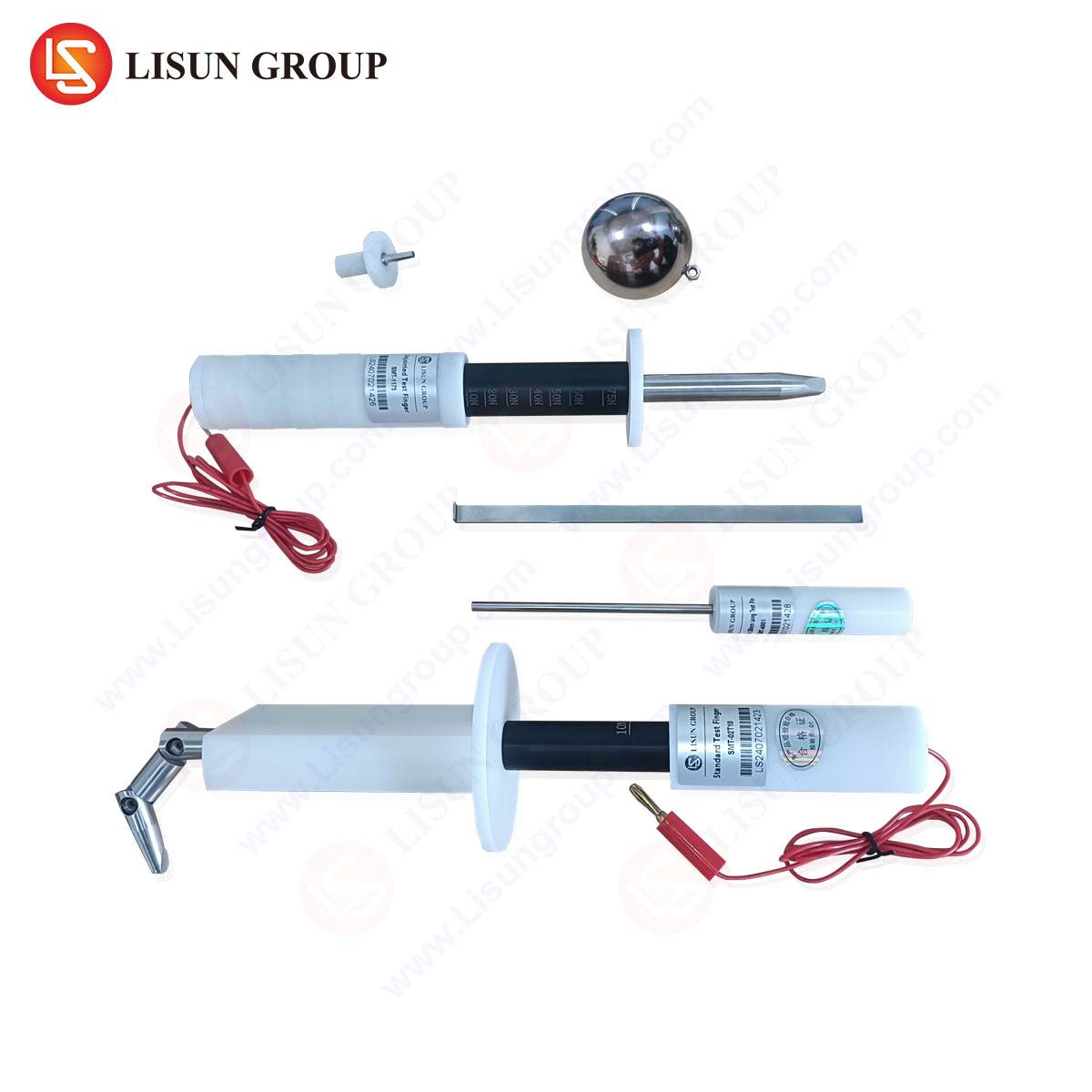
The efficacy of accessibility testing hinges upon the use of instruments that conform exactly to the dimensional and force specifications outlined in the standard. The LISUN series of compliance test probes, including the LS-JF01 Jointed Test Finger, LS-P01 Test Probe, and LS-PIN01 Test Pin, are engineered to meet these stringent requirements, serving as essential apparatus for certification laboratories and quality assurance departments.
The LISUN LS-JF01 Jointed Test Finger is designed to simulate the dimensions and articulation of a human finger, particularly that of a child. Constructed from materials such as heat-resistant polymer and metal joints, it applies a force of 10 N ± 0.5 N. Its primary function is to assess access to hazardous live parts through openings in enclosures. According to UL 1278, if the probe can contact a live part, the design fails to meet the standard’s basic safety requirements. This probe is indispensable for evaluating grilles, vents, and gaps in heater housings, control panel interfaces, and the junctions between removable panels.
The LISUN LS-P01 Test Probe, often referred to as the “unfolding probe” or “object probe,” represents a slender, rigid object like a wire or tool. With a diameter of 1.0 mm and a test force of 1.0 N ± 0.1 N, it is used to probe deeper, narrower openings that the test finger cannot enter. Its application is critical for verifying that smaller apertures—common in ventilation slots, between fins of heating elements, or in terminal block covers—do not provide a path to hazardous parts. A successful test requires that the probe cannot make contact with parts operating at a hazardous voltage.
The LISUN LS-PIN01 Test Pin is a more robust probe, simulating a stiff wire or similar object. It typically features a 3 mm diameter spherical end and is applied with a force of 3 N ± 0.3 N. This probe evaluates the strength and effectiveness of barriers. For instance, it is used to test the rigidity of grilles or mesh intended to prevent access; if the probe can deform the barrier sufficiently to contact a hazard, the barrier is deemed non-compliant. It is particularly relevant for assessing protective guards over fan blades or heating elements.
Table 1: LISUN Compliance Probe Specifications for UL 1278 Applications
| Probe Model | Simulated Object | Critical Dimension | Applied Force | Primary Testing Purpose |
| :— | :— | :— | :— | :— |
| LS-JF01 | Child’s finger | Jointed sections per standard | 10 N ± 0.5 N | Access to hazardous live parts through openings. |
| LS-P01 | Wire, tool | 1.0 mm diameter | 1.0 N ± 0.1 N | Probing narrow openings for live part contact. |
| LS-PIN01 | Stiff object | 3 mm spherical end | 3 N ± 0.3 N | Testing mechanical strength of protective barriers. |
Interdisciplinary Applications Beyond Heating Equipment
While UL 1278 specifically governs heaters, the physical principles and probe methodologies it enshrines are ubiquitous across electrical safety standards, including UL 60335-1, IEC 61032, and various automotive (ISO 20653) and aerospace (DO-160) directives. Consequently, the LISUN probe set finds extensive utility in a multitude of industries where enclosure integrity and user protection are paramount.
In Automotive Electronics and Aerospace Components, probes verify that high-voltage connections in battery management systems, infotainment units, or flight control avionics are inaccessible during routine maintenance or after an enclosure fastener is loosened. Medical Device manufacturers use these probes to ensure that serviceable compartments housing mains-powered circuitry cannot be accessed without a tool, preventing operator shock risk. For Industrial Control Systems and Telecommunications Equipment, testing with the jointed finger and test probe validates that terminal blocks, circuit breaker openings, and cooling vents on PLCs or servers are safely designed.
The Lighting Fixtures industry applies these tests to lampholders, wiring compartments, and the seams between diffusers and housings in both commercial and residential fixtures. Toy and Children’s Product safety standards heavily rely on finger and probe simulations to ensure battery compartments cannot expose terminals and that no openings can trap or contact small body parts. Even in Electrical Components like switches and sockets, probe testing confirms that live parts cannot be touched when a plug is partially inserted or a switch plate is slightly ajar.
Integrating Probe Testing into the UL 1277 Evaluation Framework
Compliance with UL 1278 is a holistic process where accessibility testing is interwoven with other critical evaluations. Probe testing is typically conducted at the beginning of the evaluation, as its failure often constitutes a fundamental non-compliance. The test sequence is logical and iterative.
First, the Static Assessment involves visual inspection and manual application of the LISUN LS-JF01 test finger to all user-accessible openings without applying force beyond its specification. The device is powered down but wired as in normal use. Second, the Dynamic Assessment may involve tilting the heater or applying the probe to openings that appear only when panels are flexed or when a malfunction (like a broken latch) is simulated. The LS-P01 test probe is then methodically inserted into every slot, gap, or opening that could permit its passage. Finally, the LS-PIN01 test pin is applied to any mesh, grille, or barrier to test for excessive deformation.
These physical tests are complemented by electrical strength (dielectric withstand) tests and temperature measurements. For example, a surface that is accessible to the test finger must also not exceed safe touch temperature limits defined in the standard. This multi-parameter approach ensures a comprehensive safety profile.
Competitive Advantages of Calibrated Test Instrumentation
The use of precisely manufactured, certified probes like the LISUN series offers distinct advantages in the compliance ecosystem. Measurement Traceability is paramount; each probe is manufactured to tolerances traceable to national metrology institutes, ensuring that test results are reliable and defensible during third-party certification audits. Repeatability and Reproducibility are enhanced by the consistent material properties and finish of the probes, eliminating variables that could arise from using improvised or worn tools. Operational Efficiency is improved for quality control teams, as dedicated, clearly labeled probes reduce setup time and prevent misapplication during production line safety checks.
From a risk management perspective, employing standardized instrumentation mitigates the liability associated with potential false-negative results—where a non-compliant product is erroneously passed—which could lead to field failures, recalls, and significant legal exposure. For R&D engineers, having access to these probes during the design phase facilitates early validation, allowing for safety considerations to be integrated into the product architecture, thereby reducing costly redesigns later in the development cycle.
Conclusion: The Synthesis of Design, Standard, and Verification
UL 1278 embodies a preventive philosophy, seeking to eliminate hazards through intelligent design rather than through warnings or procedural controls. The standardized test probes specified within its framework are the physical embodiment of this philosophy, translating abstract safety principles into concrete, actionable test criteria. The rigorous application of instruments such as the LISUN test finger, probe, and pin provides an objective, empirical foundation for declaring a product safe for public use. As electrical devices continue to evolve in complexity and integration across industries—from smart home appliances to electric vehicle systems—the role of precise, reliable compliance instrumentation only grows in significance. It forms the critical link between theoretical safety standards and physically demonstrable product integrity, ensuring that protection against shock and injury remains an invariant property of the manufactured article.
Frequently Asked Questions (FAQ)
Q1: Can a product pass the test finger (LS-JF01) probe test but fail the test probe (LS-P01) test?
Yes, this is a common scenario. An opening may be too small for the articulated joints of the test finger to enter and make contact, but it may be sufficiently large and oriented to allow the slender, rigid 1 mm test probe to penetrate deeper and reach a hazardous live part. This is why both probes are required; they address different but equally plausible access scenarios.
Q2: How often should compliance test probes like the LISUN set be calibrated or replaced?
Calibration intervals should be determined by usage frequency, environmental conditions, and quality system requirements (e.g., ISO/IEC 17025). Annual calibration is a typical industry practice for active testing laboratories. Probes should be inspected before each use for damage, wear, or deformation. Replacement is necessary if any dimension falls outside the specified tolerance, if the material is cracked, or if the applied force mechanism no longer meets specification.
Q3: In the context of UL 1278, are there openings that are explicitly exempt from probe testing?
Yes. Openings that are an integral part of the protective function of the device, such as those necessary for the admission of cooling air over a thermal cut-off, may be evaluated under different criteria. However, these openings must still be assessed to ensure they do not allow direct access to live parts. Additionally, small openings on the bottom of a portable heater, or those requiring a tool for access, may have different applicability. The standard provides specific details, and exemptions must be justified by the test engineer.
Q4: For a wall-mounted electric heater, does probe testing apply to the back of the unit against the wall?
Generally, surfaces intended to be mounted flush against a wall or building surface are not considered “accessible” in the same way as exposed surfaces. However, the standard requires evaluation of the product in its installed state. If mounting creates new openings (e.g., between the heater and the wall) that could be accessed, or if parts become accessible during the act of installation or servicing, those scenarios must be assessed. The evaluation often includes checking for accessibility before the mounting screws are fully tightened.
Q5: How does probe testing interact with the evaluation of plastic enclosures that may deform under heat?
This is a critical interaction. UL 1278 requires that enclosures provide protection not only at room temperature but also under conditions of maximum operating temperature and during abnormal tests. A plastic grille that adequately prevents probe access at 25°C may soften and deform at its operational temperature of, for example, 85°C, allowing the test pin (LS-PIN01) to penetrate. Therefore, probe tests are often repeated with the appliance operating at maximum rated conditions until temperatures stabilize, ensuring the safety of the enclosure material under real-world thermal stress.