









Here is the complete technical article, structured and written according to your detailed specifications.
Abstract
The LISUN HSCD-800 Portable Spectrophotometer – CIE No.15 & ISO 7724-1 Compliant represents a significant advancement in portable color measurement technology, designed for rigorous quality control and R&D environments. This article provides a detailed technical analysis of the HSCD series, focusing on the HSCD-800 model’s core optical architecture, compliance with international color science standards, and practical applications across multiple manufacturing sectors. Readers will gain insight into the specific metrological advantages of the dual-beam, grating-based design, the significance of SCI/SCE measurement modes, and how these features ensure data integrity for tasks ranging from plastic color matching to automotive interior consistency. The article serves as a technical reference for professionals seeking a reliable, standards-compliant solution for spectral analysis.
1.1 Grating Spectroscopy and Dual-Beam Optical System
The HSCD series utilizes a concave grating spectroscopic system, which is fundamental to its measurement accuracy. Unlike simple filter-based colorimeters, the LISUN HSCD-800 Portable Spectrophotometer employs a diffraction grating to disperse light into its constituent spectral components across the visible range (400-700nm). This allows for the capture of a full spectral reflectance curve rather than a limited set of tristimulus values. The optical system is designed with a dual-beam configuration; one beam measures the sample while the other monitors the light source output. This real-time compensation mechanism effectively eliminates errors caused by fluctuations in the xenon lamp or LED light source intensity, ensuring repeatable results even under varying ambient conditions. The spectral resolution, typically around 10nm, is sufficient for identifying metamerism and supplying precise colorant formulation data. The optical path is sealed to ingress ingress of dust, maintaining performance in industrial environments.
1.2 Nano-Integrated Optical Devices and Wavelength Accuracy
Wavelength accuracy is critical for spectral data reliability, and the HSCD-800 achieves this through the integration of fixed, precision-manufactured grating components. The instrument uses nano-level positioning and assembly techniques for its optical devices, including the slit and detector array. This construction minimizes stray light, a common source of error in portable instruments, particularly when measuring high-saturation or dark samples. The wavelength interval is set at 10nm, with a wavelength accuracy typically maintained within 0.5nm. This ensures that spectral reflectance measurements are consistent with reference instruments, a prerequisite for cross-platform data exchange.
1.3 Zirconium Calibration Whiteboard Technology
Absolute calibration is a core differentiator for the LISUN HSCD series. The instrument utilizes a proprietary zirconium dioxide (ZrO2) ceramic whiteboard as its primary reference standard. This material is chosen for its exceptional stability; it is resistant to yellowing, temperature-induced changes, and moisture absorption over long periods. The whiteboard provides a near-Lambertian surface with a calibrated reflectance factor greater than 95% across the visible spectrum. By relying on a physical, stable reference, the HSCD-800 avoids the drift associated with internal optical reference standards, providing a traceable calibration point for every measurement cycle. This directly supports compliance with standards like ISO 7724-1, which demands a defined photometric scale.
2.1 CIE No.15 and ISO 7724-1: The Foundation of Colorimetric Data
The LISUN HSCD-800 is fully compliant with CIE No.15 (Colorimetry) and ISO 7724-1 (Paints and varnishes — Colorimetry — Part 1: Principles). CIE No.15 defines the standard methods for calculating color coordinates (CIE Lab, LCh) and color differences (dEab, dE00) from spectral data. The instrument’s native 10° observer function and D65 illuminant selection are directly derived from this standard. Compliance with ISO 7724-1 ensures that the geometric conditions of illumination and viewing are strictly controlled, specifically the 45-degree illumination and 0-degree viewing (d/8 for the HSCD’s integrating sphere configuration). This conformity guarantees that color difference values generated by the HSCD-800 are reliable and can be used for pass/fail decisions in contractual agreements between suppliers and buyers.
2.2 ASTM E1164 and GB/T 3978: Standard Practices for Reflectance Measurement
The instrument adheres to ASTM E1164, the standard practice for obtaining spectrophotometric data for object-color evaluation. This involves specific protocols for instrument calibration and sample presentation. The HSCD-800 automatically manages specular component inclusion (SCI) and exclusion (SCE) via the integrating sphere, satisfying the geometric conditions required by ASTM E1164. Furthermore, it respects the spectral power distributions defined in GB/T 3978 for standard illuminants (e.g., D65, A, F2). By offering a suite of pre-programmed illuminants and observer functions, the instrument directly aligns with Chinese national standards (GB/T) as well as international norms (CIE, ASTM), making it suitable for global manufacturing supply chains.
3.1 Aperture Options: 4mm, 8mm, and 20mm
The HSCD-800 features three field-of-view aperture options, a critical feature for versatility. The 4mm aperture is designed for small, patterned, or curved surfaces, such as printed dots or plastic pellets. The 8mm aperture serves as a general-purpose standard for most flat, uniform samples. The 20mm aperture is ideal for non-homogeneous surfaces like textiles or coarse-grained plastics, where a larger measurement area provides a statistically averaged color reading. The user can switch between these apertures without requiring recalibration, thanks to the instrument’s self-calibrating logic.
3.2 SCI/SCE, Fluorescence, and Metamerism Index
The HSCD-800 measures specular component included (SCI) and excluded (SCE) data in a single measurement cycle. SCI data correlates with visual assessment of color and is used for formula prediction, while SCE data eliminates the gloss component to assess the true color of the pigment. Additionally, the instrument calculates the metamerism index (MI) under different illuminants, quantifying how two samples appear to change color under different lighting conditions. This is essential for verifying color matches under D65 (daylight), A (incandescent), and TL84 (fluorescent) sources. The instrument can also report the whiteness index per ASTM E313 and yellowness index per ASTM D1925, extending its utility to paper and plastic evaluation.
Technical Comparison Table: LISUN HSCD Series Models
| Feature / Parameter | LISUN HSCD-780 | LISUN HSCD-800 | LISUN HSCD-860 |
|---|---|---|---|
| Measurement Repeatability | dE*ab ≤ 0.05 | dE*ab ≤ 0.04 | dE*ab ≤ 0.03 |
| Inter-Instrument Agreement | dE*ab ≤ 0.20 | dE*ab ≤ 0.15 | dE*ab ≤ 0.10 |
| Aperture Options | 8mm (Fixed) | 4mm, 8mm, 20mm | 4mm, 8mm, 20mm |
| Light Source Type | LED | LED + Xenon (UV) | LED + Dual Xenon (UV) |
| Wavelength Range | 400-700nm | 400-700nm | 360-780nm (UV) |
| Battery Life | 5000 measurements | 3000 measurements | 2000 measurements |
| Connectivity | USB, Bluetooth | USB, Bluetooth, WiFi | USB, Bluetooth, WiFi, RS-232 |
| Storage Capacity | 50,000 samples | 100,000 samples | 200,000 samples |
4.1 Companion Color Analysis Software
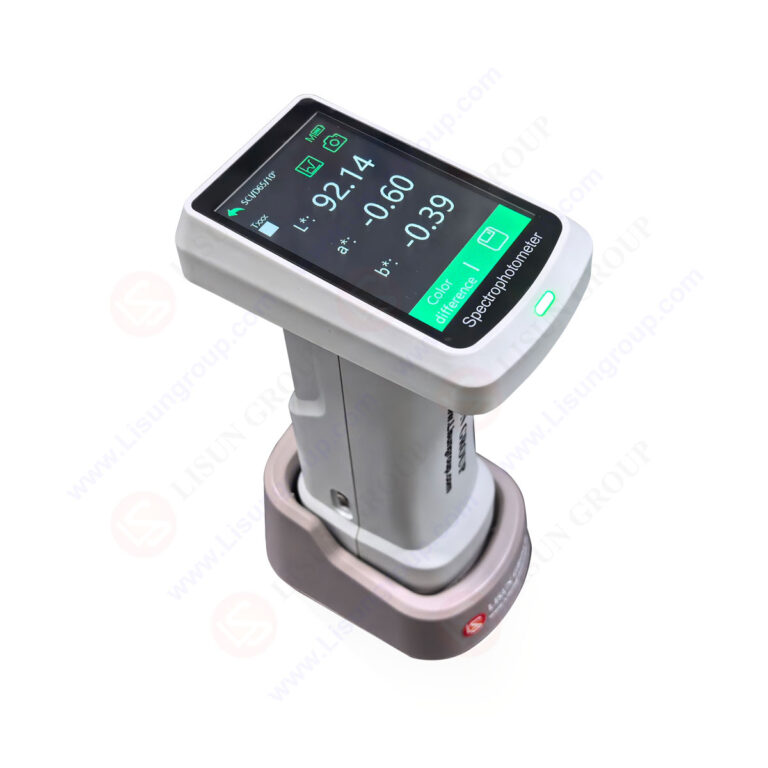
The HSCD-800 is integrated with LISUN’s Color Suite software, which transforms the device from a simple measurement unit into a comprehensive quality control hub. The software allows for the creation of tolerance sets (e.g., dE*ab < 1.0), pass/fail analysis, and the generation of detailed reports compliant with ISO standards. Users can plot spectral reflectance curves, track color trends over time, and manage color libraries. The software supports standard color spaces (CIE Lab, LCh, RGB, HSV, Hunter Lab) and multiple color difference formulas (CIE76, CIE94, CIEDE2000, CMC).
4.2 Connectivity and Data Integrity
The instrument offers multiple connectivity options, including USB, Bluetooth, and WiFi. USB provides wired, low-latency data transfer for laboratory setups. Bluetooth 5.0 offers wireless connectivity for mobile measurement. The built-in WiFi module allows integration with a local network for centralized data logging and remote monitoring. Data storage is non-volatile, with a capacity of up to 100,000 measurement records. Each record includes spectral data, date/time stamps, and user-defined sample identifiers, ensuring a complete audit trail for quality audits.
5.1 Plastic Masterbatch and Injection Molding Quality
In plastics manufacturing, the HSCD-800 is used to evaluate the color consistency of raw resin. The 4mm aperture is particularly useful for measuring small, colored pellets or disks. For finished molded parts, the instrument helps detect inconsistencies arising from flow lines or gate blush. The dE*00 metric is often preferred here for its improved correlation with visual perception of color difference in plastic materials. Regular monitoring ensures that batches from different production runs remain within the specified dE tolerance, often set at < 0.8 for high-end consumer goods.
5.2 Printing and Packaging Color Verification
The printing industry relies heavily on ISO 12647 standards for process control. The HSCD-800 facilitates this by measuring density and dot gain in addition to color coordinates. Its SCE mode is essential for evaluating the print color on coated papers, effectively removing the gloss component which can artificially influence the color reading. The ability to measure metamerism is critical for packaging, as a color match under D65 may fail under the warm light of a retail store.
5.3 Textile and Coatings Consistency
The large 20mm aperture is ideal for textile color quality control. It averages the color of the yarns or weave, providing a representative measurement that accounts for surface texture variations. For liquid coatings, the instrument is often used in wet film measurement or dry film evaluation. The LISUN software’s pass/fail function allows operators to quickly sort outgoing shipments, reducing returns due to color mismatch.
6.1 Automotive Interior and Exterior Parts
Automotive interior components require exceptional color and gloss matching across materials like leather, plastic, and metal. The HSCD-800 is used to evaluate color consistency between a dashboard plastic trim and a leather steering wheel. The instrument’s high inter-instrument agreement (dE*ab ≤ 0.15) is critical here, as multiple instruments used at different supplier sites must yield identical results. The device can also measure the yellowing index of white or clear parts, which is a key indicator of UV degradation.
6.2 Food and Appliance Color Standardization
In the food industry, the HSCD-800 aids in measuring the color of raw and processed foods, correlating with ripeness, freshness, and caramelization. In the home appliance sector, the instrument ensures that white goods (refrigerators, ovens) from different factories match the specified white point. The instrument’s robust housing and IP protection make it suitable for the slightly dusty or humid environments of a production floor.
7.1 Calibration and Verification Procedures
According to ISO 7724-2, the HSCD-800 requires a two-step calibration: zero calibration (using a light trap) and whiteboard calibration. This is an automated process performed before each measurement session or when the user selects “Calibrate.” The instrument stores the calibration standard’s absolute spectral reflectance factor from the factory. A verification tile, often a green or gray ceramic, is used daily to confirm the instrument is within tolerance.
7.2 Quality Assurance for Third-Party Testing Labs
For third-party testing laboratories, traceability to a national standard is mandatory. The LISUN HSCD-800 is designed to support this. The instrument’s firmware logs the last calibration time and the standard used. The software allows labs to generate reports that include the calibration certificate number, measurement uncertainty, and the specific standard used (e.g., CIE No.15). This level of documentation satisfies the requirements of ISO 17025 for testing and calibration laboratories.
The LISUN HSCD-800 Portable Spectrophotometer is a fully standards-compliant instrument (CIE No.15, ISO 7724-1, ASTM E1164) designed for high-precision color measurement in industrial environments. Its dual-beam optical architecture, grating spectrometer, and stable zirconium whiteboard deliver the repeatability and inter-instrument agreement necessary for rigorous quality control. The three-aperture design and extensive software suite enable its use across diverse applications, from plastics and textiles to automotive and food processing. For professionals demanding traceable data, reliable pass/fail analysis, and compliance with global colorimetric standards, the HSCD-800 represents a technically robust and practical solution.
Q1: What is the primary difference between the LISUN HSCD-800 and the HSCD-860?
A: The primary difference lies in the light source and wavelength range. The HSCD-800 uses a combination of LED and a UV xenon lamp, covering the standard visible spectrum (400-700nm). The HSCD-860, however, features dual xenon lamps (including a UV component) and extends its spectral range down to 360nm. This enables the HSCD-860 to measure fluorescence and evaluate white samples containing optical brighteners, as required by standards like ISO 2470. The HSCD-860 also offers higher inter-instrument agreement (dEab ≤ 0.10) compared to the HSCD-800 (dEab ≤ 0.15), making it more suitable for master-standard reference work and complex color formulation tasks.
Q2: How does the HSCD-800 ensure compliance with ASTM E313 for whiteness index?
A: The ASTM E313 standard defines a specific formula for calculating the whiteness index based on CIE XYZ tristimulus values. The HSCD-800’s integrated software automatically computes this index by first measuring the sample’s full spectral reflectance curve. The instrument then applies the illuminant (typically D65) and observer function (2° or 10°) to derive the X, Y, Z values. The software directly applies the ASTM E313-96 formula to report the Whiteness Index (WI). For yellowing evaluation, the instrument similarly applies the ASTM D1925 formula to calculate the Yellowness Index (YI).
Q3: Can the LISUN HSCD-800 be used to measure the color of transparent liquids?
A: Yes, the HSCD-800 can measure transparent or translucent liquids, although it typically requires an optional liquid measurement accessory which provides a defined path length cuvette holder. In standard reflectance mode, the liquid sample is poured into a cuvette with an opaque backing, and the instrument measures the reflected light from the liquid’s surface and backwall. For transmission measurements, the instrument must be configured to measure transmitted light intensity. The software can then report the color in terms of the APHA (Hazen) index, Gardner color scale, or Saybolt color.
Q4: Why is inter-instrument agreement critical for supply chain quality control?
A: Inter-instrument agreement ensures that a color measured on a supplier’s HSCD-800 will produce the same result when measured on the buyer’s instrument. Without this agreement, a part might pass at one location and fail at another, leading to rejected shipments, rework, and supply chain friction. The HSCD-800 achieves this through a combination of precision wavelength calibration (typically within 0.5nm), a stable integrating sphere geometry, and the use of a highly stable, low-drift detector array. The instrument’s factory calibration is performed against a set of certified ceramic reference standards, which are themselves traceable to national metrology institutes.