









Here is the comprehensive technical article generated according to your specifications.
Abstract
This article provides a detailed technical overview of LISUN LED Optical Aging Test Instruments for Manufacturing Quality Control, specifically the LEDLM-80PL and LEDLM-84PL systems. Designed for rigorous lumen maintenance validation, these instruments integrate Arrhenius Model-based software to predict L70/L50 lifetimes over 6000-hour test durations. The article contextualizes these solutions within critical industry standards such as IES LM-80, TM-21, IES LM-84, and TM-28, offering engineers a data-driven approach to manufacturing quality assurance. By analyzing dual-mode capabilities, temperature chamber integration, and software extrapolation methodologies, this piece serves as a practical guide for R&D and QC professionals seeking to enhance product reliability and regulatory compliance.
1.1 Defining Lumen Maintenance and Lifetime Projection
LED lumen depreciation is an unavoidable physical phenomenon driven by junction temperature and phosphor degradation. Accurate quantification of this depreciation is paramount for manufacturing quality control. Standards like IES LM-80 mandate specific test durations (e.g., 6000 hours at three case temperatures) to collect raw data, which is then extrapolated using TM-21 to project L70 (time to 70% of initial lumen output) or L50 lifetime. The LISUN LED Optical Aging Test Instruments are engineered to execute these protocols with precision, ensuring that production batches meet declared lifetime claims.
1.2 The Impact of Standards on Test Equipment Design
The LISUN LED Optical Aging Test Instruments are not generic aging ovens; they are purpose-built to comply with the stringent requirements of IES and CIE standards. CIE 127 guidelines for LED measurement and CIE 084 for luminous flux measurement dictate the photometric accuracy required. These instruments feature high-stability DC power supplies and temperature-controlled integrating spheres to minimize measurement uncertainty, which is crucial for distinguishing normal aging variance from manufacturing defects.
2.1 Dual System Variants for Specific Standards
LISUN offers two primary variants to address different testing needs:
- LEDLM-80PL: Designed for IES LM-80 (Lumen Maintenance of LED Light Sources) and TM-21 (Projecting Long-Term Lumen Maintenance) . It supports testing of individual LEDs or LED packages.
- LEDLM-84PL: Tailored for IES LM-84 (Lumen Maintenance of Solid-State Lighting Products) and TM-28 (Projecting Long-Term Lumen Maintenance of SSL Products) . This system is optimized for testing complete luminaires and lamps, requiring larger integrating spheres.
2.2 Hardware Customization and Temperature Chamber Integration
A key feature for manufacturing QC is the system’s ability to connect to up to 3 separate temperature chambers. This allows concurrent testing at the three mandatory case temperatures specified by LM-80 (typically 55°C, 85°C, and a third user-defined temperature). Each chamber can house multiple test samples, enabling statistically significant datasets. The customizable hardware configurations allow engineers to select specific integrating sphere sizes (from 0.5m to 2.0m) and spectroradiometers based on the product form factor.
Table 1: Technical Comparison of LISUN LED Optical Aging Test Instrument Variants
| Feature | LEDLM-80PL (Package/Module Test) | LEDLM-84PL (Luminaire/SSL Product Test) |
|---|---|---|
| Primary Standard | IES LM-80, TM-21 | IES LM-84, TM-28 |
| Typical Test Duration | 6000+ hours (per LM-80) | 6000+ hours (per LM-84) |
| Test Object | LED packages, modules, arrays | Complete lamps, luminaires, SSL |
| Photometric Range | 350-1050 nm (spectroradiometer) | 350-1050 nm (spectroradiometer) |
| Temperature Chamber Support | Up to 3 chambers | Up to 3 chambers |
| Key Metrics | L70, L50, flux degradation over time | L70, L50, flux degradation over time |
| Integrating Sphere Size | Typically 0.3m – 0.5m | Typically 1.0m – 2.0m |
(Data based on LISUN standard product specifications)
3.1 Constant Temperature Mode (CTM)
In Constant Temperature Mode, the LED samples are maintained at a fixed case temperature (e.g., 85°C) throughout the test duration. This mode is strictly required by IES LM-80 and IES LM-84 for establishing the baseline data needed for TM-21 and TM-28 extrapolation. The system automatically adjusts the drive current to maintain the target temperature as the LED’s electrical characteristics change due to aging. This mode is essential for ISO/IEC 17025 accredited testing labs performing certification-level analysis.
3.2 Constant Current Mode (CCM)
Constant Current Mode maintains a stable drive current regardless of LED heating, allowing the junction temperature to rise naturally. This mode is often used for R&D stress testing and failure analysis. When combined with the Arrhenius Model, it provides an accelerated aging factor that can be used to predict early-life failures in manufacturing batches. The LISUN LED Optical Aging Test Instrumentslog both flux and case temperature data simultaneously, allowing engineers to calculate the activation energy (Ea) of the degradation process, a critical input for the Arrhenius equation.
4.1 Embedded Multi-Physics Calculation Engine
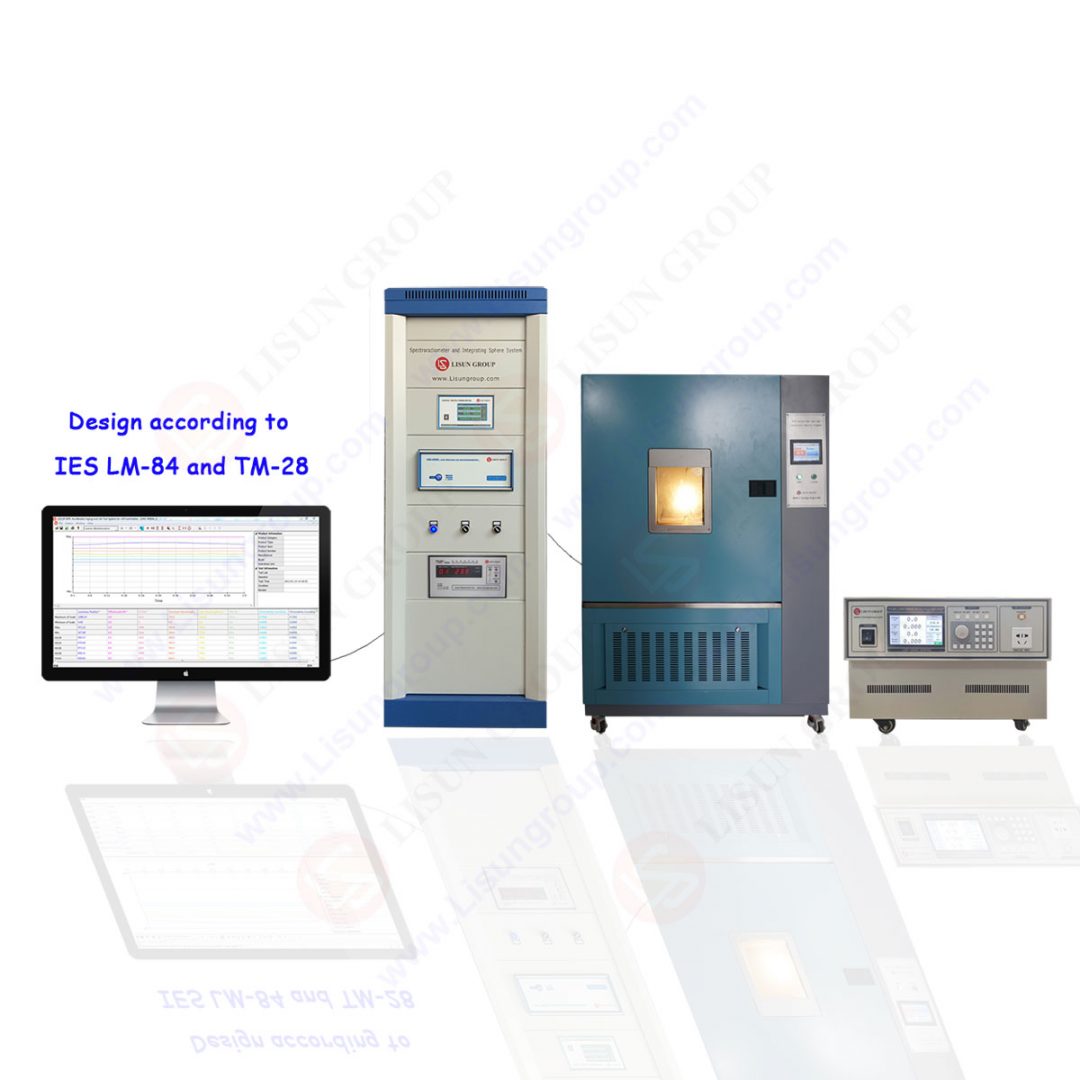
The proprietary software embedded in these instruments is not just a data logger; it is a multi-physics calculation engine. It utilizes the Arrhenius Model to establish a relationship between temperature and degradation rate. For example, if an LED shows a 5% lumen drop at 85°C after 6000 hours, the software can calculate the equivalent time at 55°C required to achieve the same degradation. This algorithm is validated against empirical data and is crucial for accurate TM-21 extrapolations, often predicting lifetimes exceeding 50,000 hours.
4.2 Automated TM-21 and TM-28 Extrapolation
The software automatically performs the quadratic regression analysis required by TM-21 and TM-28. It generates detailed reports including:
- Exponential decay constants (alpha)
- Activation energy (Ea)
- L70 and L50 projected lifetimes with confidence intervals
- Raw data plots showing every measurement point (typically at 1000-hour intervals)
This automation eliminates manual calculation errors and ensures that the Q2 traceability chain is maintained from raw data to final report, a process critical for manufacturing quality control audits.
5.1 Spectroradiometer Calibration and Stability
Accurate aging data requires a photometric system with high wavelength resolution and low noise floor. The LISUN LED Optical Aging Test Instruments employ a high-speed spectroradiometer with a resolution of 0.2 nm and a measurement range of 380nm-780nm for general lighting or 350nm-1050nm for extended applications. Frequent recalibration using a NIST-traceable standard lamp is a must. The system includes self-diagnostic routines that flag any drift in the reference detector, ensuring that the data points taken at Hour 0 and Hour 6000 are equally accurate.
5.2 Integrating Sphere Considerations
The choice of integrating sphere size and coating material directly impacts measurement uncertainty. For LM-80 testing of small LEDs, a 0.3m sphere is sufficient, but for LM-84 testing of larger luminaires, a 1.5m or 2.0m sphere is required to avoid self-absorption errors. The spheres feature a high-reflectivity barium sulfate coating (>92%) that is stable over time and temperature. The system also includes baffles and auxiliary lamp compensation methods to correct for sample self-absorption, a crucial step for accurate aging analysis per CIE 084.
6.1 Incoming Quality Control (IQC) and Bin Validation
The LISUN LED Optical Aging Test Instruments are invaluable during IQC for LED procurement. Manufacturers can run a reduced-duration test (e.g., 1000 hours at 85°C) on a sample from each new batch. By comparing the initial decay rate against the Arrhenius Model curve, engineers can validate if the supplier’s claimed L70 lifetime is accurate. This rapid screening prevents costly integration of substandard LEDs into high-reliability products.
6.2 Process Control: Root Cause Analysis of Failures
When a manufacturing batch exhibits abnormal dimming or color shift, the system’s dual-mode capability becomes a diagnostic tool. By comparing data from Constant Current Mode (which stresses the LED junction) and Constant Temperature Mode (which stresses the phosphor/encapsulant), engineers can isolate the failure mechanism. A higher degradation rate in CCM suggests a junction-level issue (e.g., solder fatigue), while degradation in CTM suggests a phosphor or encapsulant yellowing issue. This precision is central to effective manufacturing quality control.
7.1 The Shift from Component to Luminaire Testing
The lighting industry is increasingly moving towards IES LM-84 and TM-28 for luminaire-level testing. This is because the thermal management of the luminaire (heatsink, driver behavior) significantly affects LED aging. The LEDLM-84PL variant allows manufacturers to test their final product, not just the LED component. This provides a more accurate “use condition” lifetime projection, which is essential for warranty management and regulatory compliance.
7.2 Data Management and Traceability
Modern manufacturing QC demands traceable data. The software platform for these instruments includes a SQL-based database that stores all raw data, calibration certificates, and user actions. This digital thread is critical for ISO 9001 compliance. Engineers can generate trend reports showing how the production batch’s aging characteristics have shifted over time, enabling proactive adjustment of manufacturing parameters like reflow oven temperature profiles.
The LISUN LED Optical Aging Test Instruments represent a critical investment for any manufacturer committed to quality control and performance validation. By integrating dual-system variants (LEDLM-80PL and LEDLM-84PL) that align precisely with IES LM-80, TM-21, IES LM-84, and TM-28, these tools provide the technical rigor required for both component and luminaire testing. The 6000-hour test durations, support for up to 3 temperature chambers, and advanced Arrhenius Model software enable accurate L70/L50 projection, ensuring that lifetime claims are defensible. For R&D and QC engineers, these instruments offer a systematic method to move beyond simple pass/fail criteria and achieve deep understanding of LED aging kinetics. By adopting these solutions, manufacturers can significantly reduce field failure risk, enhance product reliability, and maintain a competitive edge in the global lighting market.
Q1: How does the Arrhenius Model in the LISUN instrument improve the accuracy of TM-21 extrapolation?
A: The Arrhenius Model calculates the activation energy (Ea) of the LED’s degradation process by analyzing the temperature-dependent reaction rates from data collected at multiple case temperatures (e.g., 55°C, 85°C). This allows the software to perform a multi-parameter regression, not just a simple quadratic fit on raw data. The result is a more physically meaningful extrapolation than using a single temperature dataset alone. For instance, an LED tested at 85°C with a 10% degradation may be projected to have a 50,000 hour L70 at 55°C, but if the Arrhenius analysis shows a low Ea, the actual lifetime could be significantly lower. The software automatically applies this correction, providing engineers with confidence limits (e.g., 90% lower bound) that account for thermal acceleration.
Q2: Can the LISUN LED Optical Aging Test Instruments simultaneously run LM-80 and LM-84 tests?
A: Yes, based on the hardware configuration. If you have multiple temperature chambers and the appropriate integrating spheres (e.g., a 0.3m sphere for the LEDLM-80PL and a 1.5m sphere for the LEDLM-84PL), you can run concurrent test schedules. Each chamber is independently controlled, allowing one chamber to run a LM-80 test at 85°C on LED packages while another chamber runs a LM-84 test at 55°C on a complete luminaire. The software manages multiple test projects simultaneously, logging data to separate databases. However, for regulatory compliance, each test must have its own dedicated photometric path (spectroradiometer and sphere) to avoid cross-contamination of measurements.
Q3: What is the minimum recommended sample size for a statistically valid LM-80 test using this instrument?
A: The IES LM-80-15 standard recommends a minimum of 20 samples per test condition (specific drive current and case temperature). The LISUN system is designed to accommodate this requirement. A typical setup involves a temperature chamber with a custom test board capable of holding 20 LEDs. Since the system supports up to 3 chambers, a full LM-80 qualification requires 60 samples (20 at 55°C, 20 at 85°C, and 20 at a third user-defined temperature, e.g., 105°C). The software tracks each individual sample’s serial number and measurement history, allowing the user to identify outliers (e.g., infant mortality failures) that should be excluded from the TM-21 extrapolation.