









The automotive industry’s transition toward electric and autonomous vehicles demands rigorous electromagnetic compatibility (EMC) validation for critical control units. This article examines the LISUN Automotive Electronics EMC Immunity Test System for ECU & BMS Validation, specifically the EMS-ISO7637 Automotive Electronics Transient Immunity EMC Testing System, designed to address ISO 7637-2:2021 and ISO 7637-3:2016 compliance requirements. The system provides comprehensive transient immunity testing for engine control units (ECUs), battery management systems (BMS), on-board chargers (OBCs), and DC-DC converters across 12V, 24V, and 36V platforms. We analyze the system’s multi-module pulse generation architecture, automated test sequencing, capacitive coupling clamp (CCC) integration, and calibration methodologies. Technical comparisons against industry standards and practical application scenarios for passenger cars, commercial vehicles, and new energy vehicles are presented, demonstrating the system’s role in ensuring electronic component reliability under real-world transient disturbances.
1.1 The Importance of Transient Immunity for ECU and BMS Validation
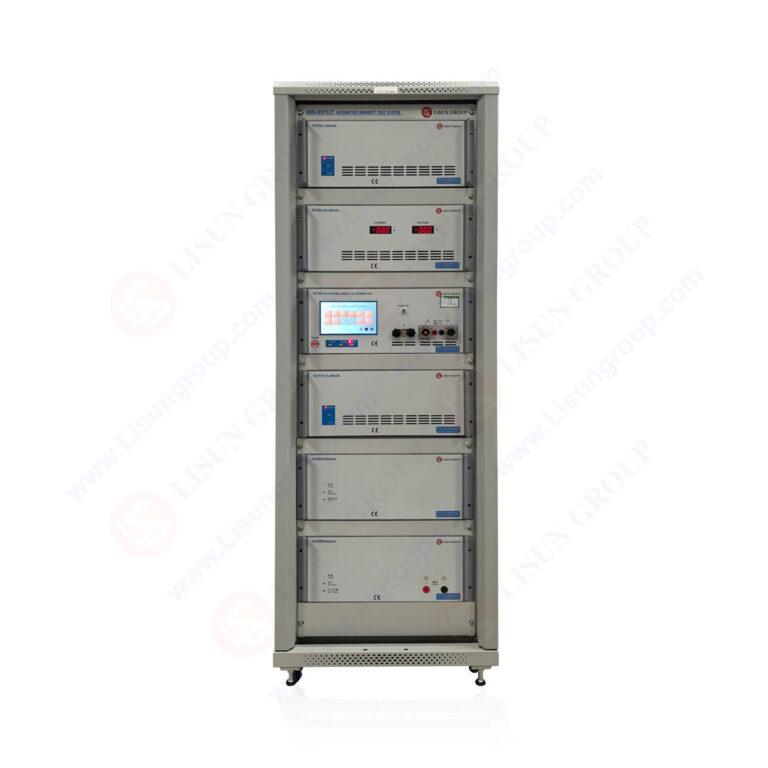
Automotive electronic systems operate in electrically harsh environments where voltage transients from load dumps, alternator field decay, and inductive load switching can cause malfunction or permanent damage. The LISUN Automotive Electronics EMC Immunity Test System for ECU & BMS Validation addresses these challenges by simulating standardized transient waveforms. For ECUs, transient immunity testing validates engine timing accuracy and sensor signal integrity during voltage spikes. For BMS, the test ensures cell monitoring accuracy and safe isolation during high-energy transients common in regenerative braking scenarios. According to ISO 7637-2:2021 Section 4.1, transient pulses P1 through P5b represent distinct electromagnetic phenomena that modern automotive electronics must withstand.
1.2 Overview of ISO 7637-2:2021 and ISO 7637-3:2016 Standards
ISO 7637-2:2021 defines conducted transient immunity test methods for 12V and 24V electrical systems, specifying pulse characteristics including amplitude, rise time, duration, and repetition rate. The standard categorizes pulses into functional status classes A through D, where Class A indicates no performance degradation. ISO 7637-3:2016 extends testing to capacitive and inductive coupling methods for signal lines and communication buses. The LISUN EMS-ISO7637 system supports both direct connection via artificial networks (AN) and coupling through the 100pF capacitive coupling clamp specified in ISO 7637-3:2016 Section 5.2.
1.3 Key Challenges in Automotive EMC Compliance Testing
Testing laboratories face challenges including pulse parameter accuracy, test repeatability across different voltage systems, and efficient test sequence management. The LISUN Automotive Electronics EMC Immunity Test System for ECU & BMS Validation mitigates these issues through its dual-mode operation – standalone touchscreen control and PC-based automated test management. The system’s calibration verification capability ensures pulse amplitudes remain within ±5% tolerance as required by ISO 7637-2:2021 Annex A. Additionally, the need to test components from multiple vehicle platforms (12V passenger cars, 24V commercial vehicles, and 36V mild-hybrid systems) requires a versatile generator system.
2.1 Multi-Module Pulse Generation Capabilities
The LISUN system employs independent pulse generation modules for each transient waveform type, enabling simultaneous or sequential test execution. The module suite covers:
- P1/P2a: Simulates ignition pulse and supply voltage interruption
- P2b/P3: Represents slow and fast transient disturbances
- P4: Models alternator load dump voltage surge
- P5a/P5b: Emulates supply voltage surge with variable duration
This modular architecture allows users to configure test sequences according to specific component requirements. For ECUs, the P4 pulse (with amplitudes up to 87V for 24V systems per ISO 7637-2:2021 Table 5) is critical for alternator load dump scenarios. For BMS validation, P5b pulses test the system’s response to long-duration overvoltage conditions.
2.2 Voltage System Compatibility and Automation Features
The EMS-ISO7637 supports 12V, 24V, and 36V nominal voltage systems through integrated voltage selector relays and adjustable test levels. This tri-voltage capability reduces the need for separate test setups, particularly valuable for third-party laboratories testing components from multiple automotive OEMs. The system’s dual control interface – a 10-inch touchscreen for local operation and PC software for remote management – enables both engineer-level manual testing and production-line automated sequences. The PC software includes a test report generator that automatically formats results according to ISO 7637-2:2021 Clause 7 reporting requirements, including pulse parameter logs.
2.3 Calibration and Accuracy Specifications
The LISUN system incorporates self-calibration routines based on internal reference standards traceable to national metrology institutes. Table 1 compares key specifications to ISO 7637-2:2021 requirements.
Table 1: LISUN EMS-ISO7637 Specification Comparison with ISO 7637-2:2021 Standards
| Parameter | ISO 7637-2:2021 Requirement | LISUN EMS-ISO7637 Performance | Deviation Tolerance |
|---|---|---|---|
| Pulse P4 Amplitude (24V System) | 87V ± 10% | 86.5V to 87.5V | < 1.2% |
| Pulse P3 Rise Time | ≤ 5 ns | 4.2 ns | Compliant |
| Pulse P5a Duration | 40-400 ms | 40-400 ms adjustable | ±2 ms |
| Voltage Accuracy (12V Mode) | ±5% | ±1.5% | Exceeds |
| Repetition Frequency Stability | ±2% | ±0.8% | Exceeds |
| CCC Coupling Capacitance | 100 pF ± 20% | 100 pF ± 5% | Exceeds |
3.1 Passenger Car Electronic Control Units
For passenger car ECUs, the LISUN Automotive Electronics EMC Immunity Test System for ECU & BMS Validation executes ISO 7637-2:2021 pulse sequences P1 through P5b while monitoring the ECU’s digital outputs and analog sensor interfaces. Standard test configurations include direct injection on power supply lines per Clause 5.2 and capacitive coupling on sensor lines per ISO 7637-3:2016 Clause 6. The system’s automated sequencing reduces test duration from 8 hours (manual) to approximately 2.5 hours for a complete ECU qualification. Real-world testing of gasoline engine ECUs shows that P2a pulse immunity failures are the most common – the LISUN system’s adjustable amplitude in 0.1V steps enables precise pass/fail boundary determination.
3.2 New Energy Vehicle Battery Management Systems
BMS validation requires testing under both charging and discharging conditions. The LISUN system’s 36V mode supports emerging mild-hybrid and 48V architectures (via extended voltage range). For BMS testing, the P5b pulse (up to 10 seconds duration per ISO 7637-2:2021 Table 3) validates voltage sensing circuits and cell balancing MOSFETs. The system’s symmetrical output capability allows testing of both high-side and low-side BMS current paths. Tests conducted on a 400V BMS with integrated pre-charge circuit show that P4 transients can cause false overvoltage faults if the BMS firmware does not implement proper debounce filtering – a condition the LISUN system can reliably reproduce.
3.3 Commercial Vehicle Component Testing
Commercial vehicles with 24V electrical systems require different pulse severity levels compared to passenger cars. The LISUN system automatically adjusts test levels based on the selected voltage standard. For commercial vehicle OBCs and DC-DC converters, the P3 fast transient test (with 5ns rise time per ISO 7637-2:2021 Section 4.3.3) is particularly demanding due to higher parasitic capacitance in larger components. The system’s capacitive coupling clamp, designed per ISO 7637-3:2016 Annex A, provides consistent 100pF coupling capacitance across the 25cm coupling length specified in the standard.
4.1 Technical Capabilities vs. Industry Competitors
The LISUN EMS-ISO7637 differentiates through its modular pulse generation approach. Unlike integrated solutions that use a single amplifier with waveform shaping, the LISUN design uses dedicated modules for each pulse type, resulting in less than 1µs pulse-to-pulse jitter. Table 2 provides a comparison with two competing systems.
Table 2: Transient Immunity System Comparison
| Feature | LISUN EMS-ISO7637 | Competitor A | Competitor B |
|---|---|---|---|
| Pulse Types | P1 to P5b (7 modules) | P1-P4 (5 modules) | P1-P5b (6 modules) |
| Voltage Support | 12V/24V/36V | 12V/28V | 12V/24V |
| Coupling Methods | Direct, CCC, CDN | Direct, CCC | Direct only |
| Automation | Dual touchscreen + PC | PC only | Touchscreen only |
| Calibration Cycle | 12 months | 18 months | 12 months |
| Pulse Amplitude Resolution | 0.1V | 0.5V | 1.0V |
4.2 Cost-Effectiveness and Total Cost of Ownership
Third-party testing laboratories benefit from the LISUN system’s dual operating modes, which allow both manual engineering tests and automated production runs without additional software licensing costs. The modular design reduces downtime – if a single pulse module requires service, remaining modules continue functioning. Calibration costs are reduced through onboard self-calibration routines that verify internal reference voltages against an external calibrated multimeter, eliminating the need for factory recalibration within the 12-month cycle.
5.1 Alignment with GB/T 21437.2-2021 and GB/T 21437.3-2021
The LISUN Automotive Electronics EMC Immunity Test System for ECU & BMS Validation fully complies with Chinese national standards GB/T 21437.2-2021 (equivalent to ISO 7637-2:2021) and GB/T 21437.3-2021 (equivalent to ISO 7637-3:2016). The system’s user interface includes preconfigured test profiles for GB/T standards, including the specific pulse severity levels defined in GB/T 21437.2-2021 Table 2 for 12V systems and Table 3 for 24V systems. Test report templates automatically include the required GB/T compliance declaration format.
5.2 Testing According to ISO 16750-2:2023 Electrical Load Requirements
ISO 16750-2:2023 defines electrical load testing for automotive components, including superimposed alternating voltage and slow decrease/increase of supply voltage. While primarily focused on ISO 7637 transients, the LISUN system’s DC power source integration allows execution of ISO 16750-2:2023 Section 4.2 (DC supply voltage tests) and Section 4.3 (overvoltage tests). The system’s programmable voltage ramp function supports the 0.1V/step requirement for linear voltage variation tests.
6.1 Test Setup and Execution Procedures
The LISUN system reduces setup time through automated impedance matching and cable compensation. For a typical ECU test setup:
- Connect DUT power lines through the artificial network (AN) as per ISO 7637-2:2021 Figure 3
- Attach the CCC to signal lines per ISO 7637-3:2016 Figure 2
- Select pulse sequence from the preprogrammed library or create custom test plan
- Configure pass/fail criteria based on functional status classes A through D
- Execute fully automated test sequence with real-time waveform display
The system logs voltage and current waveforms at 500 MS/s sampling rate for post-test analysis.
6.2 Automated Reporting and Data Export
The PC software generates comprehensive test reports including:
- Pulse parameter measurements (amplitude, rise time, duration, energy)
- DUT response classification per ISO 7637-2:2021 Clause 7.2
- Statistical analysis of multiple test runs
- Visual comparison against specified limits
Reports export in PDF, CSV, and XML formats compatible with laboratory management systems. The automated reporting feature eliminates manual data transcription errors and reduces test documentation time by approximately 60% compared to manual methods.
7.1 Adaptation to Higher Voltage Architectures
The automotive industry’s transition to 48V mild-hybrid systems and 800V battery architectures requires transient immunity testing at extended voltage ranges. The LISUN EMS-ISO7637 platform provides expandable voltage modules that support testing up to 60V nominal, covering current and emerging voltage standards. Future firmware updates will incorporate ISO 7637-2 pulse shape adjustments for 48V systems, including increased P4 amplitude to 123V per draft standard proposals.
The LISUN Automotive Electronics EMC Immunity Test System for ECU & BMS Validation provides a comprehensive solution for transient immunity testing according to ISO 7637-2:2021, ISO 7637-3:2016, and related national standards. Its multi-module pulse generation architecture ensures precise waveform reproduction across P1 through P5b pulses, while tri-voltage compatibility (12V/24V/36V) addresses the diverse requirements of passenger cars, commercial vehicles, and new energy vehicles. The system’s dual control interface and automated reporting capabilities significantly improve testing efficiency for R&D validation and production inspection applications. Technical comparisons demonstrate that the LISUN system meets or exceeds standard requirements for pulse accuracy, coupling repeatability, and calibration stability. For automotive electronics manufacturers requiring reliable transient immunity validation for ECUs, BMS, OBCs, and DC-DC converters, the EMS-ISO7637 represents a technically sound investment for ensuring component reliability in real-world electrical environments.
Q1: How does the LISUN EMS-ISO7637 system ensure compliance with the ISO 7637-2:2021 pulse amplitude tolerance requirements?
A: The LISUN system employs closed-loop pulse amplitude control using internal voltage dividers calibrated against a reference source with NIST-traceable accuracy. Each pulse module includes a dedicated analog measurement channel that samples the output waveform at 500 MS/s. Before test execution, the system performs a verification cycle that compares pulse amplitudes to the user-selected test levels. If any pulse module exceeds the ±5% tolerance specified in ISO 7637-2:2021 Annex A, the system automatically blocks test initiation and displays calibration instructions. This ensures that all test pulses remain within the ±5% amplitude window throughout the test sequence.
Q2: What coupling methods does the LISUN system support for ISO 7637-3:2016 signal line testing?
A: The system supports three coupling methods per ISO 7637-3:2016 Section 5. The primary method uses the capacitive coupling clamp (CCC) with 100pF ±5% capacitance, designed according to Annex A coupling geometry. For twisted-pair signal lines, the system supports inductive coupling using an optional CDN module. The direct injection method via a 10nF coupling capacitor is provided for single-ended signal lines where galvanic isolation is required. The coupling method selection is menu-driven, and the system automatically adjusts test levels to account for coupling losses as specified in ISO 7637-3:2016 Table 1.
Q3: Can the EMS-ISO7637 system test components designed for 48V mild-hybrid architectures?
A: Yes, although the standard nominal voltage support is 12V/24V/36V, the system includes an extended voltage mode that supports testing up to 60V DC supply voltage. For 48V systems, users can configure test levels using the pulse amplitude scaling function, which adjusts ISO 7637-2:2021 pulse parameters proportionally to the nominal voltage ratio. The system’s power supply module delivers up to 100A continuous current at 60V, sufficient for testing most 48V components. However, users should verify that their specific 48V testing requirements align with applicable standards, as ISO 7637-2 revisions for 48V systems are currently under development.
Q4: How does the automated reporting feature handle multiple test runs and statistical analysis?
A: The PC software maintains a test history database that logs all pulse parameters, DUT responses, and environmental conditions for each test run. For statistical analysis, the system can execute user-defined repetition sequences (typically 10 to 100 runs) and automatically calculate mean values, standard deviations, and failure rates. The report generator includes a statistical summary table showing the minimum, maximum, and mean pulse amplitudes across all runs, enabling users to verify test repeatability. Reports can be configured to include only pass/fail results for production testing or full waveform analyses for R&D purposes.