









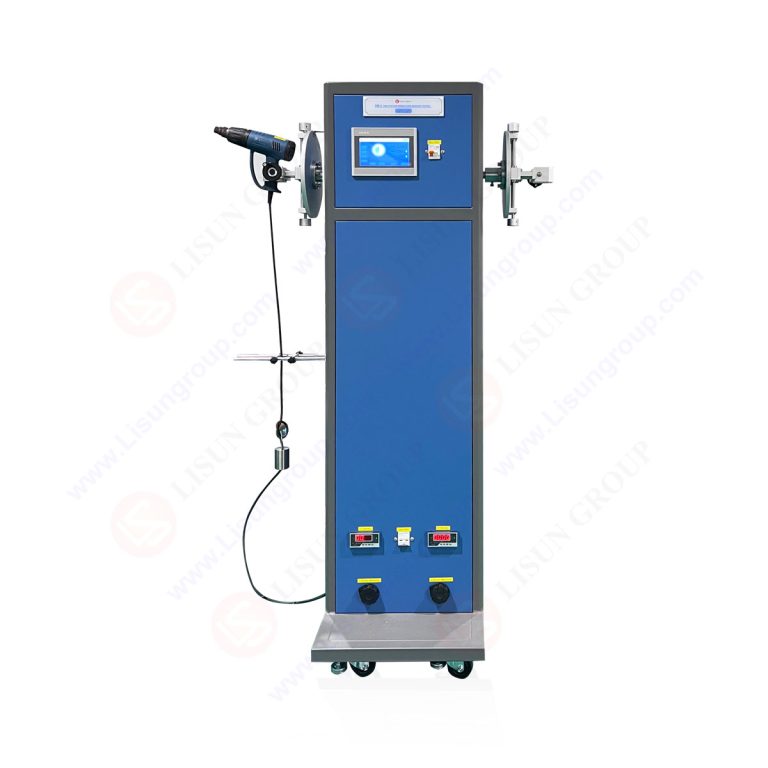
The LISUN SW Series Power Cord Flexibility Bending Tester represents a critical advancement in cable reliability validation, designed to assess the mechanical endurance of power cords under repeated bending stress. This article provides a comprehensive technical analysis of the SW-6 Power Cord Bending Tester features and technical parameters, focusing on its six-station configuration, PLC-controlled servo motor drive system, and real-time current-based test judgment capabilities. The equipment strictly complies with IEC 60884-1, IEC 60745-1, IEC 60335-1, and GB/T 2099.1 standards, enabling simultaneous testing of multiple specimens under adjustable bending angles, frequencies, and load currents. For R&D engineers and quality control professionals in household appliance, power tool, and component manufacturing industries, this article delivers data-driven insights into operational parameters, comparative model specifications, and practical implementation strategies for power cord bending tester applications.
1.1 PLC-Controlled Servo Drive System
The SW-6 power cord bending tester integrates a programmable logic controller (PLC) with a high-precision servo motor to govern all mechanical motions. The PLC executes pre-programmed test sequences, managing bending angle parameters ranging from 10 to 90 degrees, adjustable in 1-degree increments. The servo motor provides torque control with a resolution of 0.1 degree, ensuring consistent angular displacement across all six test stations. This architecture eliminates mechanical wear-induced drift that plagues cam-based systems, maintaining repeatability within ±0.5 degrees over 100,000 test cycles. The control system logs real-time position data, enabling post-test analysis of bending angle variations.
1.2 Current-Based Test Judgment Mechanism
A distinctive feature of the SW series is its current monitoring system, which continuously measures the electrical continuity through each power cord specimen under test. The system applies a configurable load current ranging from 0.1 to 25 amperes, depending on the cord cross-sectional area and standard requirements. When a cord experiences conductor fracture or insulation breach, the measured current drops below a preset threshold, triggering automatic test termination for the affected station. This real-time judgment mechanism eliminates the need for visual inspection during testing, significantly reducing operator intervention and improving data reliability. The system records the exact cycle count at failure for each specimen.
1.3 Multi-Station Synchronization and Independent Operation
The SW-6 model provides six independent test stations, each capable of holding one power cord specimen. The PLC manages synchronous operation where all stations execute identical bending profiles simultaneously, or asynchronous operation where individual stations can be started, stopped, or reset independently. This architecture enables mixed-batch testing, where cords of different specifications can be evaluated concurrently without cross-interference. Each station includes its own load circuit, current sensor, and cycle counter, ensuring that test data remains segregated per specimen.
2.1 SW-6 Power Cord Bending Tester Features and Technical Parameters
The SW-6 model delivers the following core specifications: bending frequency adjustable from 10 to 60 cycles per minute, bending angle range of 10 to 90 degrees, specimen length capacity up to 500 millimeters, load current capacity up to 25 amperes at 250 volts AC, and test cycle capacity exceeding 999,999 cycles. Each station accommodates cord diameters from 5 to 15 millimeters, with adjustable clamping mechanisms that maintain consistent grip pressure without deforming the insulation. The power supply operates at 220V/50Hz or 110V/60Hz, with power consumption of approximately 500 watts during full-load operation.
2.2 Comparative Analysis of SW-1, SW-2, and SW-6 Models
The following table provides a detailed comparison of the three LISUN SW series models, benchmarked against IEC 60884-1 minimum requirements:
| Parameter | SW-1 Single Station | SW-2 Dual Station | SW-6 Six Station | IEC 60884-1 Minimum Requirement |
|---|---|---|---|---|
| Number of test stations | 1 | 2 | 6 | 1 |
| Bending angle range | 10-90° (±1°) | 10-90° (±0.5°) | 10-90° (±0.5°) | 45° typical |
| Bending frequency range | 10-60 cycles/min | 10-60 cycles/min | 10-60 cycles/min | 10 cycles/min minimum |
| Load current capacity | 0.1-16 A | 0.1-25 A | 0.1-25 A | 0.2 A minimum (clause 23) |
| Maximum test cycles | 999,999 | 999,999 | 999,999 | 10,000 cycles (typical) |
| Cord diameter range | 5-12 mm | 5-15 mm | 5-15 mm | Not specified |
| Automatic stop function | Current-based | Current-based | Current-based | Recommended |
| Control system | Microcontroller | PLC control | PLC + Touch screen | Not specified |
2.3 Benchmarking Against Industry Standard Requirements
IEC 60884-1 clause 23 specifies the bending test procedure for plugs and socket-outlets, requiring a minimum of 10,000 bending cycles at a frequency of 10 cycles per minute with a bending angle of 45 degrees. The SW-6 exceeds these minimums by providing adjustable parameters that allow testing at higher frequencies and wider angles for accelerated life testing or application-specific requirements. IEC 60745-1 clause 20 for hand-held motor-operated electric tools mandates similar bending endurance tests but with specific load current profiles that vary by tool rating. The SW-6 supports programmable current profiles that can replicate these varying load conditions.
3.1 IEC 60884-1 Compliance Details
IEC 60884-1 clause 23.3 requires that the bending test apparatus apply a tensile force to the cord during bending, typically 10 newtons for cords up to 0.5 square millimeters cross-section. The SW-6 incorporates adjustable weight systems that apply tensile forces from 5 to 50 newtons per station, covering the entire range specified by the standard. Clause 23.4 specifies the bending motion: the cord is bent alternately through 90 degrees on each side of the vertical axis. The SW-6 executes this precisely by rotating the cord holder through 45 degrees in each direction from the neutral position, with programmable dwell time at each extreme.
3.2 IEC 60745-1 and IEC 60335-1 Application Considerations
IEC 60745-1 clause 20.4 for power tools requires that the cord withstand 10,000 cycles under load current equal to the rated current of the tool, with a bending rate of 30 cycles per minute. The SW-6 accommodates this by allowing load current settings up to 25 amperes, which covers the majority of handheld power tools including heavy-duty drills and grinders. IEC 60335-1 clause 25.14 for household appliances requires a similar test but with specific cord anchoring and bending geometry conditions. The SW-6 test jigs can be customized with interchangeable clamping fixtures to match the specific cord exit geometries required by each standard.
3.3 GB/T 2099.1 and Regional Standard Alignment
GB/T 2099.1, the Chinese national standard for plugs and socket-outlets, adopts IEC 60884-1 requirements with minor modifications in test severity levels. The SW-6 includes pre-programmed test profiles for GB/T 2099.1 clause 23 testing, enabling one-button initiation of compliant test sequences. Regional variations in bending angle requirements (for example, some standards require 90-degree total bending versus 45-degree unilateral bending) are accommodated through the fully programmable angle and frequency parameters.
4.1 Household Appliance Cord Reliability Validation
For washing machines, refrigerators, and vacuum cleaners, the SW-6 enables simultaneous testing of six cord samples representing different production batches or design variations. A typical test protocol involves setting the bending angle to 45 degrees, frequency to 30 cycles per minute, and load current to the appliance’s rated current. The system runs continuously for 24 to 72 hours, accumulating 43,200 to 129,600 cycles per specimen. The automatic stop function records the exact failure cycle for each cord, enabling statistical analysis of mean cycles to failure and Weibull distribution modeling.
4.2 Hand-Held Power Tool Endurance Testing
Power tool cords experience more aggressive bending conditions due to tool manipulation and dragging across surfaces. Testing under IEC 60745-1 conditions requires higher bending angles (60-90 degrees) and frequencies (40-60 cycles per minute). The SW-6’s PLC control allows programming of complex test profiles that simulate real-world usage patterns, including periods of high-frequency bending followed by static dwell periods. The six-station configuration enables comparative testing of different cord materials, conductor strand counts, or insulation compounds in a single test run.
4.3 Plug and Socket Component Qualification
Component suppliers use the SW-6 to qualify cord assemblies for socket-outlet compatibility. The bending tester evaluates the mechanical interface between the cord and the plug body, identifying failure modes such as conductor fracture at the strain relief, insulation chafing at the plug entry point, or internal wire breakage within the plug molding. Test data from the SW-6 informs design modifications to strain relief geometry, cord jacket material selection, and conductor stranding configurations.
5.1 Bending Angle and Frequency Selection Guidelines
The bending angle selection depends on the expected real-world flexing conditions of the application. For fixed appliances where the cord remains largely stationary, 45-degree bending angles suffice. For portable appliances and power tools, 60- to 90-degree angles provide more rigorous validation. Frequency selection balances test acceleration against realistic thermal effects: higher frequencies reduce test duration but may cause resistive heating that masks mechanical failure modes. A general guideline is to maintain a bending frequency below 40 cycles per minute for cords carrying more than 10 amperes load current, allowing adequate thermal dissipation between bending cycles.
5.2 Load Current Optimization for Failure Differentiation
Selecting the appropriate load current is critical for meaningful test results. At low load currents (below 1 ampere), conductor heating is minimal, and test failures reveal purely mechanical fatigue mechanisms. At high load currents (above 10 amperes), resistive heating accelerates conductor embrittlement and insulation degradation, representing combined thermal-mechanical stress conditions. The SW-6 supports dynamic current profiles where load current varies during the bending cycle, simulating the on-off switching patterns typical of power tool operation.
5.3 Specimen Preparation and Fixturing Best Practices
Consistent specimen preparation directly impacts test repeatability. Cord specimens should be cut to equal lengths (typically 300 to 500 millimeters), with stripped ends prepared using identical techniques to avoid introducing variable stress concentrations. The clamping mechanism should grip the cord at a distance of 100±5 millimeters from the bending axis, as specified by IEC 60884-1. The weight system should apply tensile force along the cord axis without inducing torsional stress. Proper fixturing ensures that test failures reflect intrinsic cord quality rather than artifact from improper mounting.
6.1 Cycle-to-Failure Statistical Analysis
The SW-6 records the exact cycle count at which each specimen fails, providing data for Weibull analysis. The Weibull scale parameter (characteristic life) and shape parameter (failure rate behavior) can be calculated from the failure cycle distribution across six specimens. A shape parameter greater than 1 indicates increasing failure rate with cumulative cycles, typical of fatigue-driven failures. Shape parameters less than 1 suggest early-life failures due to manufacturing defects. This statistical approach enables reliable estimation of B10 life (cycles at which 10% of population fails) for product specifications.
6.2 Failure Mode Classification Using Electrical Signatures
The current monitoring system provides electrical signatures that correlate with specific failure modes. A gradual current reduction over several cycles indicates progressive conductor strand fracture, where individual strands break sequentially until the remaining strands cannot sustain the load. A sudden current drop to zero indicates complete conductor separation, typically due to a critical flaw in the conductor or a manufacturing defect at the termination point. Intermittent current fluctuations suggest partial strand fracture with intermittent contact, which the system detects and records as a pending failure. This classification capability helps root cause analysis for design improvements.
6.3 Comparative Benchmarking Against Production Baselines
Quality control engineers use the SW-6 to establish baseline performance metrics for production batches. By testing cords from qualified production runs, engineers define acceptable cycle-to-failure ranges. Subsequent production batches are tested at reduced sample sizes (for example, 6 specimens from each batch of 1,000 units), and results are compared against the baseline using t-tests or analysis of variance. Batches showing statistically significant degradation trigger investigation into material changes, process drifts, or supplier variations.
7.1 Mechanical System Inspection and Lubrication
The servo motor and linear guide rails require periodic inspection for wear and contamination. Lubrication intervals depend on usage frequency, with a recommended schedule of every 200,000 cycles or monthly, whichever comes first. The bending arm pivots should be checked for play using a dial indicator; any angular deviation exceeding 0.5 degrees from the set point indicates bearing wear and requires immediate replacement. The clamping mechanism faces should be inspected for surface wear, which can reduce grip force and cause specimen slippage during testing.
7.2 Current Measurement System Calibration
The current monitoring system must be calibrated against a reference ammeter with traceability to national standards. Calibration frequency should align with the testing laboratory’s quality management system, typically every 12 months or after any repairs to the current sensing circuits. The calibration procedure involves applying known load currents through a calibration resistor, verifying that the SW-6’s measurement deviation remains within ±1% of the reading for currents between 0.1 and 25 amperes. Any drift exceeding this tolerance requires adjustment of the current sensor amplification circuitry.
7.3 Software and Control System Verification
The PLC firmware should be verified for correct parameter calculation and cycle counting accuracy. A simple verification involves running the SW-6 at a known frequency for a set duration and comparing the recorded cycle count against the theoretical value calculated from frequency and time. The emergency stop function should be tested weekly by triggering the stop command during active operation and verifying that all motion ceases within 100 milliseconds. Data logging functions should be verified by comparing the recorded failure cycles against independent manual recording for at least one test run per month.
The LISUN SW-6 Power Cord Bending Tester delivers robust, data-driven reliability validation for power cords used in household appliances, power tools, and electrical components. Its six-station configuration enables simultaneous testing, reducing qualification timelines by up to 80% compared to single-station alternatives. The PLC-controlled servo motor architecture ensures precise, repeatable bending motion with angular accuracy of ±0.5 degrees, while the real-time current monitoring system provides objective failure detection without operator bias. Compliance with IEC 60884-1, IEC 60745-1, IEC 60335-1, and GB/T 2099.1 standards ensures that test results are internationally recognized for product certification and regulatory submissions. The adjustable bending angle, frequency, and load current parameters allow customization for accelerated life testing, comparative analysis, and application-specific validation. For R&D engineers seeking to optimize cord design for mechanical endurance, and for quality control professionals needing reliable production batch verification, the SW-6 offers a comprehensive, standards-compliant solution. The statistical analysis capabilities derived from multi-specimen testing provide actionable insights for continuous improvement in cord reliability and manufacturing process control.
Q1: What is the maximum number of test cycles the SW-6 can accumulate before requiring maintenance?
A: The SW-6 is designed for continuous operation and can accumulate up to 999,999 cycles per test run, with the ability to restart for additional runs without hardware limitations. However, mechanical maintenance intervals are recommended every 200,000 cycles. This includes inspection and lubrication of the servo motor guide rails, bending arm pivots, and clamping mechanisms. The PLC memory retains all cycle counts and failure data even after power cycling, enabling long-term cumulative testing across multiple production batches. Users should note that the bending frequency should be reduced for high-cycle tests beyond 500,000 cycles to minimize mechanical wear and prevent thermal buildup in the servo drive system.
Q2: How does the load current setting affect test results for different cord conductor sizes?
A: The load current setting must be selected based on the cord conductor cross-sectional area and the applicable standard requirements. For cords with 0.75 mm² conductors (common in household appliances), the maximum recommended load current is 6 amperes to prevent excessive resistive heating that could artificially accelerate insulation degradation. For 1.0 mm² conductors, up to 10 amperes is permissible, and for 1.5 mm² conductors, up to 16 amperes is acceptable under IEC 60884-1 guidelines. Using load currents exceeding these recommendations may cause test failures dominated by thermal effects rather than mechanical bending fatigue, potentially masking genuine mechanical endurance issues. For standards-compliant testing, always refer to the current limits specified in the relevant standard’s bending test clause.
Q3: Can the SW-6 test power cords with different plug types or molded-on connectors without custom fixturing?
A: Yes, the SW-6 accommodates various plug and connector configurations through its adjustable clamping system. The standard clamping mechanism accepts cord diameters from 5 to 15 millimeters and can hold cord specimens with or without attached plugs. For cords with molded-on connectors that are larger than the standard clamp opening, optional wide-opening clamps are available as accessories. The bending test requires the cord to be clamped at a specific distance from the plug body (typically 100 millimeters for IEC 60884-1), which is achievable by positioning the clamp along the vertical adjustment rail. The tensile force weight system is independent of the clamping mechanism, allowing correct force application regardless of connector geometry.
Q4: What is the recommended procedure for comparing test results between the SW-6 and other bending testers in different laboratories?
A: Inter-laboratory comparability requires strict adherence to identical test parameters and specimen preparation protocols. The SW-6 should be calibrated using a reference cord specimen with known performance characteristics (for example, a cord that exhibits failure at a specific cycle count range under defined conditions). Both laboratories must agree on bending angle, frequency, load current, tensile force, specimen length, and clamping distance. The SW-6 records all test parameters in its digital log, enabling full parameter traceability. For robust statistical comparison, each laboratory should test a minimum of six specimens from the same cord batch. Cycle-to-failure results should be analyzed using Mann-Whitney U test or similar non-parametric methods, as cycle-to-failure distributions often violate normality assumptions.
Q5: How does the SW-6 handle power cords with multiple conductors (e.g., 3-core cords with live, neutral, and earth wires)?
A: The SW-6 accommodates multi-conductor cords by connecting all conductors in parallel or series through the load current circuit, depending on the test requirement. For standard IEC 60884-1 testing, all conductors are typically connected in series so that current flows through the entire cord assembly, and any single conductor failure interrupts the circuit and triggers the automatic stop. For specialized testing, individual conductor monitoring is possible by connecting each conductor to a separate current sensor, though this requires custom configuration. The clamping mechanism exerts uniform pressure across the cord circumference, ensuring that multi-conductor cords experience consistent bending stress across all internal wires. The conductor stranding configuration affects flexibility, and the SW-6 can differentiate failure modes between finely stranded cords (which tend to exhibit gradual fracture) and solid conductor cords (which show abrupt failure).