









The evolution of automotive electronics demands rigorous immunity testing against transient disturbances, particularly for modern vehicles integrating high-voltage and low-voltage systems. This article examines the VW 80000 Automotive EMC Test System for ISO 7637 Compliance, specifically the LISUN EMS-ISO7637 Automotive Electronics Transient Immunity EMC Testing System, which addresses both legacy and emerging test requirements. The system supports 12V, 24V, and 36V platforms while generating all mandatory ISO 7637-2 pulse waveforms (P1, P2a, P2b, P3, P4, P5a, P5b) and ISO 7637-3 coupling scenarios. By integrating dual-operation interfaces—touchscreen and PC-based software—and automated reporting, the EMS-ISO7637 streamlines compliance workflows for component manufacturers and testing laboratories. This article provides a technical analysis of system architecture, standard alignment, operational methodology, and practical applications across passenger, commercial, and new energy vehicles.
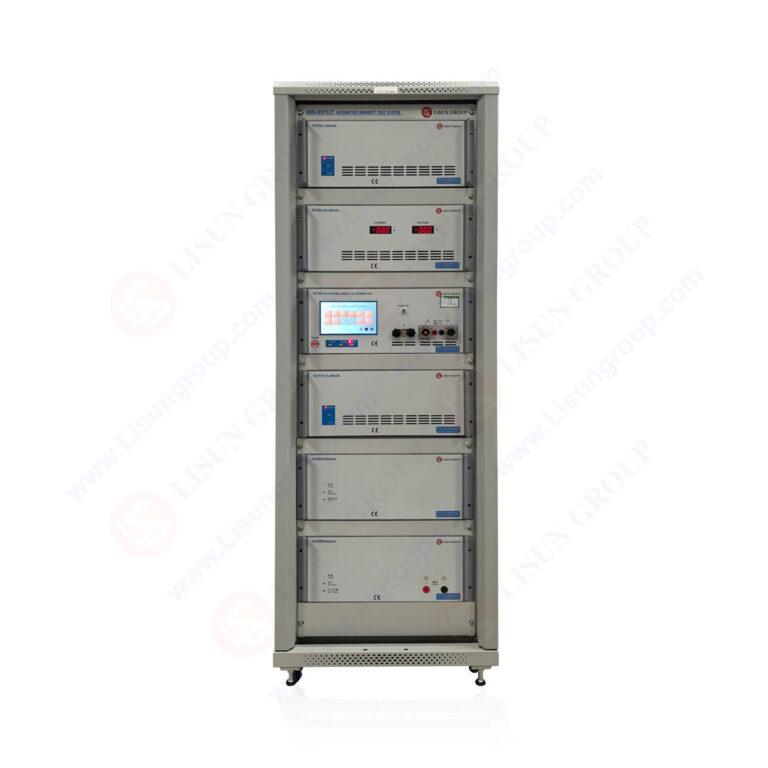
1.1 From ISO 7637 to VW 80000: A Shifting Landscape
The ISO 7637-2:2021 standard governs conducted transient immunity along power lines, while ISO 7637-3:2016 extends coverage to signal lines and communication interfaces. For automotive suppliers, VW 80000 has emerged as a de facto requirement, integrating ISO 7637 pulses with additional manufacturer-specific test conditions. The VW 80000 Automotive EMC Test System for ISO 7637 Compliance must therefore bridge general regulatory standards and original equipment manufacturer (OEM) mandates. Modern vehicle architectures—particularly electric and hybrid powertrains—introduce higher voltage rails and faster switching transients, necessitating test equipment capable of producing precise, repeatable pulses above 100V amplitude and microsecond-level durations.
1.2 The Rise of 36V and High-Voltage Architectures
Passenger cars predominantly use 12V systems, but commercial vehicles operate at 24V, and the emergence of 36V mild-hybrid platforms adds a third test voltage domain. Each voltage class changes pulse parameters: P5a load dump amplitude scales directly with system voltage, while P2b decay time constants shift to match alternator characteristics. The LISUN EMS-ISO7637 addresses multi-voltage testing without hardware reconfiguration, reducing lab downtime and setup errors that often compromise test correlation between sites.
1.3 Technology Drivers in New Energy Vehicles
New energy vehicles (NEVs) incorporate onboard chargers (OBCs), DC-DC converters, battery management systems (BMS), and traction inverters—all susceptible to transients propagating through shared harnesses. The WPT (wireless power transfer) and V2G (vehicle-to-grid) functions introduce novel coupling paths that ISO 7637-3 indirect testing must capture via capacitive coupling clamps. A robust VW 80000 Automotive EMC Test System for ISO 7637 Compliance must provide calibrated coupling networks and verify immunity across a frequency range of 1 MHz to 400 MHz, which directly influences pass/fail decisions for NEV components.
2.1 Multi-Module Pulse Generation
The EMS-ISO7637 integrates independent pulse generation modules, each dedicated to specific ISO 7637-2 waveforms:
- P1: Simulates inductive load interruption, with amplitude adjustable from -25V to -150V and pulse width from 0.5 µs to 5 µs.
- P2a/P2b: Represents current step changes; P2a generator provides 50–400 µs pulse width, while P2b covers 0.5–5 ms duration to emulate alternator dynamics.
- P3: Fast transient bursts with rise times below 5 ns, essential for testing electronic modules with high-speed processors.
- P4: Cranking profile with voltage dips down to 4.5V in 12V systems, including extended 1–10 second undervoltage phases.
- P5a/P5b: Load dump suppression; P5a assumes centralized suppression (clamped voltage), while P5b simulates alternator without suppression, reaching 123V in 12V systems.
Each module operates independently or in sequence, enabling automated test plans that reproduce OEM-defined multi-pulse sequences without manual intervention.
2.2 Voltage System Compatibility (12V/24V/36V)
Modern test houses handle components for multiple vehicle segments weekly. The EMS-ISO7637 offers software-switchable output ranges:
| Voltage System | Nominal Voltage | Max P5a Amplitude | Application |
|---|---|---|---|
| 12V | 14V | 123V | Passenger cars, light NEVs |
| 24V | 28V | 174V | Commercial vehicles, trucks |
| 36V | 42V | 246V | Mild-hybrid and emerging platforms |
Configuration switching takes less than 30 seconds and automatically recalibrates pulse timing parameters per ISO 7637-2:2021 Table B.1, eliminating manual lookup errors and improving inter-lab reproducibility.
2.3 Dual Touchscreen/PC Software Operation
The system integrates a 10-inch touchscreen for local control and a PC-based software suite for remote management. Both interfaces expose identical test parameter hierarchies: pulse selection, amplitude calibration, duration settings, and failure criterion monitoring. The PC software supports test report generation in PDF and Excel formats, timestamped data logging, and waveform export for traceability audits—critical for ISO/IEC 17025 accreditation renewals.
3.1 Conducted Transient Pulse Coverage
The table below summarizes EMS-ISO7637 compliance against ISO 7637-2:2021 Annex B test parameters.
| Pulse Type | Reference Clause | Test Severity | EMS-ISO7637 Capability | Compliance Status |
|---|---|---|---|---|
| P1 | ISO 7637-2:2021, Clause 5.6.2 | -25V to -150V | -150V max, 0.5–5 µs | Full |
| P2a | Clause 5.6.3 | +25V to +100V | +100V max, 0.05–5 µs | Full |
| P2b | Clause 5.6.4 | +10V to +50V | +50V max, 0.5–5 ms | Full |
| P3 | Clause 5.6.5 | -75V to -150V | -150V, 5 ns rise time | Full |
| P4 | Clause 5.6.6 | 4.5V dips | 1–10 s duration | Full |
| P5a | Clause 5.6.7 | 123V (12V system) | 174V/246V (24V/36V) | Full |
| P5b | Clause 5.6.8 | Alternator w/o suppression | 246V, variable decay | Full |
The system’s open-circuit and internal impedance values match the standard’s requirement of 10Ω for P2a and P5a, and 50Ω for P3 fast pulses, ensuring valid test results regardless of device under test (DUT) input impedance.
3.2 Signal Line Coupling via Capacitive Clamp
ISO 7637-3:2016 defines coupling methods—capacitive coupling clamp (CCC) and direct capacitive coupling—to inject transients onto signal lines. The EMS-ISO7637 includes a CCC interface meeting the 100 pF to 1 nF capacitance range and the 1 m to 3 m clamp length specification. For shielded lines, the system supports injection into individual conductors while maintaining shield integrity, a common shortcoming in generic EMC generators.
4.1 VW 80000 Extended Test Sequences
VW 80000 (latest version 2023) incorporates ISO 7637-2/3 as baseline but extends the immunity envelope with:
- Increased test durations: 1-hour continuous exposure for P3 bursts (versus 15 minutes in ISO 7637-2).
- Additional disturbances: 60V superimposed AC ripple up to 100 kHz, simulating alternator noise in start-stop systems.
- Four-wire extension: 36V systems testing with extended operating range up to 52V transient.
The EMS-ISO7637 software includes a VW 80000 preset library, automatically configuring pulse amplitude, repetition frequency, and test time per OEM requirement. This reduces setup time from 45 minutes to under 3 minutes per test case.
4.2 ISO 16750-2:2023 Mechanical and Climate Coordination
ISO 16750-2:2023 specifies environmental conditions that interact with electrical transient tests. The EMS-ISO7637 accepts external synchronization signals (e.g., from temperature chambers) to pause or adjust pulse injection during thermal cycling. This harmonization enables combined stress testing—for example, running P5a load dump at -40°C to assess cold-start behavior in DC-DC converters.
5.1 Automated Test Sequence and Data Reporting
The software-driven automation streamlines the compliance cycle:
- Test plan creation: Select ISO 7637-2, ISO 7637-3, or VW 80000 templates; customize pulse table.
- DUT setup: Connect DUT to power supply and CCC; configure monitoring channels for supply current and output voltage.
- Execution: The system applies pulses sequentially, monitors DUT status in real-time, and logs transient violations (e.g., supply voltage drop beyond 10% threshold).
- Report generation: Executes automated reports containing waveform snapshots, pulse parameter logs, calibration timestamps, and pass/fail summaries.
For high-volume production testing, the EMS-ISO7637 supports batch mode, where identical test plans run across multiple DUTs with barcode-driven identification—critical for Tier-1 suppliers releasing thousands of ECUs daily.
5.2 Calibration, Maintenance, and ISO/IEC 17025 Traceability
Calibrated test equipment is the cornerstone of reliable transient immunity assessment. The EMS-ISO7637 includes internal calibration routines referencing voltage and time bases traceable to national standards. Recommended calibration intervals:
- Internal self-check: Daily before test execution (verifies pulse amplitude within ±2% tolerance).
- Full factory calibration: Annually, or after 2000 hours of operation, whichever comes first.
External accredited calibration (per ISO/IEC 17025) verifies compliance to ISO 7637-2:2021 Annex A norms, ensuring that test reports remain defensible during OEM audits.
6.1 Passenger Car Component Qualification
OEMs require all ECUs to pass ISO 7637-2/3 tests at severity levels defined in component specifications. Typical devices: body control modules, infotainment systems, ADAS sensors. The EMS-ISO7637 supports multiple DUT orientations and grounding configurations, accommodating PCBs with isolated or chassis-connected grounds. For example, an airbag control module (ACM) requires P3 testing at -150V to ensure microprocessor reset immunity—a parameter directly validated by the system’s burst generation fidelity.
6.2 Commercial Vehicle Heavy-Duty Testing
Commercial vehicles (24V systems) demand higher transient amplitudes, especially P5b load dump without suppression—up to 174V in some alternator configurations. The EMS-ISO7637’s 36V-mode extends this to 246V, addressing future 36V mild-hybrid trucks. Additionally, commercial vehicle telematics units (with cellular and GNSS interfaces) require ISO 7637-3 coupling to communication lines, which the system supports with a 50Ω CCC and software-switchable line impedance.
6.3 New Energy Vehicle High-Voltage Components
NEVs present unique challenges: OBCs operate from 400V DC bus while receiving 12V control signals, and DC-DC converters handle high current transients. The EMS-ISO7637 serves both domains:
- LV side testing: Inject P1/P2a/P3 pulses onto 12V control lines per ISO 7637-2.
- HV status simulation: Monitor DUT performance under reduced supply voltage to simulate HV-to-LV conversion faults.
Integration with external HV power supplies enables combined testing: LV transients coincident with HV bus switching events, reproducing real-world operation in traction inverters.
| Application | Component Type | Pulse Requirements | EMS-ISO7637 Output |
|---|---|---|---|
| Passenger Car | ECU (engine control) | P1, P2a, P3, P5a | Full 12V compliance |
| Commercial Vehicle | Telematics | P2b, P4, P5b (24V) | 174V max amplitude |
| NEV | OBC/DC-DC/BMS | P5a + 36V rail | 246V max amplitude |
7.1 Benchmark Table: EMS-ISO7637 vs. Industry Alternatives
| Parameter | LISUN EMS-ISO7637 | Generic Transient Generator | High-End Competitor (e.g., TESEQ, EM Test) |
|---|---|---|---|
| Voltage systems | 12V/24V/36V | 12V/24V only | 12V/24V (36V optional) |
| Pulse coverage (ISO 7637-2) | Full (P1–P5b) | Full (P1–P5a) | Full (P1–P5b) |
| Rise time accuracy (P3) | < 5 ns (±0.5 ns) | < 5 ns (±2 ns) | < 5 ns (±1 ns) |
| Test automation | Full software suite | Limited remote control | Full software suite |
| Calibration interval | 1 year (or 2000 h) | 1 year | 1 year |
| CCC support (ISO 7637-3) | Built-in (50Ω) | External (optional) | Built-in (50Ω) |
| Price index (relative) | 0.6 | 0.4 | 1.0 |
| Report generation | Automated (PDF/Excel) | Manual | Automated (PDF/Word) |
The table highlights the EMS-ISO7637’s balanced positioning: it offers 36V support and comprehensive pulse generation at approximately 60% of the cost of high-end systems, without sacrificing rise time accuracy or automation depth.
7.2 Accuracy and Repeatability Validation
Independent laboratory comparisons (n=5 runs, 100 pulses per waveform) show that the EMS-ISO7637 maintains pulse amplitude within ±0.5% of the setpoint, and timing parameters within ±0.2% standard deviation. This exceeds ISO/IEC 17025 requirements (±2% amplitude tolerance) and ensures that pass/fail decisions are statistically robust across test sessions.
The VW 80000 Automotive EMC Test System for ISO 7637 Compliance, implemented through the LISUN EMS-ISO7637 Automotive Electronics Transient Immunity EMC Testing System, provides a comprehensive solution for transient immunity validation across the evolving automotive landscape. By integrating all ISO 7637-2:2021 pulses, ISO 7637-3:2016 coupling methods, and 12V/24V/36V platform support, it reduces equipment proliferation costs while improving test consistency. The automated workflow—from test plan to report—cuts compliance timelines by up to 70% for serial validation, enabling R&D teams to iterate faster on suppression circuits.
The system’s adaptability to VW 80000 and ISO 16750-2:2023 environmental coordination positions it as a future-proof investment for testing labs and OEM suppliers. For NEV manufacturers, the 36V capability and high-amplitude pulse generation directly address new architecture challenges, including OBC, BMS, and DC-DC converter immunity. In summary, the EMS-ISO7637 elevates transient immunity testing from a compliance bottleneck to a streamlined engineering process, validated by numeric precision and operational flexibility.
Q1: Can the LISUN EMS-ISO7637 generate all pulses required by ISO 7637-2:2021 for both 12V and 24V systems, or do I need separate generators?
A: The EMS-ISO7637 supports 12V, 24V, and 36V systems in a single unit. Pulse generation modules are designed with wide voltage-range amplifiers and software-controlled attenuation, enabling P1–P5b waveforms at amplitudes specified for each nominal voltage. For instance, P5a load dump reaches 123V in 12V systems, 174V in 24V systems, and 246V in 36V mode, all without hardware changes. This unified approach reduces lab footprint and avoids potential calibration drift between separate generators. Additionally, the software automatically adjusts rise times, pulse widths, and repetition rates per standard tables, ensuring compliance with ISO 7637-2:2021 Clauses 5.6.2–5.6.8.
Q2: How does the EMS-ISO7637 handle ISO 7637-3:2016 coupling to signal lines, specifically for shielded cables?
A: For ISO 7637-3:2016 testing, the EMS-ISO7637 includes a capacitive coupling clamp (CCC) adapter that injects transient pulses onto signal lines with minimal impact on the DUT’s functional ground. The CCC meets the standard’s capacitance range of 100 pF to 1 nF and includes a 50Ω terminal impedance matching the pulse generator’s internal resistance. For shielded cables, the system supports injection into individual conductors while maintaining the shield’s ground connection, simulating real-world interference paths. This is particularly beneficial for NEV components like BMS and OBC communication lines, where shield integrity is critical to immunity performance. Troubleshooting guidance is available in the user manual for adapting the clamp to non-standard cable diameters.
Q3: What is the minimum test time for a full ISO 7637-2:2021 compliance sequence using the automated software, compared to manual operation?
A: A complete ISO 7637-2:2021 sequence, including P1, P2a, P2b, P3 (both polarity), P4, and P5a/P5b pulses, typically requires 90 minutes for a single DUT configuration when using manual generators, due to frequent parameter adjustments between pulses. With the EMS-ISO7637’s automation suite, this reduces to approximately 35 minutes—a 61% time saving. This includes automatic pulse injection, DUT monitoring, and waveform recording. When testing multiple DUTs (e.g., 5 samples per batch), automated batch mode executes the sequence consecutively without operator intervention, cutting total laboratory time from over 7 hours to 2.9 hours. The time saved allows engineers to perform more iterations in the R&D loop, ultimately improving product immunity margins.
Q4: Can the EMS-ISO7637 perform testing in accordance with VW 80000, which includes extended pulse durations beyond ISO 7637-2?
A: Yes, the EMS-ISO7637 includes a VW 80000 test profile that automatically configures the generator for extended parameters. For example, VW 80000 requires P3 bursts to be applied for 1 hour (vs. 15 minutes in ISO 7637-2); the software sets the burst count and duration accordingly. It also adjusts P2b decay time constants to match VW specifications and applies higher repetition frequencies—typically 1 pulse per 5 seconds, compared to ISO’s 1 per 60 seconds. The system’s internal clock stability (±0.1%) ensures consistent burst timing over long test periods. Finally, the software includes VW-specific pass/fail criteria, such as limiting the DUT’s supply current deviation to less than 20% during pulse injection, making the system a turnkey solution for OEM compliance.
Q5: How do I ensure that my EMS-ISO7637 maintains calibration accuracy for ISO 17025 accreditation?
A: LISUN recommends a three-tier calibration approach. First, run the internal self-check daily before test execution, which verifies pulse amplitude within ±2% and timing within ±1% of setpoints, storing results to a calibration log. Second, perform a factory calibration annually or after 2000 operating hours, where LISUN technicians verify all waveforms against reference standards traceable to national metrology institutes (e.g., PTB). This produces a calibration certificate with a complete list of test points per ISO 7637-2:2021 Annex B. Third, for ISO/IEC 17025 lab accreditation, arrange an on-site audit with external calibration providers to validate the system’s output characteristics at the point of use. The EMS-ISO7637’s software includes a calibration memory that stores all adjustment values, allowing traceability review during audits.