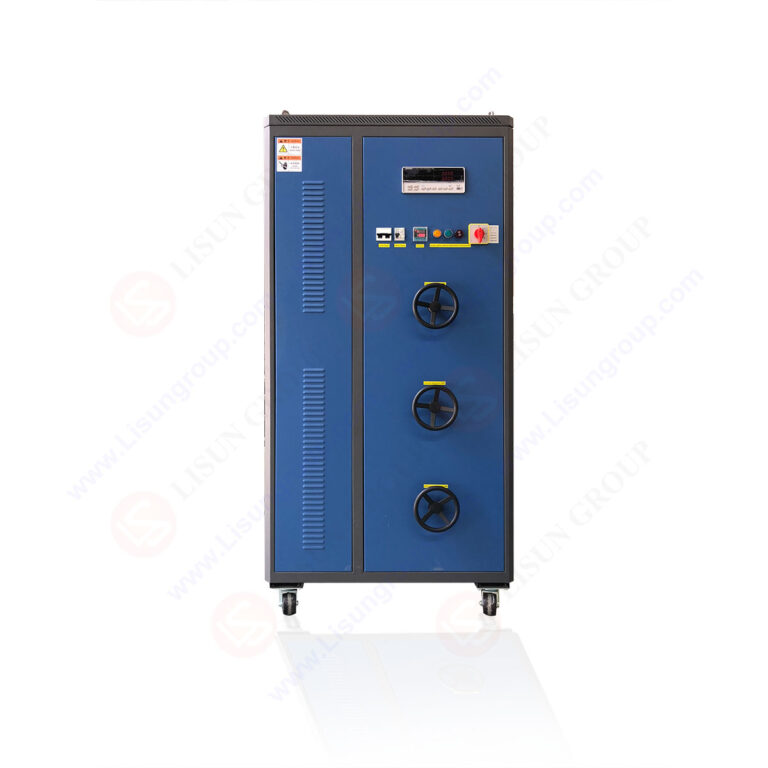
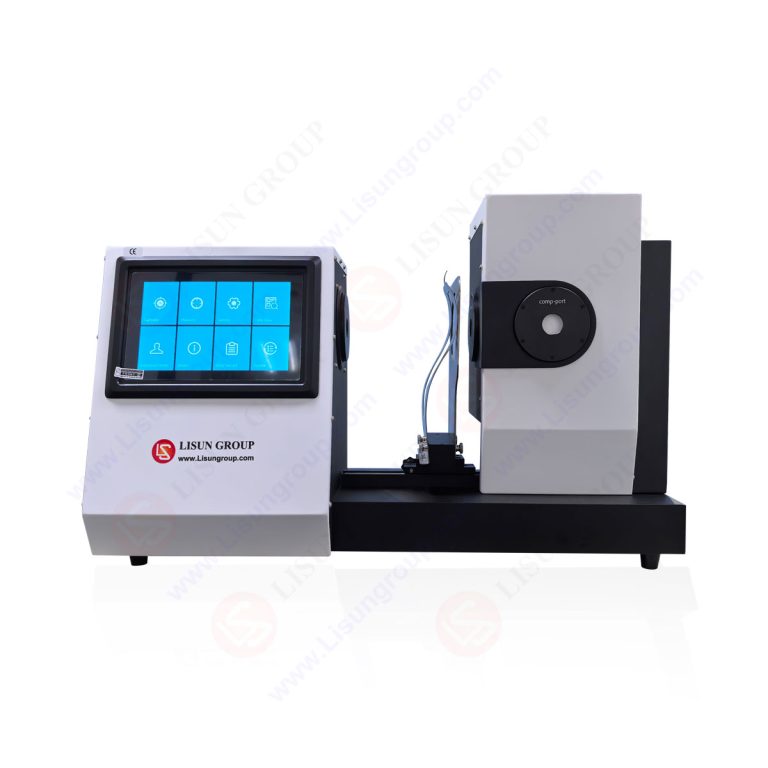
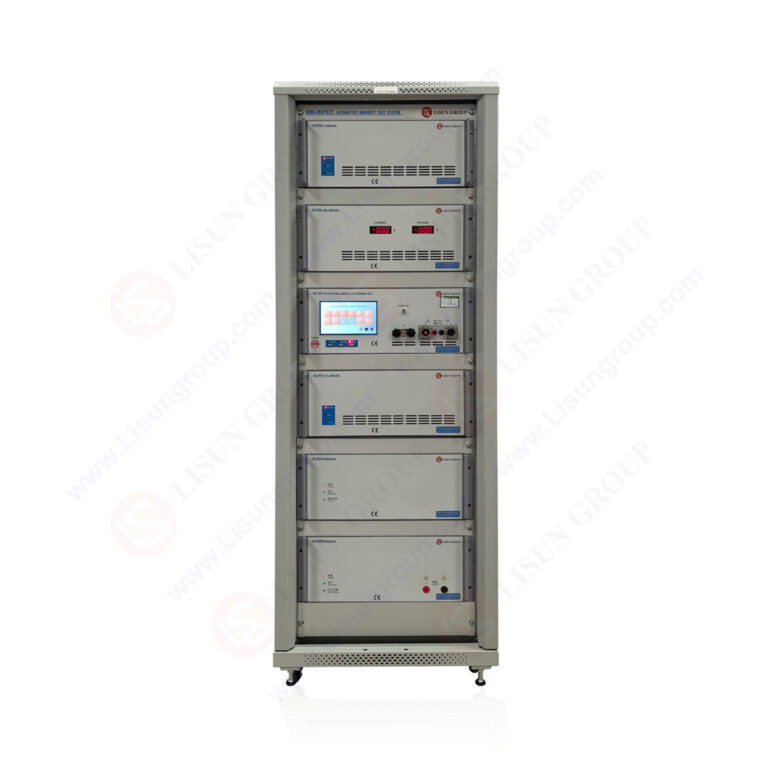
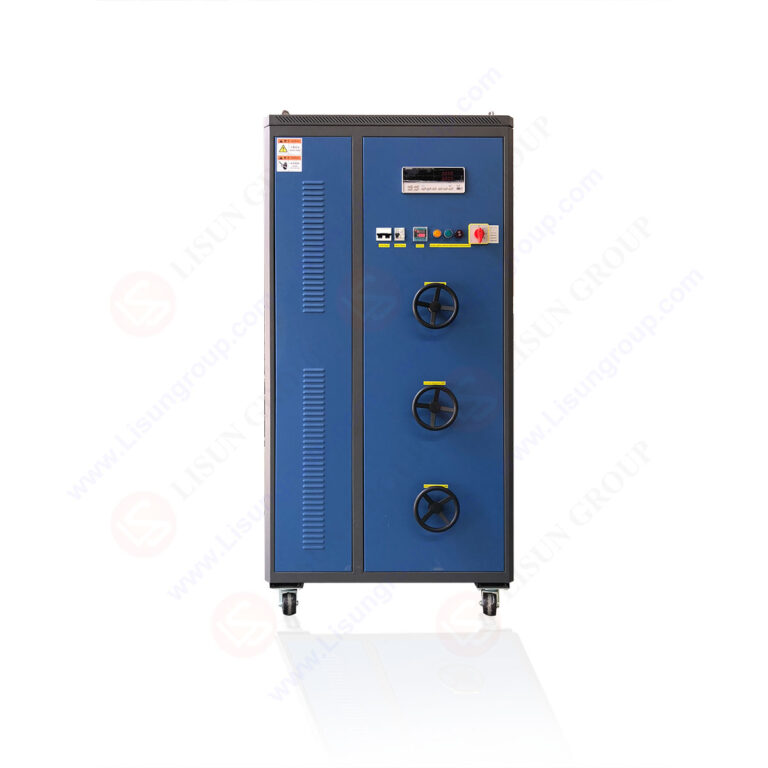



The LEDLM-80PL Test System represents a critical advancement in LED lumen maintenance testing, enabling precise evaluation of solid-state lighting longevity through accelerated aging protocols. This article comprehensively explains how the LEDLM-80PL Test System works for LED lumen maintenance testing, delving into its dual-system architecture—LEDLM-80PL for IES LM-80/TM-21 compliance and LEDLM-84PL for LM-84/TM-28 standards. By integrating Arrhenius Model-based software, dual testing modes (constant current and constant temperature), and support for up to three connected temperature chambers, the system delivers reliable L70/L50 projections across 6000+ hour test durations. Technical professionals will gain actionable insights into photometric measurement methodologies, extrapolation algorithms, and customizable hardware configurations that ensure adherence to IES LM-79-19, CIE 084, and CIE 127 standards.
1.1 The Importance of LED Lumen Depreciation Analysis
LED lumen maintenance testing quantifies the gradual reduction in light output over operational life, a critical parameter for lighting manufacturers and end-users. Unlike traditional light sources, LEDs exhibit non-linear depreciation patterns governed by junction temperature, drive current, and phosphor degradation. The LEDLM-80PL Test System addresses this complexity by tracking luminous flux decay under controlled accelerated aging conditions, enabling engineers to predict L70 (time to 70% lumen maintenance) and L50 (time to 50% lumen maintenance) metrics. Accurate lumen maintenance data directly impacts warranty periods, product certifications, and energy efficiency claims in commercial lighting applications.
1.2 Standards Governing Lumen Maintenance Testing
The LEDLM-80PL Test System is engineered to comply with multiple international standards, including IES LM-80-15 (Approved Method for Measuring Lumen Maintenance of LED Light Sources) and TM-21-19 (Projecting Long-Term Lumen Maintenance). For newer LED products, the system also supports IES LM-84-14 (Measuring Lumen Maintenance of LED Lamps, Light Engines, and Luminaires) with TM-28-14 extrapolation. These standards mandate specific test conditions: minimum 6000 hours of data collection at three case temperatures (typically 55°C, 85°C, and a manufacturer-selected temperature), with photometric measurements performed at 0, 1000, 2000, 3000, 4000, 5000, and 6000 hours. The system also references CIE 127:2007 for LED intensity measurement guidelines and CIE 084:1989 for integrating sphere photometry principles.
2.1 Dual System Variants for Different Standards
LISUN offers two primary configurations: the LEDLM-80PL (optimized for LM-80/TM-21 testing of LED packages, arrays, and modules) and the LEDLM-84PL (designed for LM-84/TM-28 testing of complete LED lamps and luminaires). The LEDLM-80PL variant includes a specialized holder system for SMD packages and COB modules, while the LEDLM-84PL accommodates larger fixtures up to 600mm diameter. Both variants share core components: an integrating sphere photometer (1m or 2m diameter options), a spectroradiometer for colorimetric measurements, and a thermal chamber system capable of maintaining ±0.5°C stability across -40°C to +150°C ranges.
2.2 Hardware Customization Capabilities
Each LEDLM-80PL system supports modular expansion, allowing technicians to connect up to three independent temperature chambers simultaneously. This enables parallel testing of different LED batches at distinct temperatures, accelerating qualification cycles. The standard configuration includes:
- 16-channel simultaneous measurement capability
- Automatic DUT positioning within the integrating sphere
- Fiber-optic coupling for spectroradiometer integration
- Calibrated reference lamp for periodic system verification
- UPS backup for uninterrupted long-duration testing
Table 1: LEDLM-80PL vs. LEDLM-84PL System Specifications
| Parameter | LEDLM-80PL | LEDLM-84PL |
|---|---|---|
| Primary Standard | IES LM-80, TM-21 | IES LM-84, TM-28 |
| Sample Type | LED packages, modules | LED lamps, luminaires |
| Maximum Sample Size | 50mm × 50mm | 600mm diameter |
| Temperature Range | -40°C to +150°C | -40°C to +150°C |
| Temperature Stability | ±0.5°C | ±0.5°C |
| Number of Chambers | Up to 3 | Up to 3 |
| Measurement Channels | 16 | 8 |
| Integrating Sphere Diameter | 1m | 2m |
| Test Duration | 6000+ hours | 6000+ hours |
3.1 Arrhenius Model-Based Projection Software
The core algorithmic engine of the how the LEDLM-80PL Test System works for LED lumen maintenance testing resides in its Arrhenius Model implementation. This physics-based model correlates accelerated thermal aging data to real-world operating conditions using the equation:
[
L(t) = L_0 cdot e^{-alpha t^{beta}}
]
Where ( alpha ) is the degradation rate coefficient, ( beta ) represents the shape parameter, and ( t ) is time. The software automatically fits measured lumen data to this model, then applies TM-21 or TM-28 extrapolation algorithms to project L70 and L50 values beyond the test duration. For example, a 6000-hour test at 85°C can project L70 values exceeding 50,000 hours at typical operating temperatures (55°C junction temperature). The software automatically calculates confidence intervals (typically 90% or 95%) and flags data sets with poor model fit (( R^2 < 0.90 )).
3.2 Dual Testing Modes: Constant Current and Constant Temperature
The system supports two primary operational modes:
- Constant Current Mode: Maintains specified drive current (±0.5% accuracy) while monitoring temperature as a dependent variable. This mode simulates real-world LED driver behavior and is preferred for TM-21 compliance.
- Constant Temperature Mode: Uses closed-loop thermal control to maintain case temperature within ±0.2°C while allowing current to fluctuate. This mode isolates temperature effects on lumen depreciation, enabling Arrhenius parameter extraction.
Technicians can configure multi-segment profiles, such as 1000-hour constant current followed by 6000-hour constant temperature, to simulate realistic duty cycles. The software logs current, voltage, temperature, and luminous flux every 10 seconds, generating over 20,000 data points per 6000-hour test.
4.1 Integrating Sphere Methodology
The LEDLM-80PL employs a 1-meter diameter integrating sphere coated with barium sulfate (BaSO₄) achieving >95% reflectance across the visible spectrum. Samples are positioned at the sphere center using a motorized holder that rotates 360° to capture full spatial luminous flux distribution. A calibrated photodetector mounted at the sphere’s equatorial port measures total luminous flux while a fiber-optic bundle directs light to the spectroradiometer for spectral analysis. The system compensates for self-absorption using the auxiliary lamp method per CIE 084 guidelines, ensuring measurement accuracy within ±1.5% for luminous flux and ±0.5 nm for dominant wavelength.
4.2 Automated Measurement Scheduling
The software automates the entire measurement sequence according to IES LM-80 requirements. At each scheduled interval (0, 1000, 2000, 3000, 4000, 5000, 6000 hours), the system:
- Ramp temperature to 25°C stabilization point
- Wait 30 minutes for thermal equilibrium (±1°C)
- Perform 10 consecutive photometric measurements
- Calculate average, standard deviation, and outlier detection
- Record spectral power distribution (350-800 nm with 1 nm resolution)
- Return to accelerated aging temperature within 15 minutes
This automated workflow eliminates human error and ensures repeatability across multi-chamber testing campaigns.
5.1 TM-21 Projection Algorithm
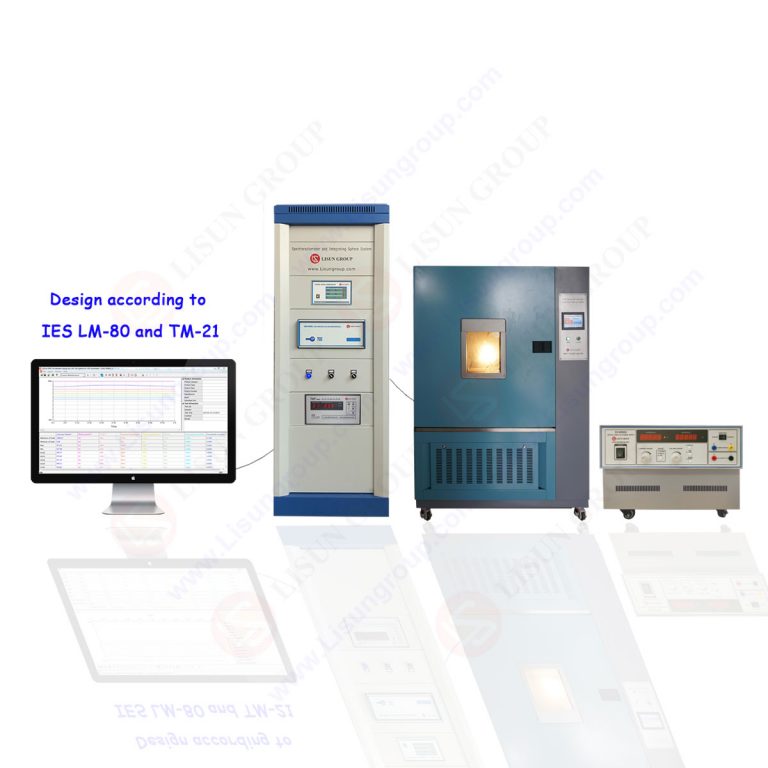
The built-in TM-21 projection algorithm follows IES-recommended procedures: only data beyond the first 1000 hours (to exclude initial burn-in effects) is used for exponential curve fitting. The algorithm applies a two-parameter exponential decay model and performs least-squares regression to estimate ( alpha ) and ( beta ) coefficients. For datasets with ( R^2 geq 0.90 ), the system extrapolates L70 to a maximum of 6× the test duration (e.g., 36,000 hours for a 6000-hour test). The software generates a comprehensive report including:
- Measured lumen data table
- Fitted curve with 95% confidence bands
- L70 and L50 estimates with upper/lower bounds
- Arrhenius plot showing degradation rate vs. temperature
- Color shift tracking (Δu’v’ per IES TM-30)
5.2 Accelerated Aging Validation Methods
The system supports simultaneous testing at three temperatures (e.g., 55°C, 85°C, 105°C) to validate the Arrhenius assumption. Data from all three temperatures must show consistent activation energy (( E_a )) values within ±0.05 eV for valid projections. The LISUN software automatically calculates:
[
E_a = -R cdot frac{ln(k_2/k_1)}{(1/T_2 – 1/T_1)}
]
Where ( k ) is the degradation rate at temperature ( T ) (Kelvin) and ( R ) is the universal gas constant. Typical activation energies for phosphor-converted white LEDs range from 0.3 to 0.6 eV, while blue LED chips exhibit 0.5 to 0.8 eV.
6.1 Multi-Chamber Synchronization
For laboratories requiring high throughput, the LEDLM-80PL supports up to three independently controlled temperature chambers, each housing 16 DUTs. The master control unit synchronizes measurement schedules across all chambers, ensuring that photometric data is collected at identical elapsed times (±1 hour tolerance). This parallel testing capability reduces qualification time by 66% compared to single-chamber setups. Each chamber includes its own calibrated PT100 temperature sensor, forced air circulation (0.5-2 m/s airflow), and humidity control (20-80% RH non-condensing).
6.2 Calibration Standards and Traceability
System calibration follows IES LM-79-19 requirements for photometric and colorimetric accuracy. The reference standards include:
- NIST-traceable standard lamp for luminous flux calibration (uncertainty ±1.2%, k=2)
- Certified spectral reference for wavelength calibration (Hg-Ar lamp, ±0.2 nm)
- Internal photodiode monitor for stability checks before each measurement cycle
Calibration intervals are automatically tracked by the software, with alerts when re-calibration is due (typically every 12 months or after 10,000 operating hours). The system also performs daily self-checks using a built-in LED reference source to verify measurement repeatability within ±0.5%.
7.1 Batch Testing and Parallel Processing
The LEDLM-80PL software supports batch testing configurations where up to 48 DUTs (16 per chamber × 3 chambers) run simultaneously. Each DUT is assigned a unique identifier with associated parameters:
- Manufacturer part number and batch code
- Drive current and voltage specifications
- Target junction temperature
- Test mode (constant current or temperature)
- Test duration (default 6000 hours, configurable up to 10,000 hours)
The software automatically rotates samples within the integrating sphere using a robotic arm, completing a full measurement cycle for 16 samples in under 2 hours. Data is stored in SQL database format with encryption and audit trail capabilities for regulatory compliance.
7.2 Remote Monitoring and Alerts
Engineers can monitor test progress via LAN or VPN connection, with real-time dashboards displaying:
- Current lumen maintenance percentage for each DUT
- Temperature stability graphs (updated every 10 seconds)
- Color shift trends (Δu’v’ vs. time)
- Estimated time to L70 completion
Automated alerts notify technicians via email or SMS for:
- Temperature excursions beyond ±1°C setpoint
- Power interruptions exceeding 1 minute
- Measurement anomalies (flux drop >5% between consecutive readings)
- Calibration due reminders
This remote capability enables 24/7 unattended operation while maintaining data integrity.
The LEDLM-80PL Test System from LISUN delivers a comprehensive, standards-compliant solution for how the LEDLM-80PL Test System works for LED lumen maintenance testing. By integrating Arrhenius Model-based software, dual testing modes, and modular hardware supporting up to three temperature chambers, the system enables accurate L70/L50 projections from 6000-hour accelerated aging data. Technical professionals benefit from automated measurement scheduling, TM-21/TM-28 compliant extrapolation algorithms, and multi-standard alignment with IES LM-80, LM-84, TM-21, TM-28, LM-79-19, CIE 084, CIE 70, and CIE 127. The parallel testing capability reduces qualification timelines by up to 66% while maintaining measurement accuracy within ±1.5% for luminous flux. For LED manufacturers and testing laboratories seeking reliable, certifiable lumen maintenance data, the LEDLM-80PL provides the precision, flexibility, and standards compliance essential for product validation and market acceptance.
Q1: What is the minimum test duration required for TM-21 projection using the LEDLM-80PL?
A: According to IES TM-21-19, the minimum data collection period for valid projection is 6,000 hours (approximately 250 days). However, the LEDLM-80PL software will only perform extrapolation if the dataset shows a good fit (( R^2 geq 0.90 )) and excludes the first 1,000 hours of burn-in data. For accelerated testing at higher temperatures (e.g., 105°C), the system can project L70 values up to 6× the test duration (36,000 hours for a 6,000-hour test). The Arrhenius model validation requires consistent activation energy across at least two test temperatures, typically 55°C and 85°C.
Q2: How does the LEDLM-80PL handle color shift measurements during lumen maintenance testing?
A: The integrated spectroradiometer measures spectral power distribution at each scheduled measurement interval, calculating correlated color temperature (CCT), color rendering index (CRI), and chromaticity coordinates (u’, v’). Per IES TM-30, the system tracks Δu’v’ shifts relative to initial measurements, which must remain within 0.006 for TM-21 compliance. The software automatically flags any DUT exceeding this threshold and includes color maintenance data in the final report. This is critical for applications like museum lighting and horticulture where spectral stability is as important as lumen maintenance.
Q3: Can the LEDLM-80PL test different LED types simultaneously in separate chambers?
A: Yes, each of the three temperature chambers can be configured with independent test parameters, including different LED types, drive currents, and temperature setpoints. The master control unit coordinates measurement scheduling but allows chamber-specific profiles. For example, Chamber 1 can test 16 high-power LEDs at 350 mA and 85°C, Chamber 2 tests 16 mid-power LEDs at 150 mA and 55°C, and Chamber 3 tests 16 COB modules at 700 mA and 105°C. All data is collected and analyzed separately, then compiled into a unified qualification report.
Q4: What is the recommended calibration frequency for the LEDLM-80PL system?
A: LISUN recommends full system calibration every 12 months or after 10,000 operating hours, whichever comes first. This includes recalibration of the spectroradiometer wavelength scale (using Hg-Ar reference), photometric sensitivity (using NIST-traceable standard lamp), and integrating sphere reflectance (via auxiliary lamp method). However, the system performs automatic daily stability checks using an internal LED reference source, and if measurements drift beyond ±0.5% from baseline, the software alerts technicians to perform an intermediate verification. Annual calibration ensures compliance with ISO 17025 and IES LM-79-19 requirements.
Q5: How does the LEDLM-80PL ensure temperature uniformity across multiple DUTs within a single chamber?
A: Each temperature chamber employs forced air circulation with variable speed fans (0.5-2 m/s) and a laminar flow baffle system to maintain ±1°C uniformity across all 16 sample positions. The control system uses three independent PT100 sensors (top, middle, bottom) and adjusts heater output proportionally. During measurement intervals, the chamber temperature is stabilized to 25°C ±1°C for photometric readings, then ramped back to the accelerated aging setpoint within 15 minutes. This rapid thermal cycling minimizes stress on solder joints and avoids thermal shock artifacts in the data.