


Abstract
The LS2050C High Precision Power Meter: AC-DC Digital Power Analyzer with Harmonic Analysis represents a significant advancement in electrical measurement instrumentation for engineering professionals requiring precise AC/DC power characterization. This digital power analyzer combines high-accuracy digital sampling waveform analysis with comprehensive harmonic measurement capabilities, addressing critical testing requirements across LED manufacturing, automotive electronics, and EMC compliance laboratories. With automatic range switching, wide frequency range coverage from 0.5Hz to 100kHz, and compliance with international standards including EN/IEC61000-3-2 and LM-79, this instrument delivers reliable power quality analysis for R&D validation and production testing applications. The LS2050C series offers model variations tailored to specific accuracy requirements, from standard LS2050B to the EMC-compliant LS2050C-IEC configuration.
1. Precision Power Measurement Architecture
1.1 Digital Sampling Waveform Technology
The LS2050C High Precision Power Meter employs advanced digital sampling waveform analysis as its core measurement methodology. This technique captures voltage and current waveforms at high sampling rates, enabling accurate calculation of true RMS values, active power, apparent power, and reactive power across both AC and DC systems. The digital sampling approach eliminates errors inherent in analog measurement circuits, particularly when dealing with non-sinusoidal waveforms common in modern power electronics. The instrument processes waveform data using proprietary algorithms that compensate for phase errors and frequency variations, ensuring measurement integrity from 0.5Hz to 100kHz. This technical foundation supports the analyzer’s capability to deliver 0.1% basic accuracy for power measurements, meeting the stringent requirements of metrology laboratories and production test stations.
1.2 Automatic Range Switching Mechanism
Automatic range switching represents a critical feature for engineers conducting measurements across varying signal levels without manual intervention. The LS2050C power analyzer incorporates intelligent range detection that continuously monitors input signals and selects the optimal measurement range for voltage (up to 1600V instantaneous maximum) and current (up to 50A instantaneous maximum). This dynamic range selection prevents saturation errors while maximizing measurement resolution. The automatic switching occurs within milliseconds, maintaining data continuity during transient events. For production testing environments where multiple product variants require different measurement ranges, this capability significantly reduces test cycle times and eliminates operator errors associated with manual range selection.
1.3 Wide Frequency Range Capability
The instrument’s frequency measurement capability extends from 0.5Hz to 100kHz, covering applications from fundamental power line frequencies through switching power supply harmonics. This wide bandwidth enables accurate characterization of variable frequency drives, switch-mode power supplies, and automotive electrical systems operating at elevated frequencies. The power meter maintains specified accuracy across the entire frequency range through adaptive filtering techniques that separate fundamental components from harmonic content. For R&D teams developing power electronics for electric vehicles or industrial automation, this frequency coverage eliminates the need for multiple instruments to characterize power quality across the operating spectrum.
2. Harmonic Analysis and Power Quality Assessment
2.1 Total Harmonic Distortion Measurement
The LS2050C High Precision Power Meter provides comprehensive harmonic analysis up to the 50th order, utilizing both IEC and CSA measurement methods. This capability allows engineers to assess total harmonic distortion (THD) for voltage and current waveforms, identifying distortion patterns that may indicate equipment malfunction or non-compliant designs. The instrument calculates individual harmonic magnitudes and phase angles relative to the fundamental frequency, enabling detailed spectral analysis. For compliance testing laboratories, this harmonic measurement capability directly supports EN/IEC61000-3-2 testing requirements for equipment connected to public low-voltage distribution systems. The power meter displays harmonic data in both numerical and graphical formats, facilitating rapid interpretation of power quality issues.
2.2 Power Factor and Displacement Factor Analysis
Beyond basic power measurement, the analyzer computes displacement power factor (DPF) and true power factor, providing engineers with comprehensive power utilization metrics. Displacement factor quantifies the phase relationship between voltage and current at the fundamental frequency, while true power factor accounts for harmonic contributions to apparent power. This distinction becomes critical when evaluating non-linear loads such as LED drivers and rectifier circuits. The instrument’s ability to simultaneously display both parameters enables targeted corrective actions, whether addressing phase compensation or harmonic filtering requirements. For automotive electronics testing, these measurements help validate power converter efficiency under varying load conditions.
2.3 Compliance-Oriented Harmonic Testing
The LS2050C-IEC model variant integrates dedicated firmware for EN/IEC61000-3-2 harmonic current emission testing. This configuration automatically applies the standard’s classification system for equipment types A through D, comparing measured harmonic currents against applicable limits. The instrument generates compliance reports documenting harmonic spectra against regulatory thresholds, streamlining the certification process for lighting products, household appliances, and industrial equipment. Engineers can configure test parameters including observation periods and averaging intervals per the standard’s requirements. This integrated compliance capability reduces the need for separate harmonic analyzers and simplifies test setup for EMC laboratories.
3. Model Comparison and Selection Criteria
3.1 Technical Specifications Comparison
| Parameter | LS2050B | LS2050C | LS2050C-IEC |
|---|---|---|---|
| Basic Power Accuracy | 0.2% | 0.1% | 0.1% |
| Harmonic Analysis Range | 1-40th order | 1-50th order | 1-50th order |
| Frequency Range | 0.5Hz-50kHz | 0.5Hz-100kHz | 0.5Hz-100kHz |
| IEC 61000-3-2 Compliance | No | No | Yes |
| Communication Ports | RS232 | RS232/RS485 | RS232/RS485 |
| Voltage Measurement Range | 0-1000V | 0-1600V | 0-1600V |
| Current Measurement Range | 0-30A | 0-50A | 0-50A |
3.2 Application-Specific Model Selection
Selecting the appropriate power meter model depends on measurement accuracy requirements and compliance testing needs. The LS2050B serves as a cost-effective solution for general production testing where 0.2% accuracy suffices, particularly in LED manufacturing quality control stations. The LS2050C addresses demanding R&D applications requiring 0.1% accuracy and extended frequency analysis up to 100kHz for automotive electronics validation. The LS2050C-IEC variant becomes essential for EMC compliance laboratories conducting official EN/IEC61000-3-2 certification testing, as it includes the specific algorithms and reporting formats required for regulatory submissions. Engineers should evaluate their testing volume and accuracy requirements when selecting between these configurations.
3.3 Upgrade Path Considerations
Organizations may consider a phased approach to instrument deployment, starting with LS2050B units for production lines while acquiring LS2050C models for development laboratories. The common user interface and measurement methodology across the series ensures consistent test results regardless of model selection. When regulatory requirements evolve or new product categories demand EMC compliance testing, the LS2050C-IEC can be integrated without retraining personnel. This product family approach allows laboratories to maintain measurement consistency while matching instrument capability to specific testing needs.
4. Hardware Design and Connectivity Features
4.1 High Overload Protection Circuitry
The LS2050C High Precision Power Meter incorporates robust input protection capable of withstanding instantaneous voltage surges up to 1600V and current transients up to 50A. This overload capacity ensures instrument survival during abnormal test conditions such as short circuits, switching transients, or misconnections. The protection circuits operate independently of measurement electronics, maintaining measurement accuracy during normal operation while safeguarding sensitive components during fault events. For production environments where test operators may encounter unexpected load conditions, this protection reduces downtime and repair costs. The instrument automatically returns to normal operation after transient events clear, maintaining test throughput.
4.2 Communication Interface Options
Multiple communication interfaces enable integration into automated test systems and data acquisition networks. The RS232 port provides point-to-point connectivity for single-instrument setups, supporting data transfer rates sufficient for most testing applications. The RS485 interface enables multi-drop configurations where multiple power meters connect to a single controller, ideal for production lines with multiple test stations. Both interfaces support standard Modbus protocols, facilitating integration with programmable logic controllers and industrial PCs. For laboratories requiring remote monitoring, the communication ports allow real-time data streaming to analysis software for extended test documentation.
4.3 Display and User Interface Design
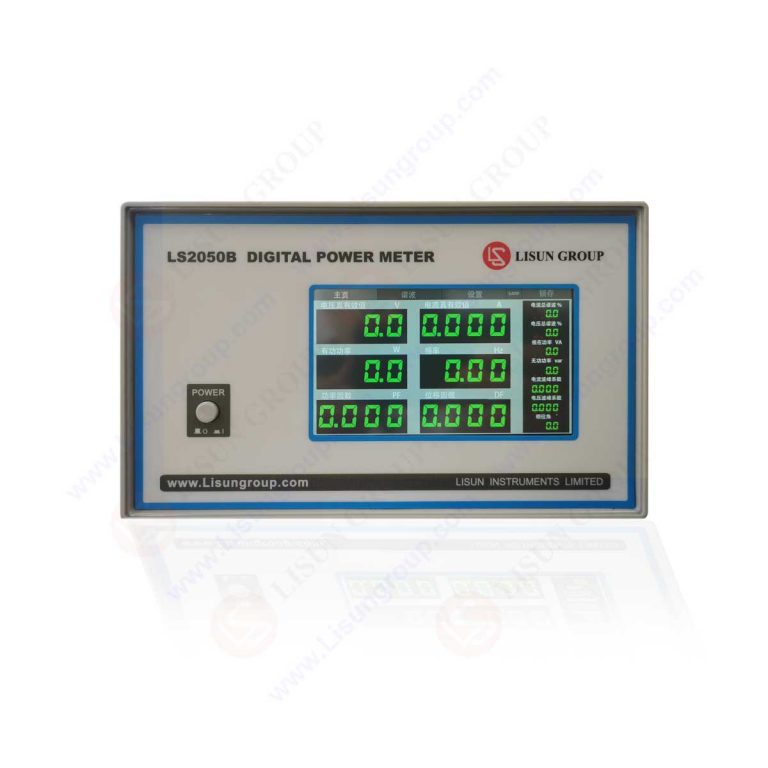
The instrument’s front panel features a high-resolution display presenting measurement values in numerical and graphical formats simultaneously. Engineers can customize display pages to show primary measurements (voltage, current, power) alongside harmonic data or power factor information. The intuitive menu structure allows quick configuration of measurement parameters, communication settings, and data logging options. For repetitive testing scenarios, users can save instrument configurations and recall them via the front panel or remote commands, reducing setup time between different test protocols.
5. Industry Standards Compliance and Certification
5.1 EN/IEC61000-3-2 Harmonic Emission Limits
The LS2050C-IEC model directly supports compliance testing against EN/IEC61000-3-2, which sets limits for harmonic current emissions from equipment connected to public low-voltage distribution systems. This standard applies to a wide range of electrical and electronic equipment with input current up to 16A per phase. The power meter’s harmonic analysis algorithms implement the standard’s classification and assessment methods, providing engineers with explicit pass/fail determinations for each harmonic order. For manufacturers exporting products to European markets, this testing capability ensures their equipment meets regulatory requirements before submission to certified testing laboratories.
5.2 LM-79 Solid-State Lighting Testing
For LED manufacturers, the LS2050C supports testing per LM-79, the IESNA approved method for electrical and photometric measurements of solid-state lighting products. This standard specifies measurement procedures for total luminous flux, electrical power, and efficacy calculations. The power meter’s AC/DC capability allows testing of both mains-powered LED lamps and low-voltage LED modules. Accurate power measurement directly impacts efficacy calculations, making the 0.1% accuracy of the LS2050C essential for compliance testing. The instrument’s ability to measure displacement factor also matters for LED driver evaluation per LM-79 requirements.
5.3 Safety Standards Compliance
The LS2050C series is designed and certified per IEC 61010, the safety standard for electrical measurement and test equipment. This certification covers protection against electric shock, mechanical hazards, and fire risks inherent in power measurement instruments. The instrument’s input terminals feature safety shrouding and internal fusing to prevent operator contact with hazardous voltages. For UL 1989 compliance, the instrument meets additional North American safety requirements for power monitoring equipment. These certifications provide assurance that the power meter can be safely used in laboratory and production environments without compromising operator safety.
6. Practical Applications in Manufacturing and R&D
6.1 LED Manufacturing Production Testing
In LED manufacturing facilities, the LS2050C power analyzer performs incoming inspection of LED drivers and final product validation of luminaires. Production test stations measure input power, power factor, and harmonic content to verify compliance with design specifications and regulatory limits. The automatic range switching feature accommodates testing of products ranging from small indicator lamps to high-bay lighting fixtures without manual intervention. Test results transmitted via RS485 to central databases enable statistical process control and early detection of production anomalies. The instrument’s 0.1% accuracy provides confidence in power measurements used for energy efficiency labeling.
6.2 Automotive Electronics Validation
Automotive electronics testing requires measurement of power consumption across wide operating ranges, from standby currents in microamperes to full-load currents exceeding 20A. The LS2050C’s wide dynamic range and 0.5Hz to 100kHz frequency coverage accommodate these requirements for testing electronic control units, infotainment systems, and power converters. Harmonic analysis helps identify electromagnetic compatibility issues before formal EMC testing, reducing development cycles. The RS232 communication interface allows integration with environmental chambers for combined temperature and power measurement testing, essential for automotive qualification per AEC-Q100 requirements.
6.3 EMC Compliance Laboratory Testing
EMC testing laboratories utilize the LS2050C-IEC for pre-compliance and full-compliance harmonic current testing per EN/IEC61000-3-2. The instrument’s ability to generate compliance documentation reduces manual data analysis and reporting time. For laboratories testing multiple product categories, the configurable test parameters accommodate different standard editions and equipment classifications. The power meter’s measurement uncertainty, documented through calibration, supports ISO 17025 accreditation requirements for testing laboratories. Integration with automated test systems via RS485 enables unattended testing sequences for high-volume compliance testing operations.
7. Technical Calibration and Maintenance Considerations
7.1 Calibration Interval and Procedures
Maintaining measurement accuracy requires regular calibration per manufacturer recommendations and quality system requirements. The LS2050C power analyzer supports field calibration using external voltage and current references, with calibration constants stored in non-volatile memory. Calibration procedures verify accuracy at multiple points across the measurement range, including DC and multiple AC frequencies. For ISO 17025 accredited laboratories, the instrument’s documented calibration traceability supports audit requirements. The expected calibration interval depends on usage intensity, with most applications requiring annual recalibration to maintain 0.1% accuracy specifications.
7.2 Firmware Updates and Feature Enhancements
LISUN provides periodic firmware updates that may include new measurement algorithms, additional harmonic analysis capabilities, or enhanced communication protocols. These updates are applied via the RS232 interface without requiring hardware modifications. Users should maintain current firmware versions to ensure compatibility with evolving standards and measurement methodologies. The instrument’s modular firmware architecture allows adding features specific to emerging applications without replacing the hardware platform.
8. Conclusion
The LS2050C High Precision Power Meter delivers comprehensive AC/DC power measurement and harmonic analysis capabilities essential for modern electrical testing requirements. Its digital sampling waveform technology, automatic range switching, and 50th-order harmonic analysis provide engineers with precise power quality data for R&D validation, production testing, and compliance certification. The model series offers scalable accuracy options from 0.2% to 0.1%, with the LS2050C-IEC variant specifically configured for EN/IEC61000-3-2 compliance testing. Robust overload protection, multiple communication interfaces, and compliance with IEC 61010 safety standards ensure reliable operation in demanding laboratory and production environments. For LED manufacturers, automotive electronics developers, and EMC testing laboratories, this power analyzer represents a versatile measurement solution that supports quality assurance and regulatory compliance objectives.
FAQ (Frequently Asked Questions)
Q1: What is the difference between the LS2050B and LS2050C models for power measurement accuracy?
A: The LS2050B provides 0.2% basic power accuracy, suitable for general production testing and quality control applications where moderate precision suffices. The LS2050C delivers 0.1% accuracy, making it appropriate for R&D validation, metrology applications, and compliance testing requiring higher measurement confidence. The accuracy difference stems from improved analog-to-digital conversion components and enhanced calibration algorithms in the LS2050C. Additionally, the LS2050C extends harmonic analysis to the 50th order versus 40th order for the LS2050B, and supports frequency measurement up to 100kHz compared to 50kHz. Engineers should select the LS2050C when testing power supplies with switching frequencies above 50kHz or when regulatory requirements demand the highest accuracy class.
Q2: How does the LS2050C-IEC perform EN/IEC61000-3-2 harmonic current testing?
A: The LS2050C-IEC incorporates dedicated firmware implementing the EN/IEC61000-3-2 standard’s measurement methodology. The instrument automatically classifies the equipment under test into the appropriate category (A through D) based on configured parameters. It measures individual harmonic currents up to the 40th order for mains-powered equipment and compares each harmonic against the standard’s emission limits. The power analyzer calculates and displays the percentage of limit for each harmonic order, providing clear pass/fail indication. Test results include statistical analysis with observation periods and averaging as required by the standard. The instrument generates reports suitable for inclusion in technical documentation, although formal certification testing still requires accredited laboratory verification.
Q3: Can the LS2050C measure DC power and AC power simultaneously?
A: The LS2050C is designed for either AC or DC measurement modes, not simultaneous measurement of both on the same input channel. The instrument automatically detects the input signal type when configured for auto-detection mode, or engineers can manually select AC or DC measurement mode. For applications requiring mixed AC/DC signals, such as rectifier circuits, the AC+DC true RMS measurement mode calculates the effective value of waveforms containing both components. This mode is particularly useful for measuring power in circuits with DC offset superimposed on AC waveforms. The instrument’s wide bandwidth ensures accurate RMS calculation even when DC and AC components have significantly different amplitudes.
Q4: What communication protocols are supported for automated test system integration?
A: The LS2050C series supports RS232 and RS485 interfaces using Modbus RTU protocol. The RS232 interface provides simple point-to-point communication for single-instrument setups, supporting baud rates up to 115200 bps for rapid data transfer. The RS485 interface enables multi-drop networks with up to 32 instruments on a single bus, suitable for production lines with multiple test stations. Both interfaces support reading all measurement values, harmonic data, and instrument status, as well as writing configuration parameters and initiating measurement sequences. For laboratory information management system integration, the instrument can stream continuous measurement data at rates suitable for real-time monitoring applications.