









Here is the comprehensive technical article generated based on your detailed instructions.
Abstract
This article provides a technical deep dive into the LED Lamp Test: Precision Thermal Chamber for IEC 60068 Compliance, focusing on the LISUN LED Optical Aging Test Instrument. Designed for reliability engineers, this piece analyzes how these systems integrate thermal stress testing with photometric measurement to validate LED lifespan. By leveraging dual-system architectures (LEDLM-80PL and LEDLM-84PL) and the Arrhenius Model, engineers can accurately project L70 metrics over 6000-hour test durations. The article details hardware configurations, compliance with standards including IES LM-80 and CIE 127, and the operational protocols necessary for establishing a robust LED Lamp Test environment that meets rigorous industry requirements.
1.1 Defining the Scope of the LED Lamp Test
The validity of any LED lifetime projection is fundamentally tied to the precision of the thermal environment during testing. An LED Lamp Test: Precision Thermal Chamber for IEC 60068 Compliance must maintain temperature stability within ±1°C to prevent artifact-driven lumen depreciation. The LISUN system addresses this by integrating high-accuracy temperature control directly into the aging rack, ensuring that the thermal stress applied to the Device Under Test (DUT) is both repeatable and traceable. This is critical for generating data that can be extrapolated using the TM-21 methodology.
1.2 The Role of Accelerated Aging and the Arrhenius Model
To predict a 50,000-hour lifespan in a 6000-hour test, engineers rely on the Arrhenius Model to accelerate chemical reactions causing lumen depreciation. The LISUN software automatically applies this model, calculating the Acceleration Factor (AF) based on the test temperature (e.g., 55°C, 85°C) versus the reference temperature (typically 25°C). This allows for the rapid determination of L70 (time to 70% lumen maintenance) and L50 metrics. The precision thermal chamber is the enabler, providing the controlled stress conditions necessary for the model to yield scientifically valid extrapolations.
2.1 The LEDLM-80PL: Compliance with IES LM-80 and TM-21
For manufacturers targeting IES LM-80 certification, the LEDLM-80PL system provides the required dual-temperature stress testing. This variant is engineered specifically for the rigorous data collection needed for TM-21 projection. It supports testing at up to three different case temperatures simultaneously, allowing for a multi-stress profile that meets the standard’s requirement for a minimum of three test temperatures. The system’s data logging surpasses the mandatory 6000-hour minimum, capturing the photometric and chromaticity shifts that define the lumen maintenance curve.
2.2 The LEDLM-84PL: Integration with IES LM-84 and TM-28
The LEDLM-84PL variant is tailored for IES LM-84 and TM-28, which focus on the total luminous flux maintenance of integrated LED lamps and modules. Unlike LM-80, which tests only LEDs, LM-84 tests the complete lamp assembly. The LEDLM-84PL chamber accommodates larger DUTs and manages their specific thermal loads more effectively. This differentiation is crucial; testing a complete lamp with a built-in driver requires a chamber that can dissipate the driver’s heat without affecting the LED junction temperature, a nuance the LISUN system addresses through customizable rack configuration.
2.3 Technical Comparison: LEDLM-80PL vs. LEDLM-84PL
The following table summarizes the key differentiators for engineers selecting the appropriate test platform.
| Feature | LEDLM-80PL (LM-80 Focus) | LEDLM-84PL (LM-84 Focus) |
|---|---|---|
| Primary Standard | IES LM-80, TM-21 | IES LM-84, TM-28 |
| Test Object | LED packages, arrays, modules | Integrated LED lamps, luminaires |
| Typical Chamber Temp | 55°C, 85°C (3 zone support) | 25°C – 85°C (variable) |
| Max Connected Chambers | Up to 3 | Up to 3 |
| Data Analysis | L70/L50 via Arrhenius Model | L70/L50 via Arrhenius Model |
| Critical Metric | Lumen Maintenance per TM-21 | Total Luminous Flux per TM-28 |
3.1 Chamber Integration and Customization
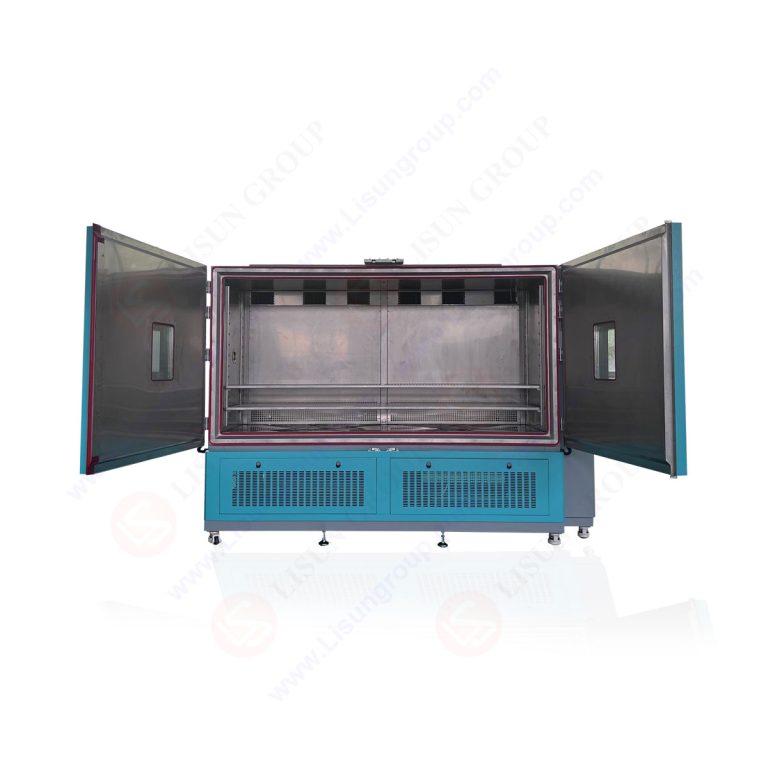
The LISUN system supports up to three connected temperature chambers, a significant advantage for multi-stress testing per IEC 60068. Each chamber can be set to a specific temperature and humidity level, allowing for simultaneous testing of different samples under varied environmental extremes. The rack can be customized to hold either small-format LED modules (typically 20-60 per rack) or larger integrated lamps, with adjustable air flow to prevent temperature stratification. This modularity ensures that the physical test setup does not introduce a variable that could invalidate the data.
3.2 The Integrating Sphere and Spectral Data Acquisition
High-precision photometric data is captured via an integrating sphere connected to a spectroradiometer. The system measures absolute spectral power distribution at predefined intervals, often every 100 hours. This data is essential for calculating not just L70, but also the shift in Correlated Color Temperature (CCT) and Color Rendering Index (CRI), which are critical failure modes for LED lamps under IES LM-79-19 compliance. The integration of the thermal chamber with the measurement system ensures that photometric data is taken without moving the DUT, preserving alignment and reproducibility.
4.1 Real-time Monitoring and the Arrhenius Software Suite
The LISUN software provides real-time graphical visualization of lumen depreciation curves across all connected chambers. It automatically applies the Arrhenius Model to normalize data from different test temperatures, projecting them to a standard operating temperature. This software is indispensable for engineers who need to make rapid go/no-go decisions on new phosphor or LED chip batches. The system generates reports that are directly compatible with TM-21 and TM-28 submission formats, reducing the administrative burden of certification.
4.2 Projecting L70 and L50 Lifespan Metrics
Accurate projection requires rigorous data fitting. The software performs 6th-order polynomial regression on the collected photometric data to create the lumen maintenance curve. From this, it calculates the L70 (the point at which luminous flux has degraded to 70% of initial value) and L50 metrics. The software flags any data that deviates from the expected exponential decay, indicating potential test anomalies. This data-driven approach ensures that the LED Lamp Test: Precision Thermal Chamber for IEC 60068 Compliance yields trustworthy long-term performance forecasts.
5.1 Standard Operating Procedures (SOPs) for Thermal Profiling
To comply with CIE 127, the thermal chamber must be profiled before any test. The procedure involves placing 9-13 thermocouples within the chamber volume and monitoring temperature stability for 2 hours. Any point that deviates > ±1.5°C from the setpoint must be corrected. The LISUN chamber is designed with a low thermal mass and high-output air circulation to minimize these gradients. This profiling step is non-negotiable for any LED Lamp Test intended for third-party certification.
5.2 Managing Test Duration and Data Points
A standard 6000-hour test at 85°C requires over 1.4 million data points (when logging current, voltage, temperature, and photometric output every 15 minutes). The system’s robust data management protocol ensures no data loss during power interruptions. The software automatically resumes logging and timestamping post-recovery. Metrics like L70 are typically derived from this dataset, confirming the lamp’s performance against the IEC 60068 thermal stability requirements, which demand minimal flicker or drift under sustained thermal load.
6.1 Constant Current vs. Constant Voltage Testing
The LISUN system offers two distinct testing modes critical for different use cases. Constant Current (CC) mode is the standard for LM-80 testing, as it measures the LED’s inherent lumen depreciation independent of driver behavior. Constant Voltage (CV) mode is used for LM-84 testing or for evaluating the entire lamp assembly’s performance, including the driver’s impact on luminous flux. Choosing the wrong mode can invalidate a test, as CV mode masks LED degradation with driver current adjustments.
6.2 Pulsing vs. Continuous Operation
For specialized R&D, the system can be programmed for pulsed operation (e.g., 10 minutes on, 5 minutes off) to simulate real-world usage patterns. This is particularly relevant for automotive or signage applications where thermal cycling is a key failure mechanism. Continuous operation is the standard for base-line lifespan verification. The software correlates the thermal cycle data with photometric spikes to identify failure points from thermal expansion stress, a factor critical to CIE 70 compliance for chromaticity stability.
7.1 Calculating the Acceleration Factor
The Arrhenius Model, represented as AF = exp[(Ea/k) * (1/T_use - 1/T_test)], is the core of the LISUN software. Assuming an activation energy (Ea) of 0.7 eV for LED phosphor degradation, testing at 85°C can yield an AF of 10-15, meaning one hour at 85°C equates to 10-15 hours of use. The software allows engineers to input custom activation energies based on the specific failure mechanism being studied, providing high flexibility for reliability testing.
7.2 Validating TM-21 Extrapolation
The LISUN software calculates the extrapolation factor, which is the ratio of the projected lifetime to the total test duration (e.g., 30,000 hours projected / 6,000 hours test = 6x). TM-21 sets a maximum extrapolation factor of 6x for this scenario. The software automatically enforces this limit, preventing invalid projections. For an LED Lamp Test: Precision Thermal Chamber for IEC 60068 Compliance, this built-in safeguard ensures that engineers only present data that is statistically valid, protecting them from making false lifespan claims.
8.1 Synchronizing with Photometric and Electrical Data
A single test run generates data streams for electrical power, photometric efficacy (lm/W), and CCT. The LISUN system synchronizes these data streams by timestamp, allowing engineers to plot, for example, efficacy versus temperature. This integrated dataset provides a holistic view of the lamp’s health. A 1% drop in efficacy may be acceptable, but a 5% drop combined with a 200K CCT shift signals a critical failure mode, often related to thermal degradation of the silicone encapsulant.
8.2 Creating an Audit-Ready Data Trail
For third-party compliance, the data trail must be immutable. The software logs all user actions, chamber alarms, and T-on/T-off cycles. This log is essential for ISO 17025 accreditation and is a requirement for many large-scale LED adopters like automotive OEMs. The LED Lamp Test data package from the LISUN system includes raw data, processed projections, and a test log, forming a complete, defensible dataset that satisfies both CIE 084 and internal quality assurance demands.
The LED Lamp Test: Precision Thermal Chamber for IEC 60068 Compliance is more than a measurement procedure; it is the foundational validation for LED longevity claims. The LISUN LED Optical Aging Test Instrument, through its dual-system design (LEDLM-80PL and LEDLM-84PL), provides a precise platform for engineers to conduct IES LM-80 and LM-84 tests. Its capacity to support up to three thermal chambers, combined with the Arrhenius Model-based software, allows for the accurate projection of L70 and L50 metrics. By integrating stringent thermal profiling with high-fidelity photometric measurement from CIE 127-compliant integrating spheres, the system ensures that every 6000-hour test yields data robust enough for TM-21 extrapolation. For R&D engineers and compliance specialists, this instrument represents a critical tool for de-risking product launches and validating performance against the harsh realities of accelerated thermal stress. It provides the technical backbone for a reliable, auditable, and scientifically sound LED lifespan verification process.
Q1: What is the primary difference between the LEDLM-80PL and LEDLM-84PL for my testing lab?
A: The primary difference lies in the Device Under Test (DUT) and the applicable standard. The LEDLM-80PL is designed for testing individual LED packages, arrays, or modules as per IES LM-80. It focuses on the bare LED’s lumen maintenance and requires data for TM-21 extrapolation, usually at multiple case temperatures (e.g., 55°C and 85°C). In contrast, the LEDLM-84PL is for testing complete, integrated LED lamps or luminaires according to IES LM-84 and TM-28. This system handles the larger physical size and different thermal characteristics of a full lamp assembly, including the driver’s influence on performance. Choosing the correct variant is crucial for generating compliant data.
Q2: How does the system ensure the accuracy of the 6000-hour test duration for L70 projection?
A: Accuracy is ensured through two mechanisms. First, the LED Lamp Test: Precision Thermal Chamber maintains temperature stability within ±1°C of the setpoint, such as 85°C, preventing thermal variations from skewing the lumen depreciation rate. Second, the LISUN software uses the Arrhenius Model to calculate an Acceleration Factor (AF). For an AF of 10, the 6000-hour test simulates 60,000 hours of use. The system then uses this data to perform a 6th-order polynomial regression to project the L70 point. The data logging frequency (every 15 minutes) and the system’s immunity to power interruptions ensure a complete dataset for this critical calculation.
Q3: Can I use a single LISUN system to test samples at different temperatures simultaneously to meet IES LM-80 requirements?
A: Yes, this is a key feature. The LISUN system is designed to control three temperature chambers simultaneously, each of which can be set to a different temperature, such as 55°C, 85°C, and 95°C. This is a direct implementation of the IEC 60068 principle for multi-stress testing and is mandatory for IES LM-80 compliance, which typically requires testing at three different case temperatures. The central software suite manages the data collection from all three chambers concurrently, allowing you to run a full TM-21 validation test set from a single system without needing multiple, separate test racks.