









The Accelerated Aging Chamber for IEC 60068 Temperature Testing represents a critical advancement in LED reliability verification, enabling manufacturers to predict lumen maintenance with unprecedented accuracy. This article explores LISUN’s integrated approach, combining the LEDLM-80PL and LEDLM-84PL systems with Arrhenius Model-based software to deliver 6000-hour accelerated aging tests compliant with IES LM-80, LM-84, TM-21, and TM-28 standards. Technical professionals will gain insights into dual testing modes—constant temperature and thermal cycling—alongside customizable chamber configurations supporting up to three connected units. The correlation between IEC 60068 temperature testing protocols and LED-specific degradation mechanisms is examined, providing actionable data for R&D engineers and compliance specialists seeking to validate product lifetimes exceeding 50,000 hours.
1.1 The Role of Thermal Stress in LED Degradation
LED lumen depreciation follows an exponential decay pattern strongly influenced by junction temperature. The Accelerated Aging Chamber for IEC 60068 Temperature Testing applies controlled thermal stress to accelerate failure mechanisms including phosphor degradation, solder joint fatigue, and encapsulant yellowing. Per IEC 60068-2-1 (cold) and IEC 60068-2-2 (dry heat) protocols, chambers maintain temperature accuracy within ±0.5°C across ranges from -40°C to +150°C. This precision enables engineers to isolate temperature-driven degradation from other failure modes.
1.2 Alignment with LISUN’s Dual-System Architecture
LISUN’s LEDLM-80PL and LEDLM-84PL systems embody two distinct testing philosophies. The LEDLM-80PL targets IES LM-80 compliance, requiring 6000 hours at three specified case temperatures (typically 55°C, 85°C, and a manufacturer-chosen third temperature). Conversely, the LEDLM-84PL follows LM-84 protocols with optional in-situ photometric measurement via integrating sphere integration. Both systems share the common foundation of the Accelerated Aging Chamber for IEC 60068 Temperature Testing, ensuring consistent thermal environments across test durations spanning 1,000 to 10,000+ hours.
2.1 IES LM-80 and TM-21: The Lumen Maintenance Benchmark
IES LM-80 (Approved Method for Measuring Lumen Maintenance of LED Light Sources) mandates 6000-hour minimum testing with data points every 1000 hours. The Accelerated Aging Chamber for IEC 60068 Temperature Testing must sustain temperature stability within ±2°C over these extended periods. TM-21 extrapolation then projects L70 (70% lumen maintenance) lifetimes using Arrhenius-derived acceleration factors. LISUN’s software automatically applies TM-21’s exponential decay model, converting raw 6000-hour data into 50,000-hour predictions with 90% confidence intervals.
2.2 IES LM-84 and TM-28: Expanding to LED Lamps and Luminaires
LM-84 extends LM-80’s methodology to complete LED lamps and luminaires, incorporating thermal management effects absent in bare LED packages. TM-28 provides the corresponding extrapolation standard. The Accelerated Aging Chamber for IEC 60068 Temperature Testing must accommodate larger DUTs (devices under test) while maintaining uniform airflow. LISUN’s chambers feature adjustable shelves and airflow deflectors, enabling 336 LED packages or 48 luminaires per unit—critical for statistically valid sample sizes required by LM-84 §6.2.
3.1 LEDLM-80PL: Precision Aging for LED Packages
The LEDLM-80PL system integrates three key subsystems: the thermal chamber, DC power supplies with 0.1% current accuracy, and the photometric measurement station. Key specifications include:
| Parameter | LEDLM-80PL Specification | LEDLM-84PL Specification |
|---|---|---|
| Test Standard | IES LM-80, TM-21 | IES LM-84, TM-28 |
| Temperature Range | -20°C to +150°C | -40°C to +180°C |
| Temperature Stability | ±0.5°C | ±0.3°C |
| Max DUT Capacity | 336 LED packages | 48 luminaires (up to 300W) |
| Test Duration | 6000+ hours (standard) | 6000+ hours (standard) |
| Data Acquisition Interval | 1-999 minutes (configurable) | 1-60 minutes (configurable) |
| Photometric Integration | External sphere (0.3m-2m) | Built-in 2m integrating sphere |
| Connected Chambers | Up to 3 units | Up to 3 units |
3.2 LEDLM-84PL: Whole-Luminaires Aging Validation
The Accelerated Aging Chamber for IEC 60068 Temperature Testing in the LEDLM-84PL configuration supports simultaneous thermal cycling and photometric measurement. Chamber humidity control (20-98% RH) enables combined temperature-humidity testing per IEC 60068-2-78. The system’s 16-bit DAQ (data acquisition) resolution ensures that 0.01-lumen changes are detectable—essential for early degradation detection.
4.1 Mathematical Framework and TM-21 Integration
LISUN’s proprietary software implements the Arrhenius equation: k = A exp(-Ea / (R T)), where k = reaction rate, A = pre-exponential factor, Ea = activation energy (typically 0.3-1.0 eV for LED materials), R = gas constant, and T = absolute temperature. The Accelerated Aging Chamber for IEC 60068 Temperature Testing collects luminous flux data at each test temperature, allowing the software to calculate acceleration factors. For example, testing at 85°C versus 55°C yields an acceleration factor of approximately 4x for Ea=0.5 eV.
4.2 Real-Time Data Visualization and Reporting
The software dashboard displays:
- Lumen maintenance curves at three test temperatures
- TM-21 projected L70 and L50 values with 90% confidence bounds
- Arrhenius plot showing activation energy calculation
- Pass/fail status relative to target lifetime (e.g., L70 > 50,000 hours)
Engineers can export reports in XML format per NEMA SSL-7A requirements, streamlining submissions to Energy Star and UL certification bodies.
5.1 Constant Temperature Mode for Steady-State Degradation
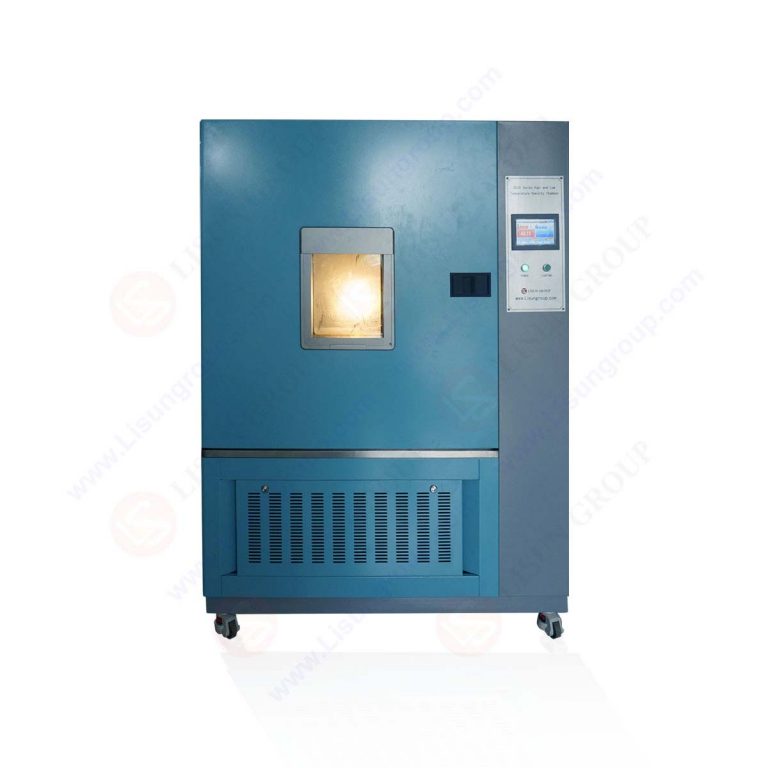
Constant temperature mode operates at fixed setpoints (e.g., 55°C, 85°C, 105°C) per LM-80 requirements. The Accelerated Aging Chamber for IEC 60068 Temperature Testing maintains ±0.5°C stability through PID-controlled heaters and mechanical refrigeration. This mode isolates temperature-driven chemical degradation, enabling Arrhenius modeling with high confidence. Data collection intervals of 1-hour ensure the 6000 data points needed for robust TM-21 extrapolation.
5.2 Thermal Cycling Mode for Mechanical Fatigue
IEC 60068-2-14 (thermal shock) testing evaluates coefficient of thermal expansion (CTE) mismatch failures in LED assemblies. LISUN’s chambers support ramp rates of 5-15°C/minute between -40°C and +150°C. The Accelerated Aging Chamber for IEC 60068 Temperature Testing logs current and voltage during each cycle, detecting intermittent failures caused by solder crack propagation. Typical thermal cycling tests run 500-2000 cycles over 1000-4000 hours.
6.1 Multi-Chamber Synchronization for High-Throughput Testing
LISUN’s architecture supports up to three chambers connected to a single control unit. Each Accelerated Aging Chamber for IEC 60068 Temperature Testing can operate at different temperatures (e.g., Chamber A at 55°C, Chamber B at 85°C, Chamber C at 105°C) simultaneously. The control system synchronizes data logging across all chambers, presenting a unified dashboard for engineers managing 1008 LED packages or 144 luminaires in parallel.
6.2 Photometric Integration Options
For LM-79-19 compliance (Electrical and Photometric Measurements of Solid-State Lighting Products), LISUN offers integrating spheres from 0.3m to 2.0m diameter. The Accelerated Aging Chamber for IEC 60068 Temperature Testing includes optical ports that mate directly with sphere entrance apertures. This integration enables:
- In-situ luminous flux measurement without removing DUTs
- Color shift monitoring (du’v’ per IES TM-30) during aging
- Spectral power distribution (SPD) tracking per CIE 127:2007
7.1 CIE 084 and CIE 70: Photometric Reference Standards
The Accelerated Aging Chamber for IEC 60068 Temperature Testing incorporates calibration traceable to CIE 084 (Measurement of Luminous Flux) and CIE 70 (Measurement of Absolute Luminous Intensity). LISUN’s photometric detectors feature NIST-traceable calibration with uncertainties <2% (k=2). This ensures that lumen maintenance data fed into TM-21 software meets the ±3% accuracy requirements of IES LM-80-15 §4.3.
7.2 Qualification and Environmental Stress Screening (ESS)
Beyond certification testing, LISUN’s chambers support production-level ESS (Environmental Stress Screening). Manufacturers can subject 100% of LED modules to 168-hour accelerated aging at 85°C, identifying early failures within the 6000-hour LM-80 timeframe. The Accelerated Aging Chamber for IEC 60068 Temperature Testing integrates a 4-wire Kelvin measurement system for each DUT, detecting ±0.1mA current changes indicative of catastrophic failure.
The Accelerated Aging Chamber for IEC 60068 Temperature Testing serves as the backbone of modern LED reliability engineering, bridging the gap between accelerated testing and real-world performance prediction. LISUN’s LEDLM-80PL and LEDLM-84PL systems, combined with Arrhenius Model-based software, deliver precise 6000-hour aging data compliant with IES LM-80, LM-84, TM-21, and TM-28 standards. The dual-mode capability—constant temperature for chemical degradation analysis and thermal cycling for mechanical fatigue detection—provides comprehensive validation across all failure mechanisms. With support for up to three connected chambers, customizable photometric integration, and data acquisition resolution down to 0.01 lumens, these systems empower engineers to confidently project L70 lifetimes exceeding 50,000 hours. For third-party testing labs and manufacturing quality control teams, LISUN’s solution eliminates the guesswork from LED product certification, ensuring compliance with CIE 084, CIE 70, and CIE 127 photometric standards. Investing in this integrated aging platform directly translates to reduced field failure rates, faster time-to-market, and defensible warranty claims—critical advantages in the competitive LED lighting industry.
Q1: How does the Accelerated Aging Chamber for IEC 60068 Temperature Testing correlate 6000-hour test data to 50,000-hour LED lifetime projections?
A: The Arrhenius Model-based software calculates acceleration factors based on activation energy (Ea) of LED materials, typically 0.3-0.7 eV. Testing at elevated temperatures (e.g., 85°C vs. expected operating temperature of 55°C) yields acceleration factors of 4-10x. For example, 6000 hours at 85°C with Ea=0.5 eV corresponds to 24,000-60,000 equivalent hours at 55°C. The software applies TM-21’s exponential decay model, fitting lumen maintenance data to A*exp(-t/B) + C, then extrapolating to L70/L50 endpoints with 90% confidence intervals. Per IES LM-80, all tests must include data at three case temperatures (typically 55°C, 85°C, and a manufacturer’s third temperature) to validate the Arrhenius relationship across the operating range.
Q2: What are the specific hardware requirements for connecting three Accelerated Aging Chambers in a synchronized testing configuration?
A: LISUN supports daisy-chaining up to three chambers via a dedicated CAN (Controller Area Network) bus, with each chamber having a unique address (1-3). The master control unit manages temperature setpoints, data logging, and power supply control across all units simultaneously. Each chamber requires independent 230V/16A power supply and compressed air (6 bar, 50 L/min) for pneumatic door seals and cooling fans. Data acquisition modules support 336 DUTs per chamber, meaning a three-chamber system can test 1008 LED packages simultaneously—each with individual current monitoring (0.1mA resolution) and temperature sensing (±0.2°C accuracy). Software synchronization ensures all chambers log data within 1-second timing accuracy.
Q3: How does thermal cycling mode in the Accelerated Aging Chamber for IEC 60068 Temperature Testing detect solder joint failures that constant temperature testing might miss?
A: Thermal cycling (IEC 60068-2-14) induces mechanical stress through CTE mismatch between LED packages, solder joints, and PCB substrates. As temperature cycles between -40°C and +125°C at 10°C/minute, cracks in solder joints open and close, causing intermittent electrical discontinuities. LISUN’s system captures these events by monitoring forward voltage (Vf) every 100ms during transitions—a cracked joint shows 50-200mV spikes compared to normal 3.0-3.5V operation. The software categorizes failures as:
- Catastrophic: complete open circuit (>10% current drop)
- Intermittent: Vf spikes >50mV during 3+ consecutive cycles
- Degradation: Vf drift >5% over 1000 cycles
This data is plotted on a Weibull distribution to predict time-to-1%-failure under field thermal cycling conditions.
Q4: What photometric measurements can be performed in-situ within the Accelerated Aging Chamber for IEC 60068 Temperature Testing?
A: The chamber integrates directly with LISUN’s 0.3-2.0m integrating spheres, enabling continuous measurement of:
- Luminous flux (lm) per CIE 084:2007 (accuracy ±1.5%)
- Correlated color temperature (CCT) per CIE 13.3 (accuracy ±30K)
- Color rendering index (Ra) per CIE 13.3 (accuracy ±0.5)
- Chromaticity coordinates (x,y) per CIE 1931 (accuracy ±0.002)
- Spectral power distribution (SPD) from 380-780nm (0.5nm resolution)
LEDLM-84PL systems include a built-in 2m sphere with spectroradiometer, while LEDLM-80PL requires external sphere connection via fiber optic cable. This eliminates DUT removal errors (typically 1-3% mechanical misalignment) and enables true L70 calculations based on identical measurement geometry throughout the 6000-hour test.
Q5: How do LISUN’s Accelerated Aging Chambers comply with the latest IES LM-80-15 requirements for sample size and data rejection criteria?
A: IES LM-80-15 §6.2 mandates minimum 20 samples per test temperature, with individual sample current stability within ±2% and temperature stability within ±2°C. LISUN’s chambers exceed these requirements through:
- Sample capacity up to 336 per chamber (2-16x the minimum)
- 4-wire Kelvin current monitoring with 0.1mA resolution
- Individual sample temperature sensors (±0.2°C accuracy)
- Automatic outlier rejection per ASTM E178 (Grubbs’ test)
Data rejection follows §8.2 criteria: samples showing >10% deviation from median are flagged, and ≥70% original samples must survive 6000 hours for valid extrapolation. The software automatically calculates and reports sample retention rates alongside TM-21 projections.