


Abstract
Color measurement accuracy directly impacts product quality across manufacturing industries, yet many professionals struggle to differentiate between spectrophotometers and colorimeters for portable applications. This technical article examines the LISUN HSCD series portable spectrophotometers—models HSCD-780, HSCD-800, and HSCD-860—as comprehensive solutions for color analysis. Unlike basic colorimeters that measure only tristimulus values under limited illuminants, these instruments employ grating spectroscopy and dual-beam optical design to deliver full spectral data from 400-700 nm with 10 nm wavelength resolution. Quality control managers, lab technicians, and R&D engineers will gain detailed understanding of measurement principles, industry standard compliance, and practical application scenarios. The LISUN HSCD spectrophotometer vs colorimeter comparison provides clarity on when spectral analysis outperforms traditional colorimetric methods for demanding industrial quality assurance.
1.1 Spectrophotometer vs Colorimeter: Core Technical Distinctions
The fundamental difference between spectrophotometers and colorimeters lies in their measurement methodology. Colorimeters use three or four filtered photodiodes to approximate human eye response, providing CIE tristimulus values (X, Y, Z) under specific illuminant-observer conditions. Spectrophotometers, including the LISUN HSCD series, measure spectral reflectance or transmittance across the visible spectrum at discrete wavelength intervals. The HSCD series employs a grating spectroscopy system with 10 nm optical resolution, capturing 31 data points from 400 nm to 700 nm. This spectral data enables calculation of color coordinates under any illuminant and observer combination, metamerism indices, and multiple color difference formulas including dEab, dECMC, dE94, and dE00. Colorimeters cannot detect metamerism, making them unsuitable for color matching under varying lighting conditions.
1.2 Dual-Beam Optical Design and Measurement Accuracy
The LISUN HSCD series integrates a dual-beam optical architecture that simultaneously measures specimen reflectance and reference channel intensity. This design compensates for fluctuations in the pulsed xenon lamp output, maintaining measurement stability within a repeatability of dEab ≤ 0.02 for white tiles. The dual-beam configuration splits the light source into two paths: one illuminating the specimen and the other directed to a reference detector. By continuously monitoring the reference channel, the instrument corrects for temporal variations in lamp intensity, temperature-induced drift, and aging effects. This technology achieves inter-instrument agreement of dEab ≤ 0.2 (average for BCRA tiles), ensuring consistent results across multiple units in production environments.
1.3 Illumination and Viewing Geometry Compliance
All HSCD series models support multiple measurement geometries with d/8° (diffuse illumination, 8° viewing) as the primary configuration, compliant with CIE No.15, ISO 7724-1, and ASTM E1164 standards. The instruments include both specular component included (SCI) and specular component excluded (SCE) modes, selectable without hardware changes. SCI mode captures total color including surface gloss, essential for quality control of finished products. SCE mode excludes specular reflection to evaluate surface color independent of gloss variations, critical for texture-sensitive materials. The 8° viewing angle aligns with standard observer conditions, while the integrating sphere with 40 mm diameter ensures uniform illumination across measurement apertures ranging from 4 mm to 8 mm.
2.1 Comparative Analysis of HSCD-780, HSCD-800, and HSCD-860
The following table presents key technical parameters differentiating the three HSCD models:
| Parameter | HSCD-780 | HSCD-800 | HSCD-860 |
|---|---|---|---|
| Wavelength Range | 400-700 nm | 400-700 nm | 400-700 nm |
| Optical Resolution | 10 nm | 10 nm | 10 nm |
| Repeatability (White Tile) | dE*ab ≤ 0.03 | dE*ab ≤ 0.02 | dE*ab ≤ 0.02 |
| Inter-Instrument Agreement | dE*ab ≤ 0.3 | dE*ab ≤ 0.2 | dE*ab ≤ 0.15 |
| Measurement Apertures | 4 mm, 8 mm | 4 mm, 8 mm | 4 mm, 6 mm, 8 mm |
| Light Source | Pulsed Xenon | Pulsed Xenon | Pulsed Xenon |
| SCI/SCE Switching | Manual | Automatic | Automatic |
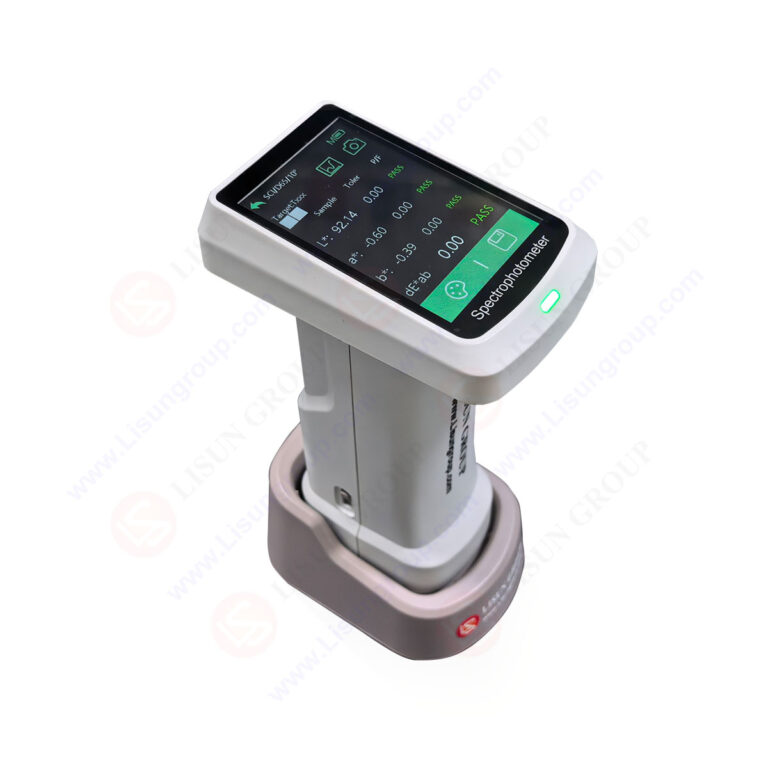
| Display | 2.8” TFT | 3.5” TFT | 4.0” TFT Touch |
| Connectivity | USB, Bluetooth | USB, Bluetooth, WiFi | USB, Bluetooth, WiFi, Ethernet |
| Battery Life (Continuous) | 5000 measurements | 8000 measurements | 10000 measurements |
| Color Indices | 30+ | 40+ | 50+ |
2.2 Nano-Integrated Optical Devices and Calibration Whiteboard
The HSCD series incorporates nano-integrated optical devices that miniaturize the spectrometer module while maintaining high sensitivity. The optical bench uses a concave holographic grating with 1200 lines/mm, fabricated using ion-etching technology for consistent spectral dispersion. The detector array employs a 256-element silicon photodiode linear array with enhanced quantum efficiency in the blue-violet region (400-450 nm), critical for accurate measurement of white and near-white specimens. The calibration system uses a zirconium oxide ceramic whiteboard with certified reflectance values traceable to national metrology institutes. This whiteboard exhibits diffuse reflectance > 95% across the visible spectrum with exceptional stability against UV radiation and thermal aging, maintaining calibration integrity for over 100,000 measurements.
2.3 Connectivity and Data Management Capabilities
Each HSCD model provides comprehensive connectivity options for industrial integration. The HSCD-860 includes Ethernet and WiFi for direct connection to laboratory information management systems (LIMS) and enterprise resource planning (ERP) platforms. Bluetooth 5.0 enables wireless data transmission to mobile devices running LISUN ColorQA software. The instruments store up to 10,000 measurement records internally with time stamps and operator identification. Data export formats include CSV, Excel, and PDF reports compliant with ISO 9001 documentation requirements. The ColorQA software supports real-time trend analysis, statistical process control (SPC) charts, and pass/fail criteria definition based on dE*ab tolerances from 0.1 to 10.0.
3.1 Compliance with International and National Standards
The LISUN HSCD series is designed for full compliance with multiple color measurement standards. CIE No.15:2004 specifies colorimetry methodology, including illuminants (D65, A, C, F2, F11, etc.) and observers (2° and 10°). ISO 7724-1 establishes general principles for color measurement of paints and varnishes. ASTM E1164 defines standard practice for obtaining spectrophotometric data for object-color evaluation. DIN5033 Teil7 covers color measurement for automotive applications. The HSCD instruments also comply with GB/T 3978 for standard illuminants and geometric conditions, GB 2893 for safety colors, and GB/T 18833 for retroreflective materials. ISO 2470 specifies measurement of brightness for pulp and paper. The instruments calculate whiteness indices per ASTM E313 and yellowness indices per ASTM D1925.
3.2 Color Difference Metrics and Tolerance Evaluation
The HSCD series supports multiple color difference formulas essential for different industrial requirements. CIE dEab (CIE 1976) provides the most common metric for basic pass/fail decisions in textile and coating industries. dECMC (2:1) offers improved correlation with visual assessment for leather and automotive interiors. CIE dE94 and dE00 incorporate weighting functions for lightness, chroma, and hue, recommended for plastics and printing applications. The instruments automatically calculate metamerism indices (MI) under different illuminant pairs (D65/A, D65/F11), critical for color matching where specimen and standard have different spectral reflectance curves. The Color Strength Index quantifies dye concentration variations, while the Coverage Factor assesses opacity for paint and ink formulations.
4.1 Plastics and Polymer Color Quality Control
In plastics manufacturing, color consistency across batches and production runs is essential for brand recognition and product uniformity. The HSCD series measures color of pellets, molded parts, and extruded sheets with apertures optimized for small and large specimens. For dark colors and masterbatch evaluation, the 4 mm aperture measures small sample areas while maintaining measurement precision. The instruments calculate yellowness index per ASTM D1925 to monitor polymer degradation during processing. For transparent and translucent materials, transmission mode measures haze and clarity. The HSCD-860’s automatic SCI/SCE switching evaluates how surface texture affects perceived color, enabling correction of mold surface finish parameters.
4.2 Printing and Packaging Color Management
Printing applications require tight color tolerances to maintain brand identity across different substrates and printing technologies. The HSCD series with 6 mm aperture (HSCD-860) is ideal for measuring printed color patches on packaging materials, labels, and corrugated board. The instruments support CMYK to Lab* conversion calculations and evaluate dot gain effects through density measurements. For metallic and special effect inks, the multi-angle measurement capability using the sphere geometry captures color variation with viewing angle. Compliance with ISO 12647 for process control ensures consistent color reproduction across printing presses. The Bluetooth connectivity enables real-time press-side measurements with immediate feedback to operators.
4.3 Coatings, Textiles, and Automotive Interiors
Coatings manufacturers use the HSCD series for raw material incoming inspection, batch formulation, and final product release testing. The instruments measure gloss-related color changes through SCI/SCE comparison, detecting surface texture variations that affect visual appearance. Textile applications include dye lot matching, fabric colorfastness testing, and finishing process control. For automotive interiors, the instruments evaluate leather, plastic trim, and fabric under D65 and A illuminants to ensure visual consistency under daylight and interior lighting. The dE*CMC metric with 2:1 weighting provides correlation with human visual assessment for the curved and textured surfaces common in vehicle cabins.
5.1 Calibration and Verification Procedures
Proper calibration is fundamental to accurate color measurement. The HSCD series performs automatic zero calibration (black trap) and white calibration (zirconium ceramic tile) at power-up. Users should verify calibration against certified reference standards daily or before critical measurement sessions. The instrument automatically detects the calibration tile and applies correction factors stored in memory. For inter-instrument agreement verification, the BCRA (British Ceramic Research Association) series of 12 ceramic tiles provides validation across the color gamut. The HSCD-860 includes built-in diagnostic routines that check photometric linearity, wavelength accuracy (using holmium oxide filters if available), and stray light levels.
5.2 Sample Preparation and Measurement Conditions
Consistent measurement conditions are necessary for reproducible results. Specimens should be clean, dry, and free from fingerprints or contaminants. For thin films and transparent materials, measure over a standard backing (black or white) as specified by the relevant standard. Textured surfaces require multiple measurements at different positions with averaging to capture representative color. The HSCD series supports statistical averaging of 2 to 10 measurements with automatic outlier rejection. Temperature and humidity conditions should be maintained within 15-35°C and 20-80% RH non-condensing to prevent instrument drift. For hygroscopic materials like paper, condition specimens at 50% RH for 24 hours before measurement per ISO 187.
6.1 Spectral and Colorimetric Data Visualization
The ColorQA software provides comprehensive data visualization tools. Spectral reflectance curves display with 10 nm resolution, allowing operators to identify metameric matches and spectral differences invisible to tristimulus colorimeters. Color difference plots show pass/fail status relative to tolerance ellipses in Lab or LCh space. Trend analysis charts monitor color drift over production time, enabling predictive maintenance and process adjustment. The software automatically calculates 50+ color indices including whiteness (CIE, Berger, Hunter, Taube), yellowness (ASTM D1925, E313), tint, opacity, hiding power, and strength.
6.2 Customizable Reporting and Integration
The HSCD series generates customizable test reports in multiple formats. Standard reports include measurement conditions (illuminant, observer, aperture, SCI/SCE mode), specimen identification, date/time stamps, spectral data, color coordinates, and color difference values. Reports can include tolerance status, metamerism indices, and color strength calculations. The software supports barcode scanning for specimen tracking and integration with laboratory information management systems (LIMS). For quality audits, the instruments maintain a complete measurement history with operator electronic signatures compliant with FDA 21 CFR Part 11 requirements. Data export to Excel enables further statistical analysis using external software.
7.1 Spectral Data vs Tristimulus Limitations
Colorimeters measure only three broad wavelength bands, typically corresponding to CIE X, Y, Z tristimulus functions. This limited data cannot detect metamerism, calculate color under different illuminants, or provide spectral information for formulation adjustment. The LISUN HSCD spectrophotometer vs colorimeter comparison demonstrates that spectral instruments capture reflectance at 31 discrete wavelengths, enabling accurate color matching even when visual perception changes under different lighting. For example, a plastic part may match under D65 but fail under incandescent light (A illuminant); only spectral data can predict this metameric failure. Colorimeters are suitable only for basic pass/fail of non-critical colors with consistent illumination.
7.2 Long-Term Stability and Calibration Confidence
The HSCD series zirconium ceramic whiteboard maintains stable reflectance over years of use, unlike the barium sulfate or PTFE-based standards used in colorimeters which degrade under UV exposure and handling. The dual-beam design compensates for lamp aging and temperature effects, maintaining measurement accuracy without frequent recalibration. Colorimeters with single-beam optics require recalibration after any change in ambient conditions. The HSCD series achieves wavelength accuracy of ±0.3 nm (tested using holmium oxide or didymium filters), ensuring consistent color measurement across the instrument’s lifetime. The modular optical design allows field replacement of the light source without affecting calibration parameters.
The LISUN HSCD series portable spectrophotometers represent a significant advancement over traditional colorimeters for industrial color quality control. The grating spectroscopy and dual-beam optical design provide full spectral data with 10 nm resolution, enabling metamerism detection, multiple illuminant evaluation, and comprehensive color index calculation. The three models—HSCD-780, HSCD-800, and HSCD-860—offer scalable performance from basic quality assurance to advanced research applications, with repeatability as low as dEab ≤ 0.02 and inter-instrument agreement within dEab ≤ 0.15 for the top model. Compliance with CIE No.15, ISO 7724-1, ASTM E1164, DIN5033 Teil7, GB/T 3978, GB 2893, GB/T 18833, ISO 2470, ASTM E313, and ASTM D1925 standards ensures acceptance across global manufacturing industries including plastics, printing, coatings, textiles, food packaging, appliances, and automotive interiors. The nano-integrated optical devices and zirconium calibration whiteboard deliver long-term stability, while connectivity options including USB, Bluetooth, WiFi, and Ethernet enable integration into modern quality management systems. For professionals requiring precise, portable color analysis, the LISUN HSCD spectrophotometer vs colorimeter comparison clearly demonstrates the advantages of spectral measurement technology for achieving consistent product color and meeting stringent quality requirements.
Q1: What is the main difference between a spectrophotometer and a colorimeter for portable color analysis?
A: A colorimeter measures color using three or four broad-band filters that approximate human eye response, providing limited tristimulus values (X, Y, Z) that are only valid for the specific illuminant used during measurement. In contrast, the LISUN HSCD spectrophotometer measures spectral reflectance at 31 discrete wavelengths from 400-700 nm with 10 nm resolution. This spectral data allows calculation of color coordinates under any standard illuminant (D65, A, F11, etc.) and observer (2°, 10°) combination, detection of metamerism, and computation of multiple color indices (whiteness, yellowness, opacity, strength). Colorimeters cannot detect when two materials match under one light but differ under another, making spectrophotometers essential for color matching in variable lighting conditions.
Q2: How do I select between HSCD-780, HSCD-800, and HSCD-860 for my application?
A: Selection depends on your specific quality control requirements. The HSCD-780 (entry-level) with dEab repeatability ≤ 0.03 and inter-instrument agreement ≤ 0.3 is suitable for basic pass/fail testing in textile and packaging applications where tight tolerances are not critical. The HSCD-800 (mid-range) offers improved repeatability (dEab ≤ 0.02) and agreement (≤ 0.2) with auto SCI/SCE switching, ideal for paint and coating manufacturers requiring consistent results across multiple production sites. The HSCD-860 (advanced) provides the best inter-instrument agreement (dE*ab ≤ 0.15), three aperture options (4, 6, 8 mm), touchscreen interface, and full connectivity (Ethernet, WiFi, Bluetooth). Choose the HSCD-860 for automotive interiors, plastics masterbatch, and research applications where maximum accuracy and data integration are required.
Q3: What maintenance procedures are required to ensure long-term measurement accuracy?
A: Regular maintenance includes daily calibration verification using the included zirconium ceramic whiteboard and black trap. The whiteboard should be cleaned monthly with lint-free cloth and isopropyl alcohol, avoiding abrasive materials that could damage the ceramic surface. The integrating sphere requires periodic inspection for dust accumulation; clean the sphere interior using compressed air (oil-free) at 6-month intervals. Replace the pulsed xenon lamp when the instrument indicates low energy (typically after 100,000-150,000 measurements). Annual recalibration at an accredited laboratory is recommended, which includes verification of wavelength accuracy (using holmium oxide or didymium filters), photometric linearity, and stray light levels. The instrument automatically tracks calibration intervals and alerts users when recalibration is due.
Q4: Can the HSCD spectrophotometer measure transparent, translucent, and opaque materials with the same accuracy?
A: Yes, the HSCD series supports both reflectance and transmittance measurement modes. For opaque materials, use reflectance mode with the specimen placed at the measurement port. For transparent and translucent materials, switch to transmission mode using the included transmission compartment. The instrument automatically compensates for the optical path difference. For translucent plastics and films, measure over a standard backing (white or black as specified by your quality standard) to achieve reproducible results. The measurements include all standard color indices (CIE Lab, LCh, XYZ) for any material type. For highly transparent materials with low haze, the instrument can measure luminous transmittance and haze percentage. The measurement aperture selection (4, 6, or 8 mm depending on model) allows optimization for small transparent samples.