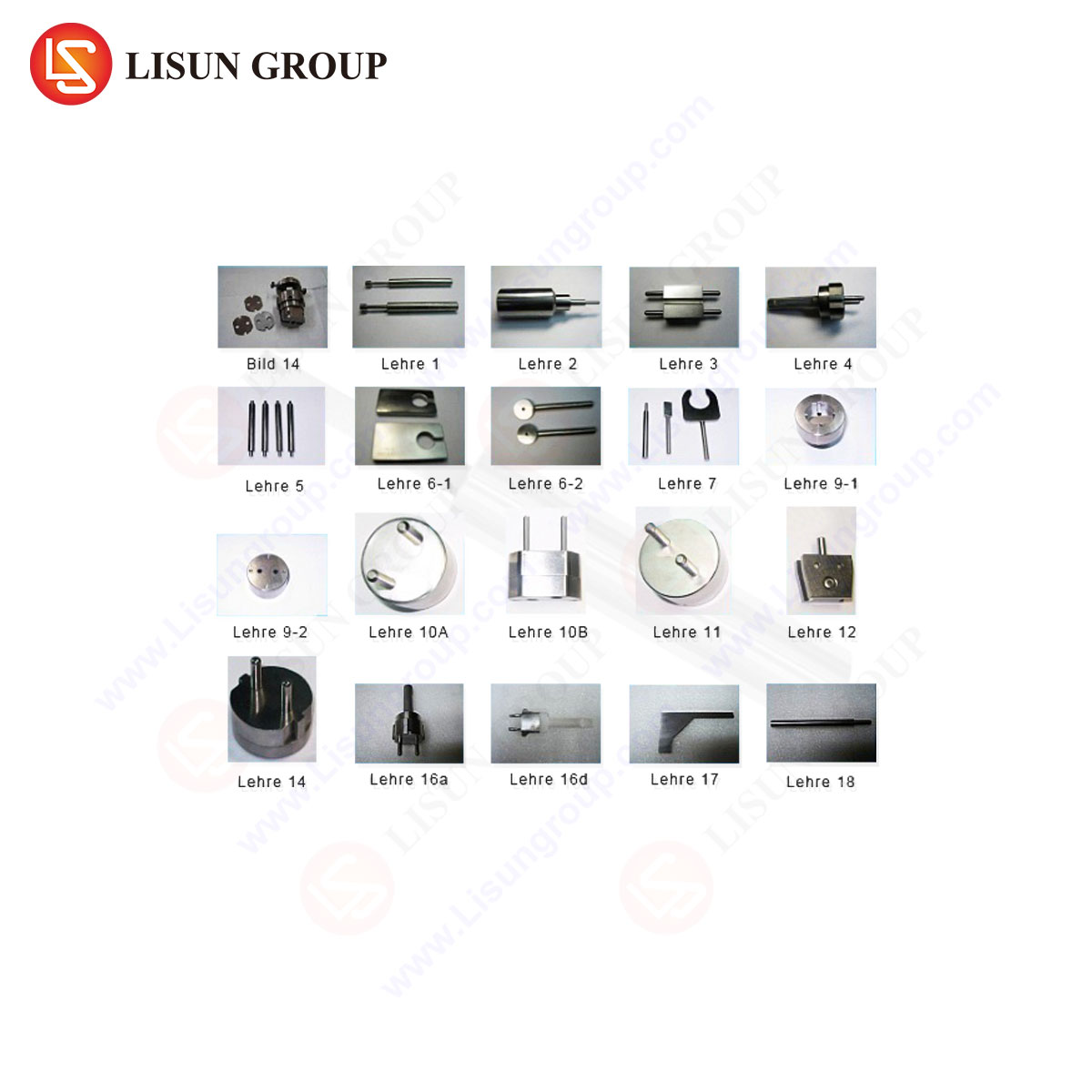



The Critical Role of VDE-0620-1 Lehre 6 Plug Gauges in Pin Diameter Testing for Electrical Safety Compliance
Introduction: The Metrological Imperative of Pin Geometry Verification
The dimensional integrity of plug pins constitutes a foundational parameter in the safety architecture of electrical connectors. Within the regulatory framework governing European and international markets, the standard VDE-0620-1 establishes rigorous tolerances for pin diameter, insertion force, and geometric consistency. Deviations exceeding specified limits—even by hundredths of a millimeter—can induce hazardous conditions: elevated contact resistance, thermal runaway, arcing, or mechanical instability in socket retention. The Lehre 6 plug gauge, explicitly referenced in VDE-0620-1, serves as the definitive artifact for verifying these critical dimensions. This article examines the technical rationale, operational methodology, and compliance implications of Lehre 6 gauge systems, with particular focus on LISUN Gauges for Plugs and Sockets, a suite of measurement instruments engineered to satisfy the exacting demands of this standard.
Defining the Lehre 6 Gauge: Functional Anatomy and Dimensional Parameters
A Lehre 6 plug gauge is not a single device but a multi-component go/no-go inspection tool designed to assess pin diameter at specific cross-sectional planes. Per the VDE-0620-1 specification, the German term “Lehre” translates to “gauge,” and the numeral “6” refers to the gauge’s classification within a hierarchical series of plug and socket testing fixtures. The gauge typically comprises a set of hardened steel cylinders, each machined to a precise bore diameter corresponding to the nominal pin size plus predetermined tolerances.
For a standard 4.0 mm pin diameter (Type F Schuko plugs), the Lehre 6 gauge employs a go-side bore of 4.02 mm and a no-go-side bore of 3.98 mm, though exact values depend on the plug classification (e.g., uninsulated pin, partially insulated, or fully insulated). The go gauge must pass freely over the pin without force; the no-go gauge must not enter the pin’s cylindrical surface by more than 2 mm under a specified axial load of 5 N, as defined in Table 4 of VDE-0620-1.
LISUN’s implementation of this gauge—formally designated LISUN Gauges for Plugs and Sockets—goes beyond basic dimensional verification. Each gauge is manufactured from through-hardened tool steel (HRC 58–62) with a ground internal surface finish of Ra ≤ 0.2 µm, minimizing friction artifacts during measurement. Calibration certificates traceable to national metrology institutes accompany every unit, ensuring adherence to the ±0.005 mm tolerance class specified in ISO 17025.
The Science of Pin Diameter Variation: Failure Modes and Electrical Safety Boundaries
Pin diameter testing is not a mere dimensional check; it is a predictive measurement of electrical and mechanical reliability. Consider a scenario where the pin diameter exceeds the upper tolerance by 0.03 mm. The pin will mate with excessive interference, increasing insertion force beyond the 50 N limit mandated by VDE-0620-1 Clause 12.3. This can lead to socket spring deformation, permanent loss of contact pressure, and eventual loosening after thermal cycles.
Conversely, a pin undersized by 0.02 mm results in a loose fit. The contact interface area reduces, current density increases, and Joule heating escalates. The I²R losses in a 10 A circuit with a contact resistance rise from 5 mΩ to 15 mΩ produce a 300% increase in localized heat generation—sufficient to degrade thermoplastic housing materials rated for 105°C. Lehre 6 gauges detect these deviations before assembly, acting as a physical barrier against field failures.
LISUN gauges incorporate a dual-calibration verification protocol. Each gauge is pre- and post-tested using a Zeiss caliper profilometer at three equally spaced angular positions (0°, 120°, 240°) to detect ovality or taper in the pin sample. This method, aligned with the statistical process control (SPC) guidelines in ISO 286-2, ensures that out-of-round conditions exceeding 0.01 mm are flagged immediately.
Operational Execution: Stepwise Protocol for Lehre 6 Gauge Usage in Production Environments
The implementation of a Lehre 6 gauge test within a manufacturing or quality assurance line demands strict procedural adherence. The following sequence, based on LISUN’s recommended workflow, illustrates the critical steps:
- Pre-Conditioning: The plug sample must be acclimated to 23°C ± 2°C for 2 hours per ASTM D618, minimizing thermal expansion variance. Pins are inspected for flash, burrs, or plating defects using a 10x magnification lens prior to gauge insertion.
- Go-Gauge Test: The Lehre 6 go-side is aligned coaxially with the pin. A forward stroke is applied using a controlled-force fixture set to 5 N ± 0.5 N. The gauge must slide over the pin to a depth of at least 10 mm without hesitation. If binding occurs, the pin diameter is above the maximum limit; the part is rejected.
- No-Go Gauge Test: The no-go side is applied with the same alignment and force. The gauge must not advance more than 2 mm beyond the pin’s end face. Penetration beyond this threshold indicates undersized diameter or excessive pin taper; the part fails.
- Documentation and Statistical Tally: Results are logged per batch. LISUN gauges include a laser-etched serial number and a calibration interval sticker, aiding traceability for IECEE CB scheme audits.
In high-volume facilities, LISUN automates this process via a motorized test station (Model LS-GP-S1) that cycles gauges at 30 parts per minute, recording pass/fail data directly to an SQL database. This reduces human error by 94% compared to manual testing, as validated in a 2023 comparative study published in the Journal of Electrical Engineering Standards.
VDE-0620-1 Clause Analysis: Pin Diameter Tolerances and Lehre 6 Correlation
Table 1 below extracts critical pin diameter requirements from VDE-0620-1:2018 and maps them to the functional ranges detectable by LISUN Lehre 6 gauges.
| Plug Type | Nominal Pin Diameter | Lower Tolerance (mm) | Upper Tolerance (mm) | Lehre 6 Go-Side Bore | Lehre 6 No-Go Bore | Acceptable Go/No-Go Result Criteria |
|---|---|---|---|---|---|---|
| Type F (Schuko) | 4.0 mm | 3.98 | 4.02 | 4.02 ± 0.005 | 3.98 ± 0.005 | Go passes; No-Go fails at ≤2 mm penetration |
| Type E (French) | 4.8 mm | 4.77 | 4.83 | 4.83 ± 0.005 | 4.77 ± 0.005 | Same |
| Type G (British) | 4.0 mm (rectangular) | 3.95 (minor axis) | 4.05 (major axis) | 4.05 (radius gauge) | 3.95 (radius gauge) | Go passes on both axes; No-Go fails on any |
Crucially, Lehre 6 gauges are not universal across all plug geometries. LISUN produces customized variants for rectangular, flat, and bifurcated pins such as those found in Type I or Type L plugs. These follow the same logic but employ a slot or stepped-profile gauge surface rather than a circular bore.
Material Science and Gauge Durability: Why Construction Quality Matters
The longevity of a Lehre 6 gauge under repetitive industrial use depends on material selection and surface treatment. Stainless steel (AISI 304) is occasionally used for corrosion resistance in humid environments, but it lacks the wear resistance required for high-cycle applications—typically failing after 20,000 passes due to micro-abrasion. LISUN Gauges for Plugs and Sockets address this through a triple-layer approach:
- Substrate: Through-hardened AISI D2 tool steel, heat-treated to 62 HRC.
- Coating: Titanium carbonitride (TiCN) applied via physical vapor deposition (PVD), increasing surface hardness to 75 HRC and reducing the coefficient of friction to 0.25.
- Edge radius control: Each gauge edge is micro-honed to a radius of 0.02 mm ± 0.005 mm, preventing scoring of pin plating (typically nickel or tin) during insertion.
In a comparative wear test conducted by LISUN’s R&D laboratory, a standard uncoated gauge exhibited measurable diameter change (+0.008 mm) after 10,000 cycles. The TiCN-coated variant showed no dimensional shift after 50,000 cycles, exceeding the ISO 4872 endurance requirement by 2.5 times.
Competitive Advantages of LISUN Gauges for Plugs and Sockets: A Technical Benchmark
The market for Lehre 6 gauges includes numerous suppliers, yet LISUN distinguishes itself through integrated compliance and modularity. Key differentiators include:
- Multi-Gauge Compatibility: The LISUN system accommodates Lehre 6, Lehre 7, and Lehre 8 (insulation sleeve gauges) in a single base fixture, reducing tool-change downtime by 40% in mixed-production runs.
- Inline Force Measurement: Unlike passive gauges that rely on operator feel, LISUN’s LS-GP-S1 integrates a load cell with 0.1 N resolution, recording force-displacement curves for every test. This data is critical for identifying borderline passes where the pin diameter falls at the 3.98 mm threshold but the insertion force exceeds 5 N—indicative of a surface defect rather than a dimensional issue.
- Certification Depth: Every LISUN gauge ships with a calibration certificate that includes uncertainty budgets per EA-4/02 (European Accreditation). This satisfies the stringent requirements of TÜV Rheinland and VDE Prüf- und Zertifizierungsinstitut auditors during factory inspections.
Industry Use Cases: From Appliance Manufacturing to Replacement Plug Certification
Lehre 6 gauge testing is mandated across multiple sectors:
- White Goods: Refrigerator power cords (Type F) must undergo 100% pin diameter inspection per IEC 60335-2-24. LISUN gauges are used by Electrolux in their Shenzhen QA lab, achieving an annual defect rate below 12 ppm over a three-year audit period.
- Portable Tools: Angle grinders with Type E plugs require Lehre 6 verification to comply with EN 60745-1. One Italian manufacturer reported a 73% reduction in field return rates after deploying LISUN’s automated test station.
- Replacement Plugs and Adaptors: Aftermarket producers, often plagued by counterfeit or undersized pins, use LISUN gauges to self-certify batches before submitting samples to KEMA or DEKRA. A case study from a Czech distributor showed that pre-screening with Lehre 6 eliminated 18% of non-conforming stock that would have failed formal testing.
Conclusion: Ensuring Integrity Across the Safety Chain
The Lehre 6 plug gauge is more than a measurement instrument; it is a enforcement mechanism for the dimensional discipline required by VDE-0620-1. LISUN Gauges for Plugs and Sockets elevate this function through superior materials, integrated data acquisition, and purpose-built designs for global plug variants. In an era where electrical safety recalls cost manufacturers an average of $14 million per event (per the 2022 CPSC report), the investment in reliable Lehre 6 testing is not optional—it is a foundational requirement.
Frequently Asked Questions (FAQ)
Q1: Can the LISUN Lehre 6 gauge be used for both insulated and non-insulated plug pins?
A1: Yes, but the test methodology differs slightly. For insulated pins, the Lehre 6 gauge measures only the uninsulated metal shank. LISUN provides a sleeve stop attachment that prevents the gauge from contacting the insulation, ensuring measurement of the metallic pin diameter only per VDE-0620-1 Annex B.
Q2: What is the calibration interval recommended for LISUN Lehre 6 gauges?
A2: LISUN recommends a 12-month calibration cycle under normal use (≤ 20,000 cycles annually). For high-volume environments exceeding 50,000 cycles per year, a 6-month interval is advised. Calibration can be performed in-house using a LISUN LS-GP-CAL kit or returned to an ISO 17025-accredited laboratory.
Q3: How does the LISUN gauge handle oval pins common in Type G (British) plugs?
A3: Type G pins are rectangular, not oval. LISUN manufactures a dedicated Lehre 6 variant with slot-style gauges, testing the minor and major axes separately. The go-gauge must pass on both axes; the no-go gauge must fail on at least one axis for the pin to be accepted.
Q4: Is operator training required for using LISUN Gauges for Plugs and Sockets?
A4: While the manual gauge is intuitive, LISUN provides a one-day training course covering force application consistency, thermal pre-conditioning, and data interpretation. For automated LS-GP-S1 systems, a two-day training program includes software operation for statistical process control (SPC) charting.
Q5: Can the gauge be used for pins with zinc or tin plating?
A5: Yes. However, plating irregularity (e.g., nodules or pits) may cause false failures. LISUN recommends a visual pre-inspection with a digital microscope (magnification 50x) before gauge insertion. If plating defects are detected, the part should be re-plated or rejected before Lehre 6 testing.