









Precision Power Measurement for Automotive Electronics: Harmonic Analysis and EMC Compliance with LISUN Digital Power Meters
Abstract
LISUN AC/DC digital power meters provide essential measurement capabilities for automotive electronics power measurement with harmonic analysis and EMC compliance validation. These precision instruments integrate digital sampling waveform analysis, automatic range switching, and total harmonic distortion (THD) analysis up to the 50th order. Designed for electrical testing engineers and quality control professionals in automotive electronics and LED manufacturing, the LS2050 series delivers accurate voltage, current, power, and power factor measurements across a frequency range of 0.5Hz to 100kHz. This article examines the technical architecture, compliance capabilities, and practical applications of these power meters for rigorous product validation against international standards including EN/IEC61000-3-2 and LM-79.
1. Technical Architecture of LISUN Digital Power Meters
1.1 Core Measurement Methodology
The LS2050 series employs digital sampling waveform analysis as its fundamental measurement technique. Unlike analog power meters that rely on averaging circuits, digital sampling captures instantaneous voltage and current waveforms at high sampling rates, enabling accurate calculation of true RMS values, active power, apparent power, and power factor. This approach is critical for automotive electronics testing, where non-sinusoidal waveforms from switching power supplies and motor drives introduce significant harmonic content. The digital architecture processes 16-bit resolution samples to compute power parameters with minimal error, even under heavily distorted waveform conditions.
1.2 Automatic Range Switching Technology
Automatic range switching eliminates manual intervention during test sequences, a crucial feature for production line testing in automotive electronics manufacturing. The LS2050 series continuously monitors input signals and selects optimal voltage and current ranges to maintain measurement accuracy. The system supports instantaneous maximum inputs of 1600V voltage and 50A current, providing substantial overload capacity for transient conditions common in automotive electrical systems. Range switching occurs within milliseconds, ensuring uninterrupted data acquisition during dynamic load variations such as motor startup or battery charging cycles.
1.3 Wide Frequency Range Capabilities
The 0.5Hz to 100kHz frequency range accommodates testing requirements across diverse automotive electronic subsystems. Low-frequency measurements apply to battery management systems and DC-DC converters operating at fundamental switching frequencies below 1kHz. High-frequency capabilities extend to inverter drives, wireless charging systems, and power line communication modules operating in the kilohertz range. This wide bandwidth ensures that a single instrument can validate power quality across the entire vehicle electrical architecture, from infotainment systems to traction motor controllers.
2. Harmonic Analysis for Automotive Power Quality
2.1 Total Harmonic Distortion Measurement
Harmonic analysis capability up to the 50th order, using both IEC and CSA calculation methods, enables comprehensive power quality assessment. Automotive power systems increasingly incorporate non-linear loads such as LED lighting drivers, PWM-controlled motors, and switched-mode power supplies for control units. These loads inject harmonic currents into the vehicle electrical network, potentially causing overheating, electromagnetic interference, and premature component failure. The LS2050 series computes individual harmonic magnitudes and total harmonic distortion (THD) for both voltage and current, providing engineers with detailed spectral information for compliance verification.
2.2 Compliance Testing Against EN/IEC61000-3-2
EN/IEC61000-3-2 establishes limits for harmonic current emissions from equipment connected to public low-voltage supply systems, with specific classifications for automotive chargers and onboard power converters. The LS2050C-IEC model incorporates dedicated firmware for automated harmonic compliance testing according to this standard. It classifies equipment into appropriate categories (Class A through D), measures harmonic currents up to the 40th order, and compares results against applicable limits with pass/fail determination. This capability reduces testing time by eliminating manual data processing and ensures reproducible results for certification documentation.
2.3 Waveform Reconstruction and Analysis
Beyond numerical harmonic data, the LS2050 series provides graphical waveform reconstruction for qualitative analysis. Engineers can visualize distorted voltage and current waveforms alongside their harmonic spectra, identifying specific harmonic orders that exceed acceptable thresholds. This visualization aids in designing mitigation strategies, such as passive harmonic filters or active power factor correction circuits. The ability to correlate waveform distortion with specific operating conditions—such as regenerative braking in electric vehicles—enables targeted improvements in power system design.
3. EMC Compliance Validation Framework
3.1 Harmonic Emission Standards for Automotive Electronics
Automotive electronics manufacturers must comply with multiple international standards for conducted emissions, including CISPR 25 for vehicle-level electromagnetic compatibility and IEC 61000-3-2 for mains-connected equipment. The LS2050C-IEC directly addresses the latter requirement, measuring harmonic currents with accuracy suitable for formal compliance testing. The instrument’s measurement uncertainty, typically below 0.1% for fundamental frequency parameters, meets the requirements specified in IEC 61000-4-7 for harmonic measurement instrumentation. This traceability is essential for laboratories seeking accreditation for EMC testing services.
3.2 Power Quality Metrics for Regulatory Reporting
Comprehensive power quality reporting requires measurement of additional parameters beyond harmonic distortion. The LS2050 series captures power factor, displacement factor, crest factor, and frequency variations, all of which contribute to regulatory compliance documentation. For electric vehicle charging stations, power factor correction requirements under standards such as IEC 61851 necessitate accurate displacement factor measurement under varying load conditions. The instrument’s ability to calculate both true power factor (including harmonics) and displacement factor (fundamental only) provides complete power quality characterization for certification submissions.
3.3 Integration with EMC Test Laboratory Workflows
The RS232 and RS485 communication ports enable seamless integration into automated EMC test environments. Test sequences can control measurement parameters, retrieve data in real-time, and generate compliance reports without operator intervention. This automation capability is particularly valuable for production validation testing, where hundreds of units undergo harmonic emission screening daily. The digital interface also facilitates data logging for long-term stability studies, allowing engineers to track power quality degradation over product lifetimes and correlate measurement data with field failure reports.
4. Comparative Analysis of LS2050 Series Models
4.1 Technical Specifications Comparison
The LS2050 series comprises three models tailored to different accuracy and compliance requirements. The following table summarizes key specifications:
| Parameter | LS2050B | LS2050C | LS2050C-IEC |
|---|---|---|---|
| Basic Accuracy (Power) | 0.2% reading + 0.1% range | 0.1% reading + 0.05% range | 0.1% reading + 0.05% range |
| Voltage Range | 0-1000V RMS | 0-1000V RMS | 0-1000V RMS |
| Current Range | 0-50A RMS | 0-50A RMS | 0-50A RMS |
| Frequency Range | 0.5Hz – 100kHz | 0.5Hz – 100kHz | 0.5Hz – 100kHz |
| Harmonic Analysis | Up to 50th order | Up to 50th order | Up to 50th order (IEC method) |
| EN/IEC61000-3-2 Compliance | Manual analysis | Manual analysis | Automated testing |
| Communication Ports | RS232, RS485 | RS232, RS485 | RS232, RS485 |
| Measurement Parameters | V, I, P, PF, F, THD | V, I, P, PF, F, THD, DF | V, I, P, PF, F, THD, DF, IEC limits |
4.2 Model Selection Criteria for Automotive Applications
The LS2050B serves as a cost-effective solution for production line quality control where high accuracy is sufficient but formal compliance certification is not required. The LS2050C with enhanced accuracy (0.1%) supports R&D applications where precise characterization of prototype power converters is necessary. The LS2050C-IEC is indispensable for EMC testing laboratories and certification bodies that must produce documented compliance evidence according to EN/IEC61000-3-2. For automotive electronics manufacturers supplying components to multiple vehicle platforms, the LS2050C-IEC’s automated compliance testing capability reduces certification costs by eliminating the need for external testing for harmonic emissions.
4.3 Calibration and Traceability
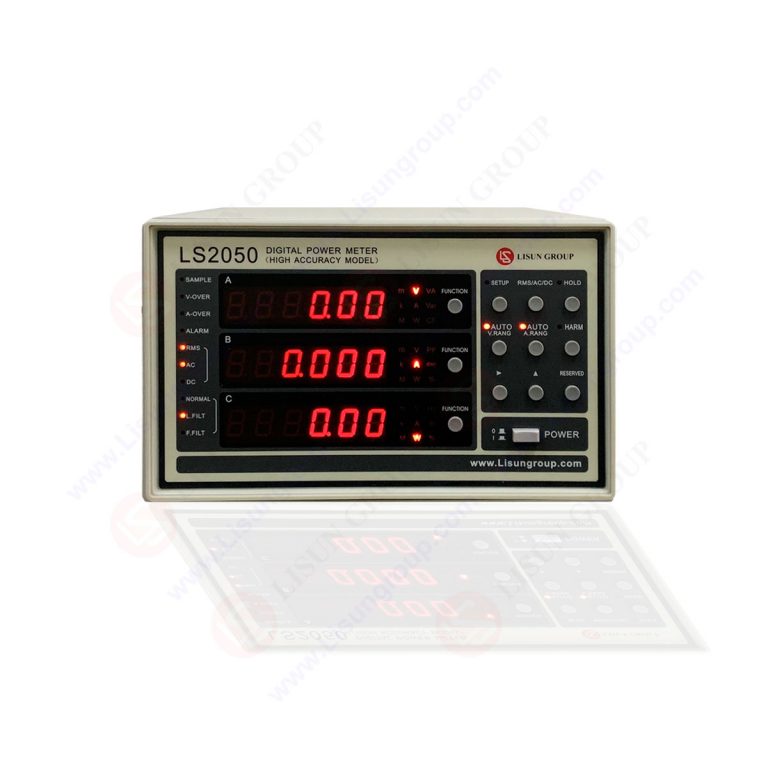
All LS2050 series instruments undergo factory calibration traceable to national standards, with recommended annual recalibration intervals. The LS2050C and LS2050C-IEC models include calibration certificates with measurement uncertainty budgets, essential for ISO 17025 accredited laboratories. Users can verify accuracy in-field using built-in self-test routines and external calibration standards. The instruments maintain specified accuracy over operating temperature ranges of 0°C to 40°C, ensuring reliable performance in production floor environments where temperature variations are common.
5. Automotive Electronics Testing Applications
5.1 LED Lighting System Validation
Automotive LED lighting systems, including headlamps, daytime running lights, and interior lighting, require precise power measurement to verify efficiency and compliance with regulations such as ECE R112 and R148. The LS2050 series measures LED driver input power with accuracy necessary to distinguish between genuine efficiency improvements and measurement artifacts. Harmonic analysis identifies whether LED drivers meet vehicle-level conducted emission limits specified by manufacturer standards. The wide voltage range accommodates nominal 12V, 24V, and 48V automotive electrical systems, as well as high-voltage battery systems in electric vehicles (400V-800V).
5.2 Power Converter and Inverter Testing
Electric vehicle traction inverters and DC-DC converters operate at high switching frequencies with complex modulation schemes that produce significant harmonic content. The LS2050 series captures power parameters during dynamic operating conditions such as acceleration, regenerative braking, and constant torque modes. The 0.5Hz to 100kHz frequency range covers both fundamental power frequencies (50/60Hz) and the modulation frequencies (typically 4kHz-16kHz for traction inverters). Engineers can correlate specific harmonic orders with switching events, enabling targeted design improvements for reduced electromagnetic interference.
5.3 Battery Management System Characterization
Battery management systems (BMS) must accurately monitor state-of-charge, state-of-health, and cell balancing currents. The LS2050 series validates BMS measurements by providing reference power measurements for comparison. The automatic range switching capability handles the wide dynamic range between microamp-level leakage currents and hundreds of amps during fast charging. Harmonic analysis of charging current reveals whether the BMS correctly filters charging ripple and whether harmonic injection from the charger affects battery lifetime.
6. Integration with Test Automation Systems
6.1 Remote Control and Data Acquisition
The RS232 and RS485 communication ports implement industry-standard protocols for remote instrument control. Test automation software can configure measurement parameters, initiate data capture, and retrieve results programmatically. The RS485 interface supports multi-drop configurations for production line testing where multiple LS2050 series instruments coordinate measurement at different test stations. Data transfer rates up to 115200 baud ensure real-time data flow for high-throughput testing applications without measurement gaps.
6.2 Automated Compliance Report Generation
The LS2050C-IEC model includes software utilities for automated report generation conforming to EN/IEC61000-3-2 requirements. These reports include full harmonic spectrum data, pass/fail determination for all applicable harmonic limits, and measurement uncertainty analysis. Reports can be exported in common formats (PDF, CSV, XML) for integration with laboratory information management systems (LIMS). Automated reporting eliminates manual transcription errors and reduces the time required for compliance documentation from hours to minutes.
6.3 Multi-Channel Synchronization
For applications requiring simultaneous measurement at multiple test points, multiple LS2050 series instruments can be synchronized via external trigger inputs. This synchronization capability is essential for testing automotive systems where input and output power must be measured simultaneously to calculate system efficiency. The master-slave configuration ensures that all units capture data within the same measurement window, eliminating time skew errors that would affect efficiency calculations.
7. Standards and Certification Compliance
7.1 Safety Standards Compliance
The LS2050 series complies with IEC 61010, the safety standard for electrical test and measurement equipment. This certification ensures protection against electric shock, arc flash, and other hazards when measuring automotive power systems with voltages up to 1000V RMS. The instrument’s input circuitry includes overvoltage protection up to 1600V instantaneous and overcurrent protection up to 50A instantaneous, providing robust safety margins for real-world testing scenarios.
7.2 Measurement Standards Compliance
In addition to EN/IEC61000-3-2 for harmonics, the LS2050 series supports measurements according to LM-79 for LED luminaire testing and UL 1989 for standby battery chargers. LM-79 compliance requires accurate measurement of total luminous flux and electrical power for solid-state lighting products. The LS2050 series electrical measurements, when combined with LISUN photometric equipment, provide complete LM-79 testing capability. UL 1989 compliance requires harmonic current measurement for standby power systems, directly addressed by the LS2050C-IEC model.
8. Conclusion
LISUN LS2050 series digital power meters deliver essential measurement capabilities for automotive electronics power measurement with harmonic analysis and EMC compliance. The combination of digital sampling waveform analysis, automatic range switching, and harmonic analysis up to the 50th order provides engineers with comprehensive power quality data for product validation. The three model variants—LS2050B, LS2050C, and LS2050C-IEC—offer graduated accuracy and compliance features to match specific application requirements from production line quality control to formal EMC certification testing. Compliance with standards including EN/IEC61000-3-2, LM-79, IEC 61010, and UL 1989 ensures that measurement results are accepted by regulatory bodies and certification organizations worldwide. The integration capabilities through RS232 and RS485 communication ports enable automated testing workflows that reduce testing time and improve measurement reproducibility. For automotive electronics manufacturers and testing laboratories seeking reliable power measurement instrumentation, the LS2050 series provides the technical foundation for rigorous compliance validation and product quality assurance.
FAQ
Q1: How does the LS2050C-IEC automate harmonic compliance testing according to EN/IEC61000-3-2?
A: The LS2050C-IEC includes dedicated firmware that implements the complete EN/IEC61000-3-2 testing procedure. Upon initiating a test, the instrument automatically classifies the equipment under test into the appropriate harmonic current limit class (Class A through D) based on user input or default parameters. It then measures harmonic currents up to the 40th order over a standardized observation period, typically 2.5 minutes for steady-state equipment. The instrument compares each harmonic magnitude against the applicable limit, calculates total harmonic distortion, and generates a pass/fail determination for each harmonic order. Results are displayed on the instrument’s screen and can be exported via RS232 or RS485 communication ports for inclusion in compliance reports. This automation eliminates the need for manual data collection and calculation, reducing testing time by approximately 60% compared to manual methods.
Q2: What is the difference between power factor and displacement factor, and why are both important for automotive electronics testing?
A: Power factor (PF) and displacement factor (DF) measure different aspects of power quality. Power factor is the ratio of active power to apparent power, encompassing both harmonic distortion and phase shift effects. Displacement factor, also called fundamental power factor, considers only the phase relationship between fundamental voltage and current (cosφ). For linear loads with sinusoidal waveforms, PF and DF are identical. However, for non-linear automotive loads like LED drivers and PWM inverters, harmonic currents reduce PF while DF may remain near unity. Both metrics are important because standards specify different requirements: EN/IEC61000-3-2 limits harmonic currents (affecting PF), while equipment specifications often require DF correction to ensure grid stability. The LS2050 series measures both parameters, enabling engineers to diagnose whether poor power factor originates from harmonics or fundamental phase shift.
Q3: Can the LS2050 series measure power on both AC and DC automotive systems?
A: Yes, all LS2050 series models measure power on AC and DC systems without requiring configuration changes. This dual-mode capability is essential for automotive testing because modern vehicles incorporate both systems: 12V/24V DC for conventional electrical systems, 400V-800V DC for traction batteries, and AC for onboard chargers and inverters. The instrument automatically detects the signal type and applies appropriate measurement algorithms. For DC systems, it measures true DC power including any AC ripple components. For AC systems, it computes true RMS values considering harmonic content. The automatic range switching operates identically for both modes, providing seamless measurement across the full voltage range of 0-1000V RMS and frequency range of 0.5Hz-100kHz. This eliminates the need for separate DC and AC power meters, reducing equipment costs and simplifying test setups.
Q4: What calibration requirements apply to the LS2050 series for ISO 17025 accredited testing?
A: For ISO 17025 accredited testing, the LS2050C and LS2050C-IEC models require annual recalibration by an ISO 17025 accredited calibration laboratory. The factory calibration certificate provides traceability to national standards through documented measurement uncertainty budgets. During recalibration, all measurement functions (voltage, current, power, power factor, frequency, and harmonic analysis) are verified against reference standards with uncertainty at least four times better than the instrument specification. Calibration procedures should follow manufacturer recommendations, typically checking at multiple points across each range. The instrument includes calibration adjustment software accessible only by authorized service personnel, ensuring calibration integrity. Users should maintain calibration records for the lifetime of the instrument and verify accuracy between calibrations using available self-test routines. For critical compliance testing, some laboratories perform intermediate checks using external voltage and current references to ensure measurement confidence between annual calibrations.