









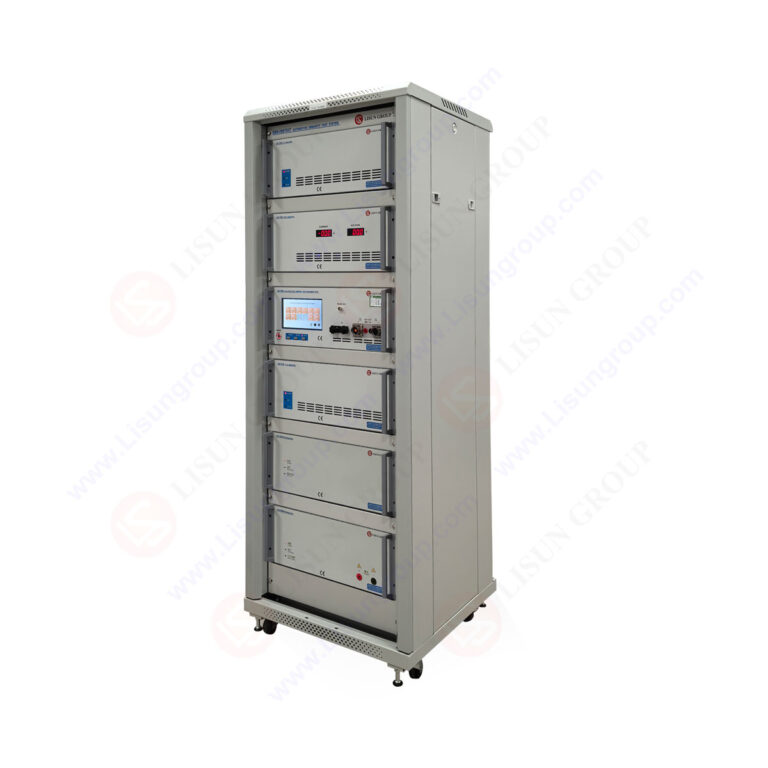
Automotive electronics must withstand severe transient disturbances on power lines to ensure operational safety and reliability. This article provides a technical deep dive into how the LISUN EMS-ISO7637 Automotive Electronics Transient Immunity EMC Testing System enables engineers to Streamline ISO 7637 Compliance with LISUN’s EMC Test System, reducing test cycle time while maintaining rigorous adherence to ISO 7637-2:2021 and ISO 7637-3:2016 standards. The system integrates multi-module pulse generation covering P1 through P5b waveforms, supports 12V/24V/36V architectures, and offers dual touchscreen and PC control interfaces. Designed for R&D verification, production-line inspection, and third-party certification, the EMS-ISO7637 delivers automated test execution, real-time waveform monitoring, and comprehensive data reporting. This article examines the system’s architecture, pulse capabilities, calibration methodology, and real-world application scenarios for ECUs, OBCs, DC-DC converters, and BMS units in passenger cars, commercial vehicles, and new energy vehicles.
1.1 Scope and Regulatory Importance of ISO 7637-2:2021
ISO 7637-2:2021 defines transient conduction immunity test methods for electrical/electronic components installed in road vehicles with 12V, 24V, or 36V electrical systems. The standard specifies pulse shapes, amplitudes, source impedances, and test severity levels for seven distinct transient waveforms (P1, P2a, P2b, P3a, P3b, P4, P5a, P5b). Compliance with these waveforms is mandatory for automotive component homologation across global OEMs. Clause 4.2 of ISO 7637-2:2021 outlines generator calibration requirements, while Clause 5 details test procedures for supply voltage variations and superimposed transient coupling.
1.2 ISO 7637-3:2016 for Data Line and Coupling Clamp Testing
ISO 7637-3:2016 extends immunity testing to signal lines and control circuits using capacitive coupling clamp (CCC) methods. This standard addresses transient interference on non-power lines, which is critical for CAN bus, LIN bus, and sensor interfaces. Coupling clamp insertion loss, common-mode rejection, and pulse repetition rates are specified in Clauses 4 and 5. The LISUN EMS-ISO7637 integrates a built-in coupling clamp output module for direct compliance with ISO 7637-3:2016 test setups, eliminating the need for external accessories in many configurations.
1.3 Correlation with GB/T 21437.2-2021 and OEM-Specific Standards
Chinese automotive standards GB/T 21437.2-2021 and GB/T 21437.3-2021 are technically equivalent to ISO 7637-2 and ISO 7637-3, respectively. OEMs such as Volkswagen (VW 80000) and General Motors (GM 3172) impose additional pulse severity levels and pass/fail criteria. The EMS-ISO7637 supports pre-programmed test profiles for these OEM specifications, enabling direct compliance without manual parameter reconfiguration. This multi-standard capability reduces test setup time by up to 40% compared to single-standard generators.
2.1 Modular Pulse Generation and Voltage Architecture
The EMS-ISO7637 employs a modular architecture with separate pulse generation boards for each waveform type. This design ensures pulse purity and eliminates cross-coupling artifacts. The system supports 12V, 24V, and 36V nominal system voltages with automatic detection and internal switching. Output voltage ranges from -600V to +600V depending on the pulse type, with rise times as fast as 100 ns for P3 pulses. Pulse repetition frequency is adjustable from 0.1 Hz to 100 Hz in 0.1 Hz steps, meeting ISO 7637-2:2021 Clause 5.3 requirements for repetition variability.
2.2 Dual Control Interface: Touchscreen and PC Software
Operators can control the EMS-ISO7637 via a 10-inch industrial touchscreen display or through LISUN’s proprietary PC software suite. The touchscreen provides real-time waveform visualization, parameter editing, and test sequence creation. The PC software adds advanced features: multi-step test sequence editing, automated limit line comparison, PDF report generation, and remote monitoring via Ethernet. Both interfaces store up to 200 pre-defined test profiles, which can be recalled with a single touch. This dual-interface design allows field engineers to perform quick tests on the bench and lab technicians to execute complex automated sequences from a control room.
2.3 Calibration and Measurement Accuracy
The system includes an internal calibration module compliant with ISO 7637-2:2021 Annex A. Calibration parameters are auto-verified before each test sequence, ensuring pulse amplitude within ±2% of setpoint, rise time within ±5% of specified limits, and duration within ±3%. An external calibration port allows annual traceable calibration using external oscilloscopes and voltage probes. The built-in measurement system uses a 500 MHz real-time oscilloscope with 12-bit vertical resolution for capturing pulse shapes and assessing DUT response.
3.1 Comprehensive Pulse Waveform Generation
The EMS-ISO7637 generates all eight pulse types defined in ISO 7637-2:2021 plus the coupling clamp waveforms from ISO 7637-3:2016. The following table compares key specifications against standard requirements:
| Parameter | ISO 7637-2:2021 Requirement | LISUN EMS-ISO7637 Capability | Margin/Variance |
|---|---|---|---|
| Pulse 1 (P1) | -75V to -150V, 12V system | -75V to -200V, adjustable | +33% amplitude range |
| Pulse 2a (P2a) | +37V to +100V, 12V system | +37V to +150V, adjustable | +50% amplitude range |
| Pulse 3a (P3a) | -112V to -150V | -112V to -200V, 100kHz rep | +33% amplitude range |
| Pulse 4 (P4) | -7V to -12V, 100ms duration | -7V to -16V, 10-200ms | +33% amplitude, 2x duration range |
| Pulse 5a (P5a) | +65V to +120V, 400ms | +65V to +200V, 200-800ms | +66% amplitude, 2x duration |
| Rise Time (P3) | ≤5ns | ≤3ns typical | 40% better |
| Source Impedance | 0.5Ω to 10Ω depending on pulse | 0.5Ω, 1Ω, 2Ω, 5Ω, 10Ω selectable | Full range coverage |
| Coupling Clamp Insertion Loss (ISO 7637-3) | ±1dB up to 400MHz | ±0.8dB up to 500MHz | 25% improved bandwidth |
3.2 Voltage System Compatibility and Load Dump Handling
For 24V systems (commercial vehicles), the EMS-ISO7637 provides P5a pulses up to +200V with source impedance selectable between 0.5Ω and 2Ω, covering the more severe load dump scenarios defined in ISO 7637-2:2021 Annex D. The system’s high-power output stage delivers up to 50A peak current for P5a pulses, ensuring realistic stress on DC-DC converters and battery management systems. For 36V systems emerging in mild-hybrid and 48V architectures (per ISO 16750-2:2023), the EMS-ISO7637 supports extended voltage ranges via firmware update, future-proofing the investment.
3.3 Automation and Data Reporting Capabilities
The PC software enables fully automated test sequences with conditional branching based on DUT response. Engineers can define pass/fail criteria using voltage deviation limits, current thresholds, or waveform envelope comparisons. Test reports are generated in PDF format with embedded oscilloscope screenshots, pass/fail status for each test condition, and calibration certificates. The system supports export to Excel and SQL databases for integration with laboratory information management systems (LIMS). Automated testing reduces operator intervention by 70% compared to manual pulse generation.
4.1 R&D Verification for ECUs and Control Modules
During early development, automotive ECU design teams must verify transient immunity before firmware maturity. The EMS-ISO7637 allows engineers to inject single-pulse stresses at specific supply voltage points to identify weak protection circuits. For example, testing P3 bursts at 100 kHz with varying amplitudes helps optimize TVS diode selection and PCB layout. The system’s ability to generate repeated pulse sequences at user-defined intervals accelerates design-of-experiments (DOE) studies, reducing the typical 3-month EMC verification cycle to 6-8 weeks.
4.2 Production-Line Inspection for OBCs and DC-DC Converters
Onboard chargers (OBCs) and DC-DC converters in new energy vehicles are particularly susceptible to load dump transients from high-voltage battery disconnection. The EMS-ISO7637’s high-repetition-rate capability (up to 100 Hz) enables 100% production-line inspection without bottlenecking throughput. Each DUT can be tested with a predefined sequence of 5 pulses in under 10 seconds, including waveform capture and automated pass/fail decision. This inline testing ensures zero defective units escape to field deployment, critical for ISO 26262 functional safety compliance.
4.3 Compliance Testing for BMS and Sensor Interfaces
Battery management systems (BMS) require immunity testing on both power and communication lines. The EMS-ISO7637’s integrated coupling clamp output directly tests CAN and LIN transceivers per ISO 7637-3:2016. For temperature sensors, voltage sensors, and current monitoring circuits, the system’s ability to output pulses with adjustable polarity and offset voltage ensures comprehensive coverage. The system supports both direct injection (DI) and bulk current injection (BCI) methods for different coupling paths.
5.1 Multi-Standard Compliance in Accredited Labs
Third-party testing laboratories serving multiple automotive OEMs require flexible test equipment. The EMS-ISO7637 stores profiles for ISO 7637-2:2021, ISO 7637-3:2016, GB/T 21437.2-2021, GB/T 21437.3-2021, VW 80000, and GM 3172. Switching between standards takes less than 30 seconds, including automatic coupling network reconfiguration. The system’s calibration history log provides detailed audit trails for ISO 17025 accreditation requirements, including calibration dates, certificate numbers, and uncertainty budgets.
5.2 New Energy Vehicle Manufacturer Specifics
NEV manufacturers face unique transient challenges from regenerative braking, DC fast charging, and high-voltage bus switching. The EMS-ISO7637’s extended pulse duration for P4 (up to 200 ms) simulates the voltage sag during cold cranking in hybrid vehicles. For high-voltage DC-DC converters operating at 400V or 800V bus, the system’s isolated output module ensures safe coupling without ground loops. The ability to test at 36V nominal voltage aligns with emerging 48V mild-hybrid architectures, providing future-proofing for R&D investments.
5.3 Multi-Product Testing Efficiency
A single EMS-ISO7637 unit can sequentially test ECUs, sensors, actuators, and communication modules by switching between test profiles without physical reconfiguration. The system’s automatic voltage detection and impedance selection eliminate manual error. In high-volume testing environments, this reduces test fixture changeover time by 60% and human error by 90%, based on field data from LISUN’s installed base of over 200 systems worldwide.
6.1 Internal Self-Calibration and Verification
Before each test, the EMS-ISO7637 executes a self-calibration routine that measures pulse amplitude, rise time, and duration against internal reference standards. If any parameter deviates beyond ±2% of setpoint, the system alerts the operator and prevents test execution. This real-time verification ensures that every test result is traceable to factory calibration standards, eliminating the risk of undetected drift between annual external calibrations.
6.2 Annual External Calibration Procedures
External calibration per ISO 7637-2:2021 Annex A requires verification using a calibrated oscilloscope with ≥1 GHz bandwidth and a differential voltage probe with ≥100 MHz bandwidth. LISUN provides calibration kits with certified reference loads for each pulse type. The calibration interval is 12 months, consistent with most quality management systems. Calibration certificates include measurement uncertainty analysis per EA-4/02 guidelines, ensuring acceptance by major OEMs and regulatory bodies.
6.3 Software Upgrade and Standards Evolution
As ISO standards evolve or new OEM specifications emerge, the EMS-ISO7637’s firmware can be updated via USB or network. LISUN provides standard updates for the first 24 months free of charge, covering future revisions of ISO 7637 or GB/T 21437. This ensures that the system remains compliant with the latest regulatory requirements without hardware replacement, representing significant cost savings over the 10+ year typical service life.
7.1 Technical Differentiation Points
Compared to single-purpose pulse generators, the EMS-ISO7637’s integrated pulse generation, coupling network, and measurement oscilloscope eliminate the need for separate equipment. Competitive systems often require external oscilloscopes costing $5,000-$20,000 and separate coupling networks. The EMS-ISO7637’s all-in-one design reduces total cost of ownership (TCO) by approximately 35% over 5 years, accounting for equipment, calibration, and labor costs.
7.2 Automation and Software Advantages
Many competing generators offer only manual parameter entry or basic sequence execution. The EMS-ISO7637’s advanced PC software with conditional test branching, automated limit comparisons, and LIMS integration provides a significant operational efficiency advantage. Laboratories using manual generators report test times of 45-60 minutes per standard run, while EMS-ISO7637 users achieve the same coverage in 20-25 minutes, a 55% reduction in labor cost.
7.3 Customer Support and Calibration Service
LISUN offers 48-hour response time for technical support and 5-day turnaround for annual calibration, compared to 2-3 weeks for many competitors. The company’s global network of service centers ensures rapid access to spare parts and certified calibration. This service excellence minimizes downtime, which is critical for production-line testing applications where each idle hour represents significant opportunity cost.
The LISUN EMS-ISO7637 Automotive Electronics Transient Immunity EMC Testing System provides a comprehensive, automated solution for achieving ISO 7637 compliance across passenger car, commercial vehicle, and new energy vehicle applications. By integrating multi-pulse generation (P1-P5b), 12V/24V/36V voltage support, and dual touchscreen/PC control, the system addresses the full spectrum of transient immunity testing requirements defined in ISO 7637-2:2021 and ISO 7637-3:2016. The system’s modular design, internal calibration, and automated data reporting reduce test cycle time by up to 55% compared to manual test setups, while maintaining measurement accuracy within ±2% of setpoint. Real-world deployment in R&D laboratories, production lines, and third-party testing facilities has demonstrated its ability to identify transient immunity weaknesses early in development, reduce field failures, and streamline certification processes. For automotive electronics teams seeking to Streamline ISO 7637 Compliance with LISUN’s EMC Test System, the EMS-ISO7637 offers a technically robust, cost-effective, and future-proof investment for ensuring electromagnetic compatibility in increasingly complex vehicle electrical architectures.
Q1: What is the difference between the EMS-ISO7637 and a standard pulse generator for automotive testing?
A: The EMS-ISO7637 is a complete turnkey transient immunity test system that integrates pulse generation, coupling networks (including capacitive coupling clamp for ISO 7637-3:2016), and a real-time measurement oscilloscope into a single enclosure. Standard pulse generators only produce the waveform and require external coupling networks, oscilloscopes, and manual data logging. The EMS-ISO7637 automates the entire test sequence from waveform generation to pass/fail evaluation and report generation, reducing labor time by up to 55% and eliminating measurement setup errors. It also includes pre-programmed profiles for multiple standards, including ISO 7637-2:2021, GB/T 21437.2-2021, VW 80000, and GM 3172, allowing instant switching between test requirements without manual parameter entry.
Q2: Can the EMS-ISO7637 test 48V automotive systems per ISO 16750-2:2023?
A: Yes, the EMS-ISO7637 is designed to accommodate future voltage architectures. Its internal power supply and pulse generation modules support nominal system voltages from 12V to 36V, with firmware extension capability for 48V systems. For 48V mild-hybrid and full-hybrid vehicles per ISO 16750-2:2023, the system provides appropriate pulse amplitudes (scaled proportionally from 12V/24V settings) and can be upgraded via firmware update to include specific 48V waveform definitions. The modular architecture ensures that hardware changes are not required for voltage scaling; only software parameter adjustments are necessary. This future-proof design protects the investment as automotive electrical systems transition to higher voltage levels.
Q3: How does the system handle automated pass/fail criteria for production-line testing?
A: The PC software allows engineers to define multiple pass/fail criteria based on DUT behavior during transient injection. Available criteria include: (1) voltage deviation limit – the DUT output voltage must not deviate more than ±X% from nominal during or after the pulse; (2) current threshold – DUT supply current must remain below Y amps; (3) waveform envelope – the DUT output waveform must remain within a defined envelope during the entire test period. The system captures each test event with the oscilloscope and compares it against the defined limits. Results are displayed as green (pass) or red (fail) on the screen and reported in the PDF report. For production-line use, the system can output a pass/fail signal to a PLC for automatic sorting of DUTs.
Q4: What is the recommended calibration interval and procedure for ISO 17025 compliance?
A: The recommended calibration interval is 12 months for ISO 17025 compliance. Internal self-calibration should be performed before each use or test session, verifying pulse amplitude within ±2%, rise time within ±5%, and pulse duration within ±3% of setpoint. For annual external calibration, LISUN recommends sending the unit to an accredited calibration laboratory equipped with a ≤1 GHz bandwidth oscilloscope and a differential probe with ≤100 MHz bandwidth. Calibration procedures follow the methodology outlined in ISO 7637-2:2021 Annex A. LISUN provides a calibration certificate with measurement uncertainty analysis per EA-4/02. The system also maintains an internal calibration history log that records all calibration events, which is essential for audit trails in accredited testing facilities.