









Here is the comprehensive technical article based on your specifications.
The LISUN HSCD Portable Spectrophotometer with Zirconium Calibration Whiteboard represents a significant advancement in color measurement technology for quality control and R&D environments. Designed to meet stringent international standards, this series delivers exceptional inter-instrument agreement and long-term stability. The integration of a durable zirconium dioxide (ZrO2) whiteboard eliminates the degradation issues common with traditional ceramic standards, ensuring consistent calibration. This article provides a detailed technical analysis of the HSCD series, covering its core optical design, spectral engine, and application-specific configurations. It serves as a definitive guide for professionals seeking reliable, high-precision color data for plastics, coatings, textiles, and printing quality assurance.
1.1 Dual-Beam Grating Spectroscopy
The LISUN HSCD series utilizes a concave holographic grating spectrometer with a dual-beam optical path. This design simultaneously measures the sample and the internal reference, compensating for fluctuations in the light source and ambient temperature. With a wavelength range of 400-700 nm and an optical resolution (FWHM) of 10 nm, the instrument meets the spectral requirements of CIE No.15. The dual-beam architecture significantly reduces drift, achieving a measurement repeatability (dE*ab) of less than 0.02.
1.2 Nano-Integrated Optical Devices
The HSCD series employs nano-scale precision optical components to minimize stray light to less than 0.1% and ensure high signal-to-noise ratios (SNR > 10000). These components enable accurate measurement of low-reflectance materials (down to 2% reflectance), which is critical for dark coatings and textiles. The integration of a high-sensitivity 256-pixel CMOS array detector allows for rapid spectral capture, typically completing a measurement in under 2 seconds.
1.3 Zirconium Calibration Whiteboard Technology
Unlike traditional ceramic whiteboards that absorb moisture and yellow over time, the LISUN HSCD features a zirconium dioxide (ZrO2) calibration whiteboard. This material offers superior chemical resistance and thermal stability. Its reflectance remains stable within ±0.1% over its operational lifespan, ensuring that the instrument’s calibration reference does not degrade. This technology directly supports compliance with ASTM E1164 standards for standardizing color measurement geometry.
2.1 Aperture and Measurement Configurations
The HSCD series offers three primary models to accommodate different sample types:
- HSCD-780: Equipped with an 8mm aperture, suitable for general industrial use.
- HSCD-800: Features an 8mm and 4mm switchable aperture for small or curved samples.
- HSCD-860: Includes 8mm, 4mm, and 1x3mm apertures for precision measurement of fine details like printed text or thin lines.
2.2 Comparative Data Table
The table below summarizes the key technical specifications across the three models.
| Parameter | HSCD-780 | HSCD-800 | HSCD-860 |
|---|---|---|---|
| Measurement Repeatability | dE*ab ≤ 0.03 | dE*ab ≤ 0.02 | dE*ab ≤ 0.02 |
| Inter-Instrument Agreement | dE*ab ≤ 0.35 | dE*ab ≤ 0.20 | dE*ab ≤ 0.20 |
| Aperture Options | Ø8mm | Ø8mm / Ø4mm | Ø8mm / Ø4mm / 1x3mm |
| Light Source Type | D65, A, F2 (Simulated) | Full LED + UV | Full LED + UV |
| Connectivity | USB, Bluetooth 4.0 | USB, Bluetooth 5.0 | USB, Wi-Fi, Bluetooth 5.0 |
| Measurement Modes | SCI/SCE | SCI/SCE | SCI/SCE |
3.1 Illuminant and Observer Standards
The LISUN HSCD series is engineered to simulate standard illuminants D65, A, and F2, as defined by GB/T 3978. It supports both 2° and 10° standard observers as per CIE No.15. This ensures that color data generated by the instrument is compatible with global color specification systems, allowing for direct comparison with supplier or customer data.
3.2 Geometry and Measurement Standards
The instrument adheres to the d/8° (diffuse illumination, 8° viewing) geometry specified in ISO 7724-1 and ASTM E1164. It supports both Specular Component Included (SCI) and Specular Component Excluded (SCE) modes. SCI measurement provides a view of the total color, ignoring surface gloss, which is critical for colorant strength evaluation. SCE measurement correlates with visual assessment, as it excludes gloss reflections.
3.3 Whiteness and Yellowness Indices
For applications in paper, textile, and plastic manufacturing, the HSCD series computes whiteness indices per ISO 2470 (CIE Whiteness) and yellowness indices per ASTM E313 (YI D1925). This makes it a suitable tool for monitoring bleaching processes and ensuring consistent optical brightness in white and off-white materials.
4.1 Plastics and Polymer Industry
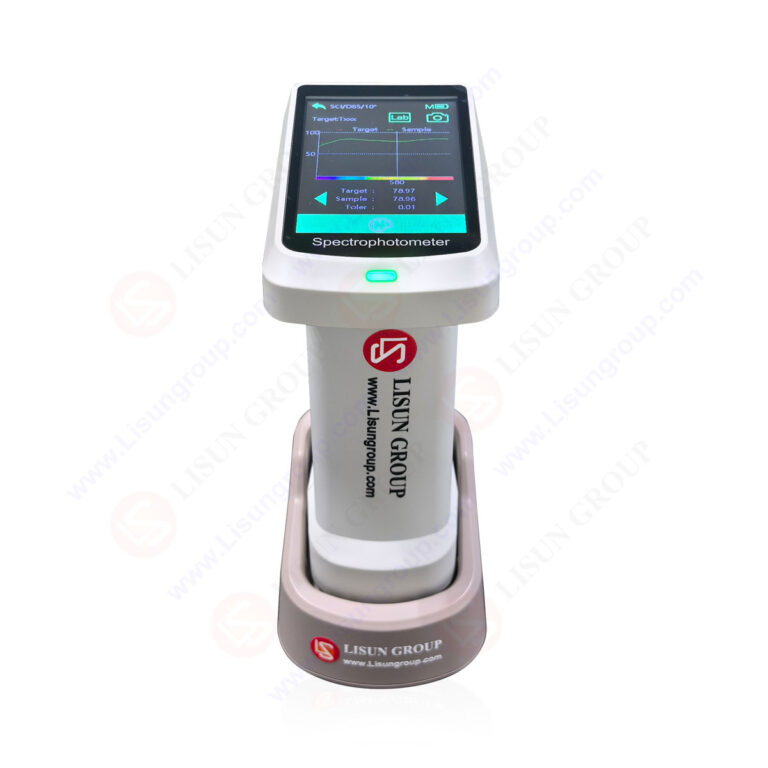
In plastics manufacturing, color consistency across batches and between cavities is critical. The LISUN HSCD with its 4mm aperture allows for measurement of small molded parts, such as automotive trim clips or bottle caps. By using the CIE Lab color space and setting tolerance limits (e.g., dE*ab < 1.0), quality control teams can reject off-color batches before assembly, reducing scrap rates.
4.2 Coatings and Paint Formulation
For paint formulators, the HSCD-860’s 1x3mm aperture is invaluable for measuring wet film draws or dry film patches on panels. The instrument’s metamerism index (MI) calculation helps formulators compare color pairs under different illuminants (D65 vs. A). This prevents the “color shift” problem where two samples match under sunlight but appear different under store lighting.
4.3 Textile and Printing
Textile QC requires measurement of complex, textured surfaces. The HSCD’s SCI/SCE toggle allows operators to account for fabric sheen. For printing, the instrument evaluates dot gain and color density by measuring specific color bars. Compliance with GB 2893 (safety colors) is also supported, enabling verification of traffic sign and safety vest colors.
5.1 Color Difference Formulas
The HSCD series supports multiple color difference formulas, including CIELAB (dEab), CIELCH (dL, dC, dh), and CIE2000 (dE00). CIE2000 is recommended for applications where visual perception is critical, such as automotive interior matching. The instrument also provides pass/fail tolerances, allowing for automatic batch sorting.
5.2 Spectral Data Analysis
Beyond standard colorimetric values, the software provides raw spectral reflectance data (400-700 nm at 10 nm intervals). This data is essential for colorant formulation software and for calculating custom indices, such as specific yellowness or grey scale ratings per ASTM D1925. The software also supports storing and comparing standard data from physical samples.
6.1 Measurement Workflow
The HSCD series is designed for high-throughput environments. It features a touch-screen interface with a simplified measurement workflow: select a standard, place the instrument on the sample, and press measure. Results, including spectral curve, dE values, and pass/fail status, are displayed in under 3 seconds.
6.2 Data Management and Integration
Data export is available via USB or Bluetooth. The instrument generates CSV and PDF reports automatically. For integration into a factory MES or LIMS system, the HSCD-860’s Wi-Fi capability allows for direct data transmission to a server. This reduces manual transcription errors and allows for real-time statistical process control (SPC) charting.
7.1 User Calibration Protocol
The instrument requires zero calibration (using a light trap) and white calibration (using the integrated ZrO2 whiteboard) at startup. The non-degrading nature of the ZrO2 material means that the white calibration data remains valid for longer periods, typically requiring re-calibration only once per shift under normal operating conditions.
7.2 Environmental Robustness
The HSCD series operates effectively in ambient temperatures ranging from 0°C to 45°C and humidity levels of up to 85% (non-condensing). The optical engine is sealed to prevent dust ingress. For laboratories requiring stringent traceability, the instrument can be sent to LISUN for a full verification against master standards traceable to national metrology institutes.
The LISUN HSCD Portable Spectrophotometer with Zirconium Calibration Whiteboard provides a robust, standards-compliant solution for color quality control across diverse industries. The combination of dual-beam grating spectroscopy and the durable ZrO2 standard ensures high inter-instrument agreement (dE ≤ 0.20) and long-term calibration stability. By supporting critical standards such as ASTM E1164, ISO 7724-1, and CIE No.15, the HSCD series meets the rigorous demands of R&D and production environments. The availability of multiple aperture models (HSCD-780, HSCD-800, HSCD-860) allows labs to match the instrument to their specific sample types, from large panels to small printed features. Ultimately, this instrument empowers quality managers to make data-driven decisions, reduce color variability, and maintain stringent product specifications.
Q1: What is the primary advantage of the zirconium calibration whiteboard over traditional ceramic standards?
A: Traditional ceramic whiteboards are porous and can absorb moisture and contaminants from the air, causing their reflectance to drift over time. The LISUN HSCD’s zirconium dioxide (ZrO2) whiteboard is non-porous, chemically inert, and highly resistant to thermal shock. This ensures that the absolute reflectance value of the calibration standard remains stable within ±0.1% for the instrument’s lifetime. For the user, this translates directly into higher inter-instrument agreement and reduced need for frequent factory re-calibrations, which is critical for maintaining consistent color standards across multiple locations.
Q2: How does the LISUN HSCD handle measurements on glossy and textured surfaces simultaneously?
A: The HSCD series supports both SCI (Specular Component Included) and SCE (Specular Component Excluded) measurement modes. For a glossy surface, the SCI mode includes the specular reflection, providing data that represents the true colorant composition regardless of gloss. This is useful for formulation. The SCE mode excludes the gloss, matching human visual assessment which sees a matte surface as a different color than a glossy one. For textured surfaces, the instrument uses a 8mm or 4mm aperture to average the color over a larger area, minimizing the effect of surface topography on the reading.
Q3: Can the HSCD-860 be used to measure the color of liquids or gels?
A: While the HSCD is primarily designed for solid samples, it can measure liquids if the sample is placed in a transparent measurement cell or cuvette. The user must ensure the cell is optically clear (e.g., quartz). For the best results, use a white backing material behind the cell to emulate a reflectance measurement. The instrument’s 8mm aperture is recommended for this application. It is also important to note that the instrument measures reflected color (reflectance), not transmitted color (transmittance), which is a different photometric property.
Q4: What is the recommended workflow for checking metamerism using this spectrophotometer?
A: To check for metamerism, measure two samples (e.g., the standard and the batch) using the HSCD. Access the software’s metamerism index (MI) function. The software calculates the color difference (dE) under the primary illuminant (e.g., D65). It then calculates the dE under a second illuminant (e.g., Illuminant A or F11). If the dE under D65 is low (good match) but the dE under Illuminant A is high (poor match), the samples are metameric. The software will output the MI value; a lower MI value indicates better color constancy across light sources.