









This article provides a comprehensive technical analysis of the LISUN IES LM-84 LED Optical Aging Test Instrument for Lumen Maintenance & L70 Prediction, a specialized system designed for accelerated aging and lumen depreciation testing in compliance with IES standards. The instrument supports dual testing protocols: the LEDLM-80PL variant for IES LM-80 and TM-21 applications, and the LEDLM-84PL variant for IES LM-84 and TM-28 protocols, both integrating the Arrhenius Model-based software for reliable L70/L50 lifetime extrapolation. With support for up to three connected temperature chambers, 6000-hour test durations, and customizable hardware configurations, this system delivers precise photometric and colorimetric data critical for LED reliability engineering. The article details technical specifications, standard compliance, test methodologies, and practical implementation strategies for LED manufacturers, testing laboratories, and R&D specialists seeking robust lumen maintenance validation.
1.1 The Importance of Lumen Depreciation and Lifetime Prediction
LED lumen maintenance testing is fundamental to establishing product reliability, warranty periods, and market acceptance. The LISUN IES LM-84 LED Optical Aging Test Instrument for Lumen Maintenance & L70 Prediction directly addresses the industry’s need for accelerated aging data that accurately projects long-term performance. Lumen depreciation, measured by L70 (time to 70% initial lumen output) and L50 (time to 50% output), is the primary metric for LED lifetime assessment. Without standardized testing, manufacturers risk overestimating product lifespan, leading to field failures and reputational damage. The instrument’s integration of IES LM-80 and LM-84 protocols ensures that test results are universally recognized by regulatory bodies and customers, eliminating ambiguity in lifetime claims.
1.2 Overview of IES Standards Governing LED Aging Tests
The Illuminating Engineering Society (IES) has established four critical standards for LED lifetime evaluation: IES LM-80 (for measuring lumen maintenance of LED packages, arrays, and modules), IES LM-84 (for LED lamps and luminaires), TM-21 (for projecting long-term lumen maintenance from LM-80 data), and TM-28 (for projecting lumen maintenance from LM-84 data). The LISUN instrument is uniquely designed to operate under both LM-80 and LM-84 frameworks, providing users with a unified platform for component and complete product testing. This dual-standard capability eliminates the need for separate equipment, reducing capital expenditure and testing complexity. The instrument’s software automatically aligns with TM-21 or TM-28 extrapolation methods, using the Arrhenius Model to accelerate aging at elevated temperatures for shorter test durations—typically 6000 hours for standard compliance.
1.3 LISUN’s Role in Global LED Reliability Testing
LISUN has established itself as a leading manufacturer of photometric and colorimetric test equipment, with over 15 years of expertise in LED reliability engineering. The LISUN IES LM-84 LED Optical Aging Test Instrument for Lumen Maintenance & L70 Prediction represents the culmination of this experience, offering a modular system that supports multiple temperature chambers (up to three units simultaneously), integrated integrating spheres for real-time photometric measurements, and proprietary software that automates data collection and L70/L50 extrapolation. LISUN instruments are deployed in major third-party testing laboratories and LED manufacturing facilities worldwide, serving clients from automotive electronics component engineers to lighting industry regulatory compliance specialists.
2.1 LEDLM-80PL: Optimized for LM-80/TM-21 Testing
The LEDLM-80PL variant is specifically engineered for testing LED packages, arrays, and modules per IES LM-80-20 standards. This system supports test durations of 6000 hours or longer, with temperature conditions ranging from 25°C to 85°C (or higher, depending on chamber specifications). The instrument accommodates up to 20 LED samples per test group, with each sample individually monitored for forward current, voltage, and case temperature. The integrated data acquisition system records photometric measurements (luminous flux, chromaticity, and color rendering index) at specified intervals—typically every 1000 hours for LM-80 compliance. The LISUN IES LM-84 LED Optical Aging Test Instrument for Lumen Maintenance & L70 Prediction platform enables seamless switching between LM-80 and LM-84 protocols, allowing users to test components and complete luminaires on a single system.
2.2 LEDLM-84PL: Optimized for LM-84/TM-28 Testing
The LEDLM-84PL variant is designed for complete LED lamps and luminaires per IES LM-84-20 standards. This system handles larger form factors, including integrated LED bulbs, downlights, and linear fixtures, with support for up to 10 luminaires per test group. The instrument utilizes a larger integrating sphere with a diameter of up to 2 meters to accommodate diverse product geometries. Temperature control is critical for LM-84 testing, and the system supports ambient temperature chambers with precision of ±1°C. The LEDLM-84PL incorporates TM-28 compliance for projecting lifetime data from LM-84 measurements, using the same Arrhenius Model-based methodology as its counterpart. The LISUN IES LM-84 LED Optical Aging Test Instrument for Lumen Maintenance & L70 Prediction provides unified software that manages both variants, ensuring consistent data analysis and reporting.
2.3 Key Differences and Selection Criteria
| Parameter | LEDLM-80PL | LEDLM-84PL |
|---|---|---|
| Applicable Standard | IES LM-80-20, TM-21-21 | IES LM-84-20, TM-28-20 |
| Test Sample Type | LED packages, arrays, modules | LED lamps, luminaires |
| Sample Capacity | Up to 20 per test group | Up to 10 per test group |
| Integrating Sphere Diameter | 0.5–1.0 meters | 1.5–2.0 meters |
| Temperature Range | 25°C to 85°C (chamber dependent) | 25°C to 55°C (typical for luminaires) |
| Minimum Test Duration | 6000 hours (LM-80 compliant) | 6000 hours (LM-84 compliant) |
| Extrapolation Method | TM-21 (non-linear least squares) | TM-28 (Arrhenius-based projection) |
| Typical Industry Users | Component manufacturers | Luminaire manufacturers, testing labs |
Selection between the two variants depends on the test article type and target standard compliance. The modular design of the LISUN IES LM-84 LED Optical Aging Test Instrument for Lumen Maintenance & L70 Prediction allows upgrades between variants, protecting user investment as testing requirements evolve.
3.1 Theoretical Foundation of the Arrhenius Model in LED Aging
The Arrhenius Model describes the temperature-dependent degradation rate of LED materials, particularly phosphor conversion layers and semiconductor junctions. The model equation, R(T) = A exp(-Ea / (k T)), relates the degradation rate (R) to activation energy (Ea), Boltzmann’s constant (k), and absolute temperature (T). The LISUN IES LM-84 LED Optical Aging Test Instrument for Lumen Maintenance & L70 Prediction integrates this model to accelerate aging at elevated temperatures—typically 55°C, 65°C, or 85°C—and project lifetime at standard operating conditions (25°C or 55°C for luminaires). The software automatically calculates the acceleration factor based on user-defined activation energy values (common Ea values for LEDs range from 0.3 to 0.7 eV), ensuring accurate extrapolation from 6000-hour test data to 50,000-hour or longer projections.
3.2 Software Features for Data Acquisition and Analysis
The instrument’s proprietary software offers real-time data visualization, automated measurement scheduling, and comprehensive reporting tools. Key features include:
- Automated data logging: Photometric measurements (luminous flux, CCT, CRI) are recorded at user-defined intervals (e.g., every 1000 hours per LM-80 requirements).
- TM-21/TM-28 curve fitting: The software applies non-linear least squares regression to determine the exponential decay coefficient (α) for lumen depreciation, then calculates L70 and L50 values using the formula Lp = ln(p/100) / (α * β), where p is the percentage of initial output.
- Arrhenius plot generation: Users can visualize the temperature-dependent degradation rates and validate the acceleration model.
- Data export: Results are exportable in CSV, PDF, and TIER-compliant formats for third-party review.
3.3 Validation of Extrapolation Accuracy
To ensure reliability, the software incorporates statistical confidence intervals (typically 90% or 95%) for all projected lifetime values. The LISUN IES LM-84 LED Optical Aging Test Instrument for Lumen Maintenance & L70 Prediction compares experimental data from multiple temperature conditions against the Arrhenius model predictions, flagging anomalies if the coefficient of determination (R²) falls below 0.95. This built-in validation ensures that manufacturers and testing labs can confidently use the results for marketing claims and regulatory submissions. Test protocols per IES TM-21 require at least 6000 hours of data for L70 projections up to 6 times the test duration, and the software automatically enforces these limits to prevent over-extrapolation.
4.1 Continuous Mode for Steady-State Aging
Continuous testing mode maintains constant temperature and current conditions throughout the test duration, simulating worst-case thermal scenarios for LED components. This mode is preferred for LM-80 testing of LED packages, where the samples operate continuously at a specified case temperature (e.g., 55°C or 85°C). The LISUN IES LM-84 LED Optical Aging Test Instrument for Lumen Maintenance & L70 Prediction in continuous mode monitors forward voltage drift and lumen depreciation every 24 hours, capturing early degradation mechanisms such as phosphor thermal quenching or solder joint fatigue. This mode typically yields faster L70 depletion times compared to cyclic testing, providing conservative lifetime estimates suitable for certification purposes.
4.2 Cyclic Mode for Realistic Operating Conditions
Cyclic testing mode alternates between on-state (powered, emitting light) and off-state (unpowered, cooling) periods, typically with a duty cycle of 8 hours on and 16 hours off. This mode better replicates real-world usage patterns for indoor and outdoor luminaires, capturing the effects of thermal cycling, inrush current stress, and moisture absorption during off periods. The instrument supports programmable on/off cycles with user-defined temperature profiles, enabling simulation of diurnal or seasonal variations. Cyclic mode is essential for LM-84 testing of luminaires, as thermal expansion and contraction can accelerate failure mechanisms not observed in continuous mode. The software separately analyzes data from each cycle block, generating L70 projections that account for recovery effects during off periods.
4.3 Comparative Performance Analysis
| Parameter | Continuous Mode | Cyclic Mode |
|---|---|---|
| Test Duration | 6000 hours minimum | 6000 hours minimum |
| Temperature Profile | Constant (setpoint ±1°C) | Programmable on/off with ramp rates |
| Application Standard | IES LM-80 | IES LM-84 |
| L70 Projection Type | Conservative (worst-case) | Realistic (operational) |
| Failure Mechanism Detection | Thermal degradation, drive current stress | Thermal cycling, inrush current, moisture |
| Sample Capacity Impact | Full capacity (up to 20 per group) | Slightly reduced (thermal equilibration time) |
| Energy Consumption | Higher (continuous heating) | Lower (off periods) |
Both modes are supported by the instrument’s flexible power supply and temperature control systems, allowing users to switch between modes without hardware reconfiguration. The LISUN IES LM-84 LED Optical Aging Test Instrument for Lumen Maintenance & L70 Prediction provides separate reporting templates for each mode, ensuring compliance with IES standard requirements.
5.1 Temperature Chamber Integration and Scalability
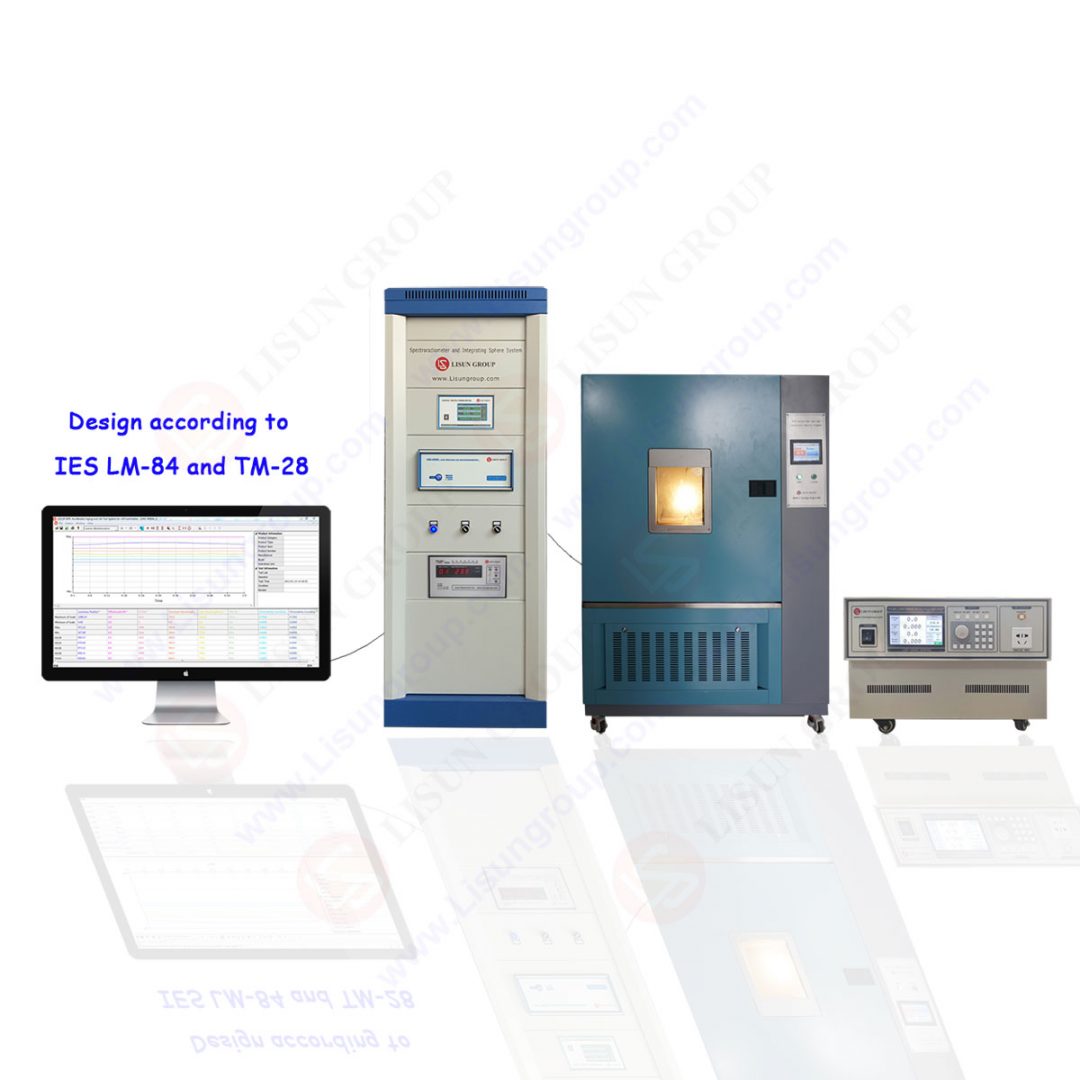
The instrument supports up to three independently controlled temperature chambers, each with programmable setpoints from -10°C to 100°C (depending on model). Chambers can operate simultaneously at different temperatures—for example, 55°C, 65°C, and 85°C—to generate Arrhenius model data points with at least three temperature conditions (as required by TM-21). The LISUN IES LM-84 LED Optical Aging Test Instrument for Lumen Maintenance & L70 Prediction includes chamber interface modules that control heaters, cooling systems, and safety interlocks. Each chamber accommodates multiple test boards or luminaire mounts, with internal dimensions customizable for customer-specific product sizes.
5.2 Integrating Sphere Options for Photometric Measurement
The instrument incorporates integrating spheres with diameters from 0.5 meters (for LED packages) to 2.0 meters (for large luminaires). Sphere coatings meet the requirements of CIE 84 for diffuse reflectance (typically 94-96% across the visible spectrum), ensuring accurate total luminous flux measurement. The system includes auxiliary lamp compensation per IES LM-79-19 to account for self-absorption, and spectroradiometers with wavelength accuracy of ±0.3 nm for colorimetric data (CCT, CRI, chromaticity coordinates). For LM-84 testing, the sphere supports 4-pi (integrating) and 2-pi (directional) measurement geometries, accommodating different luminaire beam patterns.
5.3 Power Supply and Monitoring Systems
The instrument provides programmable DC power supplies for LED modules (LEDLM-80PL) and AC power supplies for luminaires (LEDLM-84PL). DC supplies offer constant current output from 50 mA to 1500 mA with ±0.5% accuracy, while AC supplies support voltages from 100V to 277V at 50/60 Hz. Real-time monitoring includes forward voltage, current, power factor (for AC systems), and case temperature via thermocouples attached to the LED’s thermal interface point. The monitoring system samples at 1 Hz and automatically adjusts power output to maintain constant current across temperature-induced impedance changes. The LISUN IES LM-84 LED Optical Aging Test Instrument for Lumen Maintenance & L70 Prediction logs all electrical parameters synchronously with photometric data, enabling comprehensive degradation analysis.
6.1 IES LM-80 and LM-84 Compliance
The instrument is fully compliant with IES LM-80-20 (Approved Method for Lumen Maintenance of LED Light Sources) and IES LM-84-20 (Approved Method for Lumen Maintenance of LED Lamps and Luminaires). LM-80 requires testing at a minimum of three case temperatures (e.g., 55°C, 65°C, 85°C) for at least 6000 hours, with photometric measurements at 0, 1000, 2000, 3000, 4000, 5000, and 6000 hours. The LISUN IES LM-84 LED Optical Aging Test Instrument for Lumen Maintenance & L70 Prediction automates these measurement intervals and generates reports that include all mandatory data points, such as initial flux, maintained flux at each interval, and temperature profiles. For LM-84, the system supports ambient temperature testing at 25°C, 35°C, and 45°C, with a minimum of 10 luminaires per test group.
6.2 TM-21 and TM-28 Extrapolation Methodology
The software implements TM-21-21 (Projecting Long-Term Lumen Maintenance of LED Light Sources) and TM-28-20 (Projecting Long-Term Lumen Maintenance of LED Lamps and Luminaires) with strict adherence to their mathematical requirements. TM-21 requires fitting the exponential decay model to LM-80 data using non-linear least squares, with a minimum of 6000 hours data for projections up to 36,000 hours. TM-28 uses a similar method but incorporates Arrhenius model weighting for multi-temperature tests. The instrument’s software automatically calculates the 90% confidence interval for L70 and L50 projections, displaying results in both tabular and graphical formats. For cases where data fails goodness-of-fit tests (e.g., R² < 0.95), the software flags results as “non-compliant” and advises additional testing.
6.3 Additional Standards Support
The instrument also aligns with CIE 084 (Measurement of Luminous Flux), CIE 70 (Measurement of Absolute Spectral Distribution), and CIE 127 (Measurement of LEDs). IES LM-79-19 (Electrical and Photometric Measurements of Solid-State Lighting Products) is referenced for integrating sphere and goniophotometer measurement protocols. This multi-standard compliance ensures that LISUN IES LM-84 LED Optical Aging Test Instrument for Lumen Maintenance & L70 Prediction test reports are accepted by ENERGY STAR, DLC, and regulatory bodies worldwide. The system’s calibration traceability to NIST standards further enhances report credibility.
7.1 Test Planning and Sample Preparation
Effective use of the instrument requires careful test planning, including sample selection (at least 20 per group for LM-80, 10 for LM-84), temperature setpoint selection per Arrhenius requirements, and duration definition (6000 hours minimum for standard certification). The LISUN IES LM-84 LED Optical Aging Test Instrument for Lumen Maintenance & L70 Prediction includes a test configuration wizard that guides users through these steps, calculating required sample sizes for desired statistical power. Samples must be mounted on thermal test boards with controlled thermal resistance (per ASTM E1461) for LM-80 tests, while LM-84 luminaires are tested in free-air conditions without forced cooling.
7.2 Data Management and Report Generation
The instrument generates comprehensive test reports that include:
- Raw data tables: Luminous flux, chromaticity, CCT, CRI at each measurement interval
- Lumen maintenance plots: Actual data points with TM-21/TM-28 fitted curves
- L70/L50 results: Projected lifetimes with 90% confidence intervals
- Temperature profiles: Recorded chamber and case temperatures
- Arrhenius model analysis: Activation energy calculation and acceleration factor
Reports are formatted per IES standard templates and include digital signatures for audit trails. The system supports network integration for centralized data storage, allowing multiple users to access results from different test groups simultaneously.
7.3 Troubleshooting Common Testing Issues
Common issues include temperature overshoot during chamber transitions, thermocouple detachment causing false readings, and power supply fluctuations affecting current stability. The instrument’s software includes diagnostic tools that monitor chamber temperature ramps, thermocouple continuity, and power supply output in real time. The LISUN IES LM-84 LED Optical Aging Test Instrument for Lumen Maintenance & L70 Prediction automatically pauses testing if parameters exceed user-defined thresholds, logging the event for operator review. For samples that fail prematurely (e.g., catastrophic failure before 6000 hours), the software offers early termination options with partial data analysis for root cause investigation.
The LISUN IES LM-84 LED Optical Aging Test Instrument for Lumen Maintenance & L70 Prediction delivers a comprehensive, standards-compliant solution for accelerated LED aging and lifetime extrapolation. Its dual-system architecture (LEDLM-80PL and LEDLM-84PL) enables testing of both components and complete luminaires under IES LM-80, LM-84, TM-21, and TM-28 protocols. The Arrhenius Model-based software automates data collection, curve fitting, and L70/L50 projection, reducing analysis time and eliminating human error. With support for dual testing modes (continuous and cyclic), up to three temperature chambers, and customizable integrating sphere configurations, the instrument adapts to diverse testing requirements across LED manufacturing, third-party laboratories, and automotive electronics component engineering. By aligning with multiple standards (including CIE 084, CIE 70, CIE 127, and IES LM-79-19), these systems ensure globally recognized test reports. LISUN’s 15+ years of photometric testing expertise, combined with this instrument’s technical rigor, provides engineers with the confidence needed to validate product lifetimes, reduce warranty risks, and meet regulatory demands in an increasingly competitive LED marketplace.
Q1: What is the minimum test duration required for L70 projection using the LISUN IES LM-84 LED Optical Aging Test Instrument?
A: Per IES TM-21 and TM-28 standards, the minimum test duration is 6000 hours for projecting L70 lifetimes up to 36,000 hours (6× rule). The instrument supports longer durations (e.g., 10,000 hours) for extended projections. For L50 projections, 6000 hours of data can project lifetimes up to 6× the test duration, provided the data meets goodness-of-fit criteria (R²≥0.95). The Arrhenius Model-based software can accelerate testing at elevated temperatures (e.g., 85°C) to reduce test time compared to room-temperature testing, but the actual test duration must remain at least 6000 hours for standard compliance.
Q2: Can the instrument test both LED modules and complete luminaires simultaneously?
A: Yes, the system supports simultaneous testing when equipped with both the LEDLM-80PL (for modules) and LEDLM-84PL (for luminaires) configurations. However, each test group must be assigned to a dedicated temperature chamber and integrating sphere. For example, one chamber can host LED modules under LM-80 conditions, while another chamber handles luminaires under LM-84 conditions. The software manages separate test schedules and reports for each group, ensuring no data cross-contamination. Users must ensure that chamber temperatures and measurement intervals are independently programmed.
Q3: How does the Arrhenius Model software determine activation energy for my specific LED product?
A: The software includes a database of typical activation energy values for common LED materials (e.g., 0.3 eV for phosphor degradation, 0.5 eV for solder joint fatigue, 0.7 eV for semiconductor junction degradation). Users can input known values from manufacturer datasheets or run a preliminary test at three temperatures (e.g., 55°C, 65°C, 85°C) to calculate the product-specific Ea using linear regression on the Arrhenius plot. The software automatically performs this calculation and provides a 95% confidence interval for the fitted Ea. For certification-grade reports, TM-21 requires Ea to be determined from experimental data rather than assumed values.
Q4: What photometric measurements are recorded during aging tests?
A: The instrument records total luminous flux (lumens), correlated color temperature (CCT, in Kelvin), general color rendering index (Ra), chromaticity coordinates (x,y), and spectral power distribution (SPD, from 380 nm to 780 nm). For LM-80 compliance, flux and chromaticity are required at 0, 1000, 2000, 3000, 4000, 5000, and 6000 hours. The spectroradiometer in the integrating sphere has wavelength accuracy of ±0.3 nm, and the sphere coating meets CIE 84 diffuse reflectance standards (94-96%). Auxiliary lamp compensation per IES LM-79-19 is applied automatically to correct for self-absorption effects from the test sample.
Q5: Does the system support automated data export for regulatory submissions (e.g., ENERGY STAR, DLC)?
A: Yes, the software generates reports in TIER (Testing Information Exchange Format) compliant formats, which are accepted by ENERGY STAR, DLC, and other regulatory bodies. Reports include all mandatory data fields: sample identification, test conditions, measurement intervals, lumen maintenance curves, L70/L50 results with confidence intervals, and Arrhenius model parameters. Export options include PDF for certification submission and CSV for spreadsheet analysis. The system also supports digital signatures (per 21 CFR Part 11 if configured) for audit-trail compliance in regulated industries.