









The rapid evolution of new energy vehicles (NEVs) demands rigorous electromagnetic compatibility (EMC) validation, particularly for transient immunity against the seven pulse types defined by the ISO 7637 standard. This article presents a comprehensive analysis of the ISO 7637 Test System for 7 Pulse Transient Immunity in NEVs, specifically examining the LISUN EMS-ISO7637 Automotive Electronics Transient Immunity EMC Testing System. The system addresses the critical need for reproducible pulse testing across 12V, 24V, and 36V architectures, covering pulses P1 through P5b. With integrated dual-touchscreen operation, automated data reporting, and adherence to ISO 7637-2:2021 and ISO 7637-3:2016, the EMS-ISO7637 provides a turnkey solution for automotive electronics R&D teams, quality control specialists, and third-party testing laboratories. This article details the system’s technical architecture, pulse generation capabilities, calibration methodology, and practical applications for component-level immunity verification.
1.1 The ISO 7637 Standard Framework
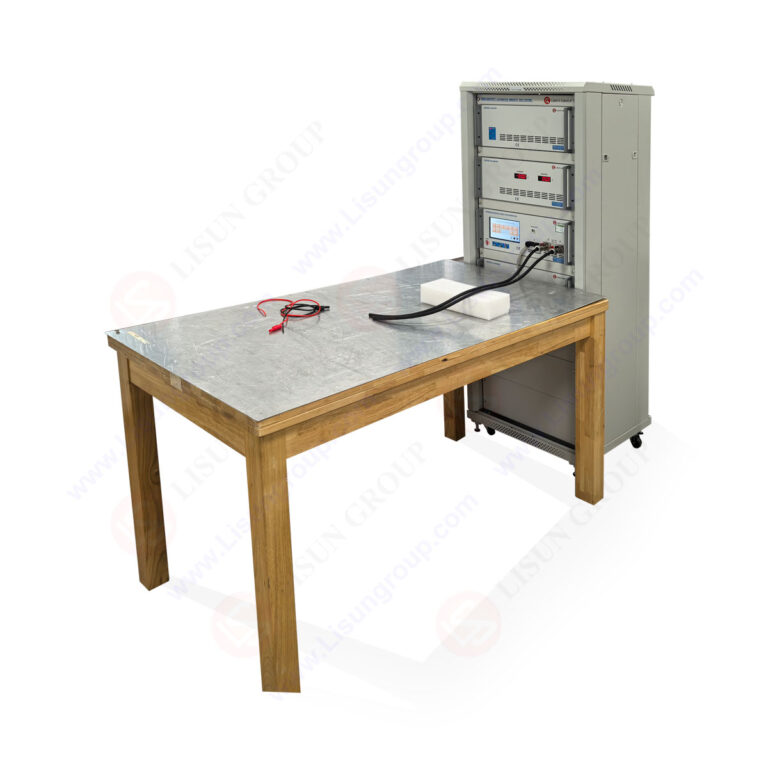
The ISO 7637 series establishes test methods and severity levels for electrical transient conduction along supply lines and signal lines of road vehicles. ISO 7637-2:2021 specifies pulse shapes, amplitudes, and repetition frequencies for seven distinct transient waveforms—P1, P2a, P2b, P3, P4, P5a, and P5b. These pulses simulate real-world disturbances caused by inductive load switching, alternator field decay, and battery disconnection events. For NEVs, the standard’s applicability extends to high-voltage DC-DC converters, onboard chargers (OBCs), and battery management systems (BMS), where transient immunity failures can compromise safety and operational reliability. The ISO 7637 Test System for 7 Pulse Transient Immunity in NEVs must therefore accommodate both traditional 12V/24V systems and emerging 36V mild-hybrid architectures.
1.2 The Seven Pulse Types and Their Origins
Each pulse type in ISO 7637-2:2021 corresponds to a specific transient phenomenon. Pulse 1 and Pulse 4 simulate supply disconnection events from inductive loads and engine starting respectively. Pulse 2a and 2b represent current interruption from distributed inductance and alternator field decay. Pulse 3 exhibits high-energy fast transients from switching operations, while Pulse 5a and 5b model load dump conditions where the alternator continues charging after battery disconnection. An ISO 7637 Test System for 7 Pulse Transient Immunity must generate these waveforms with precise amplitude control, rise times, and decay characteristics to ensure reproducible test conditions across laboratory and production environments.
1.3 Relevance to New Energy Vehicle Architectures
NEVs introduce unique challenges for transient immunity testing due to higher operating voltages, bidirectional power flows between traction batteries and regenerative braking systems, and increased electronic content per vehicle. The ISO 7637 Test System for 7 Pulse Transient Immunity in NEVs must account for galvanically isolated test setups, capacitive coupling clamps for signal lines per ISO 7637-3:2016, and extended pulse repetition rates that match the switching frequencies of modern power electronics. The LISUN EMS-ISO7637 system addresses these requirements through multi-module pulse generation capable of simultaneous waveform application across multiple test points, reducing total test time while maintaining standard compliance.
2.1 Multi-Module Pulse Generation Platform
The LISUN EMS-ISO7637 integrates dedicated hardware modules for each pulse type, enabling simultaneous or sequential waveform generation without manual cable reconfiguration. Each module incorporates independent voltage sources, capacitance banks, and resistive loads calibrated to ISO 7637-2:2021 tolerances. The system supports pulse amplitudes up to 200V for Pulse 5 load dump conditions and rise times as fast as 50 nanoseconds for Pulse 3 fast transients. This modular architecture ensures that the ISO 7637 Test System for 7 Pulse Transient Immunity in NEVs can be scaled from basic compliance testing to advanced engineering validation.
2.2 Voltage System Flexibility and Automation
A critical advantage of the EMS-ISO7637 is its support for 12V, 24V, and 36V nominal voltage systems, covering the full range of passenger car, commercial vehicle, and NEV applications. Voltage selection is software-configurable, eliminating the need for hardware reconfiguration. The system’s dual operation mode—integrated 10-inch touchscreen plus PC-based software—allows technicians to run predefined test sequences, adjust parameters in real time, and generate ISO-compliant reports automatically. This automation reduces operator variability and ensures that each ISO 7637 Test System for 7 Pulse Transient Immunity in NEVs test cycle follows identical procedures, critical for design-of-experiment (DOE) studies and production line auditing.
2.3 Data Acquisition and Reporting Capabilities
The EMS-ISO7637 includes a built-in four-channel oscilloscope and measurement port for real-time transient waveform capture. Acquired waveforms are compared to ISO 7637-2:2021 reference masks, and pass/fail criteria are applied automatically based on amplitude tolerance bands and duration thresholds. The data reporting module generates PDF or Excel reports containing test setup parameters, waveform screenshots, and deviation analysis. This functionality is essential for third-party test laboratories seeking ISO 17025 accreditation and for OEM quality control teams requiring reproducible evidence of ISO 7637 Test System for 7 Pulse Transient Immunity in NEVs compliance.
3.1 ISO 7637-2:2021 and ISO 7637-3:2016 Alignment
The LISUN EMS-ISO7637 is designed to meet all pulse shape and amplitude requirements specified in ISO 7637-2:2021 for conducted transients along supply lines. Pulse 1 through Pulse 5b are generated with amplitude tolerances within ±5% of the specified severity levels (Level I through Level IV). For signal line testing per ISO 7637-3:2016, the system includes a capacitive coupling clamp (CCC) assembly with 1nF ± 20% coupling capacitance, ensuring proper injection of Pulse 3 fast transients into communication lines such as CAN FD, LIN, and Ethernet interfaces. The ISO 7637 Test System for 7 Pulse Transient Immunity in NEVs thus provides comprehensive coverage for both power and signal line immunity verification.
3.2 Chinese National Standards GB/T 21437.2-2021 and GB/T 21437.3-2021
China’s GB/T 21437 series adopts the ISO 7637 framework with minor modifications reflecting domestic automotive requirements. The EMS-ISO7637 includes user-configurable pulse parameter sets that match GB/T 21437.2-2021 severity levels for supply lines and GB/T 21437.3-2021 signal line test procedures. This dual-standard capability simplifies compliance testing for NEV manufacturers exporting to Chinese markets or operating within SAE J2954/CATARC test protocols. The system’s software library includes preloaded test sequences for both ISO and GB/T standards, reducing setup time for the ISO 7637 Test System for 7 Pulse Transient Immunity in NEVs.
3.3 Additional Standards: ISO 16750-2:2023, VW 80000, and GM 3172
Beyond ISO 7637, the LISUN EMS-ISO7637 supports pulse generation parameters defined in ISO 16750-2:2023 for electrical loads, including different load dump clamping voltages and pulse durations. For OEM-specific requirements, the system includes parameter sets for VW 80000 (LV 124) and GM 3172, which define additional pulse shapes and test severity levels for passenger car electronics. The system’s software allows creation of custom test profiles, making it a versatile platform for laboratories handling multiple OEM certification programs. The following table summarizes the LISUN EMS-ISO7637 specifications against these standards:
| Standard | Pulse Coverage | Voltage Systems | Amplitude Accuracy | Repetition Rate | Automation Level |
|---|---|---|---|---|---|
| ISO 7637-2:2021 | P1–P5b | 12V, 24V | ±5% of setpoint | 0.1–100 Hz | Full touchscreen/PC |
| ISO 7637-3:2016 | P3a, P3b | 12V, 24V | ±5% of setpoint | 0.1–1000 Hz | Capacitive coupling clamp included |
| GB/T 21437.2-2021 | P1–P5b | 12V, 24V, 36V | ±5% of setpoint | 0.1–100 Hz | Custom GB/T sequences |
| VW 80000 (LV 124) | Extended P1–P5 | 12V, 24V | ±3% of setpoint | 0.5–50 Hz | Preloaded OEM profiles |
| ISO 16750-2:2023 | Load dump (P5) | 12V, 24V, 36V | ±2% of setpoint | Single shot | Clamping voltage calibration |
4.1 Pulse Generation Parameters and Measurement Accuracy
The EMS-ISO7637 achieves amplitude accuracy of ±2% for Pulse 5a and 5b load dump waveforms, which require precise clamping voltage control to prevent overstress of the device under test (DUT). Pulse 1 source impedance is selectable between 10Ω and 50Ω per ISO 7637-2:2021 Annex B recommendations. Pulse 2a and 2b durations are adjustable from 0.5 ms to 5 ms with rise time control within 1 μs. For Pulse 3 fast transients, the system generates rise times of 50 ns ± 10 ns and pulse widths of 150 ns ± 20 ns, meeting the most stringent OEM requirements. Calibration verification is performed using an external digital storage oscilloscope (DSO) with 1 GHz bandwidth, and the system includes self-calibration routines for amplitude and timing parameters.
4.2 Coupling Networks and Decoupling Paths
The ISO 7637 Test System for 7 Pulse Transient Immunity in NEVs incorporates both direct coupling (DC) for supply lines and capacitive coupling clamp for signal lines. The DC coupling path uses a 1 mF capacitor with pre-charge circuitry for Pulse 1 and Pulse 4, ensuring consistent pulse energy delivery regardless of DUT supply current. Decoupling networks (CDNs) with 100 μH inductance and 47 μF capacitance isolate the DUT from the auxiliary power supply, preventing pulse energy from damaging laboratory power sources. The coupling clamp for signal line testing (ISO 7637-3:2016) provides 1 nF capacitance per line, with manual or automated line selection via the touchscreen interface.
4.3 Calibration Traceability and Maintenance
Routine calibration of the EMS-ISO7637 follows ISO 17025 guidelines, with recommended intervals of 12 months for full recalibration and 6 months for verification using internal reference waveforms. The system’s firmware logs calibration dates and outputs deviation reports showing measured versus theoretical pulse parameters. Traceability to national metrology institutes (e.g., NIST, PTB) is maintained through external calibration of the internal voltage reference and timebase. This ensures that the ISO 7637 Test System for 7 Pulse Transient Immunity in NEVs delivers scientifically valid results acceptable for OEM homologation.
5.1 Electronic Control Units (ECUs) and Sensor Modules
Modern NEV ECUs manage powertrain, thermal, and battery functions, making them susceptible to supply line and signal line transients. The EMS-ISO7637 applies Pulse 2a, 3, and 5 to the ECU power input while simultaneously injecting Pulse 3 fast transients via the capacitive coupling clamp into CAN and LIN bus lines. This combined stress testing ensures that the ECU’s internal voltage regulators, clock generators, and communication PHYs maintain operation within specified thresholds. The ISO 7637 Test System for 7 Pulse Transient Immunity in NEVs is especially critical for Level 3 and above autonomous driving ECUs, where transient immunity failures could lead to loss of vehicle control.
5.2 Onboard Chargers (OBCs) and DC-DC Converters
OBCs and DC-DC converters operate at high power levels (6.6 kW to 22 kW for OBCs) and interface with both high-voltage traction batteries and low-voltage auxiliary systems. These components must survive Pulse 5b load dump conditions at 200V on the low-voltage side and ensure galvanic isolation integrity. The EMS-ISO7637 applies Pulse 4 and 5 sequences to the OBC’s 12V input while monitoring output stability via the built-in oscilloscope. The ISO 7637 Test System for 7 Pulse Transient Immunity in NEVs including high-voltage module options supports testing of the DC-DC converter’s 24V or 36V outputs, verifying compliance with ISO 16750-2:2023 load dump requirements.
5.3 Battery Management Systems (BMS) and Power Distribution Units (PDUs)
BMS units monitor cell voltages, temperatures, and current flows, requiring robust transient immunity to prevent false alarms or data corruption during regenerative braking events. The EMS-ISO7637 applies Pulse 1 and Pulse 2a sequences to the BMS supply line while simultaneously injecting Pulse 3 on the communication bus linking cell monitoring ICs. This dual-domain testing verifies that the BMS can maintain accurate state-of-charge (SoC) estimation under stress. For PDUs, which distribute power to multiple loads, the ISO 7637 Test System for 7 Pulse Transient Immunity in NEVs tests each output channel independently, ensuring that load switching transients from one channel do not affect other channels.
6.1 Configuring Test Sequences for Production Environments
The EMS-ISO7637 software allows users to create “test sequences” that include multiple pulse types applied in a specific order, with configurable dwell times and DUT monitoring intervals. For production line inspection, sequences can be preloaded and executed via barcode scanner—when an operator scans the DUT serial number, the system automatically selects the appropriate test profile (e.g., GB/T 21437.2-2021 Level III for passenger car ECUs). This automation eliminates human error and ensures 100% traceability for every DUT tested. The ISO 7637 Test System for 7 Pulse Transient Immunity in NEVs thus transitions from laboratory validation to production line quality assurance seamlessly.
6.2 Real-Time Monitoring and Adaptive Control
During test execution, the EMS-ISO7637 continuously monitors DUT supply current and waveform responses. If the DUT current exceeds a preset threshold (indicating latch-up or short circuit), the system automatically terminates the test and records the failure. Similarly, if the generated pulse deviates from the reference mask by more than 10%, the system pauses and requests operator intervention. This adaptive control protects both the DUT and the test equipment, which is particularly important when testing high-value prototypes in R&D environments. The ISO 7637 Test System for 7 Pulse Transient Immunity in NEVs incorporates safety interlocks that disable pulse generation when the coupling clamp is open or the DUT is not properly connected.
7.1 Performance Metrics and Cost-Effectiveness
When compared to alternative systems, the LISUN EMS-ISO7637 offers a unique combination of multi-module architecture, voltage system flexibility, and dual-standard compliance at a cost point suitable for both mid-tier test laboratories and OEM departments. Competing solutions often require separate modules for 12V and 24V testing or lack built-in oscilloscope functionality. The following table provides a comparative overview:
| Feature | LISUN EMS-ISO7637 | Competitor A | Competitor B |
|---|---|---|---|
| Pulse coverage | P1–P5b (all 7 pulses) | P1–P5a (6 pulses) | P1–P5b (7 pulses) |
| Voltage systems | 12V, 24V, 36V | 12V, 24V | 12V, 24V, 42V |
| Automation | Dual touchscreen + PC | PC-only | Touchscreen-only |
| Built-in oscilloscope | 4-channel, 1 GHz | Optional module | Not included |
| Standard library | ISO, GB/T, VW, GM | ISO only | ISO, GB/T |
| Calibration accuracy | ±2% (Pulse 5) | ±5% (Pulse 5) | ±3% (Pulse 5) |
| Price range (USD) | Competitive | Higher | Higher |
7.2 Support for Emerging Standards and Customization
The EMS-ISO7637’s software architecture enables firmware updates for emerging standards, such as the upcoming revision of ISO 7637-2 (expected 2026) and GB/T series amendments. Users can request custom pulse shapes or parameter ranges for specialized testing, such as pulse sequences that mimic the transient behavior of SiC and GaN power devices used in next-generation NEVs. The ISO 7637 Test System for 7 Pulse Transient Immunity in NEVs is thus future-proofed against changes in automotive electrical architectures and regulatory requirements.
The LISUN EMS-ISO7637 Automotive Electronics Transient Immunity EMC Testing System represents a comprehensive solution for the ISO 7637 Test System for 7 Pulse Transient Immunity in NEVs market, addressing the full spectrum of pulse types (P1 through P5b) across 12V, 24V, and 36V platforms. Its multi-module architecture ensures high reproducibility and reduced test time, while the dual touchscreen/PC interface eliminates operator variability. Compliance with ISO 7637-2:2021, ISO 7637-3:2016, GB/T 21437.2-2021, and ISO 16750-2:2023 guarantees acceptance at major OEMs and third-party labs. The system’s calibration traceability and automated reporting capabilities enable seamless integration into R&D verification, production line inspection, and homologation workflows. For automotive electronics manufacturers and test laboratories seeking a reliable, accurate, and cost-effective transient immunity testing platform, the EMS-ISO7637 provides the technical depth and operational efficiency required to meet current and future compliance demands. The system’s ability to simulate real-world transients for ECUs, OBCs, DC-DC converters, and BMS units ensures that components are maturely validated before vehicle integration, ultimately improving reliability and safety of next-generation NEVs.
Q1: What are the specific pulse parameters that the LISUN EMS-ISO7637 generates for ISO 7637-2:2021 compliance, and how do they differ for 12V vs. 24V systems?
A: The EMS-ISO7637 generates all seven pulse types with amplitudes scaled to the nominal voltage system. For 12V systems, Pulse 1 amplitude is –75V to –100V with 2 ms duration, while for 24V systems it is –150V to –200V with 1 ms duration. Pulse 5a load dump for 12V systems is 65V to 87V clamping voltage; for 24V systems it is 123V to 174V. Pulse 3 fast transients maintain 50 ns rise time for both systems. The system automatically selects the correct parameter set based on the configured voltage system, ensuring compliance with ISO 7637-2:2021 severity levels I–IV. All amplitudes are verified against internal calibration references traceable to national standards.
Q2: Can the LISUN EMS-ISO7637 be used for testing high-voltage NEV components (e.g., 800V traction inverters) under ISO 7637 requirements?
A: The standard ISO 7637 series primarily addresses low-voltage (≤60V) transients; however, the EMS-ISO7637 can be adapted for testing the supply lines of low-voltage auxiliary circuits within NEVs (e.g., 12V BMS power supply, 24V cooling pump controllers). For high-voltage components, refer to ISO 21498-2:2022 for conducted transients on high-voltage systems. The LISUN system’s galvanic isolation and capacitive coupling clamp are rated for test voltages up to 300V, making it suitable for 36V mild-hybrid systems but not direct coupling to 800V buses without external isolation transformers. For NEV applications, the system is best used for low-voltage ECU, OBC auxiliary output, and DC-DC converter low-side testing.
Q3: How does the EMS-ISO7637 ensure repeatability of test results between different test operators and laboratory environments?
A: Repeatability is ensured through three mechanisms. First, automated test sequences with fixed pulse parameters and dwell times eliminate manual adjustment variability. Second, the system’s self-calibration routine runs before each test sequence, verifying amplitude, rise time, and pulse width against internal standards. Third, the built-in oscilloscope captures every pulse and compares it to the ISO 7637-2:2021 reference mask; any deviation exceeding ±5% triggers a test abort and logs the event. This process guarantees that the ISO 7637 Test System for 7 Pulse Transient Immunity in NEVs generates identical stress conditions for every DUT, regardless of operator expertise.
Q4: What after-sales support and calibration services does LISUN provide for the EMS-ISO7637 system?
A: LISUN offers comprehensive support including on-site installation and training, remote firmware updates, and annual calibration services performed at ISO 17025 accredited facilities. Calibration certificates include measured pulse parameters with expanded uncertainty values (k=2). The company provides a standard 2-year warranty with optional extended coverage up to 5 years. For users developing customized test sequences, LISUN technical engineers are available for consultation on parameter adjustments meeting specific OEM requirements (e.g., VW 80000, GM 3172). The ISO 7637 Test System for 7 Pulse Transient Immunity in NEVs also includes a dedicated hotline and online portal for firmware requests, ensuring the system remains up-to-date with evolving standards.