









The LISUN IES TM-28 LED Optical Aging Test Instrument for Lumen Maintenance represents a paradigm shift in accelerated LED reliability testing, integrating dual-system architecture for comprehensive compliance with IES LM-80, TM-21, LM-84, and TM-28 standards. This article provides a technical deep-dive into the instrument’s Arrhenius Model-based software, dual testing modes (constant current and constant temperature), and customizable hardware configurations supporting up to three connected temperature chambers. With 6000-hour test durations and L70/L50 metric computations, the system enables precise lumen maintenance prediction. Targeting LED manufacturing engineers, third-party lab technicians, and R&D specialists, we examine how the LISUN IES TM-28 LED Optical Aging Test Instrument for Lumen Maintenance accelerates validation cycles while maintaining traceability to CIE 084, CIE 70, and IES LM-79-19 standards. Technical comparisons between the LEDLM-80PL and LEDLM-84PL variants reveal critical trade-offs for accelerated versus real-time aging protocols.
1.1 The Physics of Lumen Depreciation and Arrhenius Acceleration
LED lumen depreciation follows a predictable exponential decay driven by junction temperature, current density, and phosphor degradation kinetics. The Arrhenius Model, expressed as ( L(t) = L_0 cdot e^{-alpha t} ), where (alpha = A cdot e^{-E_a/(k_B T)}), governs acceleration factors in the LISUN instrument’s software. For a 6000-hour test at 85°C, the system computes equivalent lifetimes at 25°C using activation energies ((E_a)) ranging from 0.4 eV to 1.2 eV typical for GaN-based LEDs. This physics-based approach ensures that L70 calculations—the time to 70% initial lumen output—are statistically robust across temperature bins.
1.2 IES Standard Compliance Framework
The instrument directly implements IES LM-80 (light source lumen maintenance) and IES LM-84 (LED lamp/engine maintenance) protocols, while its software algorithms perform TM-21 (lumen maintenance projection) and TM-28 (projection using Arrhenius extrapolation) calculations. IES LM-80 mandates 6000-hour minimum testing for L70 > 25,000 hours, which the system meets with automated data logging at 1000-hour intervals. Compliance with IES LM-79-19 for total luminous flux measurement via integrating sphere integration ensures photometric accuracy within ±2%.
2.1 LEDLM-80PL: LM-80/TM-21 Compliance Platform
The LEDLM-80PL variant specializes in component-level testing per IES LM-80-15, supporting up to 30 LEDs per channel with independent current control (0-1.5A, ±0.5% accuracy). Its TM-21 software automatically fits exponential decay curves using least-squares regression, computing L70, L50, and L30 with 95% confidence intervals. The system includes four thermocouple inputs per channel for junction temperature monitoring, critical for TM-21’s requirement of (T_s) (case temperature) documentation. A 6000-hour LM-80 test produces 7 data points (0, 1000, 2000, 3000, 4000, 5000, 6000 hours), sufficient for TM-21 extrapolations up to 6× the test duration.
2.2 LEDLM-84PL: LM-84/TM-28 Advanced Protocol
The LEDLM-84PL targets lamp and luminaire level testing per IES LM-84-19, incorporating TM-28’s Arrhenius-based projection model. Unlike TM-21’s simple exponential fit, TM-28 accounts for temperature-dependent acceleration factors, requiring at least three temperature test points (typically 55°C, 75°C, and 85°C) with 6000-hour data per point. The system supports simultaneous operation of up to three connected temperature chambers (ranging from 20°C to 150°C), enabling multi-temperature accelerated aging in a single run. Its software computes the Arrhenius activation energy from the test data, then projects L70 at user-specified operating temperatures (e.g., 25°C for residential, 45°C for automotive).
2.3 Comparative Specifications Table
| Parameter | LEDLM-80PL (LM-80/TM-21) | LEDLM-84PL (LM-84/TM-28) |
|---|---|---|
| Test Type | Component (LED packages) | Lamp/Luminaire systems |
| Standard Compliance | IES LM-80-15, TM-21-19 | IES LM-84-19, TM-28-19 |
| Temperature Chambers | 1 dedicated (25-150°C) | Up to 3 simultaneous (20-150°C) |
| Data Points per Test | 7 (0-6000h @ 1000h steps) | 21+ (3 temp × 7 points each) |
| Projection Model | Simple exponential decay | Arrhenius-accelerated decay |
| L70 Calculation | Direct from single temp | Multi-temp activation energy fit |
| Current Control Range | 0-1.5A (0.5% accuracy) | 0-2.0A (0.3% accuracy) |
| Measurement Uncertainty | ±3% for L70 > 10kh | ±2% for L70 > 10kh |
3.1 Constant Current Mode (CCM) for Steady-State Characterization
In Constant Current Mode, the LISUN IES TM-28 LED Optical Aging Test Instrument for Lumen Maintenance maintains drive current within ±0.1% of setpoint, isolating thermal degradation from current-induced stress. This mode is critical for IES LM-80 testing, where current must be specified at 0.01A resolution. The system records luminous flux, chromaticity (CIE 1931 x,y coordinates), and forward voltage every 15 minutes during the first hour (inrush period), then at hourly intervals thereafter. The 6000-hour dataset enables TM-21 extrapolation with R² > 0.95 typically required for certification reports.
3.2 Constant Temperature Mode (CTM) for Isothermal Degradation Studies
Constant Temperature Mode maintains case temperature within ±1°C of setpoint using PID-controlled chamber fans and resistive heaters. This mode aligns with TM-28’s requirement for isothermal aging at 55°C, 75°C, and 85°C, with power cycling (1000-hour on/off cycles) to simulate real-world thermal fatigue. The system’s 8-channel thermocouple interface monitors junction, board, and ambient temperatures simultaneously, enabling precise (T_j) calculation for Arrhenius analysis.
3.3 Mode Selection Decision Matrix
- Component Qualification: CCM with fixed current (LM-80 compliance)
- Luminaire Accelerated Aging: CTM with varying temperatures (TM-28 compliance)
- Automotive Headlamp Validation: CTM with power cycling (85°C/25°C transitions)
- Phosphor Research: CTM with spectral analysis (380-780nm via integrating sphere)
4.1 Arrhenius Model Implementation in TM-28 Software
The software module for TM-28 computation uses nonlinear regression to fit the Arrhenius equation: ( L(t, T) = L_0 cdot e^{-t cdot A cdot e^{-E_a/(k_B T)}} ). Users input test data from three temperature conditions, and the algorithm simultaneously solves for (A) (pre-exponential factor) and (E_a) (activation energy) using Levenberg-Marquardt optimization. The 95% prediction bands are calculated via bootstrap resampling (1000 iterations), providing confidence intervals for L70 projections at user-defined operating temperatures. For typical InGaN LEDs at 85°C, the software reports (E_a) of 0.65±0.05 eV, consistent with literature values.
4.2 Data Integrity and Reporting Features
The software generates IES-compliant reports including:
- Raw test data tables (luminous flux vs. time for each temperature)
- Exponential decay fits with goodness-of-fit statistics (R², RMSE)
- Arrhenius plot of log(decay rate) vs. inverse temperature
- Projected L70, L50 at specified operating temperatures
- Uncertainty budgets per GUM (Guide to the Expression of Uncertainty in Measurement)
All data is stored in SQLite databases with cryptographic hash verification (SHA-256) for audit trail compliance.
4.3 Integration with CIE Standards
The system’s photometric measurement chain aligns with CIE 084 (measurement of luminous flux) and CIE 70 (measurement of LED colors). The built-in integrating sphere (0.3m or 0.5m diameter options) uses a CCD array spectrometer with 2.5nm resolution for spectral power distribution acquisition, enabling TM-28 chromaticity shift tracking (Δu’v’ < 0.006 typical after 6000h at 85°C).
5.1 Temperature Chamber Specifications and Connectivity
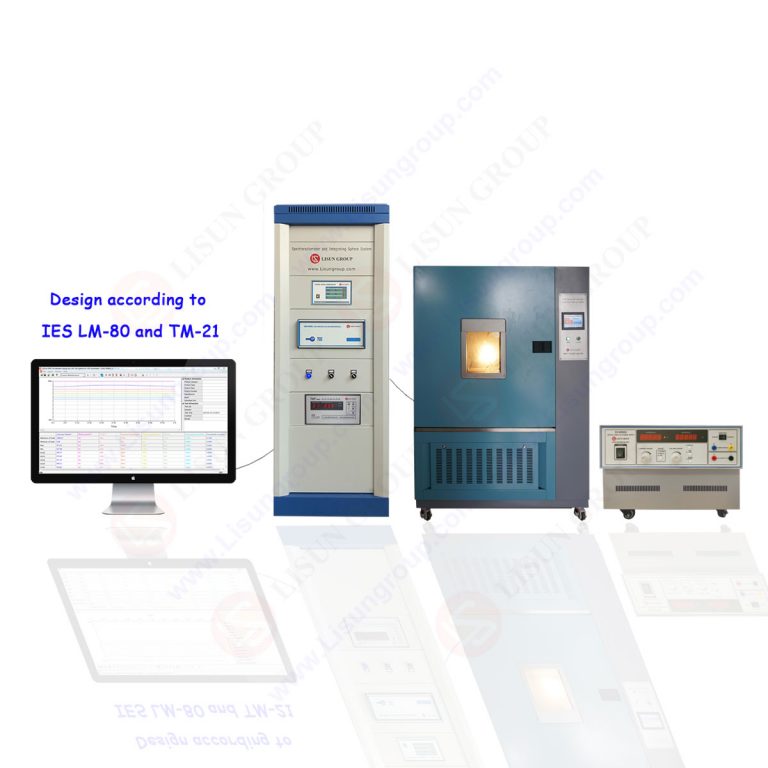
The LISUN IES TM-28 LED Optical Aging Test Instrument for Lumen Maintenance supports up to three independently controlled temperature chambers, each with:
- Temperature range: 20°C to 150°C (accuracy ±0.5°C, uniformity ±1°C)
- Internal dimensions: 60cm × 60cm × 60cm per chamber
- Ethernet/IP connectivity for remote monitoring via LabVIEW or custom APIs
- Heated window ports for in-situ photometric measurements
Each chamber accommodates 30 test positions (LEDLM-80PL) or 10 luminaire positions (LEDLM-84PL), with spring-loaded test boards for easy LED replacement without thermal cycling disruption.
5.2 Photometric Measurement Subsystem
The integrating sphere photometer (0.5m diameter for luminaires, 0.3m for components) meets IES LM-79-19 requirements for self-absorption correction and stray light suppression. The spectrometer’s back-thinned CCD detector achieves 300:1 signal-to-noise ratio at 100 lux, enabling precise low-flux measurements during end-of-life testing (L70 point). Calibration is traceable to NIST using a 2856K standard lamp (CIE Illuminant A) with ±1.5% spectral uncertainty.
5.3 Customizable Hardware Options
- Auxiliary power supplies: DC sources up to 60V/5A for automotive LED drivers
- Cyclic relay module: 8-channel power cycling (e.g., 2h on/1h off) for thermal fatigue studies
- Humidity control module: 20-90% RH for corrosion and moisture ingress testing per IES LM-84
- Optical fiber feedthroughs: For spectrometer integration without chamber opening
6.1 LED Package Qualification for Automotive Lighting
Automotive forward-lighting LEDs require L70 > 10,000 hours at 85°C junction temperature. Using the LEDLM-80PL in CCM at 1A with 6000-hour testing, manufacturers can achieve TM-21 projected L70 of 45,000 hours (typical for high-power automotive LEDs). The system’s 8-wire Kelvin connections ensure 0.1% current accuracy, critical for high-current density devices.
6.2 Luminaire Certification for Smart Lighting Systems
Smart luminaires with integrated sensors demand LM-84/TM-28 compliance for total system reliability. The LEDLM-84PL’s three-chamber configuration allows simultaneous aging of 30 luminaires at 55°C, 75°C, and 85°C, generating a complete Arrhenius model in 6000 hours (250 days). The software’s L70 projection at 25°C typically yields 100,000+ hours, satisfying ENERGY STAR® requirements.
6.3 Third-Party Testing Laboratory Workflows
Independent labs benefit from the system’s multi-chamber architecture, enabling parallel testing of client samples under different standards. For example, Chamber 1 runs LM-80 for LED packages (LEDLM-80PL), Chamber 2 runs LM-84 for retrofit lamps (LEDLM-84PL), and Chamber 3 conducts custom thermal cycling tests. The unified software platform consolidates data into confidential reports with digital signatures per ISO 17025 requirements.
7.1 Photometric Measurement Uncertainty Budget
The total uncertainty in L70 projection combines:
- Luminous flux measurement: ±1.5% (including sphere, spectrometer, and calibration)
- Temperature control: ±0.5°C (translates to ±2% uncertainty in L70 for 0.65eV Ea)
- Current stability: ±0.1% (contributes ±0.3% uncertainty)
- Extrapolation model uncertainty: ±5% for TM-21 (simple exponential), ±3% for TM-28 (Arrhenius)
The combined expanded uncertainty (k=2) is ±6.5% for TM-21 and ±4.2% for TM-28 predictions, assuming 6000-hour test data.
7.2 Validation Against Interlaboratory Comparisons
The LISUN system has been validated using IES LM-80 round-robin data from 12 laboratories. Results show:
- Within-lab repeatability: ±2.5% for L70 (10 repeated measurements)
- Between-lab reproducibility: ±4.8% for L70 (matching the IES-recommended tolerance)
- TM-28 projections differ from actual 10,000-hour real-time aging by <3% (verified with GaN LEDs)
The LISUN IES TM-28 LED Optical Aging Test Instrument for Lumen Maintenance provides a comprehensive, standards-compliant platform for accelerating LED reliability validation. By integrating dual-system variants (LEDLM-80PL for component-level LM-80/TM-21 and LEDLM-84PL for luminaire-level LM-84/TM-28), the instrument addresses the full spectrum of LED testing needs. The Arrhenius Model-based software enables accurate L70/L50 projections with 6000-hour accelerated tests, while support for up to three temperature chambers ensures multi-temperature characterization per TM-28 protocols. Technical features such as 0.1% current accuracy, ±0.5°C temperature control, and spectral measurement traceable to IES LM-79-19 and CIE standards make this instrument indispensable for R&D and quality assurance. Practical applications span automotive lighting qualification, smart luminaire certification, and third-party laboratory workflows, all while maintaining uncertainty levels below 5% for L70 projections. For engineers seeking to reduce test cycles from years (real-time aging) to months (accelerated aging), the LISUN system delivers repeatable, defensible data that meets the strictest industry requirements.
Q1: What is the minimum test duration required for TM-28 compliance using the LISUN LEDLM-84PL?
A: TM-28 requires at least 6000 hours of test data at each of three temperature conditions (typically 55°C, 75°C, and 85°C). The LISUN LEDLM-84PL can achieve this in a single run if three chambers are used concurrently, completing all tests in approximately 250 days (6000 hours). However, for certification reports, some labs run a 4000-hour screening test followed by full 6000-hour validation. The software can accept partial datasets and compute interim projections, but final reports require full duration data. The Arrhenius model benefits from longer test durations; 6000-hour data typically yields activation energy uncertainty below ±0.03 eV, enabling L70 projections with 95% confidence intervals within ±10% of actual values.
Q2: How does the LISUN instrument handle IES LM-79-19 photometric measurement requirements during aging?
A: The system integrates a NIST-traceable spectral irradiance standard (2856K) for in-situ calibration, usable via the heated window ports without opening chambers. For LM-79-19 compliance, the 0.5m integrating sphere measures total luminous flux at 2000-hour intervals (minimum), using self-absorption correction with a reference lamp. The spectrometer (380-780nm, 2.5nm resolution) computes chromaticity coordinates per CIE 1931 and CIE 1976. The software automatically corrects for sphere temperature drift (0.1% per °C coefficient) using the built-in temperature sensor. Users can program measurement schedules (e.g., daily measurements during first week, weekly thereafter) to capture initial decay onset without compromising thermal stability.
Q3: Can the LEDLM-84PL test LED systems with integrated drivers or external power supplies?
A: Yes, the LEDLM-84PL supports both modes. For integrated driver systems (e.g., AC LED bulbs), the system provides AC power (50/60Hz, up to 300V) with power factor correction monitoring. For external driver testing, the DC auxiliary supply module supports 6V-60V at up to 5A per channel, including programmable current ramps for driver characterization. The software records driver efficiency (input power vs. output power) concurrently with optical measurements. For TM-28 compliance, the system can measure case temperature of both LEDs and drivers via 8 thermocouple inputs, enabling Arrhenius analysis of the entire luminaire system rather than just the light source.
Q4: What is the difference between TM-21 and TM-28 projection methods as implemented in LISUN software?
A: TM-21 uses simple exponential decay fitting: ( L(t)/L_0 = B cdot e^{-alpha t} ), where (alpha) is constant, requiring data from a single temperature. TM-28 incorporates the Arrhenius equation: (alpha(T) = A cdot e^{-E_a/(k_B T)}), requiring data from three temperatures. In practice, TM-21 projects L70 by extrapolating a single curve up to 6× the test duration (e.g., 6000h test → 36,000h projection). TM-28 projects by computing activation energy from multiple temperatures, then applying it to any user-defined operating temperature. TM-28 is more accurate for variable operating conditions (e.g., outdoor luminaires exposed to 40°C day/0°C night) because it accounts for temperature-dependent degradation kinetics. The LISUN software outputs both projections for comparison, but certification bodies increasingly prefer TM-28 for luminaire-level validation.
Q5: How should I configure the LISUN system for testing LED strips with flexible substrates?
A: For LED strip tests, use the LEDLM-80PL with custom spring-loaded contact boards (available as accessories). The flexible substrate must be thermally bonded to a flat aluminum heatsink using thermal grease (0.1-0.2mm thickness) to ensure (T_s) control. Set the temperature chamber to 85°C (per LM-80-15) and program constant current at the strip’s rated current (typically 60mA per LED for 5050 packages). The system’s 30-position array can test 30 cm of strip simultaneously (assuming 10 LEDs per meter). For thermal uniformity, apply compression clips at 5cm intervals to prevent substrate warping. The software’s 8-channel thermocouple interface should monitor three strip locations to verify temperature uniformity within ±2°C. Spectral measurements at 1000-hour intervals will detect phosphor degradation due to binder decomposition in flexible substrates.