









The LISUN IES LM-79-19 LED Optical Aging Test Instrument represents a pivotal advancement in accelerated lumen maintenance testing, addressing the critical need for reliable lifetime prediction in solid-state lighting. This article provides a comprehensive technical analysis of the instrument’s dual-system architecture—LEDLM-80PL for LM-80/TM-21 compliance and LEDLM-84PL for LM-84/TM-28 protocols—alongside its Arrhenius Model-based software for precise extrapolation of L70 and L50 metrics over 6000-hour test durations. Designed for LED manufacturing engineers, third-party laboratory technicians, and R&D specialists, the system supports up to three connected temperature chambers, enabling simultaneous multi-temperature aging tests. By integrating IES LM-79-19 photometric measurement standards with customizable hardware configurations, LISUN’s solution ensures robust, repeatable data for TM-21 lifetime projections, reducing test cycle times while maintaining regulatory compliance across global lighting markets.
1.1 Dual System Variants: LEDLM-80PL and LEDLM-84PL
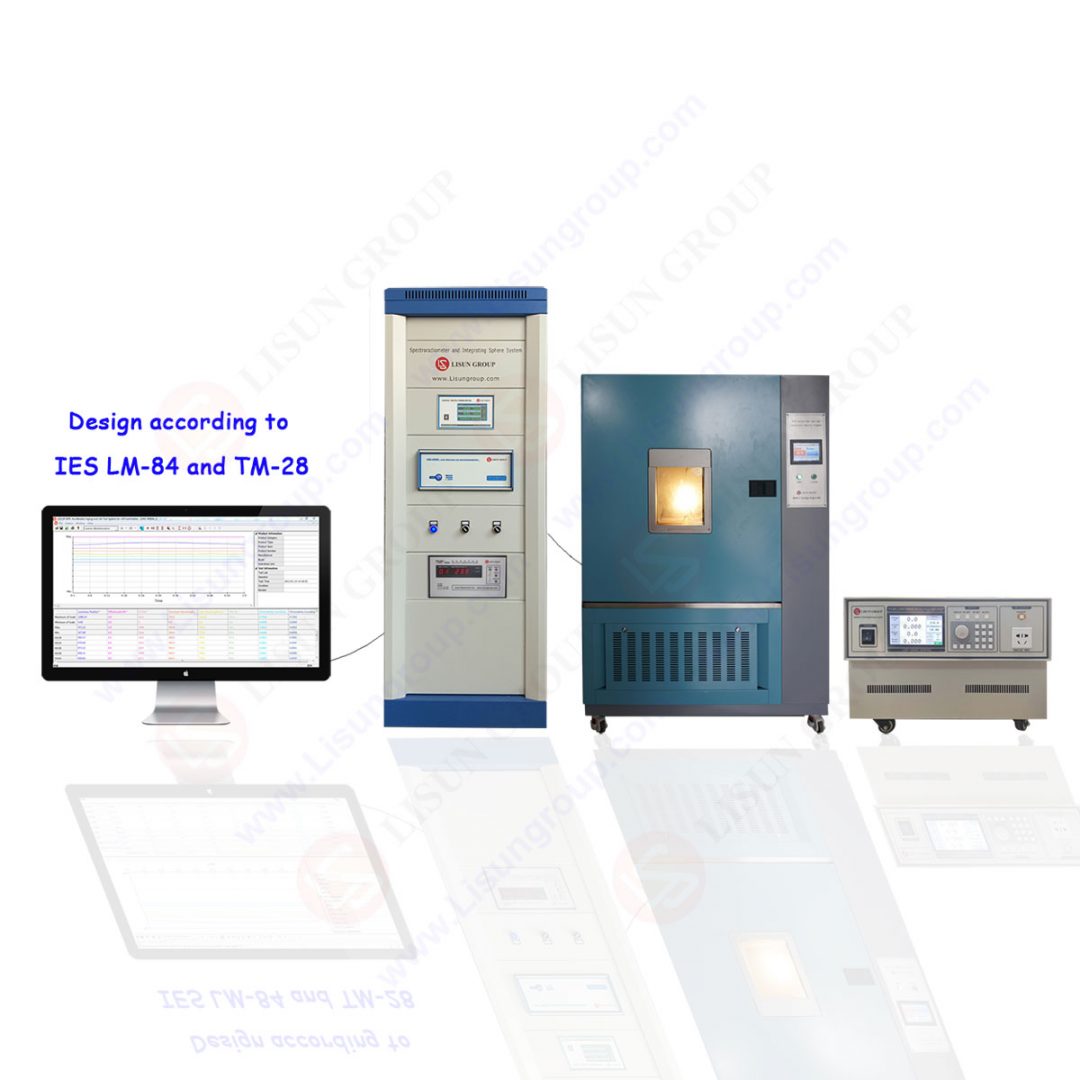
The LISUN IES LM-79-19 LED Optical Aging Test Instrument is engineered with two distinct system variants tailored to specific industry standards. The LEDLM-80PL configuration is optimized for compliance with IES LM-80-15, focusing on lumen maintenance testing of LED packages, arrays, and modules through extended duration assessments at controlled case temperatures. Conversely, the LEDLM-84PL variant aligns with IES LM-84-14, which addresses luminous flux maintenance testing of LED lamps, light engines, and luminaires. Both systems share a common hardware platform but diverge in test protocols and data processing workflows, allowing laboratories to select the appropriate configuration based on the device under test (DUT) classification and target certification requirements.
1.2 Core Measurement Capabilities and Photometric Integration
Central to the instrument’s functionality is its integration with IES LM-79-19 photometric measurement standards, which govern electrical and photometric testing of solid-state lighting products. The system incorporates high-precision integrating sphere and goniophotometer interfaces, enabling simultaneous measurement of luminous flux, chromaticity coordinates, correlated color temperature (CCT), and color rendering index (CRI) at each aging interval. The dual-mode testing capability—standard continuous aging and accelerated step-stress profiling—provides flexibility for both routine quality control and advanced R&D investigations into failure mechanisms.
1.3 Customizable Hardware Configurations for Multi-Chamber Operations
The instrument supports up to three interconnected temperature chambers, each independently controllable within a range of 25°C to 125°C with ±0.5°C stability. This multi-chamber architecture enables simultaneous testing at multiple case temperatures, as required by IES LM-80 for projection accuracy. Customizable test fixture configurations accommodate various LED form factors, from surface-mount devices to high-power COB arrays, with adjustable current sources delivering up to 10A per channel. These hardware specifications ensure compatibility with diverse product lines while maintaining traceability to NIST photometric standards.
2.1 IES LM-80-15 and TM-21-19 Lumen Maintenance Projection
The LISUN IES LM-79-19 LED Optical Aging Test Instrument fully supports IES LM-80-15 test methodology, which mandates a minimum 6000-hour test duration with data collected at intervals of no more than 1000 hours. The integrated software automatically calculates TM-21-19 extrapolation parameters, including the exponential decay coefficients for L70 and L50 lifetime projections. For LED packages tested at three case temperatures (typically 55°C, 85°C, and a manufacturer-defined third temperature), the system processes raw lumen maintenance data through Arrhenius-based acceleration models, generating statistically validated lifetime estimates with confidence intervals.
2.2 IES LM-84-14 and TM-28-14 Compliance for Integrated Products
For complete luminaires and integrated LED lamps, the LEDLM-84PL configuration adheres to IES LM-84-14 testing protocols, which focus on in-situ temperature measurement rather than controlled case temperature. TM-28-14 extrapolation methodology applies to these product categories, using the same Arrhenius model framework but with room temperature ambient conditions. The instrument’s software automatically differentiates between LM-80 and LM-84 data sets, applying appropriate temperature correction factors and projection algorithms. Compliance with CIE 084 and CIE 70 luminous flux measurement standards ensures photometric accuracy within ±2% across the visible spectrum.
2.3 CIE 127 and Auxiliary Standard Integration
The system incorporates CIE 127:2007 guidelines for LED optical radiation measurement, particularly for averaging LED intensity and total luminous flux determination. This integration is critical for ensuring that aging test data collected at intermittent measurement points maintains traceability to international photometric references. The dual-mode testing capability—measuring at designated intervals versus continuous monitoring—allows laboratories to balance data density with operational efficiency while meeting the data point frequency requirements specified in IES LM-80-15 and LM-84-14.
3.1 Exponential Decay Modeling for L70 and L50 Metrics
The proprietary software embedded in the LISUN IES LM-79-19 LED Optical Aging Test Instrument applies Arrhenius-based thermal acceleration modeling to project lumen maintenance trajectories. The core algorithm assumes first-order exponential decay, where relative luminous flux Φ(t) = Φ₀ × exp(-α × t), with α representing the decay rate constant. For L70 lifetime calculation, the software solves for time t when Φ(t) = 0.70 × Φ₀, incorporating temperature-dependent acceleration factors derived from testing at multiple case temperatures. The L50 metric, representing 50% lumen maintenance, follows the same methodology but extends the projection horizon, requiring careful validation of the minimum 6000-hour test data per TM-21 guidelines.
3.2 Statistical Confidence Intervals and Outlier Detection
The software implements rigorous statistical analysis per TM-21-19 annexes, including chi-squared goodness-of-fit tests for the exponential model and 95% confidence interval calculations for projected lifetimes. Outlier detection algorithms identify anomalous data points caused by measurement artifacts or premature failures, flagging these for operator review. The Arrhenius model parameters—activation energy (Ea) and pre-exponential factor (A)—are calculated through linear regression of ln(α) versus 1/T plots, with typical Ea values for contemporary LEDs ranging from 0.3 eV to 0.7 eV depending on phosphor composition and packaging materials.
3.3 Multi-Channel Data Management and Reporting
The instrument supports simultaneous monitoring of up to 48 individual LED samples across three temperature chambers, with automated data logging at user-defined intervals from 1 hour to 1000 hours. The LISUN IES LM-79-19 LED Optical Aging Test Instrument generates comprehensive test reports including raw data tables, exponential fit curves, TM-21 projection plots, and pass/fail criteria based on manufacturer-specified L70 thresholds. Export functionality to Excel and PDF formats facilitates integration with laboratory information management systems (LIMS) and regulatory submission packages.
4.1 Standard Continuous Aging Mode
The standard continuous aging mode conforms to IES LM-80-15 requirements, maintaining DUTs at constant case temperatures while periodically measuring photometric and electrical parameters. Typical test duration spans 6000 hours minimum, with data collection at 0, 1000, 2000, 3000, 4000, 5000, and 6000-hour intervals. The LISUN IES LM-79-19 LED Optical Aging Test Instrument implements automated measurement sequences where DUTs are transferred to an integrating sphere or goniophotometer without manual intervention, reducing operator variability and improving data reproducibility. Temperature chamber stability within ±0.5°C ensures that case temperature variations do not introduce systematic errors into the Arrhenius analysis.
4.2 Accelerated Step-Stress Profiling Mode
For R&D applications requiring rapid lifetime assessment, the accelerated step-stress mode applies incremental temperature increases—typically 10°C steps from 85°C to 125°C—while monitoring lumen depreciation in real time. This mode employs the Arrhenius model to extrapolate L70 lifetimes from data collected over 1000-2000 hours, providing preliminary estimates that can be validated against full 6000-hour tests. The software automatically adjusts acceleration factors based on the measured activation energy, enabling comparisons between different LED chemistries and packaging technologies. Customizable stress profiles—including current step-stress and humidity cycling—expand the instrument’s utility for reliability characterization beyond standard lumen maintenance.
4.3 Comparative Analysis of Testing Mode Efficiencies
The following table summarizes key performance parameters for the two testing modes:
| Parameter | Standard Continuous Mode | Accelerated Step-Stress Mode |
|---|---|---|
| Minimum Test Duration | 6000 hours | 1000-2000 hours |
| Temperature Conditions | 3 fixed case temperatures | Incremental 10°C steps |
| Data Points Collected | 7+ (at 1000-hour intervals) | 20+ (continuous monitoring) |
| TM-21 Projection Accuracy | ±10% typical | ±20% typical (preliminary) |
| Application Context | Regulatory compliance | R&D screening |
| Software Analysis | Full TM-21 exponential fit | Arrhenius extrapolation only |
5.1 Temperature Chamber Architecture and Control
The LISUN IES LM-79-19 LED Optical Aging Test Instrument supports up to three independently controlled temperature chambers, each with internal dimensions of 800mm × 800mm × 1000mm. Chamber temperature uniformity is maintained at ±1.0°C across the working volume, with ramp rates of 3°C per minute for efficient thermal cycling. Each chamber accommodates up to 16 LED samples on custom fixture plates, with individual current control per channel using precision DC sources with 0.1% accuracy. The system includes overtemperature protection features and redundant temperature sensors distributed throughout the chamber to ensure operational safety during extended unattended tests.
5.2 Photometric Measurement Subsystem
The integrating sphere configuration options include 0.3m, 0.5m, and 1.0m sphere diameters, selected based on DUT size and luminous flux range. Spectroradiometer integration, covering 380nm to 780nm with 1nm resolution, enables accurate CCT and CRI measurements at each aging interval. The goniophotometer option provides spatial luminous intensity distribution measurements, critical for luminaire testing per IES LM-79-19. All photometric channels are calibrated against NIST-traceable standard lamps, with recalibration intervals of 12 months recommended per ISO/IEC 17025 laboratory accreditation requirements.
5.3 Data Acquisition and System Control Interface
The system employs a 24-bit analog-to-digital converter with 1µV resolution for electrical parameter monitoring—voltage, current, and power—across each LED channel. The software interface supports real-time visualization of lumen depreciation curves, Arrhenius plots, and chamber status, with automated alerts for out-of-specification conditions. Network connectivity via Ethernet allows remote monitoring and data retrieval, supporting multi-lab operations where shared instruments require centralized data management. The LISUN IES LM-79-19 LED Optical Aging Test Instrument also includes backup power systems and uninterruptible power supply (UPS) integration to prevent data loss during test sessions exceeding 6000 hours.
6.1 LED Manufacturing Quality Control
For LED manufacturers conducting incoming inspection or production quality assurance, the instrument enables batch-level lumen maintenance characterization within 6000 hours, supporting rapid screening of manufacturing process variations. TM-21 projections provide L70 lifetime estimates that inform warranty periods and customer specifications. The dual-mode capability allows QC laboratories to balance throughput with accuracy—using accelerated mode for routine screening and continuous mode for qualification testing of new product families.
6.2 Third-Party Testing Laboratory Operations
Independent testing laboratories benefit from the instrument’s compliance with multiple international standards—IES LM-80, IES LM-84, TM-21, TM-28, and IES LM-79-19—allowing a single platform to serve diverse client requirements. The multi-chamber architecture increases testing throughput, enabling simultaneous evaluation of up to 48 samples across different temperature conditions. Automated data reporting reduces turnaround time for certification reports required by Energy Star, DLC, and other energy efficiency programs.
6.3 Automotive and Specialty Lighting Applications
For automotive lighting components governed by SAE and ECE regulations, the system’s temperature range up to 125°C accommodates harsh environment testing requirements. The step-stress mode is particularly valuable for evaluating LED performance under thermal cycling conditions representative of automotive under-hood or exterior lighting applications. Customizable fixture configurations support unique form factors, from chip-on-board arrays to flexible LED strips, expanding the instrument’s utility beyond general illumination.
7.1 Photometric and Electrical Parameter Calibration
The LISUN IES LM-79-19 LED Optical Aging Test Instrument requires annual recalibration of all photometric and electrical measurement channels, performed against NIST-traceable standards. Calibration procedures include luminous flux verification using standard lamps, wavelength accuracy checks via spectral line sources, and current/voltage calibration using precision reference meters. The software maintains calibration history and generates alerts when recalibration deadlines approach, supporting laboratory accreditation requirements under ISO/IEC 17025.
7.2 Routine Preventive Maintenance Procedures
Recommended preventive maintenance includes monthly cleaning of integrating sphere surfaces to maintain reflectivity above 94%, quarterly verification of temperature sensor accuracy against a calibrated reference thermometer, and annual replacement of exhaust filters on temperature chambers. The system self-diagnostics function performs automated checks of communication interfaces, temperature controller stability, and photometric channel dark current, flagging any drift beyond specified tolerances for immediate corrective action.
7.3 Data Integrity and Traceability Measures
All test data is stored in encrypted formats with timestamped audit trails, preventing unauthorized modifications and ensuring traceability for regulatory audits. The software supports user access control with tiered permissions—operator, supervisor, and administrator—restricting configuration changes and data deletion. Backup procedures automatically archive raw data files to external storage at each measurement interval, safeguarding against data loss during extended test durations exceeding 6000 hours.
The LISUN IES LM-79-19 LED Optical Aging Test Instrument provides a comprehensive, standards-compliant solution for accelerated lumen maintenance testing, integrating dual-system variants for LM-80/TM-21 and LM-84/TM-28 protocols with Arrhenius model-based lifetime prediction software. Its support for up to three temperature chambers enables simultaneous multi-temperature testing as required by IES standards, while customizable hardware configurations accommodate diverse LED product types and testing modes. By combining 6000-hour continuous aging with accelerated step-stress profiling, the instrument serves both regulatory compliance and R&D applications, delivering statistically validated L70 and L50 projections with full traceability to international photometric standards. For LED manufacturers, third-party laboratories, and specialty lighting engineers, this instrument reduces test cycle times, improves data repeatability, and ensures alignment with evolving industry regulations. The integration of IES LM-79-19 photometric measurement standards with robust hardware and software architecture positions LISUN’s solution as a critical tool for advancing LED reliability assessment and supporting global adoption of solid-state lighting technologies.
Q1: What is the minimum test duration required for LM-80 compliance using the LISUN IES LM-79-19 LED Optical Aging Test Instrument?
A: The IES LM-80-15 standard mandates a minimum 6000-hour test duration for lumen maintenance data collection, with measurements recorded at intervals not exceeding 1000 hours. The LISUN instrument’s standard continuous aging mode fully complies with this requirement, automatically scheduling photometric measurements at 0, 1000, 2000, 3000, 4000, 5000, and 6000 hours. For TM-21 extrapolation, the software requires data from at least 6000 hours for L70 projections and 8000 hours for L50 calculations. However, the accelerated step-stress mode can provide preliminary lifetime estimates within 1000-2000 hours, useful for R&D screening but not accepted for regulatory submissions. Laboratories seeking ENERGY STAR or DLC certification must complete the full 6000-hour LM-80 test to obtain valid TM-21 projections.
Q2: How does the Arrhenius model in the LISUN software handle multiple case temperature data for accurate lifetime prediction?
A: The Arrhenius model-based software processes lumen maintenance data from three case temperatures—typically 55°C, 85°C, and a manufacturer-defined third temperature (often 105°C). For each temperature, the software calculates the decay rate constant α using first-order exponential regression. It then performs linear regression of ln(α) versus 1/T (in Kelvin), where the slope equals -Ea/k (activation energy divided by Boltzmann constant) and the intercept yields the pre-exponential factor. The activation energy Ea, typically ranging from 0.3 eV to 0.7 eV for modern LEDs, determines the acceleration factor between test temperatures and use conditions. The software applies this acceleration factor to project L70 and L50 lifetimes at specified operating temperatures, with 95% confidence intervals calculated per TM-21-19 annexes. For accurate results, the instrument maintains case temperature stability within ±0.5°C and requires a minimum 6000-hour data set.
Q3: Can the LISUN IES LM-79-19 LED Optical Aging Test Instrument test both LED packages and complete luminaires simultaneously?
A: Yes, but with important configuration considerations. The LEDLM-80PL variant is designed for testing LED packages, arrays, and modules per IES LM-80, which requires controlled case temperature testing with thermocouple attachment to the DUT’s thermal pad. The LEDLM-84PL variant accommodates complete luminaires and integrated LED lamps per IES LM-84, which uses ambient temperature control with in-situ DUT temperature monitoring. Both variants share the same hardware platform, but the software differentiates between test types and applies appropriate extrapolation methodologies—TM-21 for packages and TM-28 for luminaires. However, simultaneous testing of both types within the same chamber is not recommended due to different temperature control requirements. The instrument’s multi-chamber architecture allows separate chambers for LM-80 and LM-84 tests, supporting diverse testing needs in a single instrument platform.
Q4: What are the typical L70 lifetime projection accuracy limits for TM-21 extrapolation using the LISUN system?
A: According to TM-21-19 guidelines, the maximum extrapolation period is limited to 6 times the test duration—meaning a 6000-hour test supports projections up to 36,000 hours (approximately 4.1 years). The LISUN software provides 95% confidence intervals that typically span ±10% to ±20% of the projected L70 value, depending on data quality and consistency. Accelerated step-stress mode using Arrhenius-only extrapolation yields wider confidence intervals of ±20% to ±30%, primarily suitable for screening rather than certification. Key factors affecting accuracy include the number of samples tested (minimum 20 per case temperature recommended), measurement frequency adherence, and outlier removal. The instrument’s photometric accuracy of ±2% and temperature stability within ±0.5°C minimize systematic error contributions, achieving TM-21 reproducibility within ±5% for identical test conditions across different chambers.