









Here is the comprehensive technical article generated according to your specifications.
Abstract
This article provides a technical deep dive into the LISUN LED Optical Aging Test Instruments, specifically engineered to comply with UL 60950-1 and other global safety standards. Designed for rigorous lumen maintenance validation, these systems are critical for LED manufacturers and testing labs aiming to predict long-term performance accurately. We explore the dual-system architecture—LEDLM-80PL for LM-80/TM-21 and LEDLM-84PL for LM-84/TM-28—detailing how the integrated Arrhenius Model-based software accelerates testing to deliver reliable L70/L50 projections. By focusing on data integrity and customizable hardware configurations, LISUN instruments enable professionals to achieve precise 6000-hour aging tests while maintaining compliance with industry benchmarks like IES LM-79-19 and CIE 127. This article serves as a technical guide for optimizing reliability validation workflows.
1.1 The Critical Role of Lumen Maintenance Testing
In the LED industry, predicting the useful life of a light source is paramount. Lumen depreciation, governed by junction temperature and drive current, is the primary failure mode for solid-state lighting. Accurate testing requires specialized instrumentation capable of maintaining stable environmental conditions for thousands of hours. The LISUN LED Optical Aging Test Instruments are designed to meet this need, providing a controlled platform for accelerated aging. These systems are built to help engineers generate reliable data for TM-21 extrapolation, turning 6000 hours of test data into projections of L70 (time to 70% lumen maintenance) that can exceed 50,000 hours.
1.2 Compliance with UL 60950-1 and IES Standards
Safety and standardization are non-negotiable in LED product certification. The LISUN LED Optical Aging Test Instruments are engineered to comply with UL 60950-1, ensuring that all electrical and mechanical components meet rigorous safety requirements for information technology equipment used in testing environments. Beyond safety, the systems are designed around core IES standards, including IES LM-80, IES LM-84, and IES LM-79-19. This dual focus on safety and photometric accuracy allows the instruments to serve as a reliable platform for data acquisition used in Energy Star and DLC (DesignLights Consortium) certification applications.
1.3 System Architecture: LEDLM-80PL vs. LEDLM-84PL
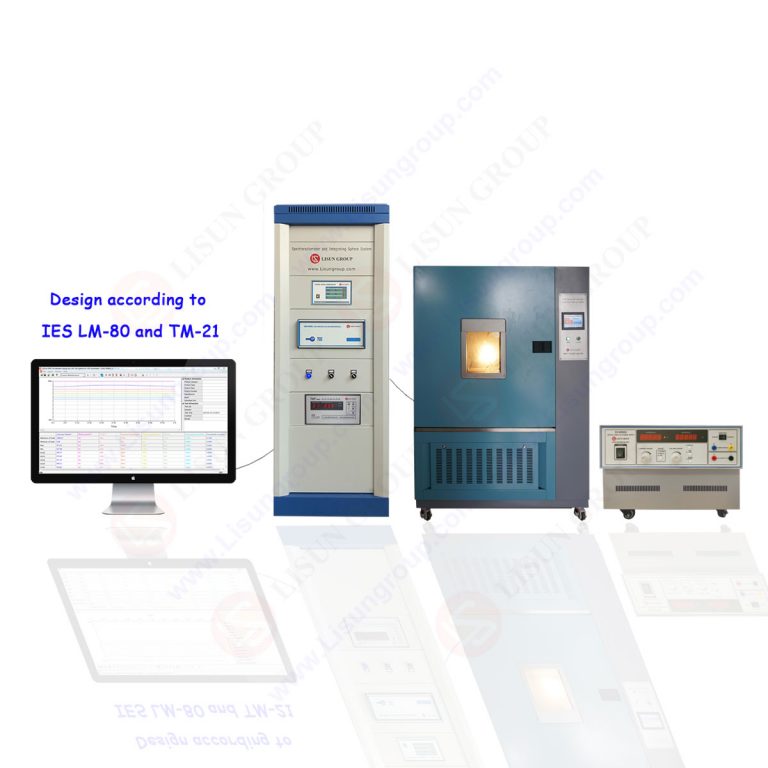
To address diverse testing methodologies, LISUN offers two primary variants. The LEDLM-80PL is tailored for component-level testing per IES LM-80, focusing on individual LEDs or LED modules. The LEDLM-84PL is designed for luminaire-level testing per IES LM-84, accommodating complete integrated lamps and luminaires. Both systems share a common control architecture but differ in test chamber configuration and sensor placement. This modular approach allows laboratories to invest in the specific system that matches their primary certification needs without compromising on the precision required for Arrhenius Model modeling.
2.1 UL 60950-1 Safety Integration in Test Systems
The focus keyword “LISUN LED Optical Aging Test Instruments: Comply with UL 60950-1 Standards” is not merely a tagline but a design principle. UL 60950-1 dictates specific requirements for creepage distances, insulation, and ground leakage currents. In a test system operating at high temperatures (often up to 85°C or more), these safety margins are critical to prevent arc faults or thermal runaway. LISUN integrates these specifications into the power supply isolation, internal wiring, and temperature sensor circuitry, ensuring the equipment itself does not become a hazard during 6000-hour continuous operation cycles.
2.2 Application of IES LM-80 and TM-21 for Component Validation
IES LM-80 provides the method for measuring lumen maintenance of LED light sources, recommending test durations of 6000 hours. The LISUN LEDLM-80PL system is optimized for this standard, offering precise temperature control (typically ±2°C) at the Solder Point. The collected data is then analyzed using TM-21, which applies an exponential curve fit to project long-term performance. The instruments’ built-in software automates this process, calculating L70 and L50 values and their respective 90% lower confidence bounds, a critical metric for warranty and quality assurance.
2.3 Utilization of IES LM-84 and TM-28 for Luminaire Testing
For integral LED lamps and luminaires, IES LM-84 replaces component-level testing. The LISUN LEDLM-84PL system supports this by providing larger test chambers capable of holding assembled products. TM-28 is the companion projection standard for this test method. A key differentiator of the LISUN system is its ability to correlate TM-28 projections with component-level TM-21 results, allowing engineers to verify that luminaire-level thermal management is not degrading expected LED life. The system supports up to 3 connected temperature chambers to run parallel tests at different case temperatures for multi-point Arrhenius modeling.
3.1 Hardware Configurations and Temperature Chamber Support
Customization is a hallmark of the LISUN product line. Depending on throughput requirements, users can configure the system with one or multiple temperature chambers. The system supports up to 3 connected temperature chambers, each independently controllable. This allows simultaneous testing at different ambient temperatures (e.g., 55°C, 85°C, and 105°C), which is essential for calculating activation energy using the Arrhenius Model. The chambers are integrated with photometric heads (integrating spheres or goniometric systems) via fiber optic cables, ensuring minimal light loss during measurement.
3.2 System Specifications Comparison Table
The following table provides a technical comparison between the two primary configurations, highlighting key numerical data relevant to test engineers.
| Feature | LISUN LEDLM-80PL (Component) | LISUN LEDLM-84PL (Luminaire) |
|---|---|---|
| Target Standard | IES LM-80, TM-21 | IES LM-84, TM-28 |
| Test Object | LEDs, LED Modules, COBs | Integrated Lamps, Luminaires |
| Max. Temp. Setting | 85°C (Standard), 105°C (Optional) | 85°C (Standard), 105°C (Optional) |
| Temperature Control | ±2.0°C | ±2.0°C |
| Test Duration | 6000 Hours (Min. per LM-80) | 6000 Hours (Min. per LM-84) |
| Key Output Metrics | L70, L50, TM-21 Projected Life | L70, L50, TM-28 Projected Life |
| Max. Chambers Support | Up to 3 | Up to 3 |
| Software Feature | Arrhenius Model, TM-21 Fit | Arrhenius Model, TM-28 Fit |
3.3 Dual Testing Modes: Continuous vs. Cyclic Operation
To simulate real-world usage, the instruments offer two primary testing modes. Continuous Mode maintains a constant current and temperature for the entire 6000-hour duration, the standard method for TM-21 projections. Cyclic Mode allows users to program on/off periods (e.g., 2 hours on, 0.5 hours off) to assess the impact of thermal cycling on solder joint integrity and phosphor degradation. The software logs changes in photometric performance (luminous flux, CCT, CRI) during both the “on” and “off” states, providing a comprehensive view of reliability under transient thermal stress.
4.1 The Mathematical Foundation of Accelerated Testing
The LISUN software suite is built around the Arrhenius Model, which describes the relationship between reaction rate and temperature. In LED testing, this model is used to accelerate the failure mechanism. By testing at elevated temperatures (e.g., 85°C vs. 55°C), the software estimates the activation energy (Ea). This value is then used to project the L70 life at a lower, rated operating temperature (e.g., 55°C). The software automatically calculates the acceleration factor, allowing engineers to achieve 50,000-hour projections from 6000 hours of real data.
4.2 Data Logging and TM-21 Extrapolation Tools
Data fidelity is critical for extrapolation. The LISUN software records photometric data at user-defined intervals (e.g., every 30 minutes). At the conclusion of the test (or at specified intermediate points), the software performs the TM-21 exponential decay fitting algorithm:
Φ(t) = α exp(-βt)
Where Φ(t) is the lumen maintenance at time t*. The software calculates the parameters α and β, and then uses them to predict the time until lumen output reaches 70% (L70) or 50% (L50). It also calculates the 90% lower confidence bound, often the most stringent requirement for warranty claims. This automated analysis eliminates manual calculation errors and ensures adherence to CIE 127 guidelines for LED measurements.
4.3 Compliance Reporting for CIE 084 and IES LM-79-19
Beyond aging data, the system can integrate with LISUN’s spectroradiometers and integrating spheres to provide full photometric compliance reports per IES LM-79-19. This standard governs the electrical and photometric measurements of solid-state lighting products. By combining the aging data from the test chamber with the LM-79-19 data (CCT, CRI, efficacy), the software provides a holistic view of the product’s reliability and initial performance. This consolidation is particularly valuable for labs that must provide a complete certification package under standards like CIE 084, which outlines the measurement of luminous flux.
5.1 Selecting the Right Test Duration and Endpoint Criteria
While 6000 hours is the minimum for LM-80 compliance, the LISUN system supports extended durations for specific R&D needs. Engineers can set endpoint criteria based on a defined percentage of lumen depreciation (e.g., stop at 95% lumen maintenance) or a maximum time limit. This flexibility is crucial when evaluating new phosphor chemistries or chip designs where failure mechanisms may differ. The system’s ability to test at high resolution allows for early detection of sudden failures or “infant mortality,” which is often invisible in standard 6000-hour summaries.
5.2 Managing Multiple Chambers for High-Throughput Labs
For third-party testing laboratories, throughput is a key performance indicator. The LISUN system supports up to 3 connected temperature chambers, each capable of holding multiple test samples (typically 20-50 LED modules for the LEDLM-80PL). The central control system manages all chambers simultaneously, assigning unique test profiles to each. This parallel processing reduces the time-to-result for a product portfolio. The software handles data routing automatically, preventing sample ID mix-ups and ensuring that the traceability required for ISO/IEC 17025 accreditation is maintained.
6.1 Maintaining Electrical Isolation and Thermal Stability
One of the greatest challenges in aging tests is ensuring that the electrical stress is applied accurately without interference from the thermal system. The LISUN instrument complies with UL 60950-1 by using isolated power supplies for each sample channel. This prevents ground loops that can cause phantom current readings. Additionally, the system employs PID (Proportional-Integral-Derivative) control logic for the temperature chambers. This ensures that the ambient temperature does not oscillate (±2°C stability), which would otherwise skew the Arrhenius Model calculations and lead to inaccurate L70 projections.
6.2 Correlating Component Data (LM-80) with Luminaire Data (LM-84)
A significant technical hurdle for R&D teams is correlating the life expectancy of individual LEDs (LM-80/TM-21) with the life expectancy of the final luminaire (LM-84/TM-28). The LISUN platform aids this by allowing users to test the LED components in the LEDLM-80PL and a complete luminaire in the LEDLM-84PL under similar thermal conditions. The software includes modules that overlay these two datasets. If the luminaire’s TM-28 projection is significantly lower than the component’s TM-21 projection, it indicates a poor thermal design or driver compatibility issue. This correlation is vital for root cause analysis.
6.3 Calibration and Traceability per CIE 70
Accurate measurement requires precise calibration. LISUN instruments align with CIE 70, which addresses the measurement of absolute spectral distribution. The photometric sensors (e.g., silicon photodiodes with V(λ) correction) are calibrated against national standards. The software tracks lamp life and schedules automatic calibration reminders. For high-accuracy work, users can connect an external spectroradiometer that is CIE 127 compliant, ensuring that the photometric data used for the TM-21 curve fit is free from spectral mismatch errors.
7.1 Adaptability to Emerging LED Technologies
As LED technology evolves—with higher efficacy and smaller form factors—testing equipment must adapt. The LISUN system’s customizable hardware configurations allow for different sample mounting boards (MCPCBs) and heat sink interfaces. The software is programmed to accept new measurement protocols as standards like IES LM-80 are updated. This flexibility ensures that the capital investment in the LISUN LED Optical Aging Test Instrument remains viable for 5-10 years, even as LED chip design and packaging evolve.
7.2 Data Integrity for Regulatory Compliance
Regulatory bodies are increasingly requiring raw data submissions rather than just summary reports. The LISUN software database stores all raw photometric and electrical data in a non-editable format. This provides an audit trail that satisfies the requirements of agencies like the EPA (for Energy Star) and the FTC (for Lighting Facts). The ability to generate a complete data package that includes the UL 60950-1 safety compliance of the test equipment itself is a powerful advantage for manufacturers facing an audit.
The LISUN LED Optical Aging Test Instruments stand as a benchmark for reliability validation in the LED industry. By fully complying with UL 60950-1 standards, they ensure operational safety during prolonged 6000-hour stress tests. The integration of the Arrhenius Model-based software with support for up to 3 temperature chambers allows engineers to accurately project L70 and L50 lifetimes using TM-21 and TM-28 extrapolation. Whether using the LEDLM-80PL for component testing or the LEDLM-84PL for luminaire qualification, professionals gain a robust platform that bridges the gap between IES LM-80/LM-84 data and real-world performance. For third-party labs and in-house R&D teams, these instruments provide the data integrity, throughput, and compliance required for Energy Star and DLC certification, ensuring that products entering the market are both safe and reliably specified. Choosing LISUN is an investment in measurement certainty.
Q1: How does the LISUN LED Optical Aging Test Instrument ensure compliance with UL 60950-1 during a 6000-hour test?
A: Compliance is ensured through specific hardware design choices. The system integrates galvanic isolation on all power supplies to prevent ground loops and stray currents that could compromise safety. Internal wiring uses double-insulated conductors with proper creepage distances as defined by UL 60950-1. Additionally, the temperature chambers feature thermal fuses and redundant over-temperature protection that disconnects the heating elements independently of the software. This ensures that even if a software error occurs, the physical safety of the test operator and the equipment is maintained. The system also locks out high-voltage adjustments when the doors are open, preventing accidental contact.
Q2: Can I use the LISUN LEDLM-80PL to generate data for TM-21 projections if I only test for 3000 hours?
A: Technically yes, but it is not recommended for compliance. The IES LM-80 standard mandates a minimum of 6000 hours of test data to be used for TM-21 extrapolation. While the software can perform a curve fit on 3000 hours of data, the resulting L70 projection will have a much wider 90% confidence interval, significantly reducing its accuracy and making it unsuitable for warranty claims. For internal R&D screening (e.g., comparing two bin codes), 3000 hours can provide preliminary data, but for formal reports submitted to Energy Star or DLC, the full 6000-hour dataset is required to comply with the TM-21 Annex and the Arrhenius Model application.
Q3: What is the difference between the L70 metric from TM-21 (Component) and TM-28 (Luminaire) when using your instruments?
A: The L70 metric is the same in concept—time to 70% lumen maintenance—but they apply to different levels of the product. TM-21 is used for LED packages, arrays, or modules tested per LM-80 on the LEDLM-80PL system. It assumes a reference drive current and temperature. TM-28 is used for integral LED lamps or luminaires tested per LM-84 on the LEDLM-84PL system. Its L70 value is measured at the luminaire level, including the effects of the driver, optics, and thermal management. A lower L70 from TM-28 (e.g., 25,000 hours) compared to TM-21 (e.g., 50,000 hours) indicates that the luminaire housing is causing the LEDs to run hotter than intended, providing a clear target for design improvement.