









Here is the comprehensive technical article generated based on your instructions.
Abstract
For LED manufacturers, ensuring long-term lumen maintenance and color stability is critical for product reliability and warranty compliance. This article explores the technical architecture and application of LISUN LED Optical Aging Test Instruments for LED Manufacturing Quality Control Testing, focusing on the LEDLM-80PL and LEDLM-84PL systems. We detail how these instruments integrate Arrhenius Model-based software for accelerated aging prediction, support dual testing modes (online continuous monitoring and offline multi-chamber batch testing), and align with IES LM-80, TM-21, LM-84, and TM-28 standards. By providing technical insights into 6000-hour test protocols, L70/L50 metric extrapolation, and customizable hardware configurations, this guide offers a data-driven roadmap for optimizing LED reliability testing and quality assurance.
1.1 Why Lumen Depreciation Testing is Non-Negotiable
LEDs are prized for longevity, yet their lumen output degrades over time due to junction temperature, drive current, and phosphor degradation. Without rigorous optical aging tests, manufacturers risk field failures that erode brand trust. Standards like IES LM-80 and IES LM-84 define the methodology for measuring this degradation, requiring test durations up to 6000 hours (LM-80) or 3000 hours (LM-84). For quality control engineers, the challenge lies not only in running these tests but in doing so with high throughput, precise temperature control, and data integrity.
1.2 The Industry Standards Landscape
Four key standards govern LED lumen maintenance testing:
- IES LM-80-15: Approved method for measuring lumen maintenance of LED light sources (packages, arrays, modules) at specified drive currents and case temperatures over a minimum of 6000 hours.
- TM-21-19: Projection of long-term lumen maintenance (L70, L50) based on LM-80 data using exponential decay models.
- IES LM-84-14: Method for measuring lumen maintenance of LED lamps, engines, and luminaires (3000+ hours).
- TM-28-14: Projection of lumen maintenance for LED lamps and luminaires based on LM-84 data.
LISUN LED Optical Aging Test Instruments for LED Manufacturing Quality Control Testing are designed to meet these standard requirements simultaneously, offering dual-system variants that eliminate hardware redundancy.
2.1 Dual-System Functional Distinction
The LISUN series provides two distinct platforms tailored to the specific test object:
- LEDLM-80PL: For LED packages, arrays, and modules (following LM-80). It includes a temperature-controlled test board (TSP) and individual socket boards for precise case temperature management, typically requiring up to 20 or 30 samples per condition.
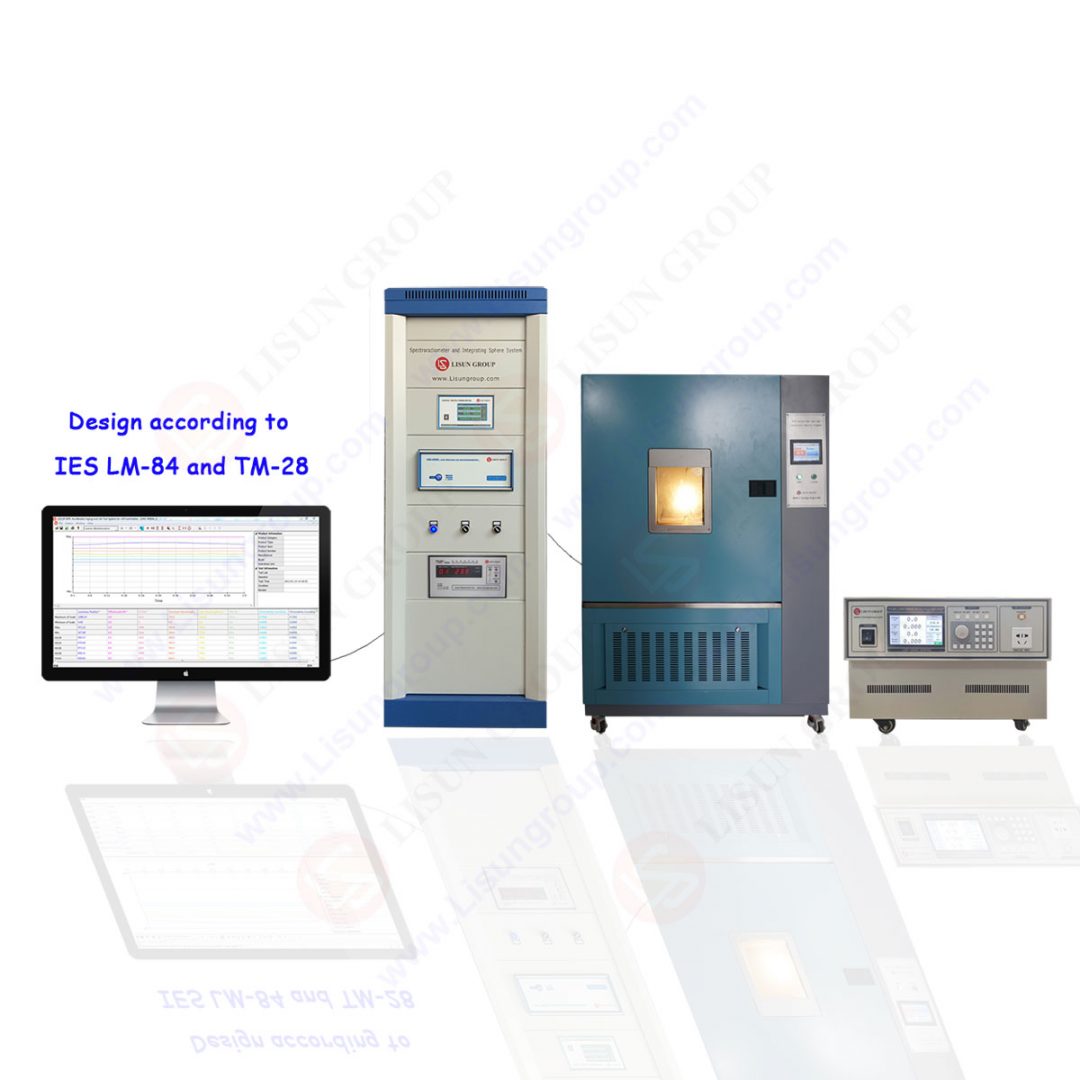
- LEDLM-84PL: For complete LED lamps and luminaires (following LM-84). It features integrated integrating sphere (e.g., 1.5m or 2m sphere) and AC/DC power supply control, enabling absolute photometric and colorimetric measurements without moving the device under test (DUT).
2.2 Unified Hardware Platform
Both systems share a common core architecture: a PC-based control unit, a multi-channel switching system, and a spectroradiometer. The hardware supports up to 3 connected temperature chambers, allowing simultaneous testing of multiple case temperature conditions (e.g., 55°C, 85°C, user-defined Ts) as required by TM-21 for activation energy estimation. Each system can monitor up to 100 channels (for the LEDLM-80PL) or 20 luminaires (for the LEDLM-84PL), providing high throughput for manufacturing quality control.
Table 1: Key Specification Comparison of LISUN LED Optical Aging Test Instruments
| Parameter | LEDLM-80PL (Package/Array/Module) | LEDLM-84PL (Lamp/Luminaire) |
|---|---|---|
| Applicable Standard | IES LM-80, TM-21 | IES LM-84, TM-28 |
| Test Duration | 6000+ hours | 3000+ hours |
| Max Channels / Samples | 100 channels (e.g., 20-30 per condition) | 20 units |
| Temperature Chamber Support | Up to 3 chambers | Up to 3 chambers |
| Measurement Method | Online continuous; offline periodic | Online continuous; offline periodic |
| Key Lumen Metrics | L70(6k), L50(6k) via TM-21 | L70(3k) via TM-28 |
| Optical Measurement | Probe-based (flux & spectral) | Integrating sphere (absolute flux & color) |
| Case Temperature Control | TSP board with thermocouples | Ambient or fixture temperature per LM-84 |
3.1 Online Continuous Monitoring Mode
In this mode, the instrument performs real-time photometric and colorimetric measurements at programmable intervals (e.g., every 30 minutes or 1 hour). The DUT remains permanently mounted, and the system records data points including lumen output, CCT, CRI, and chromaticity coordinates (x, y). This mode is critical for:
- Capturing rapid degradation events (e.g., early phosphor failure).
- Generating smooth TM-21 extrapolation curves with high R² values.
- Monitoring color shift (Δu’v’) per CIE 127 and LM-80 requirements.
3.2 Offline Batch Measurement Mode
For labs that cannot keep a spectroradiometer permanently connected to every sample, the offline mode allows periodic removal of DUTs to a dedicated measurement station (e.g., an integrating sphere). The system stores aging time data and synchronizes measurement results from the sphere. This mode supports:
- Higher sample throughput using fewer measurement instruments.
- Compliance with LM-84 lamp testing where absolute flux is required.
- Reduction in capital expenditure for multi-channel spectrometer arrays.
4.1 Deriving Activation Energy from Multi-Chamber Data
The core of LISUN’s software is the Arrhenius Model, which predicts failure time at use temperature (T_use) based on accelerated test data at high temperatures (T_test). By connecting up to 3 temperature chambers (e.g., 55°C, 85°C, and 105°C), the system allows engineers to calculate the activation energy (Ea) for the LED phosphor and die. The software automatically:
- Fits exponential decay curves (LM-80 / TM-21) to each temperature dataset.
- Plots ln(decay rate) vs. 1/T (Kelvin) to derive Ea.
- Extrapolates L70 and L50 lifetimes for a specified use temperature (e.g., 55°C or 65°C).
4.2 TM-21/TM-28 Projection Algorithm Compliance
The software computes TM-21 projections for L70 (time to 70% lumen maintenance) and L50 (time to 50%) using the exponential model: Φ(t) = B exp(-α t). Key constraints from TM-21-19 are enforced automatically:
- Data truncation: Only data after 1000 hours is used for fitting.
- Projection limit: Projection cannot exceed 6x the test duration (e.g., 6000 hours test → max 36,000 hour projection).
- Statistical quality: R², chi-squared, and residual analysis are reported.
For the LEDLM-84PL, analogous TM-28 projections are generated with a maximum extrapolation of 2x test duration (e.g., 3000 hours → 6000 hour projection).
5.1 Temperature Board and Socket Customization
For the LEDLM-80PL, the TSP (Temperature Sensor Plate) and socket boards are customizable. Manufacturers of specific package sizes (e.g., 5050, 2835, COB modules) can:
- Define board resistivity and trace width to match specified case temperature (Ts).
- Use thermocouples (type K or T) mounted directly on the board next to each sample.
- Adjust the number of samples per condition (e.g., 20 per temperature condition, as required by LM-80).
5.2 Integrating Sphere and Auxiliary Optics
For the LEDLM-84PL, integrating sphere sizes (0.5m to 2.0m) are selectable based on lamp physical dimensions. Options include:
- Auxiliary lamp compensation: Corrects for self-absorption of the DUT when measuring CCT and flux.
- Fiber optic bundle: For remote positioning of the spectrometer to avoid thermal drift.
- AC/DC power supply: Programmable voltage and frequency (50/60Hz) for global compliance testing.
6.1 CIE 084 and CIE 070 Compliance
While LM-80 and LM-84 define aging methods, CIE 084 (Measurement of Luminous Flux) and CIE 070 (Measurement of Absolute Luminous Intensity) define the geometrical and photometric measurement conditions. LISUN instruments comply by using 4π or 2π measurement geometries, cosine-corrected collectors, and calibrated spectrometers. This ensures that flux values used in TM-21/TM-28 are traceable to national standards.
6.2 IES LM-79-19 for Electrical and Photometric Data
For LED lamps (LM-84 testing), the system also captures LM-79-19 metrics: total luminous flux, efficacy (lm/W), CRI, CCT, chromaticity, and electrical power. The integration of LM-84 aging with LM-79 characterization allows manufacturers to test a single sample for both steady-state performance and long-term reliability without recalibration.
7.1 6000-Hour Test Planning and Workflow
A typical quality control program using LISUN LED Optical Aging Test Instruments for LED Manufacturing Quality Control Testing follows this flow:
- Sampling: 20-30 samples per temperature condition (e.g., 55°C, 85°C, 105°C).
- Setup: Mount on TSP boards, program current (e.g., 350mA typical for 1W LED).
- Data Acquisition: Online mode for 6000 hours (25 weeks) with measurements every hour.
- Analysis: Software generates TM-21 report with L70 and L50 projections.
- Decision: Pass/fail criteria based on manufacturer target (e.g., L70 > 50,000 hours at Ts = 85°C).
7.2 Color Shift and Bin Stability
Beyond lumen maintenance, the system tracks chromaticity shift (Δu’v’ per CIE 127). A shift exceeding 0.007 after 6000 hours is often flagged as leading to unacceptable color consistency. The instrument’s high-resolution spectrometer (< 0.5nm FWHM) ensures precise color drift detection.
The LISUN LED Optical Aging Test Instruments for LED Manufacturing Quality Control Testing represent a comprehensive solution for engineers demanding rigorous, standards-based lumen maintenance validation. By supporting both LM-80 (packages) and LM-84 (lamps) on a unified platform with Arrhenius-based software, LISUN reduces equipment redundancy while increasing test throughput. The ability to connect up to three temperature chambers, run online or offline modes, and generate TM-21/TM-28 projections with statistical confidence ensures that manufacturers can validate L70/L50 lifetimes accurately. For quality control and R&D teams, these instruments align with global standards (IES, CIE, TM) and provide the data-driven insights necessary to deliver reliable, long-life LED products. By integrating customizable hardware with advanced prediction algorithms, LISUN empowers the industry to move from reactive failure analysis to proactive reliability engineering.
Q1: What is the minimum test duration required for a TM-21 valid extrapolation using LISUN instruments?
A: For a valid TM-21 projection, the test duration must be at least 6000 hours (6,000 hours) per IES LM-80. The LISUN software will automatically enforce the truncation rules (excluding the first 1000 hours for LM-80, first 2000 hours for LM-84). The projection limit is 6x the test duration for LM-80 data (so a 6000-hour test allows up to 36,000-hour projection). For LM-84/TM-28, a 3000-hour test yields a 6000-hour max projection. Using the Arrhenius Model with data from 3 temperature chambers (e.g., 55°C, 85°C, 105°C) can improve activation energy accuracy, but the software will not extrapolate beyond the 6x or 2x bound.
Q2: Can the LISUN LEDLM-80PL simultaneously test different LED package types in the same run?
A: Yes, the system supports mixed sample configurations, provided each test condition (temperature and drive current) is consistent within a group. The customizable socket boards allow mounting different package types (e.g., SMD 2835, COB, High Power) as long as each is placed on a separate TSP with appropriate thermocouple mapping. The software treats each sample as an independent channel. However, for statistical validity per LM-80, you need a minimum of 20 samples per condition; mixing types requires sufficient sample sizes for each variant. The system’s 100-channel capacity simplifies multi-variant testing.
Q3: How does the Arrhenius Model in LISUN’s software handle different LED chemistries?
A: The Arrhenius Model assumes a single activation energy (Ea) for the dominant failure mechanism. The software computes Ea by fitting an exponential decay rate (α) to the lumen maintenance curves from at least two temperature conditions (ideally three). You input the test temperatures (in Kelvin), and the software performs a linear regression of ln(α) vs. 1/T. The slopes yield Ea. For mixed phosphor or chip chemistries, the software allows separate analysis per batch. If Ea is found to vary significantly (e.g., >0.2 eV difference), it indicates multi-failure mechanisms, and the software will flag this for engineering review, as TM-21 assumes a single dominant mechanism.
Q4: What is the advantage of the “online continuous” mode over “offline” for LM-80 testing?
A: Online continuous mode provides real-time data capture (e.g., every 30 minutes), which is essential for detecting early failure mechanisms like die attach degradation or sudden phosphor burn-out. This high-resolution data improves the R² value of the exponential fit for TM-21. Offline mode reduces spectrometer cost but only captures data at discrete intervals (e.g., every 1000 hours). For fastest degradation, online mode is preferred. However, for well-characterized LEDs with slow, predictable degradation, offline mode is more cost-effective and can handle more samples by rotating DUTs to a central sphere.
Q5: Does the LEDLM-84PL support the measurement of AC LED lamps with dimming?
A: Yes. The LEDLM-84PL includes an integrated AC/DC programmable power supply that can generate waveforms compliant with mains voltage standards (100-277VAC, 50/60Hz). For dimming tests, the system can be programmed to report lumen maintenance at specific dimming levels (e.g., 100%, 50%, 10% dimming). The integrating sphere measurement method is compatible with dimming, provided the lamp is allowed to stabilize (typically 30 minutes). The software records CCT shift under dimming, which is critical for understanding color consistency in dim-to-warm applications.