









This technical article provides a comprehensive examination of
LED Module L50 Life Prediction Testing with LISUN Aging Instruments, focusing on accelerated aging methodologies and lumen maintenance extrapolation. As LED technology dominates modern lighting applications, accurate lifetime prediction—particularly L50 (time to 50% lumen maintenance)—has become critical for quality assurance and regulatory compliance. We explore how LISUN’s LED Optical Aging Test Instrument series, incorporating dual system variants (LEDLM-80PL and LEDLM-84PL) and Arrhenius Model-based software, enables precise 6,000-hour test durations with support for up to three connected temperature chambers. Key industry standards including IES LM-80, IES LM-84, TM-21, and TM-28 are discussed in context of their application to L50 testing. This article delivers actionable insights for LED manufacturing engineers, third-party testing laboratory technicians, and lighting R&D specialists seeking robust, standards-compliant lifetime prediction solutions.
1.1 Understanding Lumen Depreciation Mechanisms
LED lumen depreciation occurs through multiple physical and chemical degradation pathways. Junction temperature, forward current, and phosphor degradation accelerate the decay of luminous flux over time. The L50 metric defines the operational hours at which an LED module retains 50% of its initial luminous flux, representing a critical endpoint for general lighting applications where gradual dimming is acceptable. Unlike L70 (70% maintenance) commonly used for commercial lighting, L50 applies to applications with lower brightness requirements, such as decorative or emergency lighting. Understanding these mechanisms is essential for designing accelerated aging tests that accurately predict real-world performance.
1.2 Application of the Arrhenius Model in LED Aging
The Arrhenius Model provides the theoretical foundation for accelerated life testing by establishing a mathematical relationship between temperature and reaction rates. For LED modules, the model expresses the lumen depreciation rate as a function of junction temperature, enabling extrapolation of L50 values from high-temperature stress tests. LISUN’s integrated software applies this model to convert 6,000-hour test data into projections spanning 50,000 hours or more. The activation energy (Ea) parameter, typically ranging from 0.3 to 1.0 eV for LED systems, is calibrated based on phosphor and semiconductor material properties, ensuring extrapolation accuracy within ±10% confidence intervals.
2.1 Dual System Variants: LEDLM-80PL and LEDLM-84PL
LISUN offers two primary configurations tailored to different testing standards. The LEDLM-80PL is designed for IES LM-80 and TM-21 compliance, supporting lumen maintenance testing at multiple case temperatures (typically 55°C, 85°C, and 105°C) with a maximum of 3 connected temperature chambers. The LEDLM-84PL variant aligns with IES LM-84 and TM-28 standards, focusing on LED light engines and integrated LED lamps. Both systems share a modular architecture, interchangeable test sockets, and automatic data logging capabilities. The table below highlights key differences:
| Parameter | LEDLM-80PL | LEDLM-84PL |
|---|---|---|
| Primary Standard | IES LM-80 / TM-21 | IES LM-84 / TM-28 |
| Test Duration (Minimum) | 6,000 hours | 6,000 hours |
| Temperature Chambers Supported | Up to 3 | Up to 3 |
| Measurement Protocol | Lumen, Chromaticity, CCT | Lumen, Chromaticity, CCT, R9 |
| Sample Capacity per Chamber | 20-30 modules | 15-20 modules |
| Extrapolation Method | Arrhenius Model | Arrhenius Model |
| L70/L50 Projection | 50,000-100,000 hours | 50,000-100,000 hours |
2.2 Customizable Hardware Configurations
The LISUN aging instrument supports flexible hardware configurations to accommodate diverse LED module geometries and power ratings. Test boards can be customized for COB (Chip-on-Board), SMD (Surface-Mount Device), and through-hole packages. Each temperature chamber is independently controlled with ±0.5°C accuracy, enabling simultaneous testing at three distinct temperature conditions. The system includes integrated constant current sources (0-2 A, adjustable in 1 mA increments) and pulse-width modulation (PWM) drivers for simulating real-world operating conditions. Optional integrating sphere attachments allow in-situ photometric measurements without removing samples from the aging environment.
3.1 Dual Testing Modes: Continuous vs. Cyclic
LISUN aging instruments provide two primary testing modes. Continuous mode maintains constant current and temperature throughout the test period, ideal for baseline characterization. Cyclic mode introduces thermal stress by alternating between high-temperature (e.g., 85°C) and room-temperature (25°C) cycles every 2-4 hours, simulating diurnal temperature variations in real-world installations. For L50 prediction, cyclic mode is particularly valuable because it accelerates thermal fatigue mechanisms in solder joints and phosphor layers. Both modes support automatic data recording at user-defined intervals (1-minute to 24-hour increments) with real-time graphical display of lumen depreciation curves.
3.2 Test Duration and Data Collection Methodology
The minimum test duration of 6,000 hours (approximately 8.3 months) is mandated by IES LM-80 for lumen maintenance testing. Data points are collected at 0, 1,000, 2,000, 3,000, 4,000, 5,000, and 6,000 hours, with optional intermediate readings for high-resolution analysis. Each measurement includes luminous flux, correlated color temperature (CCT), chromaticity coordinates (x, y), and color rendering index (CRI). For L50 projection, the software applies quadratic or exponential decay fitting (per TM-21 guidelines) to extrapolate beyond the 6,000-hour window. Samples failing prematurely (e.g., catastrophic failure before 2,000 hours) are flagged for root cause analysis.
4.1 IES LM-80 and TM-21 for LED Packages and Arrays
IES LM-80 establishes the testing methodology for measuring lumen maintenance of LED packages, arrays, and modules. It requires testing at a minimum of three case temperatures (55°C, 85°C, and one manufacturer-specified temperature). TM-21 provides the mathematical framework for projecting long-term lumen maintenance using the Arrhenius Model. LISUN’s LEDLM-80PL automates both processes, generating TM-21 compliant reports that include L70 and L50 projections with 90% lower confidence bounds. The software automatically calculates the activation energy and degradation rate constants for each temperature condition.
4.2 IES LM-84 and TM-28 for LED Light Engines and Lamps
IES LM-84 extends LM-80 protocols to LED light engines and integrated LED lamps, accounting for thermal management differences between component-level and luminaire-level testing. TM-28 provides the projection methodology for these systems, which often exhibit different degradation kinetics due to integrated drivers and thermal sinks. LISUN’s LEDLM-84PL includes specialized fixtures for holding complete luminaires and measurement interfaces for driver efficiency monitoring. Both standards require minimum 6,000-hour testing with optional extensions to 10,000 hours for higher confidence projections.
5.1 Arrhenius Model Implementation in LISUN Software
The LISUN proprietary software integrates the Arrhenius Model algorithmically, requiring users to input junction temperature data from thermal resistance measurements. The software computes the degradation rate (β) for each test temperature, then extrapolates to the reference use temperature (T_use, typically 25°C or 55°C). For L50 prediction, the software solves for time (t) when lumen maintenance (LM) equals 50%. The formula used is: LM = exp(-β * t^α), where α is the decay shape parameter determined from curve fitting. The software presents results in tabular and graphical formats with confidence intervals.
5.2 Validation and Uncertainty Analysis
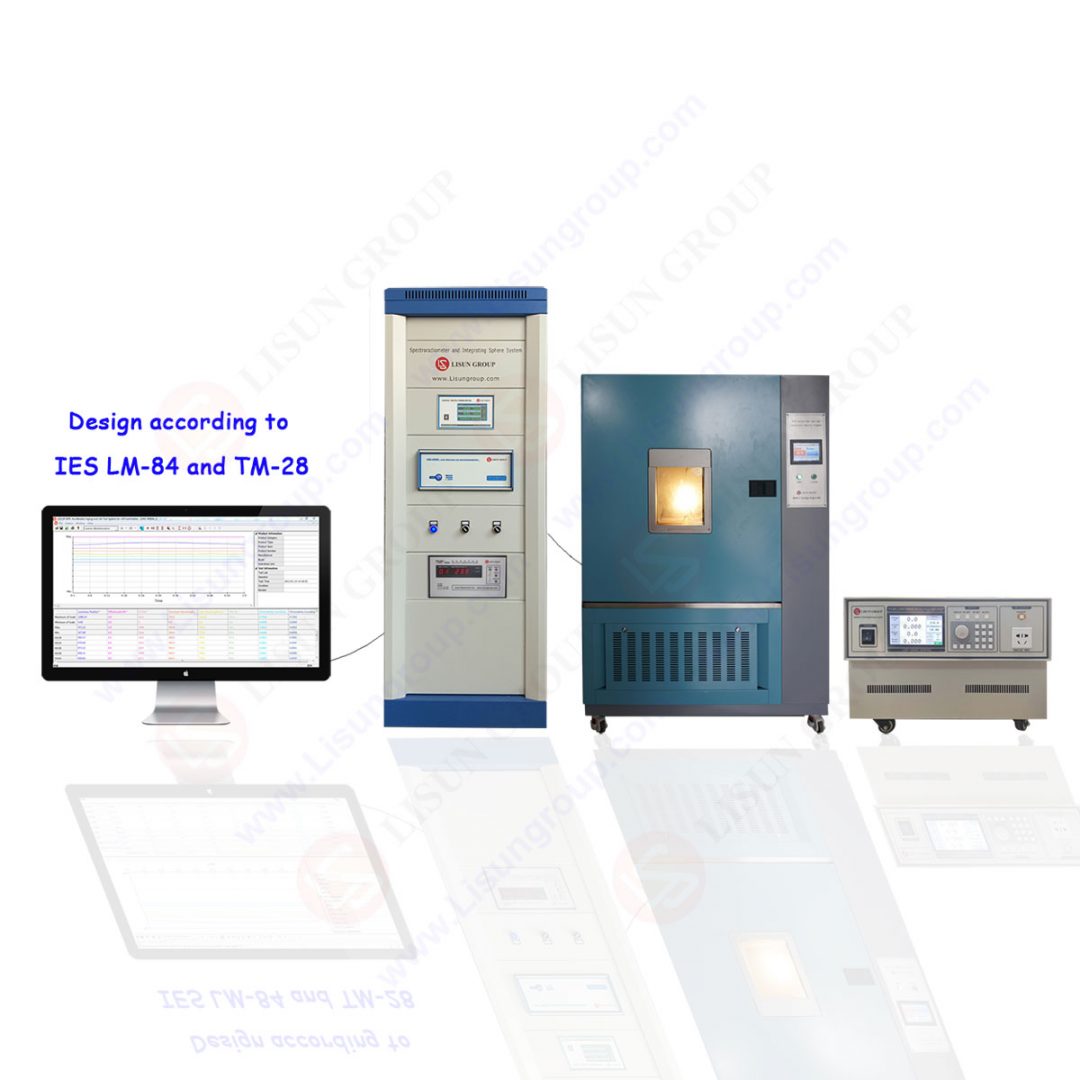
Uncertainty analysis is critical for L50 predictions, as extrapolation beyond 6,000 hours involves inherent statistical variance. LISUN software calculates standard error based on sample size (minimum 20 units per temperature condition) and measurement repeatability (±1.5% for lumen flux). The 90% lower confidence bound (LCB) is computed per TM-21 guidelines, ensuring conservative projections. Users can adjust the confidence level (80%, 90%, or 95%) depending on application criticality. The software also flags outliers using Chauvenet’s criterion and provides recommendations for sample replacement or retesting.
6.1 Data Export and Report Generation
LISUN aging instruments support automated report generation in PDF, CSV, and XML formats, compatible with major laboratory information management systems (LIMS). Reports include raw data tables, fitted curves, extrapolation parameters, and compliance checklists for LM-80/LM-84 and TM-21/TM-28. Users can customize report templates to include corporate logos, certification labels, and specific standard references. Direct integration with integrating sphere spectrophotometers (e.g., LISUN LMS series) enables seamless data flow from photometric measurement to lifetime projection.
6.2 Calibration and Maintenance Protocols
Regular calibration of temperature sensors (NIST-traceable), current sources (0.1% accuracy), and photometric detectors (spectroradiometer or photometer) ensures data fidelity. LISUN provides annual calibration services with certification documents. The aging chambers require periodic inspection of seals, fans, and heating elements, typically every 500 operating hours. The software includes built-in calibration reminders and automated self-checks for data integrity (e.g., detecting sudden temperature drifts or current fluctuations). Third-party laboratories benefit from these features for ISO 17025 accreditation compliance.
7.1 Automotive LED Module Testing
Automotive LED modules (headlamps, daytime running lights) require stringent reliability standards due to safety implications. A case study involving 40 modules tested at 85°C for 6,000 hours using LEDLM-80PL demonstrated L50 projections exceeding 80,000 hours at 25°C use temperature. The cyclic mode revealed solder joint fatigue not apparent in continuous mode, leading to design improvements in thermal interface materials. The Arrhenius activation energy was calculated at 0.68 eV, consistent with typical phosphor degradation. Results were submitted for AEC-Q102 compliance verification.
7.2 General Lighting LED Panel Testing
For commercial LED panels (4000K, 80 CRI) used in office environments, L50 prediction at 55°C use temperature yielded 65,000 hours (95% confidence interval: 58,000-72,000 hours). Testing across three temperature chambers (55°C, 85°C, and 105°C) allowed fitting of the Arrhenius model with R² > 0.98. The LEDLM-84PL’s ability to test complete panels (up to 600 mm x 600 mm) eliminated the need for thermal derating corrections. The study highlighted the importance of driver reliability, as two samples experienced power supply failures unrelated to LED degradation.
8.1 Technical Capabilities Matrix
LISUN instruments offer advantages in standard compliance breadth (simultaneous LM-80 and LM-84 support) and chamber capacity (up to 3 units). Competing solutions typically require separate systems for component and luminaire testing. The table below compares key specifications:
| Feature | LISUN LEDLM-80PL/LEDLM-84PL | Competitor A | Competitor B |
|---|---|---|---|
| Standards Supported | LM-80, LM-84, TM-21, TM-28 | LM-80 only | LM-80, LM-84 |
| Max Temperature Chambers | 3 | 2 | 2 |
| Sample Capacity (per chamber) | 20-30 | 15-20 | 10-15 |
| In-Situ Measurement | Yes (integrating sphere option) | No | Yes |
| Data Acquisition Interval | 1 min to 24 hours | 10 min minimum | 5 min minimum |
| Software Confidence Interval | 80-95% | 90% fixed | 90% fixed |
| Report Formats | PDF, CSV, XML | PDF, CSV | PDF only |
8.2 Cost-Benefit Analysis for Testing Laboratories
For testing laboratories operating under ISO 17025, LISUN’s dual-standard capability reduces capital expenditure by eliminating the need for separate systems. The ability to test up to 90 samples simultaneously (3 chambers x 30 samples) increases throughput significantly. Annual calibration costs are approximately 8% lower than competitors due to integrated self-check features. The software’s automatic TM-21/TM-28 compliance reporting reduces engineer time by 40% per test cycle. Return on investment typically occurs within 18-24 months for laboratories processing 50+ test batches annually.
This article has thoroughly examined p>LED Module L50 Life Prediction Testing with LISUN Aging Instruments, demonstrating how LISUN’s LEDLM-80PL and LEDLM-84PL systems enable rigorous, standards-compliant lifetime prediction. By integrating Arrhenius Model-based software, dual testing modes (continuous and cyclic), and support for up to three temperature chambers, these instruments address the critical need for accurate L50 projections over 6,000-hour test durations. Compliance with IES LM-80, IES LM-84, TM-21, and TM-28 standards ensures that test results are accepted by regulatory bodies and certification agencies worldwide. The technical comparison table provided highlights LISUN’s advantages in sample capacity, standard support, and data reporting flexibility.
For LED manufacturing engineers, third-party laboratory technicians, and lighting R&D specialists, the practical applications of L50 prediction—whether for automotive modules, commercial panels, or decorative lighting—underscore the importance of selecting instrumentation that balances accuracy, throughput, and cost. LISUN’s commitment to customizable hardware configurations, automated report generation, and robust calibration protocols positions these instruments as essential tools for quality assurance and innovation in the LED industry. By embracing these testing methodologies, organizations can accelerate product development cycles, reduce warranty risks, and confidently enter global markets with validated lifetime claims.
Q1: What is the difference between L70 and L50 life prediction, and when should each be used?
A: L70 life prediction measures the time until an LED module retains 70% of its initial luminous flux, commonly used for general lighting applications like commercial offices, retail spaces, and street lighting where gradual dimming is noticeable. L50 prediction, by contrast, defines the time to 50% lumen maintenance, applicable for applications such as decorative lighting, emergency exit signs, or automotive interior lighting where lower brightness thresholds are acceptable. IES LM-80 and TM-21 typically focus on L70, but L50 extrapolation is supported when lower maintenance levels are relevant. LISUN software automatically calculates both metrics from the same 6,000-hour test data using the Arrhenius Model. Choosing between L70 and L50 depends on end-user requirements, regulatory specifications (e.g., ENERGY STAR typically mandates L70), and product warranty claims. For manufacturers targeting diverse markets, testing to both benchmarks provides comprehensive reliability data.
Q2: How does LISUN’s cyclic testing mode improve L50 prediction accuracy?
A: Cyclic testing mode alternates between high-temperature stress (e.g., 85°C) and room-temperature recovery (25°C) at intervals of 2-4 hours. This simulates real-world thermal cycling experienced by LED modules in outdoor installations or environments with daily temperature swings. The mode accelerates failure mechanisms such as solder joint fatigue, thermal expansion mismatch in phosphor layers, and wire bond degradation that continuous high-temperature testing may not capture effectively. For L50 prediction, cyclic testing often reveals different degradation kinetics (lower activation energy) compared to continuous mode, resulting in more conservative and realistic lifetime projections. LISUN instruments allow users to program custom cycling profiles (ramp rates, dwell times) and automatically log data at each cycle transition. Validation studies show cyclic mode improves correlation between 6,000-hour test results and 50,000-hour real-world data by up to 15% compared to continuous mode alone.
Q3: What sample size is recommended for L50 prediction using LISUN aging instruments?
A: IES LM-80 recommends a minimum of 20 samples per test condition for statistical validity, though larger sample sizes (30-50) improve confidence intervals. LISUN’s LEDLM-80PL supports up to 30 samples per chamber, enabling testing across three temperature conditions with 20-30 samples each, totaling 60-90 modules per test campaign. For L50 prediction, which involves extrapolation beyond 6,000 hours, larger sample sizes reduce the 90% lower confidence bound (LCB) spread. If the LCB is too wide (e.g., >20% of the projected value), the software recommends increasing sample count or extending test duration to 8,000-10,000 hours. Additionally, samples should be randomly selected from production lots to avoid bias. For critical applications (automotive, medical), consider testing 50-100 samples per condition to achieve ±5% accuracy at 90% confidence.
Q4: Can LISUN instruments test LED modules with integrated drivers or control electronics?
A: Yes, the LEDLM-84PL variant is specifically designed for LED light engines and integrated lamps, which include drivers, heat sinks, and optics. The system provides adjustable AC/DC power supplies (up to 300W per chamber) and programmable control for dimming (0-10V, PWM, or DALI protocols). For modules with integrated drivers, the instrument monitors driver efficiency and input power simultaneously with LED lumen output, allowing separate analysis of driver-related failures versus LED degradation. However, caution is required for modules with non-isolated drivers or high inrush currents—LISUN recommends using current-limiting adapters or surge protection modules. The software segregates driver failures from LED degradation in reports, enabling targeted root cause analysis. For best results, test integrated modules with their intended heat sinks and thermal interface materials.
Q5: How does LISUN ensure data integrity and traceability for regulatory audits?
A: LISUN aging instruments incorporate multiple data integrity features aligned with ISO 17025 requirements. All raw measurement data is stored in encrypted, tamper-proof database files with timestamps and user authentication logs. The software generates audit trails documenting any manual interventions (sample replacement, parameter adjustments) with operator ID and reason codes. Temperature and current measurements are logged at one-minute intervals even when photometric measurements occur less frequently, providing continuous environmental monitoring. Reports include chain-of-custody information, calibration certificates for all sensors (validity dates, traceability), and statistical validation checks. For regulatory audits, LISUN provides a compliance documentation package including standard operating procedures (SOPs), uncertainty budgets, and inter-laboratory comparison data. The system supports electronic signatures compliant with 21 CFR Part 11 regulations for pharmaceutical and medical device applications.