









Here is the comprehensive technical article generated according to your specifications.
Abstract
This technical article explores the critical methodology and equipment for Accelerated LED Aging Testing: LISUN Optical Aging Test Instrument, focusing on the LISUN LEDLM-80PL and LEDLM-84PL dual system variants. Designed for compliance with IES LM-80, IES LM-84, TM-21, and TM-28 standards, these instruments utilize an Arrhenius Model-based software to predict lumen maintenance metrics like L70 and L50 from 6000-hour test durations. The article provides a data-driven analysis of hardware configurations, dual testing modes, and practical applications for LED manufacturers. By integrating real-time photometric measurement with extrapolated lifetime projections, the LISUN system enables engineers to validate product reliability, reduce time-to-market for new designs, and meet stringent global certification requirements for interior, exterior, and automotive lighting components.
1.1 Defining the Reliability Challenge
The operational lifetime of an LED, often quoted as 50,000 to 100,000 hours, presents a fundamental validation problem. Testing a product to failure under real-world conditions is commercially and logistically unfeasible. The industry relies on Accelerated LED Aging Testing: LISUN Optical Aging Test Instrument to compress this timeline through elevated temperature and controlled current stress. The core physics is governed by the Arrhenius Model, which quantifies how reaction rates (lumen decay) accelerate with temperature, allowing engineers to correlate high-temperature degradation with expected performance at typical junction temperatures.
1.2 Regulatory and Standardization Drivers
Compliance with global standards is non-negotiable for market entry. The IES LM-80-15 (Measuring Lumen Maintenance of LED Light Sources) and its newer companion, IES LM-84-14 (for LED lamps and luminaires), define the photometric testing protocols. Without a dedicated system like the LISUN LEDLM series, labs struggle to maintain the stringent temperature control ((pm)2°C) and periodic data acquisition required for a valid 6000-hour (minimum) test. Furthermore, TM-21-11 (Projecting Long-Term Lumen Maintenance) relies on this data to mathematically extrapolate performance to L70 (70% lumen output) and L50 endpoints.
1.3 Economic Implications of Predictive Accuracy
A 10% error in predicting L70 can lead to premature warranty claims or over-designed thermal management systems, each costing millions in recalls or increased Bill of Materials (BOM). The Accelerated LED Aging Testing: LISUN Optical Aging Test Instrument minimizes this risk by providing high-precision PMT (Photomultiplier Tube) or spectroradiometer-based measurement stability over thousands of hours, ensuring that the exponential decay curve fitted by the TM-21 software is statistically valid.
2.1 Distinguishing Test Object and Protocol
The LISUN product line addresses two distinct testing hierarchies, as defined by IES documents. The LEDLM-80PL is specifically designed for LM-80 testing of individual LED packages, modules, and arrays. It requires a high-temperature controlled oven (typically with thermal cycling capabilities) and precise constant current power supplies. Conversely, the LEDLM-84PL targets LM-84 compliance for complete LED lamps and luminaires, which involves measuring the whole optical assembly, including driver losses and thermal sinking characteristics. This distinction is critical for manufacturers who produce both components and finished fixtures.
2.2 Hardware Configuration and Scalability
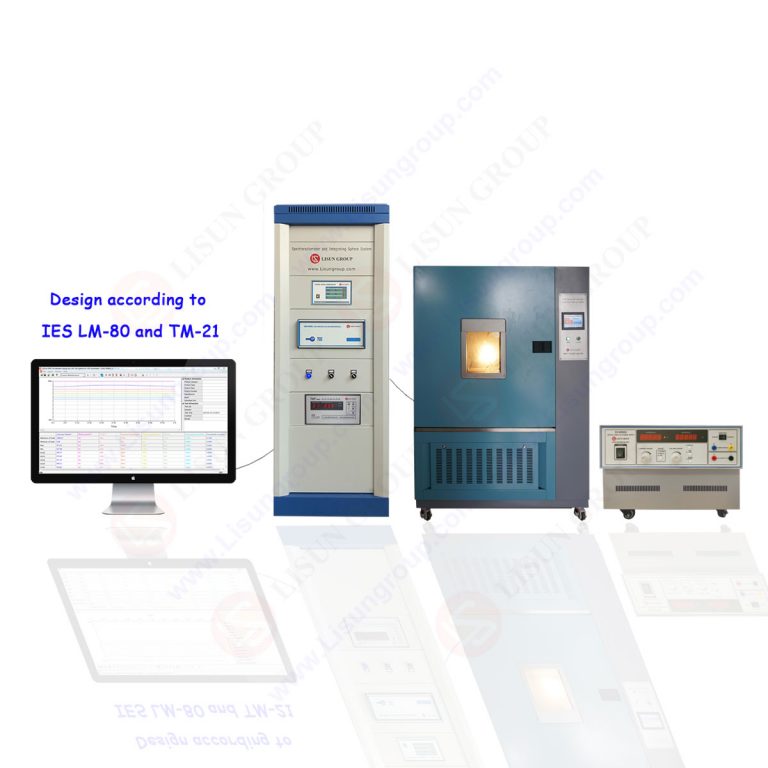
Both instruments share a common core: a high-speed CCD array spectrometer or an AC/DC driven integrating sphere system. However, their physical implementation diverges significantly. The LEDLM-80PL is integrated with a specific aging oven (like the LS-OTxx series), supporting up to 3 connected temperature chambers for multi-condition testing (e.g., 55°C, 85°C, and a manufacturer-defined temperature). The LEDLM-84PL typically employs a larger sphere (e.g., 2.0m for high-lumen luminaires) and is designed for ambient air-flow testing per LM-84 guidelines.
2.3 Key Technical Comparison Table
This table clarifies the system-specific capabilities and their impact on testing scope.
| Feature | LISUN LEDLM-80PL (LM-80/TM-21) | LISUN LEDLM-84PL (LM-84/TM-28) |
|---|---|---|
| Primary Standard | IES LM-80-15, CIE 127 | IES LM-84-14, CIE 084 |
| Extrapolation Standard | TM-21-11 (L70/L50 for components) | TM-28-14 (L70 for lamps/luminaires) |
| Test Object | LED Packages, Modules, Arrays | LED Lamps, Luminaires (Retrofit, Integrated) |
| Max Connected Chambers | 3 (e.g., 55°C, 85°C, 105°C) | 1 (Ambient + forced airflow control) |
| Measurement Speed | High (Sequential scanning of multiple DUTs) | High (Single or dual sphere configuration) |
| Typical Duration Required | 6000 hours (minimum per LM-80) | 6000 hours (minimum per LM-84) |
3.1 Real-Time Continuous Monitoring Mode
In this mode, the spectrometer or photodetector is permanently connected to the Device Under Test (DUT) inside the temperature chamber. The instrument records luminous flux, CCT, and Chromaticity coordinates (per CIE 70) at intervals as short as every minute. This is indispensable for capturing rapid degradation events, such as die attach failure or phosphor thermal quenching. The primary advantage is data density, which improves the statistical confidence of the TM-21 extrapolation, particularly for the early failure period (0-1000 hours).
3.2 Periodic Readout (Stepping) Mode
For high-throughput scenarios (e.g., testing 100+ DUTs simultaneously), the LISUN instrument employs a stepping mode. A mechanical switching system moves the optical fiber or a goniometer assembly to each DUT at defined intervals (e.g., every 1000 hours). While this reduces the granularity of data, it aligns perfectly with the recording requirements of IES LM-80 (data points required at 0, 1000, 2000, 3000, 4000, 5000, and 6000 hours). The Accelerated LED Aging Testing: LISUN Optical Aging Test Instrument software automatically compensates for temperature stabilization delays between measurements, ensuring data integrity.
3.3 Data Integrity and Synchronization
A critical challenge in accelerated aging is decoupling measurement drift from actual DUT degradation. The system self-calibrates using an internal reference LED source that is kept at a controlled, non-aging temperature. This allows the software to correct for spectrometer drift over the 6000-hour test period, ensuring that a 0.5% lumen loss reading is truly degradation, not instrument artifact. This feature is vital for meeting the reproducibility requirements of ISO 17025 accredited labs.
4.1 Mathematical Framework for Lifetime Extrapolation
The core software relies on the Arrhenius equation: (k = A exp(-E_a/RT)), where (k) is the reaction rate (lumen depreciation rate), (A) is the pre-exponential factor, (E_a) is the activation energy (typically 0.4–1.0 eV for LEDs), (R) is the gas constant, and (T) is the absolute temperature. The LISUN software automatically solves for (E_a) by fitting data from two or three different temperature test runs (e.g., 55°C and 85°C). A calculated activation energy outside the normal range typically indicates a failure mechanism (e.g., solder joint fatigue) rather than intrinsic lumen depreciation.
4.2 TM-21 and TM-28 Projection Algorithms
The software implements the exponential decay model mandated by TM-21:
(Phi(t) = B exp(-alpha t))
Where (Phi(t)) is lumen output at time (t), and (B) and (alpha) are constants derived from the fitted curve. The LISUN tool then calculates the L70 (time to 70% flux) using (L70 = ln(0.7/B)/-alpha). Crucially, the software automatically applies the 6x extrapolation limit (i.e., for a 6000-hour test, maximum projection is 36,000 hours) as per TM-21 guidelines, preventing over-extrapolation that could lead to false L70 claims.
4.3 Customizable Stress Profiles
Beyond constant temperature, the system supports step-stress and cyclic stress testing. Engineers can program the oven to cycle between -40°C and +125°C (per automotive standards) while the optical system continuously monitors. This is particularly relevant for Accelerated LED Aging Testing: LISUN Optical Aging Test Instrument applications in outdoor luminaires and automotive headlamps, where thermal shock is a primary degradation driver. The software generates a 3D degradation map (Temperature vs. Time vs. Lumen Output) providing a holistic view of reliability.
5.1 Spectral and Photometric Options
The system can be equipped with either a high-spectral-resolution (e.g., 0.5nm) CCD spectrometer for full spectral power distribution (SPD) analysis or a fast PMT based photodetector for high-speed luminous flux measurement. For LM-79-19 compliance (Electrical and Photometric Measurements of Solid-State Lighting Products), the full SPD measurement is required to calculate CRI, CCT, and R9 values at each aging interval. The LISUN system allows switching between these sensor heads without recalibrating the sphere.
5.2 Sphere Size and Coating Stability
The integrating sphere size is selected based on the DUT geometry and lumen output (per CIE 084). For LM-80PL (component testing), a 0.3m or 0.5m sphere is standard. For LM-84PL (luminaires), a 1.0m or 2.0m sphere is required to maintain the 4π geometry condition. The sphere coating (BaSO4 or PTFE) must maintain >95% reflectivity over the 6000-hour duration, even when exposed to elevated temperatures from the chamber exhaust. LISUN integrates a heating jacket around the sphere to prevent condensation, which would skew spectral readings.
5.3 Auxiliary Power and Temperature Control
The system’s power supply module offers (pm)0.1% current stability, essential for constant current aging of LEDs. A key feature is the in-situ Vf (forward voltage) measurement, which provides an orthogonal degradation indicator. A sudden drop in Vf often indicates an electrical short or die failure, while a gradual rise may indicate increased series resistance in the chip or bond wire. This data is logged in parallel with optical data, allowing engineers to classify failure modes (optical vs. electrical vs. thermal).
6.1 Aligning with IES and CIE Standards
The instrument is designed to satisfy the most stringent requirements of:
- IES LM-80-15: Mandates 3 temperature conditions (55°C, 85°C, and one user-defined) for component qualification. The LISUN system supports this via its multi-chamber connectivity.
- IES LM-84-14: Requires temperature measurement within (pm)2°C of the ambient set point. The system’s PID controller and redundant thermocouples ensure this.
- TM-21-11: The software’s non-linear curve fitting tool must have a high (R^2) (>0.98) to be valid. The system provides this goodness-of-fit metric in every report.
- CIE 127: Defines the measurement conditions for LED intensity and flux. The instrument’s spatial averaging eliminates errors due to minor beam misalignments.
6.2 Practical Certification Workflow
- Setup: Place 20 DUTs per temperature condition (LM-80 requires min. 20 samples per temp).
- Initial Measurement: Conduct a 100% flux measurement at 25°C (ta) with a 0.5A pulse (to avoid self-heating).
- Aging: Insert DUTs into the LISUN aging chamber at specified temperatures. The system automatically cycles to all connected chambers for measurement.
- Data Extraction: After 6000 hours, the software generates the TM-21 extrapolation report, including L70, L50 (if applicable), and the 90% confidence bounds.
- Reporting: Generate a PDF report formatted per the requirements of Energy Star, DLC, or UL verification programs.
7.1 Accelerating Time-to-Market
Using the LISUN system, a manufacturer can complete a preliminary 3000-hour test (which allows a 18,000-hour TM-21 projection) in just 4.2 months. This is a dramatic improvement over real-time testing. This enables rapid design iterations on phosphor composition or die layout, where the effect of a 5% change in phosphor density on thermal quenching can be quantified precisely within weeks.
7.2 Reducing Field Failure Rates
The ability to identify outliers (DUTs failing significantly faster than the population) is a key value proposition. The software automatically flags any sample whose degradation rate ((alpha)) is more than 3 sigma from the mean. This helps identify process issues like die attach voiding or wire bond weaknesses early in the production cycle. For automotive applications, this statistical rigor is mandatory for meeting AEC-Q101 qualification.
7.3 Third-Party Lab Integration
For third-party testing labs, the modular design of the Accelerated LED Aging Testing: LISUN Optical Aging Test Instrument allows parallel testing of multiple client projects. The system can be equipped with up to 16 independent temperature channels, each running a different test profile. The data management software isolates client data, supports 21 CFR Part 11 compliance (for pharmaceutical/medical device applications), and provides remote monitoring via Ethernet, which is vital for 24/7 operation.
The Accelerated LED Aging Testing: LISUN Optical Aging Test Instrument represents a critical investment for any organization serious about LED reliability engineering. By providing dedicated hardware for both the LM-80/TM-21 (component) and LM-84/TM-28 (luminaire) testing protocols within a single unified software platform, it eliminates the guesswork from lifetime prediction. The dual-mode testing (real-time and periodic) combined with the Arrhenius-based predictive analytics, allows engineers to achieve accurate L70 and L50 projections from 6000-hour test durations, fully compliant with IES LM-79-19 and CIE 127 standards. For the LED manufacturer, this means faster innovation cycles, lower warranty risk, and credible data for global certifications. For the testing lab, it offers the scalability and precision required to serve a demanding client base. The LISUN system is not merely a tester; it is a comprehensive reliability validation platform that transforms time-dependent degradation into a manageable, quantifiable engineering parameter.
Q1: What is the minimum test duration required by IES LM-80 for a valid TM-21 projection, and how does the LISUN system support this?
A: According to IES LM-80-15, the minimum test duration for a valid report is 6000 hours of continuous aging. While a 3000-hour test can be used for preliminary data, full compliance for Energy Star or DLC listing requires the 6000-hour dataset. The LISUN LEDLM-80PL is designed to operate uninterruptedly for this period with a typical up-time of >99.5%. It features redundant power supplies and automatic data logging. The system automatically records data points at 0, 1000, 2000, 3000, 4000, 5000, and 6000 hours, as mandated. If a transient event (e.g., a brief power loss) occurs, the real-time monitoring mode allows the system to resume testing without losing the sample history, ensuring that the 6000-hour clock is accurate.
Q2: Can the LISUN system test both individual LED components (LM-80) and complete luminaires (LM-84) simultaneously?
A: While the system software can manage multiple projects, the hardware configurations are specialized. A direct answer is no, not within the same chamber. The LEDLM-80PL uses a small integrating sphere or a fiber optic pick-up inside a forced-air temperature chamber designed for small packages. The LEDLM-84PL requires a larger integrating sphere (typically 1m to 2m in diameter) and a different thermal management approach (ambient air with controlled velocity). However, LISUN offers integrated, turnkey solutions where both systems can be installed in a single lab and managed from one PC. For example, a lab might have an LEDLM-80PL running component tests and an LEDLM-84PL running luminaire tests simultaneously, with results collated in the same database for comprehensive energy star reporting.
Q3: How does the Arrhenius software handle data when the DUT fails catastrophically mid-test?
A: This is a crucial feature for statistical analysis. When a sample fails (e.g., goes open circuit), the software detects it instantly via the Vf measurement (voltage reading drops to zero or goes to compliance limit). The system discontinues optical recording for that specific channel but keeps the sample in the statistical population as a “suspended” failure (Type II censored data), which is the correct method per TM-21. The extrapolation algorithm uses the surviving population data for the exponential fit. However, for warranty risk analysis, the software provides a separate “Failure Time” report listing the exact hour of failure for each DUT. This allows engineers to calculate a Weibull distribution in parallel with the TM-21 projection, providing a more complete picture of reliability.