









Here is the comprehensive technical article on LED Production Line Reliability Validation with LISUN Optical Aging Testers, structured according to your specifications and tailored for industry professionals.
Abstract
Achieving robust LED Production Line Reliability Validation with LISUN Optical Aging Testers is critical for ensuring long-term lumen maintenance and compliance with global standards. This article details how the LISUN LEDLM-80PL and LEDLM-84PL systems, utilizing advanced Arrhenius Model-based software and dual testing modes, accelerate failure analysis and meet rigorous industry benchmarks like IES LM-80, TM-21, and IES LM-84. By integrating high-precision temperature control and support for multiple chambers, these systems enable engineers to predict L70/L50 lifetimes accurately, optimize production output, and reduce costly field failures. For R&D and QC teams, understanding the intricacies of accelerated aging validation is key to competitive advantage.
1.1 Risk Mitigation and Warranty Assurance
High-volume LED production introduces variability in binning, phosphor application, and thermal management. Without rigorous validation, batches risk early lumen depreciation, chromaticity shift, or catastrophic failure. Production line reliability validation using systems like the LISUN Optical Aging Testers ensures that every batch meets the manufacturer’s claimed lifetime, typically 50,000 to 100,000 hours, mitigating warranty liabilities and brand damage.
1.2 Accelerated Testing vs. Real-Time Monitoring
While real-time testing offers the most accurate data, it is impractical for production validation due to the multi-year durations required. Accelerated aging tests, conducted at elevated temperatures (e.g., 55°C, 85°C), statistically correlate with long-term performance. LISUN’s systems apply the Arrhenius Model to extrapolate data from 6,000 hours of testing to predict behavior at 60,000+ hours. This allows manufacturers to ship product with confidence after a standardized 6,000-hour run.
2.1 Dual System Variants for Specific Standards
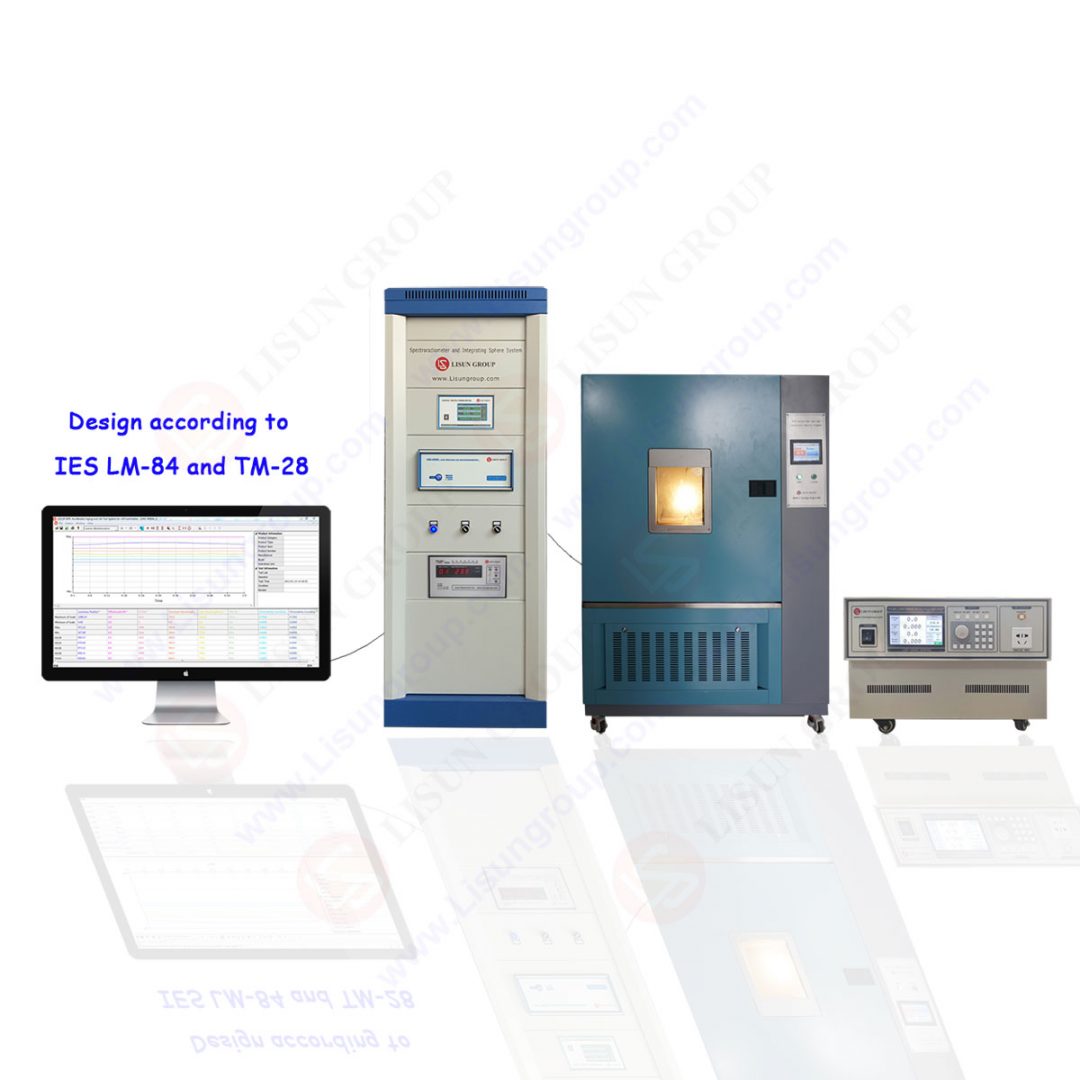
The LISUN systems are designed to align with specific IES standards. The LEDLM-80PL is tailored for IES LM-80 and TM-21, focusing on housed LED packages and arrays. In contrast, the LEDLM-84PL is optimized for IES LM-84 and TM-28, which address LED light engines and integral lamps. Choosing the correct variant ensures that test setups mimic real-world operational conditions without unnecessary complexity.
2.2 Hardware Configurations and Environmental Control
Both systems feature robust hardware capable of supporting critical operational parameters:
- Temperature Chambers: Supports up to 3 connected temperature chambers simultaneously, enabling parallel testing of groups at 55°C, 85°C, or other specified ambient temperatures.
- Photometric Measurement: An integrated integrating sphere or goniometer (configurable) allows for in-situ luminous flux measurement without removing the device under test (DUT), preserving thermal stability.
- Power and Data Channels: Capable of monitoring multiple DUTs concurrently, logging voltage, current, temperature, and flux data at user-defined intervals (e.g., every 1000 hours).
2.3 The Arrhenius Model Software Core
The proprietary software is the analytical heart of the system. It integrates the Arrhenius Model to automate the extrapolation of test data. By inputting the thermal resistance and junction temperature (Tj) of the LEDs, the software calculates acceleration factors. This allows engineers to predict the L70 (time to 70% lumen maintenance) and L50 metrics quickly, standardizing the reliability validation process across different temperature runs.
3.1 IES LM-80 and TM-21 for Packages and Arrays
IES LM-80-08 defines the method for measuring lumen maintenance of solid-state lighting (SSL) sources. Tests must run for a minimum of 6,000 hours. The LISUN LEDLM-80PL adheres strictly to this standard, offering automated cycling and logging. The data is then processed per TM-21-11, which provides the statistical model for projecting long-term lumen maintenance. The software’s non-linear regression analysis fits the data to an exponential decay curve, generating projections with quantified uncertainty bounds.
3.2 IES LM-84 and TM-28 for Light Engines
For finished products like integrated LED lamps (e.g., A-lamps, MR16s), IES LM-84-14 is the governing standard, with TM-28-14 defining the projection methodology. The LEDLM-84PL variant is specifically designed to test these complete engines, applying appropriate voltage and current while measuring total system efficacy. This distinction is crucial because driver interaction and thermal sinking behavior differ from bare LED packages.
3.3 Supporting Standards: LM-79, CIE 084, and CIE 127
While aging tests focus on longevity, they must be coupled with initial electrical and photometric characterization. IES LM-79-19 defines the procedure for measuring total luminous flux and electrical power. The LISUN system can be integrated with a separate LM-79 compliant setup. Furthermore, the testing protocols respect CIE 084 (measurement of luminous flux) and CIE 127 (measurement of LEDs), ensuring that the photometric data captured during aging intervals is accurate and reproducible.
4.1 Continuous Testing Mode
In Continuous Mode, the DUTs are powered on 24/7, except during brief measurement cycles. This mode is ideal for accelerating the aging of components designed for constant-on applications like street lighting or commercial signage. It maximizes the (t times T) (time at temperature) stress factor, reducing the total calendar time required to reach 6,000 operational hours.
4.2 Duty Cycle (Switching) Testing Mode
For LEDs intended for intermittent use (e.g., occupancy sensors, automotive brake lights), thermal shock from constant on/off cycling is a primary failure mechanism. The Duty Cycle Mode allows engineers to program specific off-times (e.g., 30 minutes on, 30 minutes off). This mode stresses the solder joints, wire bonds, and phosphor layers differently than constant current, revealing failure modes invisible in continuous testing. The LISUN system logs flux immediately upon each recovery, capturing the thermal transient response.
To clarify the application of each system, the following table provides a technical comparison based on standard compliance and hardware configuration.
| Feature | LEDLM-80PL (LM-80/TM-21) | LEDLM-84PL (LM-84/TM-28) |
|---|---|---|
| Primary Application | LED Packages & Arrays | LED Light Engines & Lamps |
| Governing Standard | IES LM-80, TM-21 | IES LM-84, TM-28 |
| Sample Form Factor | Small units mounted on test board | Complete, self-contained lamps |
| Max Connected Chambers | 3 | 3 |
| Typical Test Duration | 6,000 hours (minimum) | 6,000 hours (minimum) |
| Key Metric Extrapolated | L70, L50 (Package Level) | L70, L50 (System Level) |
| Thermal Management | Controlled case temperature (Tcase) | Controlled ambient temperature (Ta) |
This table demonstrates that the choice of system depends on the specific manufacturing output. A component manufacturer (LEDLM-80PL) validates before shipment to integrators. A lamp manufacturer (LEDLM-84PL) validates the final product’s total system reliability.
6.1 Lumen Depreciation Curve Fitting
The raw data from a 6,000-hour test shows a non-linear decay. The software applies a least-squares regression to fit the data to an exponential decay function:
[ Phi(t) = Phi_0 times e^{-alpha t} ]
where (Phi(t)) is the luminous flux at time (t), (Phi_0) is the initial flux, and (alpha) is the decay constant. The Arrhenius Model then correlates (alpha) to temperature, allowing the software to extrapolate performance at a 25°C reference temperature.
6.2 Chromaticity Shift Validation
Reliability is not just about brightness; color shift (Duv) is a critical metric for architectural lighting. The LISUN system, equipped with a spectrometer, monitors the wavelength shift of the dominant peak over 6,000 hours. A significant shift in the blue chip emission or a degradation of the yellow phosphor indicates poor material quality. Production lines can be halted if the Duv shift exceeds the specifications defined by ANSI C78.377.
6.3 Early Failures (Catastrophic and Wear-Out)
The software automatically flags failures that fall outside the Weibull distribution of the test population. This differentiation between random failures (infant mortality) and wear-out failures (end of life) is critical for production line tuning. For example, if 5% of DUTs fail at <2,000 hours due to wire bond breakage (catastrophic), the production line must immediately review the die attach or wire bonding process parameters.
7.1 Batch Sampling and Qualification Protocols
Implementing this validation requires a statistically significant sample size. For a typical production line, a sample of 20-30 units per batch (e.g., per 100,000 units) is tested in the LISUN Optical Aging Tester. A “Pass” requires that the projected L70 value exceeds the warranty period (e.g., 50,000 hours) with a 90% confidence interval. This step gates the shipment of the full batch.
7.2 Accelerated Feedback Loop for Process Control
The 6,000-hour test duration (approximately 8 months) is significantly faster than real-world aging. However, for rapid process control, LISUN systems can be used for screen testing. A shortened 1,000-hour test at a high stress temperature (95°C) can quickly identify catastrophic failures or grossly substandard materials, providing a fast feedback loop for the production line within 6 weeks.
The deployment of LISUN Optical Aging Testers for LED Production Line Reliability Validation transforms a lengthy, post-market feedback process into a proactive, data-driven quality control gate. By rigorously adhering to standards such as IES LM-80, TM-21, IES LM-84, and TM-28, these systems provide actionable data on the L70 and L50 performance of LED components. The integration of the Arrhenius Model software and the flexibility of dual testing modes (Continuous and Duty Cycle) empower engineers to identify failure mechanisms—from phosphor degradation to driver failure—before products leave the factory. For any LED manufacturer seeking to lower warranty claims and enhance long-term reliability, strategic investment in this validation equipment is not optional; it is foundational to industry credibility and operational excellence.
Q1: What is the difference between the LISUN LEDLM-80PL and the LEDLM-84PL, and which one should I use for production line validation?
A: The primary difference lies in the standard compliance and the Device Under Test (DUT) form factor. The LEDLM-80PL is designed to test bare LED packages and arrays according to IES LM-80, focusing on the intrinsic performance of the chip and phosphor. It requires that the DUT be mounted on a thermal test board. The LEDLM-84PL is for testing completed light engines or integral lamps per IES LM-84, where the driver and heat sink are included. For production line validation, if you manufacture LED packages, use the LEDLM-80PL. If you manufacture finished lamps or luminaires, use the LEDLM-84PL to assess total system reliability.
Q2: How does the Arrhenius Model software extrapolate long-term L70 from a 6,000-hour test?
A: The software uses the Arrhenius Model to relate the rate of a chemical reaction (lumen decay) to temperature. By testing multiple groups at different elevated temperatures (e.g., 55°C and 85°C), the software calculates an activation energy (Ea) specific to your LED’s materials. This Ea value is then used to create an acceleration factor (AF). The 6,000 hours of data is fit to an exponential decay curve. Using the TM-21 projection formula, the software applies the AF to statistically estimate how long it takes for the lumen output to decline to 70% of its initial value at a standard operating temperature (typically 25°C or 55°C).
Q3: Can the LISUN system handle production volumes if we test different product SKUs every month?
A: Yes, the system is designed for high throughput flexibility. The ability to connect up to 3 temperature chambers allows you to run tests on three different SKUs or three different temperature conditions simultaneously. The hardware can be configured to accept various test boards or lamp sockets. Furthermore, the software supports custom test profiles, allowing you to easily switch between different product specs and measurement criteria. The data management system archives results by SKU, enabling trend analysis over time to monitor if production line drift is affecting reliability.