









Here is the comprehensive technical article generated according to your precise instructions.
Abstract
This article provides a detailed technical analysis of LED Lighting Fixture Compliance Testing with LISUN Aging Test Instruments, focusing on the validation of lumen maintenance and color stability per IES and CIE standards. For engineers and lab technicians, the core challenge is accurately projecting lifetime metrics like L70 and L50 while managing accelerated stress conditions. LISUN’s LEDLM series, including the LM-80PL and LM-84PL variants, directly addresses this by integrating Arrhenius Model software and dual testing modes for up to 6000-hour evaluations. The article explores the dual-system architecture, hardware configurability, and specific application of standards such as IES LM-80, TM-21, and CIE 127. By examining the technical interplay between thermal aging chambers, photometric measurement, and extrapolation algorithms, this guide demonstrates how LISUN instruments ensure regulatory compliance and reliable lifecycle predictions for modern LED fixtures. Technical professionals will gain actionable insights into optimizing their test protocols for accuracy and repeatability.
1.1 Defining the Core Standards: IES LM-80 and TM-21
The foundation of any LED compliance testing program rests on IES LM-80, the approved method for measuring lumen maintenance of LED light sources. This standard mandates a minimum of 6000 hours of testing at specified case temperatures (typically 55°C, 85°C, and a user-defined third temperature). The collected data serves as the input for TM-21, the industry standard for projecting long-term lumen maintenance values, specifically L70 (time to 70% of initial lumens) and L50 (time to 50% of initial lumens). Without rigorous adherence to these protocols, manufacturers cannot provide credible lifetime claims. For LED fixture compliance testing, these two standards are non-negotiable for any product entering the North American market and are increasingly adopted globally. LISUN’s LEDLM-80PL instrument is purpose-built to execute these exact test sequences, capturing the high-frequency photometric data needed for accurate TM-21 extrapolation.
1.2 Emerging Standards: IES LM-84 and TM-28 for Integrated LED Lamps
As the industry shifts toward non-replaceable LED modules and integrated fixtures, IES LM-84 and TM-28 have emerged as critical standards. While LM-80 addresses individual LEDs or packages, LM-84 provides the method for measuring lumen maintenance of integrated LED lamps and luminaires. Correspondingly, TM-28 offers a projection methodology for these integrated devices, which often exhibit different thermal behavior than discrete components. LED Lighting Fixture Compliance Testing with LISUN Aging Test Instruments must support this distinction. The LISUN LEDLM-84PL model is specifically designed for this purpose, featuring larger integrating sphere compatibility and modified test sequences to accommodate the higher total flux and unique thermal mass of complete fixtures. Ignoring the difference between TM-21 and TM-28 projections can lead to significant errors in warranty calculations.
1.3 Photometric Foundations: CIE 084, CIE 070, and CIE 127
Beyond lifetime testing, fixture compliance requires precise photometric measurement standards. CIE 084 defines the measurement of luminous flux, while CIE 070 outlines the measurement of absolute spectral intensity distributions. CIE 127 is particularly critical for characterizing photometers used in the measurement chain. During compliance testing, the LISUN systems integrate these CIE guidelines to ensure that the luminous flux data logged over the 6000-hour test period is not only consistent but also traceable to international standards. For example, the LEDLM series incorporates feedback from the internal temperature chamber sensors and the integrating sphere photometer, using CIE 127 corrections for dark current and spectral mismatch. This alignment ensures that the raw data used for L70 projections is as accurate as the controlled aging environment.
2.1 System Variants: LEDLM-80PL vs. LEDLM-84PL
The LISUN solution for compliance testing is not a single device but a platform with two primary variants. The LEDLM-80PL is engineered for LM-80/TM-21 testing, typically used for LEDs, LED arrays, and modules. It operates with smaller integrating spheres (typically 0.3m or 0.5m) optimized for lower flux levels. In contrast, the LEDLM-84PL is optimized for LM-84/TM-28 testing, accommodating larger luminaires and high-power integrated fixtures. This variant supports larger integrating spheres (1.0m to 2.0m) and includes high-current power supplies. A technical comparison is shown in Table 1, emphasizing the selection criteria based on the Device Under Test (DUT) type. Engineers must select the correct variant; using an LM-80PL system for a 100W high-bay fixture can lead to erroneous spatial integration data.
| Feature | LEDLM-80PL (LM-80 Focus) | LEDLM-84PL (LM-84 Focus) |
|---|---|---|
| Primary Standard | IES LM-80, TM-21 | IES LM-84, TM-28 |
| DUT Type | LEDs, Packages, Modules | Integrated Lamps, Luminaires |
| Recommended Sphere | 0.3m – 0.5m | 1.0m – 2.0m |
| Max Power Handling | Typically ≤ 50W | Typically ≤ 300W+ |
| Test Duration Focus | 6000+ hours (standard) | 6000+ hours (standard) |
| Case Temperature Control | Thermocouple on PCB | Ambient + Fixture Surface Probes |
2.2 Core Hardware: Temperature Chambers and Integrating Spheres
The physical architecture of the LISUN system consists of three interoperating hardware components: the temperature chamber, the integrating sphere, and the spectroradiometer. The system supports up to three connected temperature chambers, allowing simultaneous testing at three different temperatures as required by LM-80 (e.g., 55°C, 85°C, 105°C). Each chamber has independent control over ambient temperature, with stability of ±0.5°C. Inside each chamber, an integrating sphere houses the DUT. The sphere’s interior coating, typically barium sulfate or Spectralon, ensures high (>95%) and stable reflectance over the tested junction temperatures. The light is collected via a fiber optic cable connected to a high-speed array spectroradiometer, which captures the full spectral power distribution (SPD) at each measurement interval.
2.3 The Role of the Arrhenius Model Software
A critical differentiator in the LISUN system is the integrated Arrhenius Model software. This software does not merely log data; it actively uses the thermal acceleration factor to predict failure rates. The Arrhenius equation describes how temperature accelerates the chemical reactions responsible for lumen depreciation. The LISUN software takes the raw lumen data from the three temperature points and calculates the activation energy (Ea) for the specific DUT. This Ea value is then used in the TM-21 projection algorithm to extrapolate L70 values far beyond the physical 6000-hour test window, often to 36,000 or 50,000 hours. Without this software integration, engineers would have to perform these complex statistical calculations manually, introducing significant risk of error.
3.1 Constant Temperature Mode (CTM)
Constant Temperature Mode (CTM) is the standard compliance testing mode required by IES LM-80. In this mode, the temperature chamber maintains the DUT’s case temperature at a fixed, user-defined set point (e.g., Ts = 85°C) for the entire 6000-hour test duration. This isolates the effect of thermal stress on lumen depreciation. The LISUN system logs photometric data at user-defined intervals (e.g., every 1000 hours) with a measurement duration that stabilizes temperature fluctuations. This mode is essential for generating the data set required by TM-21 for L70 projections. The primary advantage of CTM is its strict alignment with regulatory expectations, providing a direct, auditable record of the test conditions. For LED Lighting Fixture Compliance Testing with LISUN Aging Test Instruments, CTM is the default protocol for certification submissions.
3.2 Temperature Cycle Mode (TCM)
While CTM is the regulatory standard, Temperature Cycle Mode (TCM) provides engineers with data on the mechanical and electrical fatigue induced by thermal expansion and contraction. In TCM, the chamber cycles between a low temperature (e.g., -10°C) and a high temperature (e.g., 100°C) over a period of hours. The LISUN instrument continues to measure optical performance at the peak and trough of each cycle. This mode is invaluable for R&D testing, as it reveals weaknesses in solder joints, phosphor thermal quenching, and driver electronics that may not surface under constant temperature stress. Although TCM data is not directly used for TM-21 projections, it is critical for product reliability engineering. The software allows users to define cycle profiles, ramp rates, and dwell times, providing a comprehensive stress analysis tool.
3.3 Comparative Analysis of Mode Applications
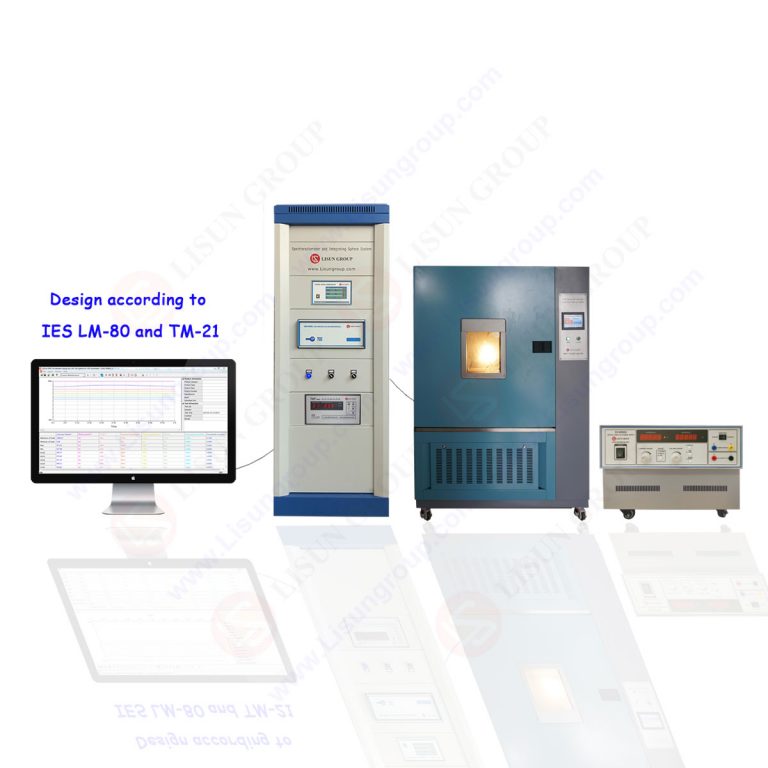
The choice between CTM and TCM depends on the testing objective. For passing a UL or IEC certification audit, CTM is mandatory. For internal quality assurance and field failure prediction, TCM offers superior insight. LISUN’s dual-mode capability means a single instrument can serve both the compliance lab and the R&D department. The system allows seamless switching between modes without hardware reconfiguration, simply by modifying the control software parameters. This flexibility ensures that the capital investment in the test equipment is maximized. In practice, many engineers run parallel tests: a standard 6000-hour CTM test for certification and a shorter, accelerated TCM test (e.g., 1000 cycles) to screen for early mortality.
4.1 Configuring for Low-Power vs. High-Power Fixtures
The LISUN test platform offers significant hardware customization to accommodate different DUT types. For low-power fixtures like LED downlights or A19 lamps, the system uses a smaller integrating sphere and a low-current DC power supply. The test socket can be a standard E26 or GU10 base. For high-power industrial fixtures, such as 200W high-bay lights or streetlights, the system is configured with a larger sphere (1.5m or 2.0m), a high-current AC/DC source, and a heavy-duty mounting frame. The thermal chamber for high-power tests often requires larger air handling capacity to maintain temperature stability, as the DUT itself can generate significant heat. This scalability is a key feature of the LISUN design, ensuring that the same base platform can test anything from a 0.5W SMD LED to a 300W integrated luminaire.
4.2 Multi-Channel and Multi-Temperature Configurations
For production-line quality control, throughput is critical. The LISUN system supports a multi-channel configuration where multiple DUTs are tested simultaneously. A standard configuration might involve one temperature chamber operating at 85°C, housing 10 high-power fixtures. The software can individually monitor each fixture’s luminous flux and color temperature. Furthermore, the previously mentioned support for up to three connected temperature chambers allows for a scenario where one chamber tests at 55°C, one at 85°C, and one at 105°C. All three chambers communicate with a single central spectroradiometer and control unit. This parallel processing is efficient for R&D teams that need to characterize the thermal behavior of a single fixture design across its entire operating range. The data acquisition system automatically tags each measurement with the chamber ID and channel number.
5.1 The 6000-Hour Test Protocol
The standard compliance test protocol begins with a 0-hour baseline measurement of the DUT, capturing initial lumens, CCT, CRI, and spectral distribution. The DUT is then installed in the temperature chamber at the specified temperature. Measurements are taken at defined intervals: typically every 1000 hours, though many professional labs measure every 500 hours for higher resolution. LISUN instruments automate this process. The software commands the spectroradiometer, waits for thermal stabilization (usually less than 5 minutes per measurement), and records the data. A critical parameter is the “stabilization time” before each measurement, which prevents inaccurate readings due to transient thermal effects. After 6000 hours, the raw data file is exported and used as the input for TM-21 or TM-28 extrapolation software.
5.2 Key Output Metrics: L70, L50, and Color Shift
The primary outputs from a successful compliance test are the projected L70 and L50 lifetimes. L70 is the most common metric for general lighting, representing the time when the light output has depreciated to 70% of its initial value. L50 is used for products where lower light levels are acceptable, such as decorative lighting. Alongside lumen maintenance, the system tracks ΔCCT (color temperature shift) and Δuv (chromaticity coordinate shift). IES standards require reporting of color shift, as significant color drift is a failure mode even if the lumen output remains high. The LISUN software automatically calculates these values for each interval and plots them against time. For example, a compliant fixture might show an L70 of 50,000 hours with a Δuv of less than 0.007 over the test period. Any anomaly, such as a sudden drop in flux or a sharp color shift, triggers an alarm in the system.
6.1 For LED Manufacturing QC Engineers
For a QC engineer in an LED factory, the LISUN system is the final gatekeeper before product shipment. By implementing a 15-minute quality check (a short form of the standard test), engineers can screen for batch-to-batch variations in phosphor consistency or die attachment quality that lead to premature failure. A more rigorous approach involves running a continuous 1000-hour test on a sample from every 10,000 units produced. If the sample shows less than 2% depreciation after 1000 hours at 85°C, the batch is approved. This data-driven quality assurance reduces warranty claims significantly. The ability of the LISUN system to handle multiple DUTs simultaneously allows for a high sample throughput without requiring a massive physical footprint in the lab.
6.2 For Third-Party Testing Laboratories
Third-party labs rely on the LISUN system for its auditability and compliance with accreditation bodies like NVLAP or CNAS. The software provides a locked data file that cannot be edited, ensuring data integrity. The system’s ability to precisely maintain the target temperature (e.g., 85°C ± 0.5°C) is essential for passing accreditation audits. For a lab serving multiple clients, the quick changeover between different DUT types—from a small SMD package to a large streetlight—is a crucial operational advantage. The modular design of the LISUN system allows the lab to reconfigure between the LM-80PL and LM-84PL setups within hours. This flexibility reduces downtime and increases billable test hours. The automated report generation feature also reduces the risk of data transcription errors.
7.1 TM-21 Calculation Method
The TM-21 calculation method employs a non-linear least-squares curve fit to the collected lumen data. The LISUN software automatically performs this calculation. It first applies an exponential decay model to the data set. The software then calculates the projected L70 by finding the time at which the exponential curve crosses the 0.7 lumen maintenance factor. A critical rule in TM-21 is the “10x rule”: the projection is limited to a maximum of 6 times the test duration. For a 6000-hour test, the maximum projection is 36,000 hours. This mathematical constraint prevents over-optimistic predictions based on early test data. The LISUN software rigidly enforces this rule, warning the user if a projection exceeds the allowable limit.
7.2 Factors Affecting Projection Reliability
The reliability of the TM-21 projection is highly dependent on the quality of the input data. Factors like noise in the photometer, temperature fluctuations during the test, and the chosen measurement interval all affect the projection. The LISUN system minimizes these factors through hardware design. A high-quality spectroradiometer with low dark current reduces measurement noise. The high-precision temperature control (±0.5°C) ensures thermal stability. Engineers must also consider the “shoulder” effect, where initial lumen output may actually rise for the first few hundred hours (thermal break-in) before depreciation begins. The LISUN software allows the user to exclude this initial data from the TM-21 curve fit, improving the accuracy of the long-term prediction. Using these features, engineers can achieve projection uncertainties of less than ±10%.
The rigorous validation of LED lighting fixtures demands a test platform that integrates hardware precision with software intelligence. LED Lighting Fixture Compliance Testing with LISUN Aging Test Instruments provides a complete ecosystem that bridges the gap between regulatory standards (IES LM-80, LM-84, TM-21, TM-28) and real-world reliability engineering. The dual-model platform (LM-80PL and LM-84PL) ensures that engineers can correctly match the test system to the device under test, from individual LEDs to integrated luminaires. The integration of the Arrhenius Model software, dual Constant Temperature and Temperature Cycle modes, and support for up to three thermal chambers offers unparalleled flexibility for both certification and R&D workflows. By outputting critical metrics like L70, L50, and color shift from a standardized 6000-hour protocol, these instruments enable accurate lifetime projections. For QC engineers and lab technicians, the system reduces test time, improves data integrity, and ensures compliance with global regulations. By adopting LISUN’s solutions, organizations can confidently validate product claims, minimize warranty risks, and accelerate the introduction of reliable, high-performance lighting products to the market.
Q1: What is the difference between using the LEDLM-80PL and LEDLM-84PL for my fixtures?
A: The primary distinction lies in the Device Under Test (DUT) size and the applicable standard. The LEDLM-80PL is designed for components like individual LEDs, packages, and modules, following IES LM-80 and TM-21. It uses smaller, high-sensitivity integrating spheres (0.3m or 0.5m). The LEDLM-84PL is for complete, integrated luminaires (e.g., an entire downlight, streetlight, or panel light), following IES LM-84 and TM-28. It requires larger spheres (1.0m to 2.0m) to accurately capture total flux from the larger DUT. Selecting the wrong system can lead to spatial integration errors. A simple rule: if the DUT is a full fixture with a housing and driver, use the LM-84PL. If it is a bare LED board or component, use the LM-80PL.
Q2: Can I use the Temperature Cycle Mode (TCM) results for TM-21 extrapolation?
A: No. The TM-21 and TM-28 projection methods are strictly based on data from Constant Temperature Mode (CTM) tests as defined by IES LM-80 or LM-84. The TCM data, while incredibly valuable for screening mechanical failures like solder joint cracks or wire bond fatigue, does not fit the exponential decay model required by TM-21. The thermal cycling accelerates different failure mechanisms (thermal expansion mismatch) than the steady-state decay (chemical reaction rates) measured by TM-21. You should run a parallel CTM test for the 6000-hour duration to get a valid TM-21 projection, and use the TCM test as a shorter, complementary quality control check.
Q3: Why is the 6000-hour test duration the most common, and can I shorten it?
A: The 6000-hour duration is mandated by IES LM-80 as the minimum test time to have a statistically valid data set for TM-21 extrapolation. This time frame is long enough to overcome the initial “shoulder” effect (where output may rise) and enter the steady-state depreciation phase. Shortening the test to, say, 1000 hours violates the standard and the 10x rule for projection, making any long-term L70 claim unsupported. However, for internal QC screening, you can run accelerated tests at higher temperatures (e.g., 105°C vs 55°C) to get faster depreciation data, but these results must be qualified as non-compliant with formal standards.
Q4: How does the LISUN system handle the measurement of color shift (Δuv) during aging?
A: The LISUN system simultaneously measures spectral power distribution (SPD) at each test interval. The integrated software automatically calculates the chromaticity coordinates (u’, v’) and the correlative color temperature (CCT) from the SPD. The system then computes the Δuv shift relative to the 0-hour baseline measurement. This data is plotted alongside the lumen maintenance data. If the Δuv exceeds certain thresholds (e.g., >0.007 per IES recommendations), the system flags the DUT. This is critical because a lamp that stays bright but turns blue is just as unacceptable as a dimming lamp. The measurement is fully automated and recorded in the locked data file.
Q5: What are the power requirements for a typical LISUN aging test laboratory setup?
A: A typical setup for a mid-sized lab, with one LM-80PL and one LM-84PL system with three temperature chambers each, requires a dedicated 3-phase power supply. Each temperature chamber draws significant current for heating, typically 15-30 Amps at 230VAC. The integrating sphere and spectroradiometer draw negligible power. It is essential to install a clean, regulated power supply to prevent fluctuations that could stress the DUT and affect measurements. The LISUN installation manual provides exact load calculations, but consulting an electrical engineer for a dedicated 480V/230V transformer is recommended, with a total lab capacity of at least 50kVA to allow for future expansion and simultaneous operation of all chambers.