









This technical article provides a comprehensive guide on utilizing LED Optical Aging Test Instruments for performing 6000-hour LM-80 testing, essential for validating LED lumen maintenance and reliability. Focused on LISUN’s advanced systems—the LEDLM-80PL (compliant with IES LM-80/TM-21) and LEDLM-84PL (compliant with IES LM-84/TM-28)—the article explores Arrhenius Model-based software, dual testing modes (constant current and constant temperature), and customizable chamber configurations supporting up to three connected temperature chambers. It references critical industry standards including IES LM-80, TM-21, IES LM-79-19, and CIE 127, providing engineers with actionable insights for accurate L70/L50 projections, accelerated aging protocols, and regulatory compliance. This resource equips LED manufacturing and testing professionals with the technical knowledge required for robust optical aging validation.
1.1 The Critical Role of Lumen Maintenance Testing
LED lumen depreciation over time is a fundamental reliability metric defined by industry standards such as IES LM-80. This standard specifies that LED light sources must undergo 6000 hours of testing at controlled temperatures (typically 55°C, 85°C, and a third optional temperature) to quantify luminous flux maintenance. LED Optical Aging Test Instruments, like LISUN’s LEDLM-80PL, automate this process, ensuring precise data collection for TM-21 extrapolation, which projects L70 (time to 70% lumen output) and L50 (time to 50% lumen output) lifetimes. Without standardized testing, manufacturers risk overestimating product longevity, leading to field failures and warranty costs.
1.2 Overview of LISUN’s Dual System Variants
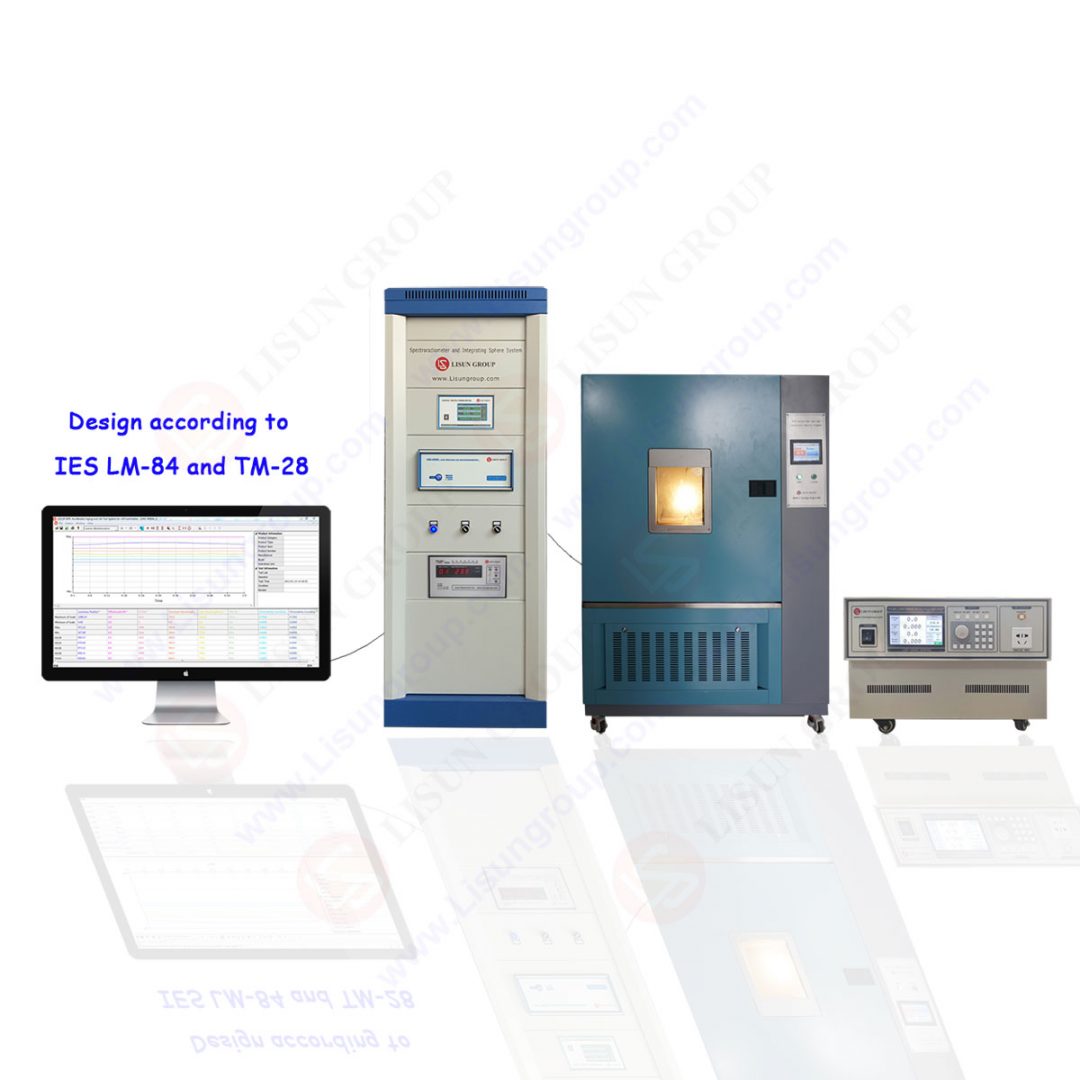
LISUN offers two primary system variants tailored to specific standards: the LEDLM-80PL, designed for IES LM-80 and TM-21 compliance, and the LEDLM-84PL, which aligns with IES LM-84 and TM-28 for broader luminaire-level testing. Both systems integrate high-precision photometric measurements using integrating spheres and spectroradiometers, with capabilities for up to three connected temperature chambers. The LEDLM-80PL supports 6000-hour test durations with customizable temperatures from ambient to 100°C, while the LEDLM-84PL extends to luminaire testing per LM-84 requirements. This dual approach enables comprehensive validation from component-level LEDs to finished luminaires.
2.1 IES LM-80 and TM-21: The Foundation of LED Reliability
IES LM-80-08 (reaffirmed 2018) mandates that LED packages, arrays, and modules undergo at least 6000 hours of testing at three case temperatures (55°C, 85°C, and an optional temperature between 75°C and 100°C). Data is collected at 0, 1000, 2000, 3000, 4000, 5000, and 6000 hours, with lumen maintenance reported as a percentage of initial output. TM-21-11 then uses exponential curve fitting (Arrhenius Model) to project L70 and L50 lifetimes based on this data. LISUN’s software automates this extrapolation, reducing manual calculation errors and ensuring compliance with ENERGY STAR requirements.
2.2 Additional Standards: LM-84, TM-28, LM-79, and CIE References
IES LM-84-14 extends LM-80 principles to complete luminaires, requiring 6000-hour testing but allowing for in-situ temperature monitoring. TM-28-14 provides projection methods for luminaire-level data. IES LM-79-19 governs electrical and photometric measurements (e.g., total flux, chromaticity) using integrating spheres or goniophotometers, vital for initial baseline data. CIE 127:2007 specifies LED measurement conditions, including spatial radiation patterns, while CIE 084 and CIE 70 define standard illuminants and photometric measurement practices. Integrating these standards ensures holistic LED quality assessment.
3.1 Hardware Configuration and Customization
The LEDLM-80PL features modular design with support for up to three connected temperature chambers (e.g., LISUN’s programmable environmental chambers), enabling simultaneous testing at multiple temperatures. Each chamber holds up to 20-30 LED samples, depending on form factor. The system includes:
- High-precision integrating sphere (diameter options: 0.3m, 0.5m, 1.0m) with barium sulfate coating for >95% reflectance.
- Spectroradiometer (spectral range 350-1050nm, wavelength accuracy ±0.3nm).
- Constant current power supply (accuracy ±0.1%) for LED drive during aging.
- Temperature control ranging from ambient to 100°C (±0.5°C stability).
3.2 Dual Testing Modes: Constant Current vs. Constant Temperature
LISUN systems support two primary testing modes:
- Constant Current Mode: Maintains fixed drive current throughout aging, simulating real-world LED driver behavior. Suitable for component-level LM-80 tests.
- Constant Temperature Mode: Stably controls case temperature using Peltier or resistive heating, allowing isolation of thermal stress effects. Preferred for TM-21 data quality.
Both modes record photometric data (luminous flux, CCT, CRI) at user-defined intervals (e.g., every 1000 hours). The Arrhenius Model software then analyzes degradation rates across temperatures.
4.1 Sample Preparation and Baseline Measurement
Begin with 20-30 LED samples per test temperature per standard guidelines. Measure initial photometric parameters using IES LM-79-19 protocols in an integrating sphere: total flux (lumens), CCT (K), CRI (Ra), and chromaticity coordinates. Record voltage-current characteristics at ambient temperature (25°C ±1°C). Label each sample uniquely and mount them on temperature-controlled plates in the aging chamber. LISUN’s software tracks sample IDs automatically if using barcode scanning.
4.2 Aging Execution and Data Collection
Set chamber temperatures to 55°C, 85°C, and an optional temperature (e.g., 75°C or 100°C) per LM-80 requirements. Activate constant current mode at rated drive current (e.g., 350mA for high-power LEDs). Run for 6000 hours with photometric measurements at 0, 1000, 2000, 3000, 4000, 5000, and 6000 hours. LISUN’s automated system sends alerts at each measurement point and stores data in CSV format. Ensure ambient temperature inside the chamber is monitored with thermocouples (accuracy ±0.1°C).
4.3 Data Analysis and TM-21 Extrapolation
After 6000 hours, use LISUN’s Arrhenius Model software to calculate lumen maintenance degradation rates (β) at each temperature. Input data into TM-21 curve fitting: L(t) = B * exp(-αt), where α = degradation rate and B = initial lumen output. Extrapolate L70 and L50 lifetimes for 50,000+ hours (typical projection). The software provides 95% confidence intervals and flags outlier samples. Report results per TM-21 requirements: actual test duration, number of failures, and extrapolated lifetime.
Table 1: Comparison of LISUN LEDLM-80PL and LEDLM-84PL Specifications
| Parameter | LEDLM-80PL (LM-80/TM-21) | LEDLM-84PL (LM-84/TM-28) |
|---|---|---|
| Compliance Standards | IES LM-80, TM-21 | IES LM-84, TM-28 |
| Test Duration | Up to 6000 hours | Up to 6000 hours |
| Supported Chambers | Up to 3 temperature chambers | Up to 2 temperature chambers |
| Sample Capacity | 20-30 LEDs per chamber | 5-10 luminaires per chamber |
| Temperature Range | Ambient to 100°C | Ambient to 85°C (luminaire level) |
| Integrating Sphere | 0.3m, 0.5m, or 1.0m diameter | 1.0m or 2.0m diameter |
| Measurement Parameters | Luminous flux, CCT, CRI, chromaticity | Luminous flux, CCT, CRI, electrical power |
| Projection Method | Arrhenius Model (TM-21 exponential) | Arrhenius Model (TM-28 exponential) |
| Key Applications | LED packages, arrays, modules | LED luminaires, integrated lamps |
5.1 Theoretical Basis of the Arrhenius Model
The Arrhenius model describes temperature-dependent degradation: degradation rate (β) = A * exp(-Ea/kT), where Ea = activation energy (typically 0.3-0.5 eV for LEDs), k = Boltzmann constant, and T = absolute temperature. LISUN’s software calculates Ea from multi-temperature data and extrapolates to use conditions (e.g., 55°C). This enables L70/L50 projections for 50,000+ hours from 6000-hour tests, crucial for LED reliability validation.
5.2 Software Features for Data Management
LISUN’s software includes:
- Automated data logging: Captures photometric readings at user-set intervals (minimum 1 hour).
- Curve fitting: Applies TM-21 exponential or TM-28 double-exponential models automatically.
- Outlier detection: Flags samples with >20% deviation from median degradation rate.
- Report generation: Produces compliant test reports (LM-80-08 format) with graphs of lumen maintenance vs. time.
- Multi-chamber coordination: Manages three chambers simultaneously with independent temperature setpoints.
6.1 Constant Current Mode: Simulating Real-World Operation
Constant current mode maintains drive current within ±0.1% throughout aging, mimicking typical LED driver behavior. This reveals lumen depreciation due to intrinsic LED degradation (e.g., phosphor aging, semiconductor junction degradation). LISUN’s power supply (0-2A, 0-100V) ensures low ripple (<1%). This mode is preferred for LM-80 component tests where thermal runaway must be avoided.
6.2 Constant Temperature Mode: Isolating Thermal Stress Effects
Constant temperature mode uses active cooling/heating to maintain stable case temperature (e.g., 85°C ±0.5°C). This isolates thermal stress from electrical stress, allowing engineers to study temperature-dependent failure mechanisms (e.g., yellowing of encapsulant). The chamber’s Peltier elements achieve 0.1°C/minute ramp rates. This mode is critical for Arrhenius modeling, as it ensures uniform thermal conditions across samples.
7.1 Integrating Sphere and Spectroradiometer Options
LISUN offers integrating spheres in three sizes: 0.3m (ideal for individual LEDs), 0.5m (LED modules), and 1.0m (arrays and small luminaires). The spectroradiometer (wavelength accuracy ±0.3nm) captures full spectral data for chromaticity and CRI calculations. For LEDLM-84PL luminaire testing, a 2.0m sphere is available. All spheres feature built-in auxiliary lamps for self-absorption correction per IES LM-79.
7.2 Temperature Chamber Interface and Expansion
Each temperature chamber connects via RS485 or Ethernet to the central control unit. The system supports up to three chambers in parallel, each with independent PID temperature control. Chamber specifications:
- Temperature range: -20°C to 150°C (optional).
- Humidity control: 20-98% RH (optional for combined stress testing).
- Internal dimensions: 0.5m x 0.5m x 0.5m (standard).
- Sample mount: Customizable LED boards (metal-core PCB) with thermal interface material.
Performing 6000-hour LM-80 testing with LED Optical Aging Test Instruments like LISUN’s LEDLM-80PL and LEDLM-84PL is essential for demonstrating LED reliability and compliance with IES LM-80, TM-21, and related standards. By leveraging Arrhenius Model-based software, dual testing modes (constant current and constant temperature), and customizable hardware (integrating spheres, spectroradiometers, and up to three temperature chambers), engineers can accurately project L70/L50 lifetimes and validate lumen maintenance under accelerated conditions. This technical capability enables manufacturers to meet ENERGY STAR requirements, reduce warranty risks, and enhance product credibility. LISUN’s systems provide the precision and flexibility needed for both component-level and luminaire-level testing, ensuring alignment with global industry standards. Embracing these tools empowers R&D and quality control teams to deliver high-reliability LED products to market with confidence.
Q1: What is the minimum sample size required for LM-80 testing, and how does LISUN’s equipment accommodate it?
A: IES LM-80-08 recommends a minimum of 20 LED samples per test temperature to ensure statistically significant data. LISUN’s LEDLM-80PL chamber holds up to 30 samples per chamber, supporting simultaneous testing at up to three temperatures (55°C, 85°C, optional) using three connected chambers. The system’s automated barcode tracking and sample mapping ensure traceability for each individual LED. For smaller batches, the software can still perform TM-21 extrapolation but with wider confidence intervals. Using fewer than 20 samples may result in non-compliance with ENERGY STAR requirements, so LISUN recommends maximum capacity testing for certification purposes.
Q2: How does the Arrhenius Model software handle multi-temperature extrapolation for L70 projections?
A: The Arrhenius Model software in LISUN systems calculates the degradation rate (β) at each test temperature (e.g., 55°C, 85°C, 100°C) by fitting exponential curves to 6000-hour lumen maintenance data. It then computes activation energy (Ea) using the Arrhenius equation: β = A * exp(-Ea/kT). For L70 projection, the software extrapolates to a user-defined use temperature (e.g., 55°C) by solving for time to 70% lumen output. The algorithm applies TM-21’s 6x multiplier rule (projection limited to 6x actual test duration, i.e., up to 36,000 hours from 6000 hours) but can extend to 50,000+ hours if data quality permits. Confidence intervals are provided based on sample variability.
Q3: What is the difference between constant current and constant temperature modes, and when should each be used?
A: Constant current mode maintains a fixed drive current (e.g., 350mA ±0.1%) through the LED during aging, simulating real-world operation with typical drivers. It reveals intrinsic lumen depreciation due to junction degradation and phosphor aging, making it ideal for component-level LM-80 tests. Constant temperature mode stably controls the case temperature (e.g., 85°C ±0.5°C) using active Peltier heating/cooling, isolating thermal stress effects. This mode is critical for Arrhenius Model input because it eliminates temperature variations between samples. Use constant current for production validation and constant temperature for failure mechanism analysis or research studies. LISUN systems allow easy switching between modes.
Q4: Can LISUN’s instruments test luminaires per LM-84, and what additional measurements are needed?
A: Yes, the LEDLM-84PL variant is specifically designed for IES LM-84 luminaire-level testing. It supports up to two temperature chambers, each holding 5-10 luminaires (depending on size). The 2.0-meter integrating sphere accommodates large luminaires up to 60cm diameter. Unlike LM-80 component tests, LM-84 requires in-situ temperature monitoring using thermocouples on heat sinks and internal components. LISUN’s system includes 16-channel thermocouple input (accuracy ±0.5°C) per chamber. Electrical power measurement (current, voltage, power factor) per IES LM-79 is also conducted at each measurement interval (1000 hours). Data is projected using TM-28 double-exponential models.
Q5: What maintenance is required for the integrating sphere and spectroradiometer during long 6000-hour tests?
A: During 6000-hour tests, the integrating sphere requires periodic cleaning of the barium sulfate coating every 1000 hours using compressed nitrogen to remove dust accumulation. The spectroradiometer should be wavelength-calibrated weekly using a mercury-argon source (provided with LISUN systems). The system’s auxiliary lamp (for self-absorption correction) must be replaced every 2000 hours to maintain accuracy. Temperature chambers require monthly checks on Peltier modules for thermal efficiency. LISUN recommends performing a full photometric system calibration every 6 months per ISO 17025 standards.