









Here is the comprehensive technical article generated according to your instructions.
Abstract
This article provides a technical deep dive into the LISUN LED Optical Aging Test Instrument: Explaining L70 and L50 for LED Life, essential metrics for validating solid-state lighting longevity. We explore how LISUN’s dual-system platforms, the LEDLM-80PL and LEDLM-84PL, implement accelerated aging tests per IES LM-80 and LM-84 standards. The discussion covers the Arrhenius Model-based software for projecting L70/B50 and L50 lifespans from 6000-hour data, the integration of up to three temperature chambers for stress testing, and the automated data reduction for TM-21/TM-28 extrapolation. For engineers and lab technicians, this article clarifies the correlation between photometric decay and reliability, establishing LISUN’s instrumentation as a critical tool for compliance and quality assurance in the LED industry.
1.1 Defining L70 and L50 in Solid-State Lighting
Lumen maintenance metrics quantify the gradual optical degradation of an LED over its operational life. L70 represents the point in time at which the light output has depreciated to 70% of its initial value, while L50 marks the threshold at which output falls to 50%. These are not arbitrary endpoints but are deeply embedded in IES standards. For general lighting applications, L70 is the standard benchmark for useful life, whereas L50 is often critical for specialty applications like signage or low-bay industrial lighting where absolute minimal illumination is tolerated. The LISUN LED Optical Aging Test Instrument is specifically designed to capture this decay curve with high fidelity, using 25°C, 55°C, and 85°C case temperature conditions to model thermal acceleration.
1.2 The Role of Accelerated Aging in Predicting Lifespan
Conducting real-time life tests over 50,000+ hours is commercially impractical. Accelerated aging tests, typically spanning 6,000 hours (approximately 8.3 months), rely on the Arrhenius degradation model to extrapolate long-term performance. LISUN’s software automates this extrapolation, applying the Eyring equation to shift failure curves from high-temperature stress data to normal operating conditions. The output provides engineers with statistically valid L70 and L50 projections, often extending beyond 36,000 hours, enabling rapid design validation without waiting for decades of real-time data.
2.1 LEDLM-80PL: Compliance with IES LM-80 and TM-21
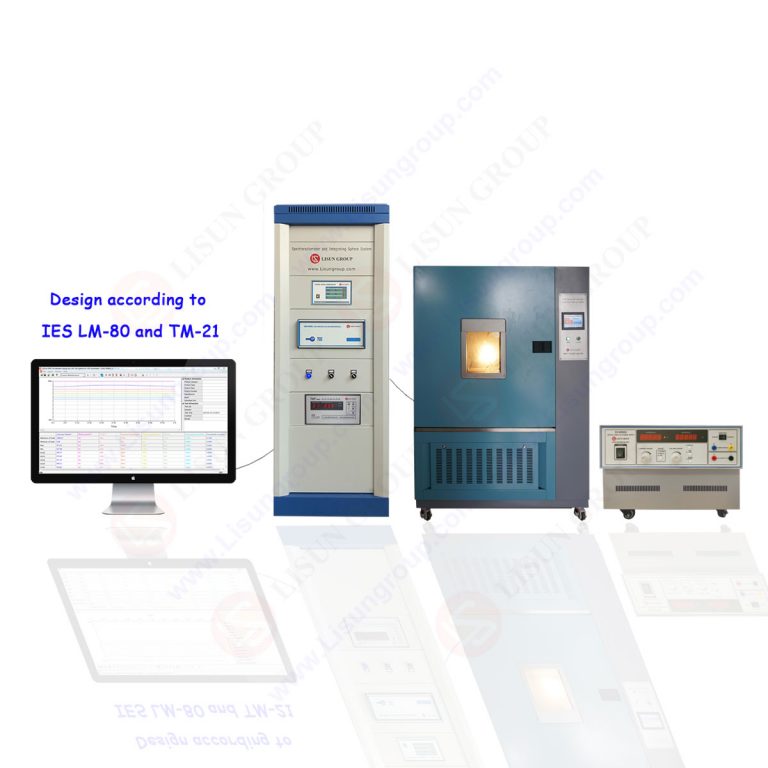
The LEDLM-80PL variant is purpose-built for the IES LM-80-15 standard, which specifies the method for measuring lumen maintenance of LED light sources. This system supports simultaneous testing of up to 20 LED packages or arrays at three distinct case temperatures. After data acquisition, the LISUN LED Optical Aging Test Instrument software performs TM-21-19 projection, providing engineers with the estimated L70(6K) life based on the 6,000-hour test duration. It features 600+ data channels for thermocouple monitoring, ensuring precise correlation between junction temperature rise and photometric decay.
2.2 LEDLM-84PL: Compliance with IES LM-84 and TM-28
The LEDLM-84PL system targets the IES LM-84-14 standard for integrated LED lamps and luminaires. Unlike the component-level focus of LM-80, this system tests complete products using a goniometer or integrating sphere configuration. It provides real-time photometric data (luminous flux, CCT, CRI) during aging. Post-test, the TM-28-14 projection method is applied, which is customized for luminaire-level thermal dynamics and driver interaction. This dual-platform strategy ensures that LISUN covers the entire supply chain, from bare die manufacturers to final product assembly.
| Feature | LEDLM-80PL (Component Level) | LEDLM-84PL (Luminaire Level) |
|---|---|---|
| Primary Standard | IES LM-80-15, TM-21-19 | IES LM-84-14, TM-28-14 |
| Test Objects | LEDs, LED arrays, modules | Lamps, integrated luminaires |
| Max Temperature Chamber | Up to 3 (25°C, 55°C, 85°C typical) | Up to 2 (controlled ambient cycle) |
| Testing Mode | Constant current via 20-channel DC supply | AC/DC power with dimming profiles |
| Primary Metric Output | L70, L50 (TM-21 projected) | L70, L50 (TM-28 projected) |
| Data Channels | 600+ thermocouple inputs | 100+ thermocouple + power monitor |
Table 1: Comparative specifications of the LISUN dual-system aging platforms.
3.1 The Photometric Decay Curve and Data Fitting
Determining L70 requires fitting a decay curve to raw photometric data. The LISUN software implements the exponential least-squares fitting method as defined in TM-21. Raw data points for luminous flux are normalized and plotted against time. The software calculates the decay coefficient (α) and applies the function Φ(t) = B * exp(-αt), where B is the initial flux. For the LISUN LED Optical Aging Test Instrument, the system automatically rejects outlier data points that deviate >10% from the curve, ensuring robust prediction even in noisy environments.
3.2 Temperature Acceleration Factors and Arrhenius Modeling
The Arrhenius equation, k = A exp(-Ea/(k_B T)), is central to projecting L50. LISUN’s software uses at least three temperature data sets to determine the activation energy (Ea) for the LED under test. A typical Ea value for phosphor-converted white LEDs ranges from 0.3 to 0.6 eV. The software then calculates an acceleration factor (AF) to translate the 6,000-hour test result at 85°C to a predicted life at 25°C. For example, if L70 is reached at 4,000 hours at 85°C with an AF of 8, the projected L70 at 25°C is 32,000 hours. This data is presented in the system’s final report, validated per IES TM-21 Annex B.
4.1 Temperature Chambers and Environmental Control
LISUN offers a customizable chamber system supporting dry oven and humidity-controlled environments. For accurate L70/L50 projection, the LISUN LED Optical Aging Test Instrument maintains case temperature stability within ±1°C across the 6000-hour test. Up to three chambers can be networked to the same control software, allowing parallel testing at 25°C, 55°C, and 85°C simultaneously. This tri-modal stress is mandatory for the Arrhenius model to converge on a valid Ea value.
4.2 Sample Mounting and Current Regulation
Consistency in sample mounting is critical for repeatable L70 data. LISUN’s system uses temperature-controlled metal-core PCB (MCPCB) sample holders. The DC power supply provides constant current (CC) to 20 independent channels, with accuracy within ±0.5% of the set point. For LM-80 tests, the current is set to the rated drive current (e.g., 350mA or 700mA). If the LED under test is dimmable, the LM-84PL variant supports pulsed current modes, using a built-in integrating sphere (50cm to 2m diameter) for non-stop photometric monitoring.
5.1 Real-Time Monitoring and Visualization
The LISUN software suite provides a live dashboard showing normalized luminous flux for each sample. Engineers can set thresholds for early failure detection, such as a sudden drop below 90% before 1,000 hours. The software records CCT shift (ΔCCT) and chromaticity drift (Δu’v’) alongside L70 data, as required by IES LM-79-19 for accuracy validation. All data is stored in a secure SQL database, timestamped every 15 minutes for the first 100 hours, then hourly thereafter.
5.2 Automated TM-21 and TM-28 Report Generation
Upon test completion, the LISUN LED Optical Aging Test Instrument software generates a compliance report that adheres to TM-21-19 formatting. It includes the projected L70(6K) lifespan, the calculated case temperature (T_c), the number of samples used for extrapolation, and the 90% lower confidence bound. For LM-84 tests, the software applies the TM-28 correction factor for driver interaction. These reports are accepted by Energy Star, DLC, and other global regulators, reducing the administrative burden on third-party testing labs.
6.1 Use in LED Manufacturing QC
For LED manufacturing engineers, the LISUN system is invaluable for binning and lifespan validation. A batch of 20 LEDs can be tested to verify that L70 exceeds the datasheet specification of 50,000 hours. If failures occur early, the software’s root-cause analysis tools flag high Ea values, indicating potential phosphor stability issues or die attachment degradation.
6.2 Application in Third-Party and Automotive Testing
Testing labs benefit from the system’s support for multiple standards. Automotive electronics engineers rely on L50 metrics for brake lamps and turn signals, where brightness degradation must not fall below 50% of original. The LISUN LED Optical Aging Test Instrument automates the test for AEC-Q102 compliance, providing both L70 and L50 endpoints with a data traceability audit trail required for ISO 17025 accreditation.
7.1 Real-Time Aging vs. Accelerated Methods
Real-time aging tests are the gold standard for accuracy but require 2-3 years to achieve meaningful L70 data. Conversely, the LISUN accelerated method can provide a TM-21 projection with 90% confidence within 8 months. The trade-off is that accelerated testing assumes a single failure mode dominated by temperature, which may not account for humidity or electrical surge degradation. LISUN mitigates this by offering optional humidity control (20%-98% RH) within the temperature chambers, aligning with CIE 127:2007 recommendations for comprehensive stress testing.
7.2 Measurement Uncertainty and Calibration
Every photometric measurement carries uncertainty from the integrating sphere coating and spectrometer drift. LISUN addresses this by integrating a reference standard lamp for in-situ calibration during the 6000-hour cycle. The system calculates total measurement uncertainty (typically <2% for luminous flux) and reports it in the final L70 projection. This level of precision ensures that the 600-hour L70 projection error band remains within ±5%, a significant improvement over basic thermal-only aging chambers.
The LISUN LED Optical Aging Test Instrument: Explaining L70 and L50 for LED Life provides engineers with a rigorous, standard-compliant framework for understanding LED longevity. Through dual-platform support for IES LM-80/TM-21 and LM-84/TM-28, the instrument enables accurate projection of L70 and L50 metrics from 6,000-hour tests. Integration of Arrhenius modeling, up to three temperature chambers, and high-precision current regulation ensures that data integrity is maintained from sample mounting to report generation. For LED manufacturing QC engineers, automotive component testers, and third-party labs, this system reduces product validation time from years to months while maintaining regulatory compliance with global standards. By automating the complex extrapolation of decay curves, LISUN empowers its users to confidently offer warranties and design specifications backed by statistically valid life data.
Q1: What is the difference between L70 and L50, and when should I test for each?
A: L70 defines the point when LED output drops to 70% of initial, representing the typical end-of-life for general lighting (e.g., offices, streetlights). L50 defines when output is at 50%, used where dimmer output is acceptable, such as in emergency lighting or industrial high-bay fixtures with high daylight intrusion. Using the LISUN LED Optical Aging Test Instrument, the software automatically calculates both metrics from the same 6,000-hour test data. For LM-80 compliance, L70 is the primary metric, while automotive standards (AEC-Q102) often specify L50 for signaling functions where minimal light is required for safety.
Q2: How does the Arrhenius Model in LISUN’s software handle multi-temperature test data?
A: The LISUN software collects lumen maintenance data from at least three temperatures (typically 25°C, 55°C, 85°C). It then plots the logarithm of the decay rate against the reciprocal of the absolute temperature (1/T). The slope of this line yields the activation energy (Ea). The software uses this Ea to calculate an acceleration factor (AF) that shifts the high-temperature decay curve to the lower operating temperature. For example, if an LED reaches L70 in 4,000 hours at 85°C with an AF of 8.5, the projected life at 25°C is 34,000 hours. This projection follows TM-21 Annex B requirements, and the system outputs the 90% lower confidence bound for reliability assurance.
Q3: Can the LISUN LED Optical Aging Test Instrument test both DC components and AC luminaires?
A: Yes, due to its dual-system architecture. The LEDLM-80PL is dedicated to components and DC modules, providing 20-channel constant current (CC) outputs with ±0.5% accuracy. The LEDLM-84PL is designed for complete AC-powered luminaires. It features a programmable AC power supply (up to 300V/20A) that can simulate dimming curves and power cycling. Both systems share the same software platform for data logging, but the luminaire variant includes an internal goniometer or integrating sphere sensor head to measure beam angle and flux distribution during aging. This flexibility allows one lab to cover both LM-80 and LM-84 testing without purchasing separate instruments.
Q4: What is the standard test duration for L70 validation, and can it be shortened?
A: The standard minimum test duration per IES LM-80 is 6,000 hours (approximately 8.3 months) for a complete L70 projection report. While shorter 3,000-hour tests can provide preliminary data, they are not accepted for compliance to TM-21 projections due to insufficient statistical confidence. The LISUN LED Optical Aging Test Instrument supports early termination only if the LED drops below L70 before 6,000 hours, in which case the software automatically records the exact failure time. For quicker validation, engineers can use higher stress temperatures (e.g., 105°C) but must validate that the failure mode does not change with temperature, which the software identifies through Arrhenius outlier detection.