









Here is the comprehensive technical article comparing the LISUN LEDLM-80PL and LEDLM-84PL, structured according to your specifications.
Abstract
This article provides a detailed technical comparison of the LISUN LEDLM-80PL vs LEDLM-84PL: Key Differences for LED Optical Aging Tests, focusing on their distinct roles in lumen maintenance validation. The core distinction lies in their compliance pathways: the LEDLM-80PL is engineered for the IES LM-80 standard and TM-21 extrapolation, while the LEDLM-84PL is dedicated to the newer IES LM-84 test method and TM-28 projection. We explore the hardware configurations, from the 6000-hour base test duration support to the capacity for connecting up to 3 temperature chambers. Technical insights into the Arrhenius Model integration, dual testing modes (single/continuous), and the L70/L50 metric derivation are analyzed. This article provides LED test engineers with a data-driven framework for selecting the correct aging system based on specific regulatory and reliability requirements.
1.1 IES LM-80 vs. IES LM-84: The Regulatory Divide
The primary differentiator between the LISUN LEDLM-80PL vs LEDLM-84PL: Key Differences for LED Optical Aging Tests is their respective compliance with two distinct IES standards. The LEDLM-80PL is built to certify LEDs under IES LM-80-15, which requires testing at 55°C, 85°C, and a third selected case temperature. This standard mandates a minimum of 6,000 hours of data for TM-21 extrapolation. Conversely, the LEDLM-84PL is designed for IES LM-84-14, a method focused on measuring lumen maintenance of LED lamps, engines, and luminaires. This standard often involves shorter test durations and is paired with TM-28 for lifetime projection. The hardware architecture of each system is optimized for the specific thermal and electrical requirements of its respective standard.
1.2 TM-21 and TM-28 Extrapolation Models
The software suite in each system is calibrated to a specific projection model. The LEDLM-80PL utilizes the Arrhenius Model-based projection defined in TM-21-19, which uses the 6,000-hour test data to extrapolate L70 (time to 70% lumen maintenance) values. The LEDLM-84PL, on the other hand, is integrated with TM-28-14, which applies a different statistical model for projection based on the input data from the LM-84 test. This distinction is critical; using the wrong standard for a product type can lead to non-compliant lifetime claims.
1.3 Core Hardware and Chamber Integration
Both systems feature a high-precision DC power supply and an integrating sphere-based optical measurement system. However, the control logic differs. The LEDLM-80PL is designed for high-volume component testing, supporting up to 3 connected temperature chambers for simultaneous aging at different temperatures. The LEDLM-84PL is typically configured for single or dual chamber setups, reflecting the lower sample count required for lamp-level testing. The data acquisition rate is customizable, but both systems log photometric data at intervals compliant with their respective standards.
2.1 Single Test Mode for Rigid Compliance
The single test mode is the default operational state for both the LEDLM-80PL and LEDLM-84PL. In this mode, the system runs a continuous, predefined test cycle at a specific temperature until the user-defined threshold (e.g., 6,000 hours) is met. This is the standard method for generating data for a formal LM-80 or LM-84 report. The LEDLM-80PL is particularly rigid in this mode, locking power levels to the rated current of the DUT to ensure reproducibility required by TM-21.
2.2 Continuous Test Mode for R&D Profiling
For research and development, the continuous test mode offers significant flexibility. When evaluating LISUN LEDLM-80PL vs LEDLM-84PL: Key Differences for LED Optical Aging Tests, this mode is where the Arrhenius Model integration shines. Users can program step-changes in temperature or drive current to accelerate degradation beyond standard rates for failure analysis. The continuous mode on the LEDLM-84PL allows for rapid evaluation of lamp thermal management systems, while the LEDLM-80PL can be used to stress test individual packages to destruction to identify failure mechanisms.
2.3 Data Logger and Lumen Depreciation Curves
Both systems include a high-resolution data logger that captures lumen output, forward voltage, and temperature at each measurement point. The raw data is automatically processed into lumen depreciation curves. The software highlights key metrics like L70, L50, and the projected failure rate. The LISUN LEDLM-80PL vs LEDLM-84PL debate is often settled by the required confidence interval; the LEDLM-80PL provides the rigorous statistical data needed for a 10-year projection, while the LEDLM-84PL offers faster, but less extrapolated, insights for product validation.
3.1 Thermal Stability and Uniformity
Thermal management is the most critical hardware aspect of any aging test. The chambers used with the LEDLM-80PL are designed to maintain stability within ±1°C of the set point over 6,000 hours. The LEDLM-84PL chambers, while similar, are often larger to accommodate lamps, requiring a higher thermal mass. Both systems use a forced air convection system to eliminate hot spots. The LEDLM-80PL requires precise case temperature measurement (Tc) on the PCB, while the LEDLM-84PL focuses on ambient temperature control within the chamber.
3.2 Multi-Chamber Synchronization for LM-80
A key hardware capability of the LEDLM-80PL is its ability to synchronize data from up to 3 temperature chambers. This allows the engineer to run tests at 55°C, 85°C, and a third specified temperature (e.g., 105°C) simultaneously, all logged under one unified software interface. This is non-negotiable for IES LM-80 compliance. The LEDLM-84PL typically operates with fewer chambers, as the LM-84 standard allows for testing at a single temperature for certain product categories, reducing the need for multi-point thermal profiling.
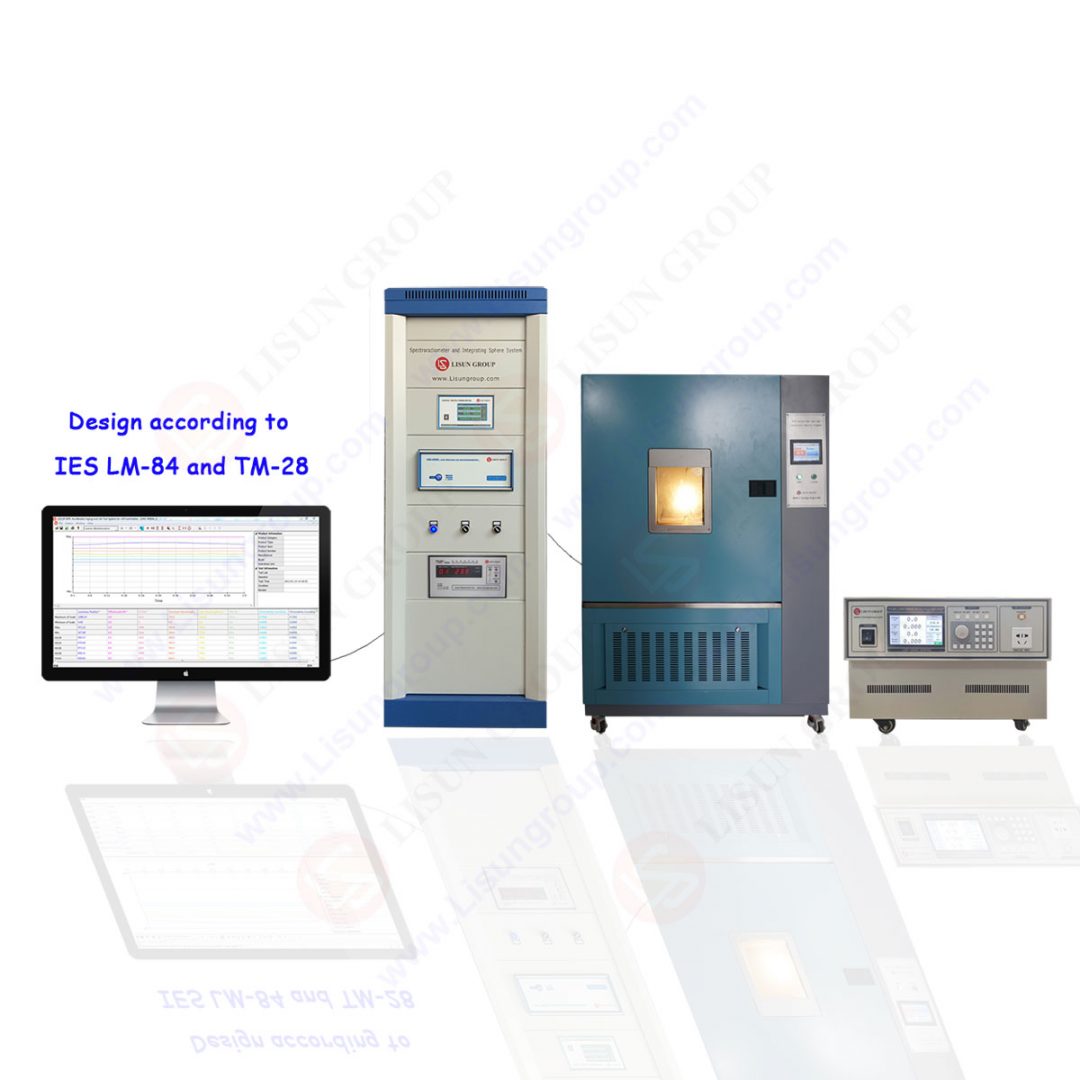
4.1 Sphere Size and Geometry Configuration
Both the LEDLM-80PL and LEDLM-84PL utilize integrating spheres for photometric capture. The LEDLM-80PL typically uses a smaller sphere (e.g., 0.3m or 0.5m) optimized for individual LEDs and small modules. The LEDLM-84PL often requires a larger sphere (1m or 2m) to accommodate the physical dimensions of lamps and luminaires. The sphere coating must maintain a reflectivity >95% across the visible spectrum to ensure measurement accuracy as the DUT degrades over time.
4.2 Spectral Responsivity and Calibration
The spectroradiometers in both systems are cross-calibrated to NIST standards. However, the spectral analysis frequency differs. The LEDLM-80PL is optimized for rapid, sequential single-color measurements (e.g., white, blue, red). The LEDLM-84PL demands higher sensitivity for low-light measurement at the end of life (L50) for large-area lamps. The signal-to-noise ratio must be maintained below 0.1% to ensure that the TM-28 projection is based on valid data, not instrument drift.
| Feature | LISUN LEDLM-80PL | LISUN LEDLM-84PL |
|---|---|---|
| Target Standard | IES LM-80 / TM-21 | IES LM-84 / TM-28 |
| Primary DUT Type | LED Packages / Modules | LED Lamps / Luminaires |
| Test Duration (Base) | 6,000 hours (Min.) | 3,000 – 6,000 hours |
| Temperature Chambers | Supports up to 3 chambers | Supports 1-2 chambers |
| Projection Model | Arrhenius (TM-21) | TM-28 (Specific) |
| Integrating Sphere | Small (0.3m / 0.5m) | Large (1m / 2m) |
| Lifetime Metrics | L70 / L50 (via TM-21) | L70 / L50 (via TM-28) |
5.1 Arrhenius Model Integration for Lifetime Prediction
The software within the LISUN LEDLM-80PL vs LEDLM-84PL systems is the intellectual core. The LEDLM-80PL’s software applies the Arrhenius equation to model failure acceleration due to temperature. It calculates the activation energy (Ea) for the DUT, which is crucial for projecting lifetime at different operating temperatures. The LEDLM-84PL software uses a different algorithm that accounts for the thermal characteristics of the entire luminaire, which often dissipates heat differently than a bare LED package.
5.2 Report Generation and IES File Output
Compliance is only useful if the data is properly formatted. Both systems generate detailed reports that include tables of photometric data, graphical depreciation curves, and extrapolated L70/L50 values. The LEDLM-80PL software outputs data in the exact format required for TM-21 submission, including the specific X, Y, Z values for chromaticity shift. The LEDLM-84PL focuses on generating the “LM-84 Test Report” format, which often includes in-situ photometry data. Both systems support export to CSV and PDF formats.
5.3 Real-Time Monitoring and Alarms
Remote monitoring is standard. The software allows the operator to view all connected chambers in real-time. If a DUT fails catastrophically (e.g., open circuit), the system triggers an alarm and logs the event. This is vital for long-term tests. The LEDLM-80PL is particularly sensitive to power interruptions; its software can automatically resume the test and log the interruption time, which is required for a valid LM-80 test report.
6.1 LED Component Manufacturers (LEDLM-80PL)
For a company manufacturing SMD LEDs or COB arrays, the LEDLM-80PL is the mandatory tool. It is used to qualify the LED package for use in fixtures. The 6,000-hour test at three temperatures (e.g., 55°C, 85°C, 55°C/85°C) provides the “fingerprint” of the chip’s reliability. The IES LM-80 report generated by this system is the ticket to enter the automotive and high-end lighting markets. Without this certification, luminaire manufacturers cannot claim a specific lifetime for their final product.
6.2 Luminaire Design and Validation (LEDLM-84PL)
The LEDLM-84PL is the tool for the final product validation engineer. After selecting the LED component (qualified via LM-80), the engineer tests the complete luminaire under LM-84. This identifies issues related to thermal management within the fixture. For example, a well-designed driver might overheat the LEDs. The LEDLM-84PL captures this system-level degradation, allowing the engineer to iterate the thermal design before mass production, saving significant warranty costs.
The differentiation between the LISUN LEDLM-80PL vs LEDLM-84PL: Key Differences for LED Optical Aging Tests is a matter of precision, standards alignment, and test scope. The LEDLM-80PL is the definitive instrument for component-level reliability engineering, adhering strictly to IES LM-80 and TM-21 to characterize the fundamental lifetime of LED packages over extended durations at multiple temperatures. Its support for up to 3 temperature chambers ensures comprehensive Arrhenius modeling and accurate L70/L50 projections. In contrast, the LEDLM-84PL serves the system-level test required by IES LM-84 and TM-28, focusing on the final lamp or luminaire performance. This distinction is not arbitrary; it reflects the industry’s regulatory framework.
For the senior test engineer, selecting the correct system hinges on the test objective. Is the goal to certify a component’s raw performance for design-in purposes, or to validate the system’s performance against thermal and design stresses? By providing dedicated hardware and software for each pathway, LISUN ensures that test results are both rigorous and compliant. Whether you are a QC manager qualifying an LED supply chain or an R&D engineer validating a new luminaire, the choice between LEDLM-80PL and LEDLM-84PL defines the accuracy and regulatory acceptance of your optical aging test results.
Q1: Can the LISUN LEDLM-80PL be used to test complete LED luminaires?
A: Technically, it can operate a luminaire, but this is not recommended. The LEDLM-80PL is designed for IES LM-80 requirements, which are strictly for LED packages, arrays, and modules. The test criteria require specific case temperature measurements that are difficult to replicate on a large luminaire. For testing a completed lamp, the LEDLM-84PL is the correct choice as it is aligned with IES LM-84 and features larger integrating spheres and thermal chambers suitable for final product validation. Using the LEDLM-80PL for luminaires would yield data that cannot be used for TM-21 lifetime projections.
Q2: How does the Arrhenius Model in the LEDLM-80PL differ from the model in the LEDLM-84PL?
A: The core Arrhenius equation is the same, but the application differs significantly. In the LEDLM-80PL, the model uses the measured junction temperature (Tj) of the LED chip to calculate activation energy (Ea) and accelerate life testing. This is very precise for the semiconductor junction. The LEDLM-84PL uses a modified Arrhenius approach that accounts for the thermal gradient between the LED junction, the thermal interface material, and the luminaire housing. This system-level model is less sensitive to the chip’s intrinsic Ea and more sensitive to the thermal resistance (Rth) of the fixture, ensuring a realistic projection for the finished product.
Q3: What is the minimum test duration required to get a reliable L70 value from these systems?
A: For the LEDLM-80PL (for TM-21), the IES standard requires a minimum of 6,000 hours of test data. Any projection based on less data is considered unreliable for official reporting. For the LEDLM-84PL (for TM-28), the minimum test duration is often 3,000 hours for lamps, but 6,000 hours is preferred for higher confidence. In both cases, the software can perform early projections for internal engineering guidance, but official regulatory submission requires adherence to these strict minimum durations to ensure the L70/lumen maintenance value is statistically sound.