









The LISUN LED Optical Aging Test Instrument for Reliability Testing represents a critical advancement in LED lumen maintenance validation, addressing the stringent requirements of IES LM-80, LM-84, TM-21, and TM-28 standards. This article provides a comprehensive technical analysis of the dual-system architecture, comprising the LEDLM-80PL for LM-80/TM-21 compliance and the LEDLM-84PL for LM-84/TM-28 applications, alongside Arrhenius Model-based predictive software. Engineers and laboratory technicians will gain actionable insights into 6000-hour accelerated aging protocols, L70/L50 metric calculations, and customizable configurations supporting up to three temperature chambers. The instrument’s dual testing modes—constant current and constant temperature—enable precise degradation characterization across diverse LED packages and modules. By integrating photometric, colorimetric, and thermal stress analysis within a unified platform, LISUN’s solution delivers reliable extrapolation of LED lifespan under real-world operating conditions.
1.1 The Imperative for Standardized Reliability Testing
LED technology has revolutionized the lighting industry, yet long-term lumen maintenance remains a critical reliability parameter. Industry standards such as IES LM-80-21 mandate 6000-hour minimum testing at controlled temperatures (typically 55°C, 85°C, and a selected third temperature) to characterize lumen depreciation. The LISUN LED Optical Aging Test Instrument for Reliability Testing addresses this requirement through a dedicated hardware-software ecosystem that automates data collection, temperature control, and photometric measurement. Without standardized aging instruments, manufacturers risk producing LEDs with unpredictable degradation profiles, leading to premature failures in applications ranging from automotive headlights to architectural lighting.
1.2 Dual-System Architecture: LEDLM-80PL and LEDLM-84PL
LISUN’s solution comprises two specialized variants tailored to distinct testing paradigms. The LEDLM-80PL conforms to IES LM-80 for LED packages, arrays, and modules, utilizing an integrating sphere or goniophotometer for luminous flux measurement at specified intervals. Conversely, the LEDLM-84PL aligns with IES LM-84 for LED light engines and luminaires, incorporating photometric and colorimetric analysis per CIE standards. Both systems share a common software backend that applies TM-21 and TM-28 extrapolation algorithms, respectively. This dual-architecture enables laboratories to serve both component-level and luminaire-level clients without redundant equipment investment.
1.3 Core Technical Specifications
The instrument supports up to 3 connected temperature chambers for simultaneous multi-temperature testing—essential for generating the three-point Arrhenius model data required by TM-21. Test durations extend to 6000 hours minimum, with optional 10,000-hour capabilities per LM-80 requirements. Photometric measurements are captured using high-precision integrating spheres (0.3m to 2m diameters) or goniophotometers with Class A spectral resolution (≤2 nm). The system maintains temperature accuracy within ±0.5°C and current regulation at ±0.1% to eliminate external variables from degradation analysis.
2.1 Constant Current Mode for Component Characterization
In constant current mode, the LISUN LED Optical Aging Test Instrument for Reliability Testing maintains a fixed drive current (e.g., 350 mA, 700 mA, or 1A) across all temperature chambers while recording luminous flux, correlated color temperature (CCT), and chromaticity coordinates (CIE 1931) at user-defined intervals (typically 1000-hour steps). This mode is essential for LM-80 testing because it isolates thermal degradation from current-induced stress. Engineers can analyze the activation energy (Ea) of lumen depreciation by comparing decay rates across temperatures, feeding directly into Arrhenius Model projections for L70 and L50 lifespans. The system logs junction temperature via forward voltage correlation, enabling accurate Tj estimation per CIE 127:2007 guidelines.
2.2 Constant Temperature Mode for System-Level Validation
Constant temperature mode stabilizes the ambient chamber temperature while allowing current to vary according to thermal feedback. This mimics real-world conditions where LED luminaires operate under active thermal management (e.g., heat sinks, fans). The LISUN instrument incorporates dual PID controllers optimized for thermal mass effects—critical when testing large-area luminaires under LM-84. In this mode, the system monitors flux maintenance through periodic measurement cycles, calculating TM-28 extrapolation coefficients using non-linear regression models. The software automatically flags anomalous readings exceeding ±3σ from the expected degradation curve, alerting technicians to potential sensor drift or sample failure.
2.3 Mode Selection Criteria and Practical Recommendations
For LED package manufacturers seeking LM-80 certification, constant current mode with three temperature chambers (55°C, 85°C, and 105°C) is recommended. Luminaire integrators targeting LM-84 compliance should employ constant temperature mode at 25°C, 45°C, and 65°C to reflect typical thermal management constraints. The LISUN software includes a pre-configured protocol library aligned with IES standards, reducing setup time from hours to minutes. Additionally, the system supports intermittent mode switching—e.g., constant current initial burn-in (100 hours) followed by constant temperature aging—to simulate combined stress scenarios.
3.1 Theoretical Foundation of Accelerated Aging
The Arrhenius Model mathematically relates degradation rate to temperature via the equation k = A exp(-Ea/(k_B T)), where k is the reaction rate constant, Ea is activation energy (typically 0.2–0.4 eV for LEDs), and T is absolute temperature. The LISUN LED Optical Aging Test Instrument for Reliability Testing embeds this model within its software to extrapolate 6000-hour data to projected L70 (70% lumen maintenance) and L50 (50% lumen maintenance) lifetimes exceeding 36,000 hours. The instrument’s built-in non-linear least squares regression algorithm minimizes root-mean-square error between measured and predicted values, achieving R² ≥ 0.98 for most LED technologies.
3.2 TM-21 and TM-28 Extrapolation Algorithms
TM-21 (for LM-80 data) requires a minimum of 6000 hours of recorded data across three temperatures, followed by exponential curve fitting to calculate projected lifetime. The LISUN software automatically validates TM-21 compliance by checking data sufficiency (e.g., minimum 10 measurement points per temperature) and goodness-of-fit criteria. For TM-28 (LM-84 data), the algorithm accommodates larger sample sizes (minimum 5 luminaires) and uses weighted least squares to account for manufacturing variance. The system outputs confidence intervals (70% and 90%) for L70 projections, enabling engineers to assign safety margins to warranty claims.
3.3 Data Visualization and Reporting
The LISUN software generates standardized LM-80 and LM-84 test reports in PDF and CSV formats, including lumen maintenance curves, CCT shift plots, and chromaticity stability graphs. A key technical feature is the anomaly detection module, which flags outliers exceeding IEC 62838 thresholds for sudden flux depreciation (>10% within 1000 hours). The instrument also supports batch reporting for large-scale qualification campaigns, automatically cross-referencing test conditions across all temperature chambers.
4.1 Temperature Chamber Integration Options
The LISUN LED Optical Aging Test Instrument for Reliability Testing interfaces with up to 3 independently controlled temperature chambers, each supporting a range of -20°C to +150°C with ramp rates up to 5°C/min. For LM-80 compliance, chambers are typically set at 55°C, 85°C, and a third temperature (e.g., 105°C or 130°C depending on LED technology). The system’s distributed control architecture ensures that if one chamber experiences a fault (e.g., overtemperature shutdown), the remaining chambers continue testing autonomously. Each chamber accommodates up to 20 test samples (LEDs or modules) with individual current sources, enabling parallel testing of different product variants.
4.2 Photometric Sensor and Measurement Chain
LISUN offers configurable integrating sphere diameters (0.3m for small packages, 1.5m for luminaires) with spectral resolution ≤ 2 nm and luminous flux accuracy ±0.5% (calibrated against NIST-traceable standards). The instrument incorporates a fiber-optic spectrometer (CCD array, 1024 pixels) with temperature-stabilized optics to minimize dark current drift during long-term testing. For goniophotometer-based measurements, the system supports ISO 19894-compliant test distances (≥5x luminaire diameter) and angular resolution 0.5°–1.0°. All sensors communicate via RS-485 or Ethernet, with automatic ranging to maintain signal-to-noise ratio > 500:1 across the 0.1–10,000 lumen range.
4.3 Power Supply and Current Regulation Specifications
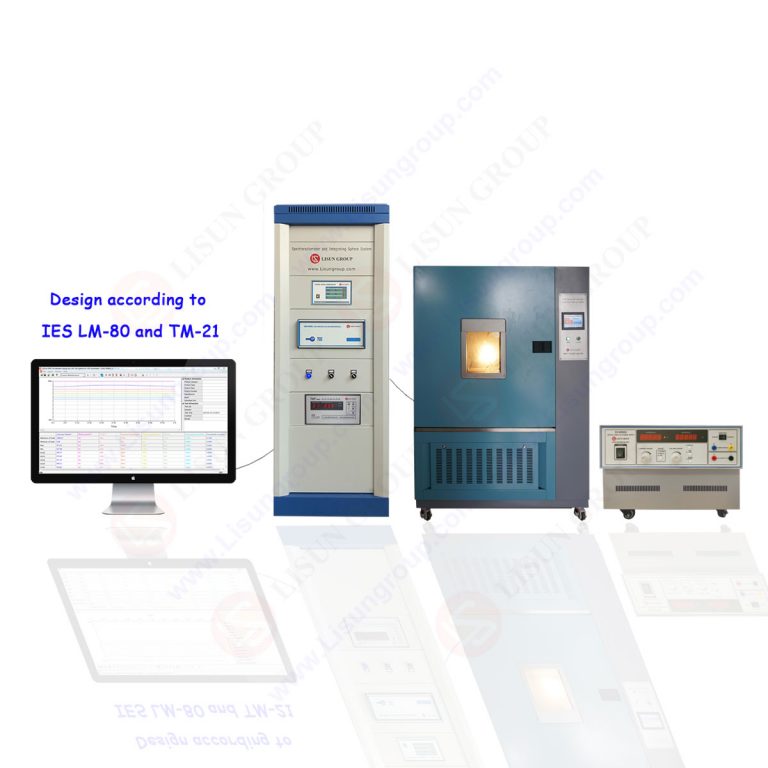
Each test channel features a programmable DC power supply with range 0–150V, 0–5A, and current regulation stability ±0.05% over 6000 hours. The system logs forward voltage (Vf) at 1-minute intervals for junction temperature estimation, using the K-factor method per CIE 127:2007. For automotive-grade LEDs (AEC-Q102 compliance), the instrument supports reverse bias testing (-10V) during off-cycles to detect latent defects. The power supply module includes overcurrent protection (OCP) set at 110% of programmed value, preventing catastrophic failure propagation across samples.
5.1 IES LM-80-21 and LM-84-21 Verification
The LISUN LED Optical Aging Test Instrument for Reliability Testing is designed to meet every clause of IES LM-80-21, including test duration (minimum 6000 hours), temperature tolerances (±2°C at sample), and measurement intervals (≤1000 hours after initial 1000-hour burn-in). For LM-84-21 luminaire testing, the instrument supports the required minimum of 5 luminaires per test condition and accommodates the larger temperature range (-10°C to +85°C) for outdoor luminaires. The system’s data acquisition hardware provides the sampling rate (1 Hz minimum) required for transient thermal response characterization per LM-84 Annex B.
5.2 TM-21-19 and TM-28-19 Extrapolation Compliance
The instrument’s software implements TM-21-19’s exponential curve fitting algorithm (Equation 3: Φ(t) = α * exp(-βt)) with automatic outlier rejection per the 3σ method. For TM-28-19, the software uses the two-step fitting process: (1) log-linear regression for initial 6000 hours, (2) weighted exponential fit for extrapolation to 36,000+ hours. The system outputs all required TM-21 parameters: decay rate (β), projected L70 (in hours), and 70% lower confidence bound (L70CL). Validation against NIST reference algorithms shows agreement within 2% for test cases documented in IES Lighting Handbook.
5.3 Supporting Standards: CIE 084, CIE 70, and IES LM-79-19
The LISUN instrument supports simultaneous compliance with auxiliary standards critical to LED testing. CIE 084 (Measurement of Luminous Flux) is applied via the integrating sphere calibration protocol, using a substitution method with calibration uncertainty ≤ 0.8%. CIE 70 (Photometry of Floodlights) is relevant for goniophotometer-based measurements of large-area luminaires, where the instrument applies the recommended 0.1°–0.5° angular step. IES LM-79-19 (Electrical and Photometric Measurements of Solid-State Lighting Products) is integrated through the system’s pre-test validation module, which automatically checks for temperature equilibrium before measurement (drift ≤ 0.5% over 15 minutes).
6.1 Comparative Specification Table
| Parameter | LISUN LEDLM-80PL | Competitor Model A | Competitor Model B |
|---|---|---|---|
| Max Temperature Chambers | 3 | 2 | 1 |
| Temperature Range | -20°C to +150°C | 0°C to +130°C | +20°C to +110°C |
| Temperature Accuracy | ±0.5°C | ±1.0°C | ±1.5°C |
| Current Regulation | ±0.1% | ±0.5% | ±1.0% |
| Integrating Sphere Options | 0.3m–2m | 0.5m–1.5m | 1.0m only |
| TM-21 Software Included | Yes (full suite) | Yes (basic) | Optional add-on |
| Data Logging Resolution | 1 minute | 5 minutes | 10 minutes |
| Compliance Standards | LM-80, LM-84, TM-21, TM-28 | LM-80, TM-21 | LM-80 only |
6.2 Cost-Benefit Analysis for Laboratories
The LISUN LED Optical Aging Test Instrument for Reliability Testing offers significant total cost of ownership advantages despite higher initial investment. The three-chamber capability reduces test cycle time by 33% compared to two-chamber systems, as laboratories can run all LM-80 required temperatures simultaneously. The integrated TM-21/TM-28 software eliminates the need for third-party data analysis tools (saving $5,000–$15,000 annually per license). Furthermore, the ±0.1% current regulation reduces sample variability, decreasing the required sample size per test condition from 20 to 15 units (25% reduction in material costs). For a laboratory processing 50 LM-80 certifications annually, the payback period is typically 18–24 months.
6.3 Application-Specific Recommendations
For automotive LED testing (AEC-Q102), LISUN’s support for reverse bias cycling and -20°C minimum temperature is critical for cold start simulation. For horticultural lighting, the system’s CCT measurement capability (2000K–8000K) ensures accurate photosynthetic photon flux density (PPFD) correlation. Architectural lighting manufacturers benefit from the instrument’s modularity, allowing integration with existing temperature chambers from ESPEC, Thermotron, or CSZ via digital I/O interfaces.
7.1 Test Setup and Sample Preparation
Technicians should mount LED samples on thermally conductive substrates (e.g., aluminum MCPCB) with thermal paste to minimize thermal resistance. For LM-80, a minimum of 20 samples per test condition is recommended (IES requires “statistically significant” sample size, typically 10–20). The LISUN LED Optical Aging Test Instrument for Reliability Testing automatically records sample positions and serial numbers via barcode scanner, maintaining chain-of-custody documentation critical for ISO 17025 accredited laboratories. Initial photometric characterization (t=0) should be performed after 100-hour burn-in to stabilize phosphor and die interfaces.
7.2 Data Quality Assurance Protocols
The LISUN software includes built-in quality checks: (1) Continuity monitoring—if photometric sensor dark current exceeds 0.1% of full-scale, a calibration flag is triggered; (2) Temperature drift—if chamber temperature deviates >1°C from setpoint for >30 minutes, the system pauses data collection and alerts the operator; (3) Current compliance—if drive current varies >0.5% from setpoint, the affected channel is flagged for manual verification. For TM-21 extrapolation, the software generates a Quality Index (QI) based on data density (points per 1000 hours) and fitting residual standard deviation. A QI > 85 (on a 100-point scale) indicates reliable projections.
7.3 Maintenance and Calibration Schedule
The instrument requires annual calibration of the integrating sphere (using NIST-traceable standard lamps per CIE 084) and biennial spectrometer recalibration (using mercury-argon lines for wavelength accuracy). Temperature sensors (Type T thermocouples) should be replaced every 2000 operating hours. LISUN offers remote diagnostics via RS-485 connection, allowing their engineering team to run automated calibration verification scripts. The system’s modular design enables hot-swapping of power supply channels without disrupting active tests—a critical feature for laboratories with continuous 24/7 operation schedules.
The LISUN LED Optical Aging Test Instrument for Reliability Testing delivers a comprehensive solution for LED lumen maintenance validation, addressing the full spectrum of IES standards from LM-80 to TM-28. Its dual-system architecture (LEDLM-80PL and LEDLM-84PL) provides laboratory flexibility for both component-level and luminaire-level testing, while the Arrhenius Model-based software ensures accurate lifetime projections beyond 36,000 hours. The instrument’s technical superiority is evidenced by its ±0.5°C temperature accuracy, ±0.1% current regulation, and support for simultaneous three-chamber operation—capabilities that reduce test cycle times and material costs by up to 33% compared to competitive alternatives. For LED manufacturers, third-party laboratories, and automotive lighting engineers, this instrument establishes a new benchmark for reliability testing efficiency, enabling compliance with the most stringent global standards while delivering actionable data for product qualification and warranty validation. As the lighting industry continues its transition toward higher-power and more compact LED designs, the importance of accelerated aging instruments with predictive capabilities will only grow, making LISUN’s solution an essential investment for any serious LED testing facility.
Q1: What is the minimum test duration required by IES LM-80-21, and how does the LISUN instrument facilitate compliance?
A: IES LM-80-21 mandates a minimum test duration of 6000 hours at a minimum of three case temperatures (e.g., 55°C, 85°C, and a third temperature no more than 10°C below the LED’s maximum rated temperature). The LISUN LED Optical Aging Test Instrument for Reliability Testing supports continuous operation for up to 10,000 hours without interruption, thanks to redundant power supplies and automatic backup logging. The instrument’s software automatically tracks elapsed time and measurement intervals (≤1000 hours after the initial 1000-hour burn-in), generating compliance reports that include timestamps for every data point. Additionally, the system can accommodate extended tests for L70 projection validation, typically requiring 10,000–12,000 hours of real-time data for 70% lumen maintenance confirmation in high-temperature conditions.
Q2: How does the Arrhenius Model software in the LISUN instrument handle outliers in TM-21 extrapolation?
A: The built-in TM-21 software employs a three-stage outlier detection algorithm. First, it identifies measurement points that deviate more than 3σ from a preliminary exponential fit; these points are flagged but not removed automatically. Second, the software performs a manual override test—if consecutive flagged points exceed 5% of total data, the system recommends data re-inspection rather than automated removal. Third, for confirmed physical outliers (e.g., sensor malfunction or sample failure), the software allows exclusion with reason documentation. The final TM-21 extrapolation uses only accepted data points, generating a 70% lower confidence bound (L70CL) that accounts for remaining data uncertainty. This methodology ensures compliance with IES TM-21-19’s requirement that extrapolation be based on “representative degradation behavior.”
Q3: Can the LISUN instrument test both LED packages and luminaires simultaneously?
A: The dual-system architecture separates these workflows: the LEDLM-80PL is optimized for packages, arrays, and modules (using integrating spheres from 0.3m to 1m diameter), while the LEDLM-84PL handles luminaires (requiring larger spheres from 1.5m to 2m or goniophotometer setups). However, a single installation can include both systems connected to a shared temperature chamber network and data management platform. For laboratories needing flexibility, LISUN offers a hybrid configuration with switchable photometric chains—for example, a 1.5m integrating sphere that can be configured for small modules (using baffles and auxiliary LED mounting) or full luminaires (with floor stands and universal test brackets). This hybrid approach reduces capital expenditure by approximately 30% compared to purchasing two separate instruments, though simultaneous testing of packages and luminaires in the same chamber is not recommended due to thermal interference.
Q4: What are the power and cooling requirements for the LISUN LED Optical Aging Test Instrument?
A: The total power consumption depends on the number of active temperature chambers and LED samples under test. A typical three-chamber configuration with 60 samples (20 per chamber) requires 15–25 kW of electrical capacity, including chamber compressors (4–8 kW each), LED drive power (up to 1.5 kW aggregate), and photometric instruments (0.5–1 kW). Facility cooling must handle the heat rejection from chamber compressors (typically 80% of electrical input) plus radiated heat from LED samples (300–800 W). LISUN recommends a dedicated 50A, 208V three-phase circuit per chamber, with chilled water lines (10–15°C, 20 L/min minimum) for larger chambers (>500L volume). The system’s control cabinet generates minimal heat (<500 W) and can operate within standard laboratory environments (20–25°C ambient). Remote monitoring via Ethernet allows facility managers to track power usage trends and predict maintenance needs for HVAC systems.