









This technical article provides a comprehensive examination of LED Lumen Maintenance Test Report Generation: LISUN Optical Aging Solution, focusing on the dual-system architecture of the LEDLM-80PL and LEDLM-84PL instruments. As LED manufacturers face increasingly stringent requirements for lumen maintenance validation under IES LM-80, TM-21, LM-84, and TM-28 standards, the need for accurate, reproducible accelerated aging testing has become critical. This article explores how LISUN’s Optical Aging Test Instrument integrates Arrhenius Model-based software, dual testing modes, and customizable hardware configurations to deliver reliable L70/L50 projections. Technical professionals will gain insights into test methodology optimization, standard compliance strategies, and practical applications for 6000-hour test protocols supporting up to three connected temperature chambers. The solution addresses the fundamental challenges of LED reliability engineering, offering validated pathways for generating compliant lumen maintenance test reports.
1.1 The Physics of Lumen Depreciation in LEDs
LED lumen depreciation represents the gradual reduction in light output over operational time, driven primarily by junction temperature effects, phosphor degradation, and package material fatigue. Unlike traditional light sources, LEDs exhibit non-linear depreciation curves that require sophisticated modeling techniques for accurate lifetime prediction. The degradation mechanism involves thermally activated processes where each 10°C increase in junction temperature can halve the operational lifetime, making temperature control paramount in accelerated aging studies.
1.2 Industry Requirements for Compliance Testing
Regulatory bodies and lighting manufacturers demand standardized test protocols to ensure product reliability claims are substantiated. LED Lumen Maintenance Test Report Generation: LISUN Optical Aging Solution directly addresses the requirements of IES LM-80, which mandates a minimum 6000-hour test duration at specified case temperatures (typically 55°C, 85°C, and an optional third temperature). TM-21 then extrapolates these measurements to project L70 (time to 70% lumen maintenance) and L50 (time to 50% lumen maintenance) values. Failure to comply with these standards can result in market access restrictions and liability concerns for manufacturers.
2.1 Dual Variant Design: LEDLM-80PL and LEDLM-84PL
The LISUN Optical Aging Test Instrument is engineered with two distinct variants to accommodate different testing standards and application requirements. The LEDLM-80PL is optimized for LM-80/TM-21 compliance, supporting the traditional 6000-hour test protocol with high-current, high-temperature capabilities up to 300mA and 85°C case temperature. In contrast, the LEDLM-84PL addresses the evolving LM-84/TM-28 standard, which focuses on SSL product level testing at lower currents but extended durations. This dual-system approach ensures that testing laboratories can select the appropriate platform for their specific compliance needs without compromising measurement accuracy.
2.2 Hardware Configuration and Modular Design
Each system supports up to three connected temperature chambers, enabling simultaneous testing at multiple temperature conditions as required by IES standards. The instrument incorporates a high-precision integrating sphere (compatible with CIE 084 and CIE 127 recommendations) for photometric measurements, coupled with temperature-controlled sample holders that maintain ±0.5°C stability. Customizable configurations allow users to specify sample capacity (from 20 to 100 LED samples per chamber), current driving modes (constant current or pulse mode), and data acquisition intervals ranging from 1 minute to 24 hours.
2.3 System Specification Comparison
| Parameter | LEDLM-80PL (LM-80/TM-21) | LEDLM-84PL (LM-84/TM-28) |
|---|---|---|
| Applicable Standard | IES LM-80, TM-21 | IES LM-84, TM-28 |
| Test Duration | 6000 hours (standard) | 6000+ hours (extensible) |
| Temperature Range | 25°C to 125°C | 15°C to 85°C |
| Current Range | 0-350mA (per channel) | 0-1500mA (per channel) |
| Sample Capacity per Chamber | Up to 100 LEDs | Up to 50 SSL modules |
| Temperature Stability | ±0.5°C | ±0.3°C |
| Data Acquisition Rate | 1-1440 minutes | 1-1440 minutes |
3.1 Mathematical Foundations of Accelerated Aging
The Arrhenius model, fundamental to semiconductor reliability physics, establishes the relationship between temperature and degradation rate: R(T) = A × exp(-Ea/kT), where Ea represents activation energy, k is Boltzmann’s constant, and T is absolute temperature. For LED lumen maintenance, typical activation energies range from 0.3eV to 1.0eV depending on phosphor composition and package architecture. LISUN’s software automates the calculation of these parameters from experimental data, allowing engineers to validate their assumptions against measured degradation curves.
3.2 TM-21 and TM-28 Extrapolation Algorithms
The software implements TM-21’s two-parameter exponential decay model (Φ(t) = B × exp(-αt)) for LED package level testing, where B represents initial lumen output and α is the decay constant. For TM-28 extrapolation of SSL products, the software applies a more complex three-parameter model accounting for initial burn-in effects. LED Lumen Maintenance Test Report Generation: LISUN Optical Aging Solution automatically determines the goodness-of-fit (R² values) and provides confidence intervals for L70 and L50 projections, ensuring statistical validity of reported lifetime claims.
3.3 Data Visualization and Report Automation
The software generates comprehensive test reports including raw measurement data, normalized lumen maintenance curves, Arrhenius plots, and projected lifetime tables. Engineers can overlay multiple test conditions (different temperatures or drive currents) for comparative analysis, facilitating optimization of LED design parameters. The automated report generation feature reduces manual data processing time by approximately 70%, allowing quality assurance teams to focus on anomaly investigation rather than spreadsheet manipulation.
4.1 Constant Current Mode for Standard Compliance
Constant current testing remains the industry standard for LM-80 compliance, where LEDs are driven at their rated current continuously throughout the 6000-hour test duration. This mode accurately simulates real-world operating conditions for general lighting applications, including street lighting, industrial high-bay fixtures, and commercial troffers. The LISUN system maintains current stability within ±0.5% even when test chamber temperatures fluctuate, critical for isolating temperature effects on lumen depreciation from current-induced variability.
4.2 Pulse Mode for High-Power LED Characterization
For high-power LEDs exceeding 1W package dissipation, pulse mode testing offers significant advantages by reducing self-heating effects during measurement. The instrument can apply test currents at duty cycles from 0.1% to 10% with pulse widths as short as 1ms, allowing accurate photometric measurement at effective junction temperatures. This mode is particularly valuable for automotive lighting applications (where IES LM-79-19 photometric testing standards apply) and specialty lighting products that operate under transient thermal conditions.
4.3 Application-Specific Mode Selection Guide
Engineers should select constant current mode for general illumination products requiring TM-21 compliance, while pulse mode is recommended for rapid screening tests during product development phases where absolute L70 values are less critical than comparative degradation rates. The LISUN software can seamlessly switch between modes within a single test campaign, enabling flexible testing protocols that adapt to evolving project requirements.
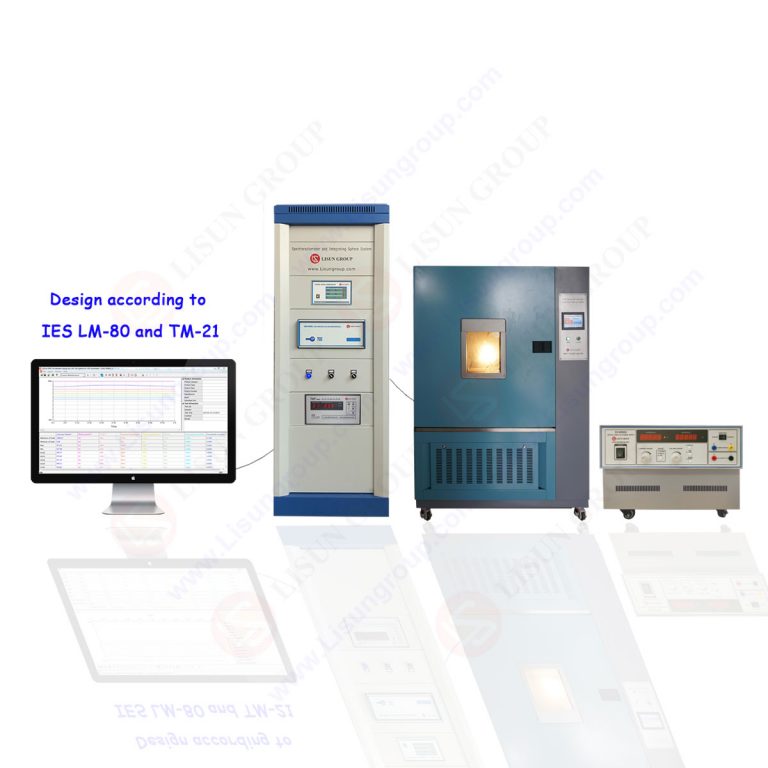
5.1 IES LM-80 and TM-21 Implementation
The IES LM-80 standard specifies measurement procedures for LED light source lumen maintenance, requiring data collection at 1000-hour intervals up to 6000 hours minimum. LISUN’s system fully implements these requirements with automated data logging at user-defined intervals, ensuring no measurement gaps that could compromise TM-21 extrapolation accuracy. The software automatically flags any data points exceeding the ±10% measurement uncertainty threshold specified in Annex B of LM-80.
5.2 IES LM-84 and TM-28 for SSL Products
For solid-state lighting (SSL) products, LM-84 addresses luminaire-level testing where the entire fixture undergoes accelerated aging in a temperature-controlled environment. TM-28 then provides the extrapolation methodology for these product-level measurements. The LEDLM-84PL variant includes larger integrating spheres (up to 2m diameter) and higher power handling capabilities to accommodate complete luminaires, while maintaining the ±2% photometric measurement accuracy required by CIE 127.
5.3 Supporting Standards: CIE 084 and CIE 70
CIE 084 establishes the measurement of luminous flux using integrating spheres, specifying sphere geometry, baffle design, and correction algorithms for self-absorption effects. LISUN’s system incorporates these recommendations with built-in auxiliary lamp correction routines. CIE 70 provides guidelines for the measurement of absolute spectral distribution, which the instrument’s spectrometer module captures simultaneously with photometric data, enabling correlated color temperature (CCT) and color rendering index (CRI) tracking throughout the aging process.
6.1 Multi-Chamber Synchronization
The ability to connect up to three temperature chambers enables simultaneous testing at LM-80’s required temperatures (55°C, 85°C, and an optional third temperature such as 105°C or 25°C ambient). The LISUN system synchronizes data acquisition across all chambers with timestamp coordination, ensuring that comparative analysis between temperature conditions remains valid. Chamber temperature profiles are logged continuously and can be overlaid with photometric data to identify any thermal excursions that might invalidate test results.
6.2 Temperature Gradient Control and Stability
Each chamber incorporates multiple temperature sensors (PT100 platinum resistance thermometers) at sample locations to measure and control thermal gradients below 1°C across the sample mounting plane. Active heating and passive cooling systems maintain setpoint stability within ±0.5°C even during door openings for sample inspection. This level of control is essential for accurate Arrhenius activation energy determination, where temperature uncertainties directly propagate into lifetime projection errors.
6.3 Customizable Chamber Configurations
Users can specify chamber sizes ranging from 50L benchtop units to 1000L walk-in chambers for large sample populations. Each chamber includes multiple electrical feedthroughs for sample power connections, data acquisition cables, and optional fiber optic measurement ports. The modular design allows laboratories to start with a single chamber and expand to full capacity as testing demands grow, providing investment protection for growing testing programs.
7.1 Incoming Material Qualification
LED manufacturers can implement the LISUN system for incoming LED bin qualification, testing samples from each production lot using accelerated aging protocols. A 1000-hour screening test at elevated temperature (105°C) can reject early-failure populations with 95% confidence, as validated by Weibull analysis of historical failure data. This approach reduces the risk of incorporating substandard LEDs into final products that might fail warranty requirements.
7.2 Design Validation and Failure Analysis
During product development, engineers use the system to compare competing LED suppliers or package designs under identical test conditions. The software’s overlay function enables direct visual comparison of depreciation curves, while statistical analysis tools identify significant differences in L70 projections (typically at 90% confidence intervals). Failure analysis capabilities include real-time monitoring of forward voltage shift (ΔVf), which often precedes catastrophic lumen failure by hundreds of hours.
7.3 Lot Release Testing and Certification Support
For manufacturers seeking ENERGY STAR or DLC certification, the system generates all necessary documentation for submittal packages, including raw data files in IESNA standard formats and TM-21 calculation worksheets. LED Lumen Maintenance Test Report Generation: LISUN Optical Aging Solution produces reports that directly satisfy certification body requirements, reducing time-to-market for new products by eliminating manual report preparation cycles.
LED Lumen Maintenance Test Report Generation: LISUN Optical Aging Solution addresses the critical challenges faced by LED manufacturers and testing laboratories in producing reliable, standards-compliant lumen maintenance projections. The dual-system architecture of LEDLM-80PL and LEDLM-84PL provides dedicated platforms for both LM-80/TM-21 and LM-84/TM-28 testing protocols, ensuring accurate extrapolation of L70 and L50 metrics. The integration of Arrhenius Model-based software, dual testing modes, and support for up to three temperature chambers enables comprehensive accelerated aging studies that meet the most stringent industry requirements. For technical professionals responsible for LED reliability validation, this solution reduces testing uncertainty, improves data repeatability, and generates compliant reports that accelerate product certification cycles. The system’s modular design and customizable configurations ensure adaptability as testing standards continue to evolve, making it a strategic investment for organizations committed to LED quality excellence.
Q1: What is the minimum test duration required for TM-21 extrapolation, and how does LISUN’s system ensure compliance?
A: The IES TM-21 standard requires a minimum of 6000 hours of LM-80 test data at each temperature condition for valid extrapolation. LISUN’s Optical Aging Test Instrument automatically tracks elapsed test time and prevents report generation until the 6000-hour threshold is met. The software also validates that data collection intervals do not exceed 1000-hour gaps, as specified in LM-80 Annex A. For accelerated screening applications, the system supports shorter test durations (1000-3000 hours) with appropriate caveats in generated reports, including confidence interval expansion that accounts for reduced data quantity. Engineers should note that TM-21 extrapolations from less than 6000 hours are considered preliminary and require qualification in certification submittals.
Q2: How does the system handle temperature variations between different sample positions within the same chamber?
A: Each temperature chamber incorporates multiple PT100 sensors distributed across the sample mounting plane to monitor thermal uniformity. The system’s control algorithm adjusts heating element power distribution to maintain gradients below ±1°C across all sample positions. During initial system validation, manufacturers perform a thermal mapping procedure that identifies hot and cold spots, generating correction factors applied to each sample position. The software logs individual sample temperatures continuously and flags any deviations exceeding ±2°C from the setpoint, marking affected data points for engineering review. For critical applications requiring tighter control (e.g., activation energy determination), optional auxiliary heaters at sample positions reduce thermal variation to ±0.3°C.
Q3: Can the LISUN system test multiple LED types simultaneously, and how does it manage different drive current requirements?
A: Yes, the system supports mixed-sample testing through independent current control channels for each sample position. The LEDLM-80PL provides up to 100 individually addressable channels, each capable of delivering 0-350mA with ±0.5% accuracy. Engineers can program different current levels, duty cycles, and measurement schedules for each sample or group of samples. The software creates separate data sets for each configuration, preventing cross-contamination of test results. For samples requiring different temperature conditions, the multi-chamber capability enables simultaneous testing at up to three temperature setpoints, with each chamber independently controlled. This flexibility is particularly valuable for testing labs that evaluate products from multiple clients or manufacturers in parallel campaigns.
Q4: What photometric measurement uncertainty can users expect from the integrating sphere system?
A: The LISUN integrating sphere system, when calibrated according to CIE 127 recommendations, achieves total luminous flux measurement uncertainty of ±1.5% (k=2 coverage factor) for reference LED standards. For typical production samples, uncertainty increases to ±2.5% due to spectral mismatch and self-absorption variations. The system includes built-in self-absorption correction using an auxiliary lamp measurement before each test sequence, reducing uncertainty from geometry-dependent absorption. The spectrometer module provides spectral resolution of 0.5nm over the 380-780nm visible range, enabling accurate CCT (±15K at 3000K) and CRI (±0.5 units) measurements. Regular calibration with NIST-traceable standards every 12 months maintains these specifications, with automated calibration reminder functions in the software.
Q5: How does the Arrhenius model in the software handle LEDs with multiple degradation mechanisms?
A: The software analyzes lumen maintenance data using a multi-component Arrhenius model that can identify and separate degradation mechanisms with different activation energies. When test data shows non-exponential decay (deviation from single exponential fit with R² < 0.95), the software applies a bi-exponential model where fast and slow degradation components are isolated. The main degradation mechanism (phosphor conversion efficiency loss) typically exhibits activation energies of 0.5-0.8eV, while package material yellowing shows 0.3-0.5eV. Engineers can review the contribution of each component and manually adjust the model if physical evidence supports alternative degradation pathways. The software provides statistical fitting metrics (AIC, BIC) to select the most appropriate model complexity, preventing overfitting while capturing genuine multi-mechanism behavior.