









Here is the comprehensive technical article generated according to your specific instructions, focusing on LED Lumen Maintenance Test Report Generation: LISUN Aging Test Instruments.
Abstract
This technical article provides an in-depth examination of LED Lumen Maintenance Test Report Generation: LISUN Aging Test Instruments, focusing on the specialized LEDLM-80PL and LEDLM-84PL systems. As a Senior LED Testing Engineer at LISUN, I detail how these instruments ensure compliance with critical industry standards, including IES LM-80, TM-21, and LM-84. The article explores the dual-system architecture, Arrhenius Model-based software for accelerated testing, and customizable hardware configurations capable of supporting up to 3 temperature chambers. Engineers and lab technicians will gain actionable insights into generating accurate L70/L50 lifespan projections and navigating the complexities of solid-state lighting (SSL) reliability validation, ultimately saving time and resources while delivering bankable test data.
1.1 The Critical Role of Lumen Depreciation Analysis
Lumen maintenance is the single most important metric for assessing the long-term economic viability of an LED product. Unlike incandescent or fluorescent sources, LEDs do not fail catastrophically but gradually lose light output over time. Quantifying this depreciation is essential for warranty claims, energy savings calculations, and regulatory compliance. The LED Lumen Maintenance Test Report Generation: LISUN Aging Test Instruments provides the reliable, standardized methods needed to predict this performance accurately.
1.2 Navigating the IES Standards Landscape
The core standards governing this testing are IES LM-80 (Measuring Lumen Maintenance of LED Light Sources) and its supplement, IES LM-84 (Measuring Lumen Maintenance of LED Lamps, Engines, and Luminaires). These standards prescribe 6,000 hours of actual test data (with optional extensions to 10,000 hours) at specific case temperatures (e.g., 55°C, 85°C, and a third user-defined temperature). The subsequent projection of Lifespan data using TM-21 (for components) and TM-28 (for luminaires) is mandatory for any report claiming compliance.
2.1 System Specifics and Target Applications
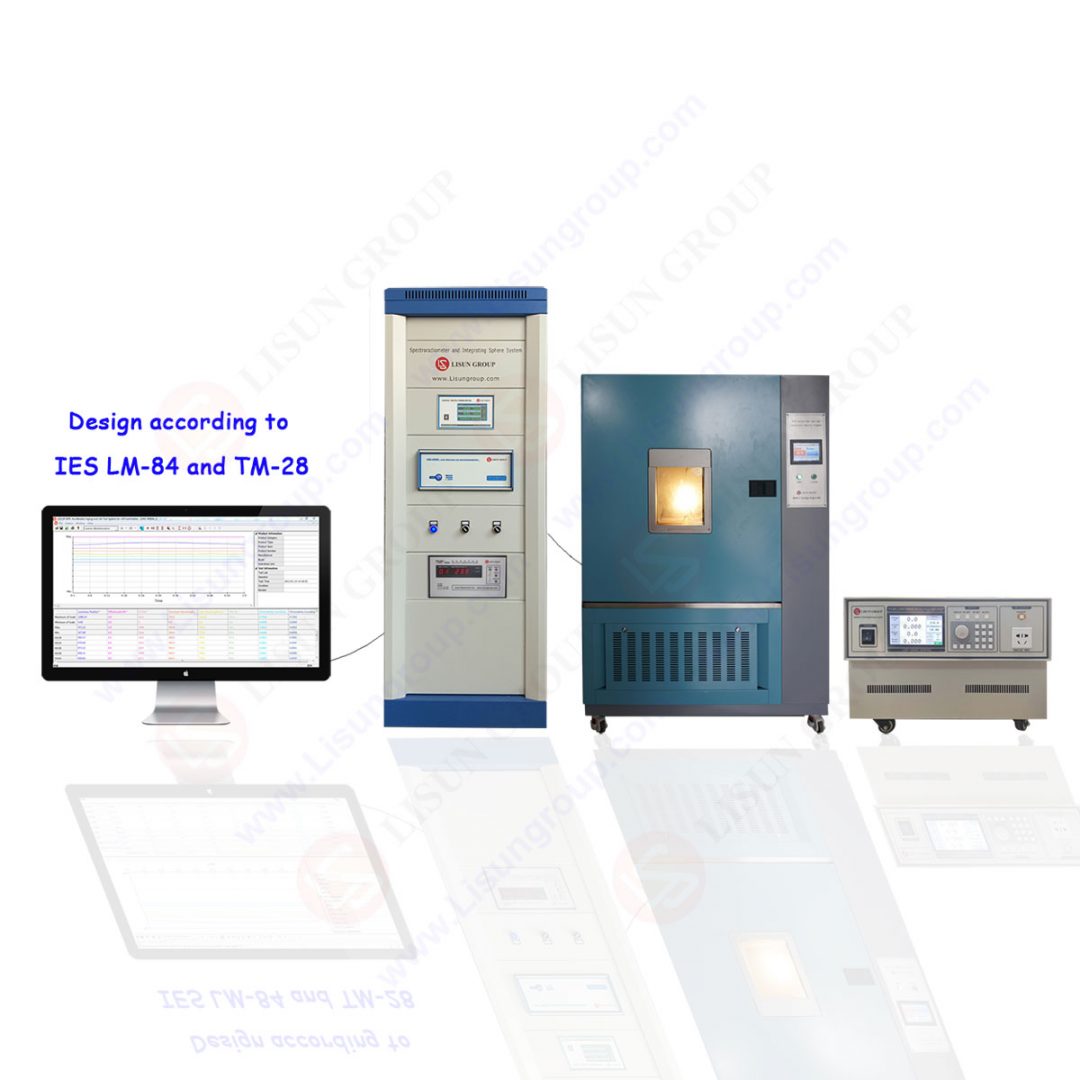
The LISUN portfolio offers two distinct advanced aging systems designed for different levels of the product hierarchy. The LEDLM-80PL is targeted at component-level testing (LED packages, modules, and arrays) in strict compliance with IES LM-80. Conversely, the LEDLM-84PL is engineered for final product validation of LED lamps, drivers, and luminaires in accordance with IES LM-84 and TM-28. This dual architecture ensures that engineers use precisely the correct hardware for their specific testing scenario.
2.2 Hardware Customization and Temperature Chamber Integration
Both systems are highly customizable, supporting up to 3 connected temperature chambers to run simultaneous testing at different temperatures. This parallel processing capability is vital for accelerating data collection. The systems integrate with LISUN’s high-accuracy integrating spheres (e.g., the LPCE series) for photometric measurement at defined intervals (e.g., every 1,000 hours). The hardware can be configured with different current drivers and temperature sensing modules to match the precise specifications of the Device Under Test (DUT).
Table 1: Key Specification Comparison – LEDLM-80PL vs. LEDLM-84PL
| Feature | LEDLM-80PL (Component Level) | LEDLM-84PL (Luminaire Level) |
|---|---|---|
| Primary Standard | IES LM-80, TM-21 | IES LM-84, TM-28 |
| Test Objects | LED Packages, Modules, Arrays | LED Lamps, Luminaires, Drivers |
| Typical Duration | Min 6,000 hours (LM-80) | Min 6,000 hours (LM-84) |
| Temp. Chamber Support | Up to 3 units | Up to 3 units |
| Data Output | Lumen Maintenance, CCT Shift, Chromaticity | Lumen Maintenance, Chromaticity Shift, Driver Efficiency |
| Extrapolation Report | TM-21 (Automatic) | TM-28 (Automatic) |
| Measurement Method | Integrating Sphere & Spectroradiometer | Integrating Sphere & Spectroradiometer |
3.1 The Science of the Arrhenius Model in LISUN Systems
While the core LM-80/LM-84 standards are based on real-time aging, the LISUN software leverages the Arrhenius Model for accelerated life testing (ALT) within specific project parameters. This model defines the relationship between temperature and reaction rate (lumen depreciation). The LISUN software uses the Arrhenius equation to estimate the activation energy (Ea) of the LED’s failure mechanism. By testing at elevated temperatures (e.g., 105°C), engineers can simulate years of wear in weeks, provided they understand the model’s limitations regarding potential new failure modes at extreme temperatures.
3.2 Dual Testing Modes: Real-Time vs. Short-Term Acceleration
LISUN instruments uniquely support two distinct operational modes for LED Lumen Maintenance Test Report Generation. Real-Time Mode strictly follows the IES standard, collecting data over 6,000 hours for official reports. Accelerated Mode uses elevated temperature and current within a defined and calibrated range to produce TM-21 projections rapidly, perfect for internal R&D screening. The software intelligently manages data from both modes, ensuring that final reports clearly differentiate between measured real-time data and model-based predictions.
4.1 Automated Data Acquisition and Analysis
The core of the LISUN system is its advanced software, which automates the entire reporting workflow. From initial setup of the DUT in the temperature chamber to periodic photometric measurements in the integrating sphere, the system collects raw luminous flux data. The software then calculates the relative lumen maintenance percentage, instantly detecting outlier data points or failed samples. This minimizes human error and ensures data integrity is preserved throughout the often months-long test cycle.
4.2 Generating Compliant TM-21 and TM-28 Reports
Once the required 6,000 hours of data are collected, the software applies the non-linear least squares curve fitting algorithm defined by TM-21 (for components) or TM-28 (for luminaires). It calculates the projected L70 (time to 70% lumen maintenance) and L50 (time to 50% lumen maintenance) values. The software also provides the 6x rule projection limit, ensuring no extrapolation is made beyond six times the total test duration. The generated report is a complete, IESNA-format compliant document ready for submission to Energy Star, DLC, or customer quality teams.
4.3 Handling L70/L50 Metrics and 6,000-Hour Data
The software provides a clear graphical representation of the lumen depreciation curve. Engineers can easily identify the point at which the DUT crosses the L70 or L50 threshold. For products achieving exceptionally long life, the software generates a projected lifespan value that is clearly labeled as an “Extrapolated Value.” This transparency is critical for LED Lumen Maintenance Test Report Generation: LISUN Aging Test Instruments, providing a bankable number without over-promising based on limited real-time data.
5.1 Integration with IES LM-79 for Total Flux and Efficacy
Before or during aging, establishing a baseline photometric performance is mandatory. This is done using IES LM-79-19 (Electrical and Photometric Measurements of Solid-State Lighting Products). The LISUN LPCE series integrating sphere system, often paired with the aging tester, performs these initial measurements. The LM-79 report provides the initial total luminous flux, electrical power, efficacy (lm/W), and chromaticity coordinates (CCT, CRI). This baseline is crucial context for the lumen maintenance report, as a 10% lumen drop from a high-efficiency baseline is different from a 10% drop from a poor one.
5.2 Adherence to CIE Standards for Measurement Accuracy
The entire measurement chain, from spectroradiometer calibration to sphere correction, adheres to CIE standards. CIE 127 (Measurement of LEDs) provides the guidance for accurate near-field goniometry and flux measurement of discrete LEDs. CIE 084 (Measurement of Luminous Flux) and CIE 70 (The Measurement of Absolute Luminous Intensity Distribution) ensure that the integrating sphere and gonio-spectroradiometer configurations are correct for the size and beam angle of the DUT. Compliance with these standards ensures the data’s scientific validity and global acceptance.
6.1 Modular Design for Different DUT Form Factors
The LISUN aging test systems are not monolithic devices. They feature a modular design, allowing users to swap out test boards, current drivers, and temperature monitoring probes. For the LEDLM-80PL, custom-designed loading boards accommodate various LED package footprints (3528, 5050, COB, etc.). For the LEDLM-84PL, the system can accommodate large luminaires, panel lights, and even automotive LEDs, with adjustable fixture holders and thermal management interfaces.
6.2 Integration with Multi-Zone Temperature Chambers
For performing accelerated testing in parallel, the system can control and monitor up to 3 independent temperature chambers. This allows an engineer to run a standard 55°C, 85°C, and 105°C test simultaneously. The software assigns a unique measurement schedule to each chamber. The ability to control and monitor these chambers from a single software interface streamlines workflow significantly, reducing the time from test initiation to finalized LED Lumen Maintenance Test Report Generation: LISUN Aging Test Instruments.
7.1 Designing a Robust LM-80/LM-84 Test Plan
A standard test plan using LISUN equipment begins with sample selection—typically a minimum of 20 units per temperature per standard. The engineer defines the test temperature (Ts or Tc for LM-80, Ta and Tmp for LM-84) and the current (Io for LM-80). The LISUN software then manages the entire lifecycle. This structured approach is essential for supplier qualification in automotive (AEC-Q102) and indoor/outdoor SSL sectors, where a test failure can halt a product launch.
7.2 Troubleshooting Early Failures with Real-Time Data
One advantage of the continuous monitoring system is the ability to identify early failures. If a single LED module in the chamber experiences a sudden catastrophic failure or a rapid drop over 10% within the first 2,000 hours, the system flags it. This allows engineers to immediately investigate the root cause—perhaps a thermal interface material failure or an EOS event—without waiting for the full 6,000-hour test to complete. This feature transforms the aging test from a mere compliance exercise into a powerful QA diagnostic tool.
Mastering LED Lumen Maintenance Test Report Generation: LISUN Aging Test Instruments is not merely about ticking a compliance box; it is a strategic imperative for any organization serious about LED quality, warranty management, and brand reputation. The comprehensive LISUN LEDLM-80PL and LEDLM-84PL systems provide the precise, standardized, and flexible platform required to generate definitive IES LM-80/TM-21 and LM-84/TM-28 reports. With support for up to 3 temperature chambers, dual testing modes (real-time and accelerated), and a software suite that automates complex Arrhenius model calculations, LISUN eliminates ambiguity from the longevity prediction process. By integrating seamlessly with existing photometric measurement chains (LM-79) and adhering to the full suite of CIE standards, these instruments deliver data that is both scientifically rigorous and universally accepted. For the modern R&D and QA engineer, investing in this capability translates directly into faster time-to-market, lower warranty risk, and a deeper understanding of product reliability. It moves the industry from guessing about lifespan to mathematically projecting it with confidence.
Q1: Our lab currently uses a legacy aging system. What is the primary advantage of switching to a LISUN system that separates LM-80 (component) and LM-84 (luminaire) testing?
A: The primary advantage is precision and compliance simplification. A single monolithic system often compromises on the specifics of DUT (Device Under Test) mounting and thermal management. The LISUN LEDLM-80PL is optimized for the thermal metrics of an individual LED package (Ts point temperature) as per IES LM-80. The LEDLM-84PL, conversely, is designed for the ambient temperature (Ta) and luminaire measurement point (Tmp) required by LM-84. Using the wrong platform can lead to invalid results. Furthermore, the dedicated software for each system handles the different curve-fitting and extrapolation algorithms (TM-21 for components vs. TM-28 for luminaires) automatically, reducing the risk of a compliance audit failure due to incorrect data processing.
Q2: Is a 6,000-hour real-time test still mandatory if I use the accelerated aging mode in the LISUN software?
A: For final certifiable reports intended for third-party agencies like Energy Star or DLC, the answer is usually yes. The core IES standards (LM-80 and LM-84) are based on real-time data. The accelerated mode in the LISUN software is a powerful R&D tool for rapid screening and design validation. After a software-driven accelerated test, you may have high confidence in the L70 projection, but this data cannot replace the 6,000-hour benchmark for an official report. We recommend using accelerated testing to down-select materials (e.g., choosing between two phosphor types) and then running a formal 6,000-hour test on the final candidate to generate the bankable report.
Q3: How does the LISUN system handle data for products that far exceed 6,000 hours and show very little lumen depreciation?
A: This is a common scenario for high-quality LEDs. The LISUN software uses the TM-21 (or TM-28) algorithm to perform the non-linear least squares exponential curve fit. If the true depreciation is very shallow, the software will extrapolate the lifecycle. However, it strictly applies the “6x rule” – meaning the projected L70 value cannot exceed six times the test duration. For 6,000 hours of test data, the maximum reported projection is 36,000 hours. If the DUT shows virtually no drop, the software will generate a report indicating that the projected L70 is greater than 36,000 hours, effectively showing a “pass” with an asterisk. This conservative approach is mandated by the standard to avoid over-extrapolating from a flat curve that might have a sudden “drop off” later in life.