









Here is the comprehensive technical article based on your instructions.
Abstract
This article provides a detailed technical analysis of the
LEDLM-80PL LED Lumen Maintenance and Aging Life Test System for IES LM-80 Compliance, designed by LISUN to meet rigorous industry standards. It explores the system’s dual architecture, including the LEDLM-80PL for LM-80/TM-21 and the LEDLM-84PL for LM-84/TM-28 standards. The discussion covers the application of the Arrhenius Model for accelerated aging, the precision of dual testing modes (constant current and constant temperature), and customizable hardware configurations supporting up to 3 connected temperature chambers. By examining L70/L50 metrics and 6000-hour test protocols, this article offers engineers and lab technicians the technical insights required to ensure reliable LED lifetime predictions and regulatory compliance in the solid-state lighting industry.
1.1 The Critical Need for Standardized Aging Tests
Lumen depreciation is the primary failure mechanism in LED products, directly impacting their useful lifespan and energy efficiency. Unlike traditional light sources, LEDs do not burn out suddenly but gradually lose light output over time. Standards like IES LM-80 prescribe a methodology for measuring this depreciation, typically over a minimum of 6,000 hours, to derive life metrics such as L70 (time to 70% of initial lumens) and L50 (time to 50% of initial lumens). Without rigorous, standardized testing, manufacturers cannot guarantee product performance, leading to potential warranty claims and regulatory non-compliance.
1.2 Overview of the LEDLM-80PL System
The LISUN
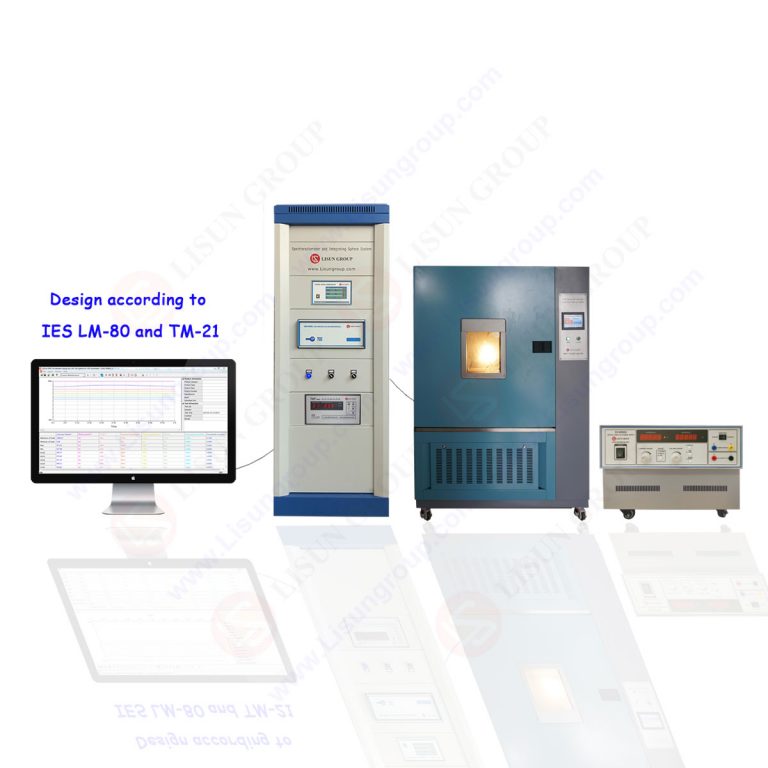
LEDLM-80PL LED Lumen Maintenance and Aging Life Test System for IES LM-80 Compliance is a dedicated solution engineered to meet these stringent requirements. It features a modular design that allows integration with multiple temperature chambers, enabling simultaneous testing of LED samples at three distinct case temperatures as required by the standard. The system’s core intelligence lies in its software, which automatically records photometric data and applies the TM-21 projection methodology to extrapolate long-term lumen maintenance from relatively short-term test data, such as the standard 6,000-hour benchmark.
2.1 Dual System Variants: LEDLM-80PL vs. LEDLM-84PL
LISUN offers two primary variants to address different testing standards. The LEDLM-80PL is optimized for IES LM-80, focusing on lumen maintenance testing of LED packages, arrays, and modules. The companion LEDLM-84PL is designed for the IES LM-84 standard, which applies to integral LED lamps and luminaires. While the core aging hardware is similar, the LM-84PL variant often integrates with goniophotometers or integrating spheres for absolute photometry, as per IES LM-79-19 requirements. This distinction is critical for lab managers who must choose a system based on their product certification scope.
2.2 Customizable Chamber and Fixture Configurations
A key technical advantage is the system’s support for up to three connected temperature chambers, each controlled independently. This allows users to run the LM-80-required test points (e.g., 55°C, 85°C, and a third user-defined temperature) concurrently, dramatically reducing test cycle completion time. Each chamber can hold multiple test boards with varying drive currents. The fixtures are designed for easy insertion and removal, with thermocouple ports for direct case temperature monitoring, ensuring that the junction temperature of the DUT is accurately maintained per the standard’s specifications.
2.3 Power Supply and Data Acquisition Hardware
The system employs high-accuracy DC power supplies with resolution down to 0.1 mA for constant current testing. The data acquisition unit uses a multiplexer to scan through hundreds of channels, measuring voltage, current, and temperature for each sample. This data is logged at user-defined intervals (e.g., every 1,000 hours) to provide a detailed depreciation curve. The photometric measurement is often performed offline at specific intervals by transferring the samples to a calibrated integrating sphere, ensuring that the aging process is uninterrupted by measurement cycles.
3.1 Integration of the Arrhenius Model for Acceleration
The software suite is built around the Arrhenius Model, which describes the relationship between temperature and the rate of chemical reactions, including those that cause lumen depreciation. By testing at elevated temperatures (e.g., 85°C vs. 55°C), the model allows the system to accelerate the aging process. The software automatically calculates the activation energy of the failure mechanism from the multi-temperature test data, enabling a more accurate projection of lifetime at the rated operating temperature (e.g., 25°C or 45°C). This is a cornerstone of the TM-21 standard, which relies on this thermal acceleration principle.
3.2 TM-21 and TM-28 Projection Algorithms
The software explicitly supports TM-21 (for LM-80 data) and TM-28 (for LM-84 data) projection algorithms. It performs a non-linear least squares regression on the collected lumen maintenance data to fit a double-exponential decay curve. The system then calculates the projected L70 and L50 values, along with the 90% confidence intervals. This automation removes the manual calculation burden from the engineer and ensures that the projections are performed using the exact mathematical formulas defined by the IES committees, reducing the risk of calculation errors in compliance reports.
3.3 Software-Driven Dual Testing Modes
The system software controls two fundamental testing modes:
- Constant Current Mode: The most common mode for LM-80 testing, where the drive current is held steady (e.g., 350 mA) while the temperature is controlled by the chamber. This mode isolates the effect of thermal stress on the LED package.
- Constant Temperature Mode (Junction Temperature Control): The software adjusts the drive current to maintain a constant junction temperature (Tj) as the LED ages. This mode is crucial for understanding how the LED behaves under thermal management scenarios, such as in a luminaire where the heatsink keeps Tj constant over time.
These modes provide engineers with comprehensive data on both electrical and thermal degradation mechanisms.
4.1 Alignment with IES LM-80 and TM-21
The primary purpose of the
LEDLM-80PL LED Lumen Maintenance and Aging Life Test System for IES LM-80 Compliance is to generate data that meet the exacting requirements of IES LM-80-15. This includes testing a minimum of 20 units per test condition, maintaining case temperature tolerance within ±2°C, and reporting data at the 0, 1000, 2000, 3000, 4000, 5000, and 6000-hour marks. The system’s software generates a standardized test report that includes all required data sheets, making it directly acceptable for submission to Energy Star or DLC certification bodies.
4.2 Integration with IES LM-79-19 and CIE 127
For luminaire testing via the LM-84PL variant, the system must interface with photometric measurement equipment. The system is designed to export data to integrating sphere software that complies with IES LM-79-19 (Electrical and Photometric Measurements of Solid-State Lighting Products) and CIE 127 (Measurement of LEDs). This integration ensures that the total luminous flux and colorimetric data, measured at specific intervals, are accurate, traceable, and aligned with global measurement standards, thereby ensuring the reported L70 values are photometrically valid.
4.3 Relation to CIE 084 and CIE 070
The software’s analysis of luminous flux depreciation leverages the principles of CIE 084 (Measurement of Luminous Flux) to ensure accurate photometric integration. Furthermore, the system’s reliance on the Arrhenius Model for thermal acceleration is deeply rooted in the concepts of CIE 70 (The Measurement of Absolute Luminous Intensity Distributions), which, while focused on goniometry, establishes the foundational principles for photometric accuracy over time. By adhering to these CIE guidelines, the LISUN system ensures that its test data is internationally recognized, facilitating product certification in global markets.
5.1 L70/L50 Lifetime Projection Accuracy
The key metric derived from the system is the projected lifetime. For a standard LM-80 test, a typical result might be an L70 of >50,000 hours or an L50 of >100,000 hours. The accuracy of these projections depends on the correlation coefficient (R²) of the exponential fit. The LEDLM-80PL software provides a real-time display of the R² value and the confidence bounds, allowing the engineer to validate the data quality. If the R² value is below 0.9, it may indicate a need for a longer test duration or a review of the test conditions.
5.2 Technical Comparison: LM-80 vs. LM-84 Testing
The table below highlights the key differences between the two testing protocols supported by the dual-variant system.
| Feature | IES LM-80 (LEDLM-80PL) | IES LM-84 (LEDLM-84PL) |
|---|---|---|
| Test Subject | LED Packages, Arrays, Modules | Integral LED Lamps, Luminaires |
| Min. Test Duration | 6,000 hours | 6,000 hours (for projection) |
| Temperature Points | 3 (e.g., 55°C, 85°C, 105°C) | 1 (Typical operating temp) |
| Measurement Method | Offline (Integrating Sphere) | In-situ or Offline |
| Projection Standard | IES TM-21 | IES TM-28 |
| Sample Size | 20 per condition | 10-20 per condition |
| Primary Metric | L70 (B50) | L70 (Lumen Maintenance Factor) |
This table demonstrates that the LM-84 route is often simpler for finished goods testing, while the LM-80 route is more rigorous for component qualification.
5.3 Data Export and Reporting
The system automatically compiles data into CSV, Excel, and PDF formats. The report includes the raw lumen maintenance data, the TM-21 exponential curve fit parameters, the projected L70/L50 values, and the temperature profile logs. This comprehensive reporting capability is vital for third-party lab technicians who must present auditable evidence of test compliance. The software also includes a feature for comparing multiple test runs, aiding R&D teams in evaluating the effects of different phosphor chemistries or packaging materials on lifetime.
6.1 Accelerating LED Die and Phosphor Validation
For LED manufacturing engineers, the system is crucial for validating new die designs or phosphor formulations. By running a 6,000-hour accelerated test at 85°C, engineers can quickly determine if a new phosphor exhibits a high degradation rate. The software’s ability to plot the depreciation curve hour-by-hour allows for the detection of sudden failures (e.g., wire bond lift-off) versus gradual degradation (phosphor darkening). This data helps in root cause analysis and process control.
6.2 Ensuring Supply Chain Quality
Third-party testing labs use the
LEDLM-80PL LED Lumen Maintenance and Aging Life Test System for IES LM-80 Compliance to perform incoming quality audits for lighting OEMs. By testing LEDs from different suppliers on the same hardware platform, labs can provide objective comparative data on lifetime metrics. This helps OEMs make data-driven decisions about which LED supplier offers the best long-term reliability, mitigating warranty risks associated with premature lumen depreciation in field-deployed products.
7.1 Managing Thermostatting for Up to 3 Chambers
To optimize test throughput, the system can control up to three individual temperature chambers. Best practice dictates that one chamber is set to the lowest required temperature (e.g., 55°C), one to the mid-point (85°C), and a third to the maximum (e.g., 105°C or 125°C). This setup allows a single technician to manage the entire LM-80 cycle for a specific sample set. The software enables remote monitoring of all three chambers, sending email alerts if a chamber deviates from its set-point, ensuring the test integrity is maintained 24/7.
7.2 Calibration and Maintenance
Maintaining the integrity of the photometric measurement chain is critical. The system’s integrating spheres and spectrometers must be calibrated against a NIST-traceable standard lamp before and after each 6,000-hour test cycle. The temperature sensors in the chambers should be calibrated annually. LISUN provides a calibration kit and a standard operating procedure (SOP) for the LEDLM-80PL, which helps lab managers maintain accreditation to ISO 17025 standards.
The LISUN
LEDLM-80PL LED Lumen Maintenance and Aging Life Test System for IES LM-80 Compliance stands as a robust and essential tool for the modern LED industry. By accurately implementing the Arrhenius Model for accelerated aging and providing automated TM-21 projections, it bridges the gap between short-term testing and long-term reliability predictions. The system’s ability to handle complex, multi-temperature protocols (supporting up to 3 chambers) and output data compliant with IES LM-80, IES LM-84, and CIE standards makes it indispensable for R&D engineers validating new components and for laboratory technicians certifying finished products. The data-driven insights derived from this system directly improve product quality, reduce warranty costs, and ensure regulatory compliance across global lighting markets. For any organization serious about LED reliability, mastering the capabilities of the LEDLM-80PL is a strategic investment in product excellence.
Q1: What is the minimum test duration required by IES LM-80, and how does the LEDLM-80PL ensure compliance?
A: The IES LM-80 standard requires a minimum test duration of 6,000 hours, with data reported at 0, 1,000, 2,000, 3,000, 4,000, 5,000, and 6,000 hours. The LISUN LEDLM-80PL system is designed to automate this process. It logs temperature, current, and voltage data continuously. For photometric data, the operator removes the samples at these specific intervals to measure them in a calibrated integrating sphere, as per IES LM-79-19. The software then records these flux values and flags any missing data points. The system’s high-stability power supplies ensure the drive current remains within ±0.5% of the setpoint, a critical tolerance for the test duration.
Q2: How does the Arrhenius Model improve the accuracy of LED lifetime predictions in the TM-21 standard?
A: The Arrhenius Model is a chemical kinetics equation that defines the reaction rate (in this case, lumen depreciation) as an exponential function of temperature. By testing LEDs at three different case temperatures (e.g., 55°C, 85°C, 105°C) using the LEDLM-80PL, the software can calculate the activation energy (Ea) of the failure mechanism. This Ea value is then used in the TM-21 projection algorithm to “de-rate” the high-temperature test results back to the user’s intended operating temperature (e.g., 45°C). Without this model, the predicted L70 at 45°C would be inaccurate, as it ignores the thermodynamic acceleration that occurs at higher temperatures. The system’s software automates this complex calculation, ensuring rigorous compliance.
Q3: Can the LEDLM-80PL test finished luminaires, or is it only for LED packages?
A: The specific LEDLM-80PL model is primarily designed for testing LED packages, arrays, and modules, following the IES LM-80 protocol. To test finished luminaires or integral lamps, you would typically require the companion LEDLM-84PL system, which is designed for the IES LM-84 standard. However, the hardware platform is very similar. The key difference is the software algorithms (TM-21 vs. TM-28) and the size of the integrating sphere required for measurement. LISUN offers a complete suite, allowing you to configure the system for either component-level qualification (LM-80) or luminaire-level verification (LM-84), depending on your specific application and target industry standards.