









Here is the technical article on the LISUN LEDLM-84PL LED Lumen Maintenance and Aging Life Test System, structured according to your specifications.
Abstract
Accurate prediction of LED lifespan is critical for compliance with energy regulations and warranty validation. The LISUN LEDLM-84PL LED Lumen Maintenance and Aging Life Test System provides a robust solution for accelerated aging tests and lumen maintenance data acquisition. This article explores the system’s dual-configuration architecture, supporting IES LM-80/TM-21 and IES LM-84/TM-28 standards, and its integration of the Arrhenius Model for temperature-driven failure analysis. We detail technical specifications including support for up to three temperature chambers, 6000-hour test durations, and L70/L50 metric calculations. This data-driven analysis offers manufacturing engineers a clear framework for selecting test modes and optimizing reliability validation. The LISUN LEDLM-84PL LED Lumen Maintenance and Aging Life Test System ensures that testing protocols meet global regulatory demands while reducing time-to-market for new LED products.
1.1 The Challenge of LED Longevity Validation
Unlike traditional lighting, LEDs do not typically fail catastrophically; instead, they experience gradual lumen depreciation. Regulatory bodies require manufacturers to project lifespan to L70 or L50 thresholds, where the light output falls to 70% or 50% of its initial value. Testing for 6,000 hours under controlled thermal conditions is the industry baseline for applying TM-21 extrapolation to estimate 25,000 to 50,000+ hours of life.
1.2 System Overview: The LISUN LEDLM-84PL
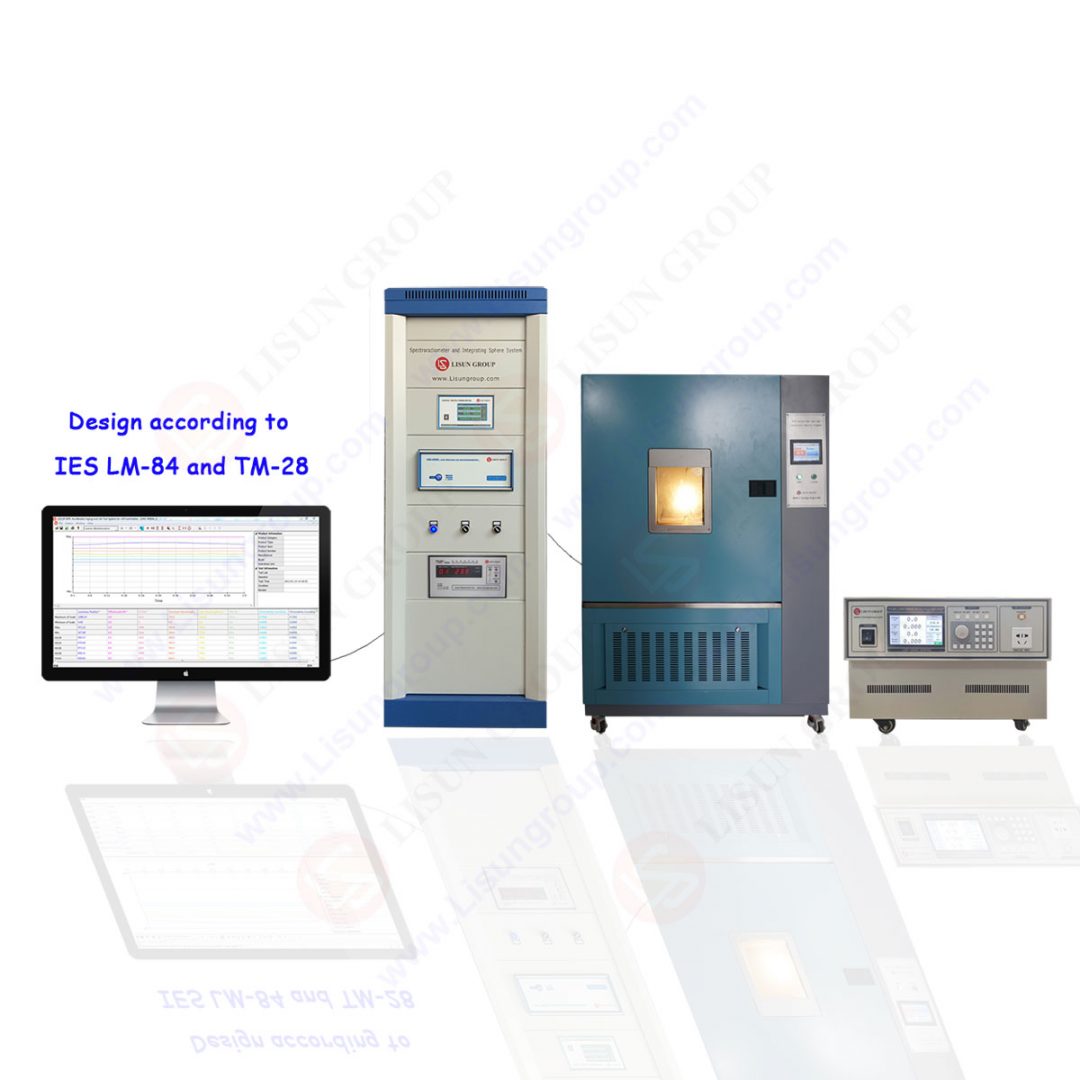
The LISUN LEDLM-84PL LED Lumen Maintenance and Aging Life Test System is designed to bridge the gap between photometric accuracy and high-throughput reliability testing. It supports dual testing modes—constant current and constant voltage—accommodating various LED packages, modules, and arrays. The system’s modular design allows for expansion via three connected temperature chambers, enabling simultaneous testing at different stress temperatures as required by sample size calculations in IES LM-80.
1.3 Relevance to Industry Standards
Compliance with standards such as IES LM-80-15 (for LED packages) and IES LM-84-14 (for LED lamps and luminaires) is non-negotiable for market access. The LISUN system provides the data acquisition fidelity required for TM-21 (non-linear least squares regression) and TM-28 (IES-approved method for lamps) projections. This ensures that engineering teams can confidently report lifetime data to end-users and certification bodies.
2.1 Dual System Variants: LM-80 vs LM-84 Compliance
The platform is offered in two primary configurations to address distinct testing scopes. The selection depends on whether the Device Under Test (DUT) is a component or a final product.
| Feature | LEDLM-80PL (Component Focus) | LEDLM-84PL (Lamp/Luminaire Focus) |
|---|---|---|
| Primary Standard | IES LM-80-15 | IES LM-84-14 |
| DUT Type | LED Packages, Modules, Arrays | LED Lamps, Luminaires, Integrated DUTs |
| Typical Test Duration | 6,000 hours (min.) | 6,000 hours (min.) |
| Key Metric | L70 / L50 (Component level) | L70 / L50 (System level) |
| Extrapolation Standard | TM-21-19 | TM-28-14 |
2.2 Temperature Chamber Connectivity and Stress Testing
Accurate lumen maintenance testing requires testing at multiple case temperatures (TMPLED or TMP). The system supports up to three independently controlled temperature chambers. This allows engineers to run tests at 55°C, 85°C, and a user-defined stress temperature simultaneously, directly supporting the Arrhenius Model acceleration. Each chamber can house multiple sample boards, ensuring statistical validity.
2.3 Optical Measurement Integration
The system typically integrates with an integrating sphere or goniophotometer for periodic photometric measurements. The LISUN software controls the X-axis (time) and Y-axis (luminous flux) data logging. The hardware is designed to minimize handling errors by providing in-situ measurement capabilities or quick-transfer fixtures between the aging rack and the measurement station.
3.1 Arrhenius Model Integration for Lifetime Projection
The embedded software utilizes the Arrhenius Model to correlate elevated temperature stress with failure rates. This is essential for predicting lifetime at nominal operating temperatures (e.g., 25°C or 55°C) from high-stress data (e.g., 85°C). The software calculates activation energy (Ea) based on the measured depreciation curves at different temperatures, providing the foundation for TM-21 and TM-28 extrapolations.
3.2 TM-21 and TM-28 Curve Fitting Protocols
The software automatically performs the non-linear regression required by TM-21 (IES LM-80-15). It identifies the exponential decay function that best fits the lumen maintenance data. For lamp tests adhering to LM-84, the software applies the TM-28 method, which accounts for potential turn-on/turn-off cycles and different stabilization periods. The system outputs projected L70 (hours) and L50 (hours) with confidence intervals.
3.3 Dual Testing Modes: Constant Current vs. Constant Voltage
The system allows engineers to choose the driving mode—constant current (CC) for determining lumen flux stability or constant voltage (CV) for assessing driver and LED interactions. This flexibility is vital for testing integrated LED lamps (LM-84) where driver stability is a variable. The software logs voltage drift and current ripple alongside lumens, providing a holistic view of degradation.
4.1 Electrical and Photometric Parameters
The LISUN LEDLM-84PL LED Lumen Maintenance and Aging Life Test System supports a wide range of input power levels. It is designed to handle high-power LEDs and modules up to several hundred watts. The measurement accuracy for luminous flux is better than ±2% (at calibration), while the temperature control stability within the chambers is typically ±1°C. This precision is critical for differentiating between random noise and actual degradation.
4.2 Data Acquisition Frequency
During the 6,000-hour test window, the system records photometric data at pre-defined intervals (e.g., every 1,000 hours for the first 5,000 hours, then at 6,000 hours). The control system also captures ambient temperature and board temperature data every minute. This high-frequency monitoring allows engineers to detect early life failures (infant mortality) which are often masked in manual reading systems.
4.3 Capacity and Scalability
The system is modular. A single unit can test 84 LEDs (as indicated by the model number) or multiple lamps/luminaires depending on the fixture size. With three chambers connected, the total sample quantity can exceed 200 components, meeting the statistical sample size requirements of IES LM-80 (minimum 20 samples per temperature). This allows for large-scale reliability qualification runs.
5.1 Implementing IES LM-80 with the LEDLM-80PL
To achieve IES LM-80 compliance, the user must test for 6,000 hours at three different case temperatures. The LISUN system automates this process. The software generates a report that includes the raw data table (Number of units, test duration, luminous flux data) required by the standard. The system also tracks the thermocouple readouts to prove that the TMPLED was maintained within the ±2°C tolerance.
5.2 Implementing IES LM-84 with the LEDLM-84PL
For lamp and luminaire testing per IES LM-84, the LISUN LEDLM-84PL LED Lumen Maintenance and Aging Life Test System provides the necessary ambient temperature control. Unlike component testing, LM-84 focuses on the assembled product. The system’s ability to control the ambient air temperature in the chamber (rather than just the board temperature) is a key differentiator. The software applies TM-28 extrapolation, which is specific to lamp test data.
5.3 Data Integrity and Reporting
The software offers audit trails and data export in Excel or CSV formats. This is essential for third-party labs that need to submit reports to the IES or DOE. The system prevents data tampering by locking the time-stamped raw data, ensuring compliance with ISO 17025 standards for testing laboratories.
6.1 The 6000-Hour Benchmark
While LED data sheets often claim 50,000-hour life, the IES requires a minimum of 6,000 hours of test data for a valid TM-21 projection. The LISUN system is optimized for this continuous run. It includes protective features such as over-temperature shutdown and main power failure recovery, ensuring that a 250-day (6,000 hour) test does not fail due to a 2-second power glitch.
6.2 Temperature Stress Profiles
The Arrhenius model dictates that testing at higher temperatures accelerates the failure mechanism. However, excessive temperature can cause unwanted failure modes (e.g., browning of encapsulant). The system allows the user to define stress profiles based on the LED manufacturer’s recommendations. The software will automatically adjust test time to achieve equivalent stress.
6.3 Failure Analysis Correlation
The system is not just a test bed; it is a diagnostic tool. By analyzing the shape of the lumen depreciation curve—specifically the decay rate—engineers can identify whether the failure is chip-related (junction heat) or phosphor-related (thermal quenching). The system’s data logs help correlate color shift (Δu’v’) with lumen drop, providing a complete failure analysis package.
7.1 Integrating Sphere vs. Goniophotometer
While the LISUN system often partners with integrating spheres for total flux measurement, it is compatible with goniophotometers for spatial distribution. The choice depends on the DUT.
| Measurement Type | Integrating Sphere | Goniophotometer |
|---|---|---|
| Speed | Fast (3-5 min per measurement) | Slow (20-60 min per measurement) |
| Data Output | Total Luminous Flux, CCT, CRI | Luminous Intensity Distribution, TM-15 Luminous Engine Data |
| Ideal DUT | LED Packages, Modules | Luminaires, Large Panels |
| Standard | CIE 127, IES LM-79 | CIE 70, IES LM-79 |
The LISUN software can merge data from either source to perform the lifetime calculation (LM-80).
7.2 False Failures vs. Genuine Degradation
A common problem in aging tests is electrical noise causing false readings. The system uses averaging algorithms and median filtering to distinguish between power supply fluctuations and actual lumen drop. This reduces the rate of false positives in TM-21 extrapolation, saving time and money on re-testing.
The LISUN LEDLM-84PL LED Lumen Maintenance and Aging Life Test System represents a critical investment for any organization serious about LED reliability engineering. By offering a dual-platform solution for both IES LM-80 (component) and IES LM-84 (lamp) standards, it eliminates the guesswork from lifetime projection. The integration of the Arrhenius Model, support for up to three temperature chambers, and adherence to TM-21/TM-28 algorithms provide engineers with a statistically valid pathway to claim L70 and L50 values. For quality control engineers and third-party testing labs, this system reduces human error through automation and ensures data integrity for regulatory submissions. The ability to test in constant current or constant voltage mode adds a layer of flexibility essential for modern integrated LED products. By leveraging precise 6,000-hour data acquisition, this system bridges the gap between accelerated stress and real-world performance, ensuring that the LEDs entering the market will meet their performance claims for years to come.
Q1: How does the LISUN LEDLM-84PL differentiate between the LM-80 (component) and LM-84 (lamp) testing standards?
A: The system exists in two variants: the LEDLM-80PL for components and the LEDLM-84PL for lamps/luminaires. The primary difference lies in the temperature control methodology and software extrapolation. For LM-80, the software controls the case temperature (TMPLED) via thermocouples mounted on the LED board. For LM-84, the software controls the ambient air temperature around the lamp, which is more complex due to air flow dynamics. Furthermore, the LEDLM-84PL applies TM-28 extrapolation, which accounts for additional variables like driver efficiency and thermal heat sinking of the full assembly, while the LEDLM-80PL uses TM-21 for component-level data.
Q2: Why is the 6000-hour test duration mandatory for TM-21 projection, and does the system support longer tests?
A: The 6,000-hour threshold is defined by IES LM-80-15 as the minimum data set required to perform a reliable exponential extrapolation (TM-21). A smaller data window (e.g., 1,000 hours) leads to high statistical uncertainty. The LISUN system supports indefinite testing beyond 6,000 hours (e.g., 10,000 hours) for high-reliability applications. However, the most common qualification requires the 6,000-hour base. The system is designed for 24/7 continuous operation to accommodate this 250-day test cycle without interruption.
Q3: How does the system apply the Arrhenius Model to predict L70 life without 50,000 hours of testing?
A: The Arrhenius Model is used for acceleration. The system tests the LEDs at a high stress temperature (e.g., 85°C) and a nominal temperature (e.g., 55°C). The ratio of the degradation rates at these two temperatures allows the software to calculate an Activation Energy (Ea). This Ea is then used to calculate the equivalent time at a lower (use-case) temperature. For example, 6,000 hours of data at 85°C might be equivalent to 30,000 hours of data at 25°C, allowing a valid TM-21 projection to 50,000 hours.
Q4: Can the system test both constant current (CC) and constant voltage (CV) driven LEDs simultaneously?
A: Yes, the system supports both modes, but they are typically allocated per channel or per test station. The hardware includes programmable power supplies capable of CC or CV regulation. This dual-mode capability is critical for testing integrated LED lamps where the driver board may malfunction if switched from CV to CC. The software logs the compliance voltage and current separately, ensuring that the lifetime calculation is based on the correct electrical stress conditions.
Q5: What is the role of the integrating sphere in the Lumen Maintenance testing workflow?
A: The integrating sphere is used for periodic photometric measurements. The DUT is aged inside the temperature chamber. At every required interval (e.g., 1,000 hours), the DUT is either measured in situ if the chamber is equipped with a side port, or transferred to a dedicated integrating sphere. The LISUN software synchronizes the measurement data with the aging timeline. This is vital for CIE 127 compliance, which requires total luminous flux (Φ) rather than just illuminance.