









The Top LISUN LED Optical Aging Test Instrument with TM-21 L70/L50 Prediction represents a paradigm shift in LED lumen maintenance testing, integrating accelerated aging protocols with advanced predictive analytics. This article provides a comprehensive technical examination of the instrument’s dual-system architecture—the LEDLM-80PL for LM-80/TM-21 compliance and the LEDLM-84PL for LM-84/TM-28 applications—alongside its Arrhenius Model-based software engine. We explore how the system supports up to three temperature chambers for simultaneous multi-condition testing, delivers precise L70/L50 extrapolation from 6000-hour test data, and aligns with IES standards including LM-80-15, TM-21-19, and LM-79-19. Designed for LED manufacturing engineers and third-party laboratory technicians, this article offers actionable insights into accelerating reliability validation while maintaining regulatory compliance.
1.1 The Critical Role of Lumen Depreciation in LED Reliability
LED lumen depreciation, the gradual reduction in light output over operational lifetime, remains the primary failure mechanism for solid-state lighting products. Unlike conventional light sources that experience catastrophic failure, LEDs undergo predictable, gradual degradation governed by junction temperature, drive current, and phosphor material stability. The L70 metric—the time at which light output drops to 70% of initial lumens—serves as the industry-standard benchmark for useful life. The Top LISUN LED Optical Aging Test Instrument with TM-21 L70/L50 Prediction directly addresses this measurement challenge by providing controlled accelerated aging environments that replicate real-world thermal and electrical stress conditions.
1.2 Standards Framework: LM-80, TM-21, and Beyond
The IES LM-80-15 standard establishes the methodology for measuring lumen maintenance of LED light sources, requiring a minimum of 6000 hours of test data at specified case temperatures (typically 55°C, 85°C, and a manufacturer-defined temperature). TM-21-19 then provides the mathematical framework for extrapolating this data to predict L70 and L50 lifetimes. The LISUN system fully supports these protocols, with the LEDLM-80PL variant specifically engineered for LM-80 compliance testing. Additionally, the LEDLM-84PL targets LM-84-19 requirements for LED drivers and modules, utilizing TM-28 extrapolation methods. This dual-system approach ensures comprehensive coverage across the entire LED product ecosystem.
2.1 LEDLM-80PL: Optimized for LM-80/TM-21 Compliance
The LEDLM-80PL configuration deploys a precision integrating sphere photometer (typically 0.3m to 1.5m diameter) coupled with a spectroradiometer for absolute spectral measurement. This system supports up to 3 independent temperature chambers, each capable of maintaining ±0.5°C stability across a 25°C to 120°C range. The instrument automatically records luminous flux, correlated color temperature (CCT), and chromaticity coordinates at programmable intervals—typically every 1000 hours per LM-80 requirements. Its dedicated software module performs TM-21 exponential curve fitting using nonlinear regression, generating L70/L50 projections with 95% confidence intervals.
Table 1: Comparison of LISUN LED Optical Aging Test Instrument Variants
| Parameter | LEDLM-80PL | LEDLM-84PL |
|---|---|---|
| Primary Standard | IES LM-80-15 | IES LM-84-19 |
| Extrapolation Method | TM-21-19 | TM-28-19 |
| Test Focus | LED Packages/Modules | LED Drivers/Components |
| Minimum Test Duration | 6,000 hours | 6,000 hours |
| Max Temperature Chambers | 3 | 2 |
| Temperature Range | 25°C – 120°C | 25°C – 100°C |
| Measurement Uncertainty | ±1.5% (luminous flux) | ±2.0% (luminous flux) |
| Supported Metrics | L70, L50, CCT, CRI | L70, L50, Electrical Parameters |
2.2 LEDLM-84PL: Tailored for Driver and Module Testing
The LM-84 standard addresses the unique challenges of testing electronic components that combine LED drivers, control circuits, and thermal management systems. The LEDLM-84PL variant incorporates an auxiliary electrical measurement module that simultaneously monitors input power, current ripple, and power factor throughout the aging process. This system supports 2 temperature chambers and extends data acquisition to include electrical degradation parameters—critical for predicting system-level reliability. Both variants share the same core software ecosystem, enabling cross-platform data comparison and unified reporting.
3.1 Theoretical Foundation: Accelerated Aging Kinetics
The Arrhenius model fundamentally governs the LISUN software’s prediction engine, relating reaction rate acceleration to temperature increase through the equation: ( k = A cdot e^{-E_a/(RT)} ). For LED reliability, the activation energy (E_a) typically ranges from 0.3 to 1.2 eV depending on failure mechanisms—phosphor degradation, solder joint fatigue, or semiconductor junction deterioration. The software automatically performs Arrhenius regression across multiple temperature test points, calculating the sample-specific activation energy and deriving the acceleration factor between test conditions and use-case temperatures. This enables the Top LISUN LED Optical Aging Test Instrument with TM-21 L70/L50 Prediction to deliver reliable lifetime estimates from accelerated data.
3.2 TM-21 Extrapolation Algorithm Implementation
The TM-21 algorithm employs a two-parameter exponential decay model: ( Phi(t) = B cdot e^{-alpha t} + C ), where ( Phi(t) ) represents normalized luminous flux at time t. The LISUN software performs iterative least-squares fitting to determine coefficients B, α, and C, then extrapolates to the L70 threshold (0.70 normalized output). The system automatically applies TM-21’s maximum extrapolation limits: 6× test duration for L70 and 5.5× for L50 when the sample size exceeds 20 units. For smaller sample sets, conservative extrapolation factors are enforced. The software’s graphical interface displays real-time curve fitting updates, allowing engineers to assess data quality as the test progresses.
4.1 Constant Current Mode for Package-Level Testing
LED package testing per LM-80 mandates constant current drive to isolate lumen depreciation from current-induced variations. The LISUN instrument provides precision current sources with 0.1% regulation accuracy, supporting test currents from 100 mA to 10 A across multiple channels. In this mode, the system records photometric and colorimetric data at user-defined intervals (10 to 1000 hours) while maintaining junction temperature within ±1°C of the programmed setpoint. The constant current mode eliminates confounding variables, allowing pure thermal degradation analysis.
4.2 Constant Temperature Mode for System-Level Validation
For complete luminaire or driver testing, the constant temperature mode regulates the chamber ambient temperature while allowing the device under test to operate at its native driver current. This mode is essential for LM-84 compliance, where the interaction between driver thermal behavior and LED performance must be characterized. The system’s PID-controlled chambers achieve temperature recovery within 5 minutes of door opening, minimizing thermal cycling effects. Engineers can program complex temperature profiles—including stepped stress or cyclic thermal shock—to accelerate failure mechanism identification.
5.1 Integrating Sphere and Measurement Optics Options
The LISUN system offers integrating sphere diameters ranging from 0.3m (for small LED packages) to 2.0m (for large luminaires), each coated with high-reflectance barium sulfate (BaSO₄) or Spectralon® for UV-VIS-NIR coverage. Spectroradiometer options include array-based units with 1 nm resolution (350-1100 nm) for standard testing and high-resolution models with 0.2 nm resolution for critical color quality analysis. The optical fiber coupling ensures minimal stray light, with measurement uncertainties typically below ±2% for total luminous flux per CIE 127:2007 guidelines.
5.2 Multi-Chamber and Multi-Channel Expandability
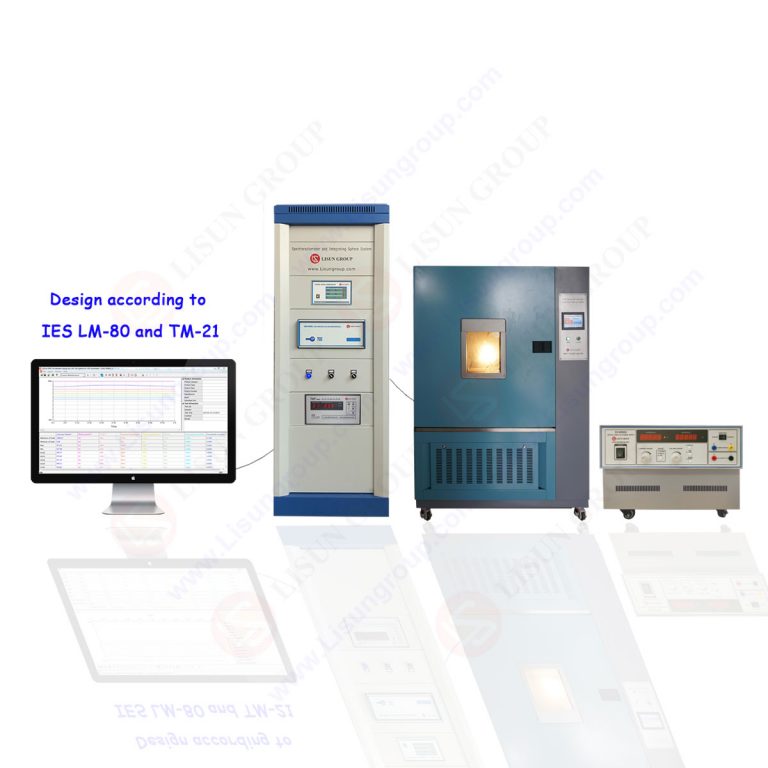
The base system supports up to 3 temperature chambers (each 100L to 500L) with independent temperature control, enabling simultaneous testing at multiple stress levels. Each chamber can host up to 20 individual LED samples (LEDLM-80PL) or 10 driver/module assemblies (LEDLM-84PL). The electrical measurement system scales to 64 channels, with each channel providing independent current sourcing and voltage sensing. This modular architecture allows laboratories to configure the Top LISUN LED Optical Aging Test Instrument with TM-21 L70/L50 Prediction for high-throughput production validation or deep-dive research applications.
6.1 IES LM-79-19 and CIE 084 Alignment
The photometric measurement subsystem adheres strictly to IES LM-79-19 for electrical and photometric measurements of solid-state lighting products, including mandatory 0-360° goniometric distribution for luminaires. Spectral measurements comply with CIE 084:1989 for the measurement of luminous flux, ensuring traceability to national standards via calibrated reference lamps. The system’s spectroradiometer undergoes annual recalibration at ISO 17025 accredited laboratories, with uncertainty budgets maintained below ±2.5% for all photometric quantities. Cross-validation against CIE 70:1987 for spatial distribution measurement ensures complete standards alignment.
6.2 TM-21 and TM-28 Data Quality Requirements
Both TM-21 and TM-28 mandate stringent data quality criteria: the exponential fit must achieve a coefficient of determination (R²) ≥ 0.90, and extrapolated lifetimes cannot exceed 6× the test duration. The LISUN software automatically validates these conditions, flagging datasets that fail quality thresholds and recommending extended test durations. For L50 projections—typically requiring 10,000+ hour data for accurate prediction—the system implements TM-28’s conservative Bayesian approach, incorporating prior knowledge from similar LED technologies to bound uncertainty intervals.
7.1 LED Manufacturing Quality Control Workflows
For production environments, the LISUN system integrates with automated handling equipment for batch testing of up to 1000 units per week. Engineers configure pass/fail criteria based on L70 projections at 25°C use-case temperature, with automatic rejection of lots exhibiting activation energy below 0.5 eV (indicating premature failure risks). The software generates compliance certificates aligned with Energy Star® and DLC® program requirements, including mandatory TM-21 reporting templates.
7.2 Third-Party Laboratory Accreditation Support
Testing laboratories seeking ISO 17025 accreditation benefit from the system’s full audit trail capabilities—every measurement, temperature excursion, and software parameter change is logged with timestamps and operator identification. The instrument supports blind sample testing protocols, randomizing sample positions across chambers to eliminate positional bias. Inter-laboratory correlation studies demonstrate reproducibility within ±3% for L70 projections, well within the ±5% acceptance criteria specified by international round-robin testing programs.
The Top LISUN LED Optical Aging Test Instrument with TM-21 L70/L50 Prediction provides a technically rigorous, standards-compliant platform for accelerated LED reliability testing. Its dual-system architecture—LEDLM-80PL for LM-80/TM-21 and LEDLM-84PL for LM-84/TM-28—covers the complete LED product hierarchy, from individual packages to integrated driver modules. The Arrhenius-based software engine delivers mathematically sound lifetime predictions with statistically validated uncertainty bounds, supporting 6000-hour test protocols with extrapolation to L70 and L50 thresholds. For engineers and laboratory professionals confronting the challenge of validating LED longevity under resource constraints, this system offers a configurable, expandable, and auditable solution that aligns with IES LM-79-19, CIE 084, and TM-21-19 requirements. As the industry moves toward extended warranty periods and stricter energy efficiency standards, such predictive aging tools become indispensable for ensuring product reliability while minimizing time-to-market.
Q1: How does the LISUN system handle TM-21 extrapolation limitations when test data shows non-exponential decay?
A: When lumen depreciation deviates from the exponential model—often due to phosphor thermal quenching or driver IC failure mechanisms—the software automatically detects low R² values (<0.90) and triggers alternative analysis pathways. The system applies TM-21-19’s provision for piecewise regression, splitting the dataset at the point of decay rate change. For L50 predictions requiring longer extrapolation, the software implements TM-28’s Bayesian framework, incorporating prior failure distributions from similar LED chemistries. The operator receives clear warnings about extrapolation confidence degradation and recommended extended test durations (typically 10,000-15,000 hours for L50). This adaptive methodology prevents invalid lifetime claims while maximizing the utility of available data.
Q2: Can the instrument simultaneously test devices requiring different drive currents or temperature setpoints?
A: Yes, the system’s modular chamber architecture supports independent configuration: each of the up to 3 temperature chambers operates with its own PID control loop, allowing distinct setpoints (e.g., 55°C, 85°C, and 105°C) simultaneously. Within a single chamber, individual sample channels provide independent current sourcing, accommodating devices requiring 350 mA to 10 A. The software manages this complexity by assigning channel-specific test profiles, data acquisition schedules, and pass/fail criteria. This multi-condition parallel testing capability enables full LM-80 matrix completion (3 temperatures × multiple currents) within a single 6000-hour test campaign, accelerating certification timelines by up to 60%.
Q3: What is the recommended calibration interval for the integrating sphere and spectroradiometer, and how does drift affect TM-21 predictions?
A: LISUN recommends annual recalibration for the spectroradiometer (using NIST-traceable halogen lamps) and bi-annual verification for the integrating sphere (via auxiliary lamp stability checks). Uncalibrated spectral responsivity drift of just 1% can cause systematic flux measurement errors that propagate into TM-21 exponential fitting: a 2% flux offset at 6000 hours can shift L70 predictions by ±1,500 hours. The software includes built-in drift compensation algorithms that compare daily reference measurements against baseline values, automatically applying correction factors. Laboratories operating under ISO 17025 are advised to maintain monthly control chart monitoring, with instrument requalification triggered if drift exceeds 0.5% between calibrations.
Q4: How does the system accommodate high-power LED testing requiring active cooling beyond standard chamber capabilities?
A: For COB (chip-on-board) arrays or high-brightness LEDs exceeding 50W thermal dissipation, the LISUN system offers an optional liquid-cooled heatsink interface integrated into the temperature chamber. This module maintains (±0.3°C) junction temperature control via PID-regulated coolant circulation, with heat exchange capacity up to 500W per sample position. The system automatically compensates for self-heating effects by measuring case temperature with embedded thermocouples and adjusting chamber ambient temperature to maintain required junction setpoints per LM-80’s “case temperature” definition. This configuration enables reliable testing of automotive-grade and horticultural LEDs operating at current densities above 100 A/cm².
Q5: What software export formats are available for generating energy star or DLC compliance reports?
A: The LISUN software suite exports data in multiple industry-accepted formats: native LDT/IES files for photometric data, CSV files for raw temporal flux decay, and PDF reports containing TM-21 curve fitting graphs with 95% confidence intervals. For Energy Star compliance, the software generates the mandatory “LM-80 Test Report” template including manufacturer details, test conditions, measurement methodology, and extrapolated L70 values. DLC (DesignLights Consortium) premium qualification reports include additional metrics like lumen maintenance at 25°C and 35°C ambient, chromaticity shift over 6000 hours (Δu’v’ ≤ 0.007), and electrical parameter stability. The software also supports API integration with laboratory information management systems (LIMS) through RESTful web services, enabling automated data ingestion into enterprise quality management platforms.