









Here is a comprehensive technical article generated based on your instructions.
Abstract
This technical article provides a detailed analysis of the LED Optical Aging Test Instrument: 6000-Hour Lumen Maintenance Test, a critical validation process for ensuring long-term LED reliability. We explore the dual-system architecture of the LISUN LEDLM-80PL and LEDLM-84PL instruments, designed specifically to comply with IES LM-80, TM-21, LM-84, and TM-28 standards. The discussion covers hardware configuration, software modeling using the Arrhenius equation, and operational methodologies for accelerated aging tests. The article delivers data-driven insights into lumen depreciation metrics (L70/L50), system accuracy, and practical applications for LED manufacturers and third-party testing laboratories. It offers a robust framework for conducting standardized 6000-hour photometric aging tests, emphasizing superior test repeatability and stringent adherence to international regulatory benchmarks for LED product qualification.
1.1 The Criticality of LED Lifespan Prediction
The long-term performance of an LED is not merely a marketing metric but a fundamental reliability parameter. Without rigorous testing, a manufacturer risks early field failures that can lead to contract penalties and reputational damage. The LED Optical Aging Test Instrument: 6000-Hour Lumen Maintenance Test serves as the industry’s benchmark for validated lifespan projection. The test involves operating LED samples at a controlled elevated temperature (typically 85°C or 105°C) for 6,000 hours, with periodic photometric measurements to chart the lumen depreciation curve.
1.2 Dual Standards: LM-80 vs. LM-84
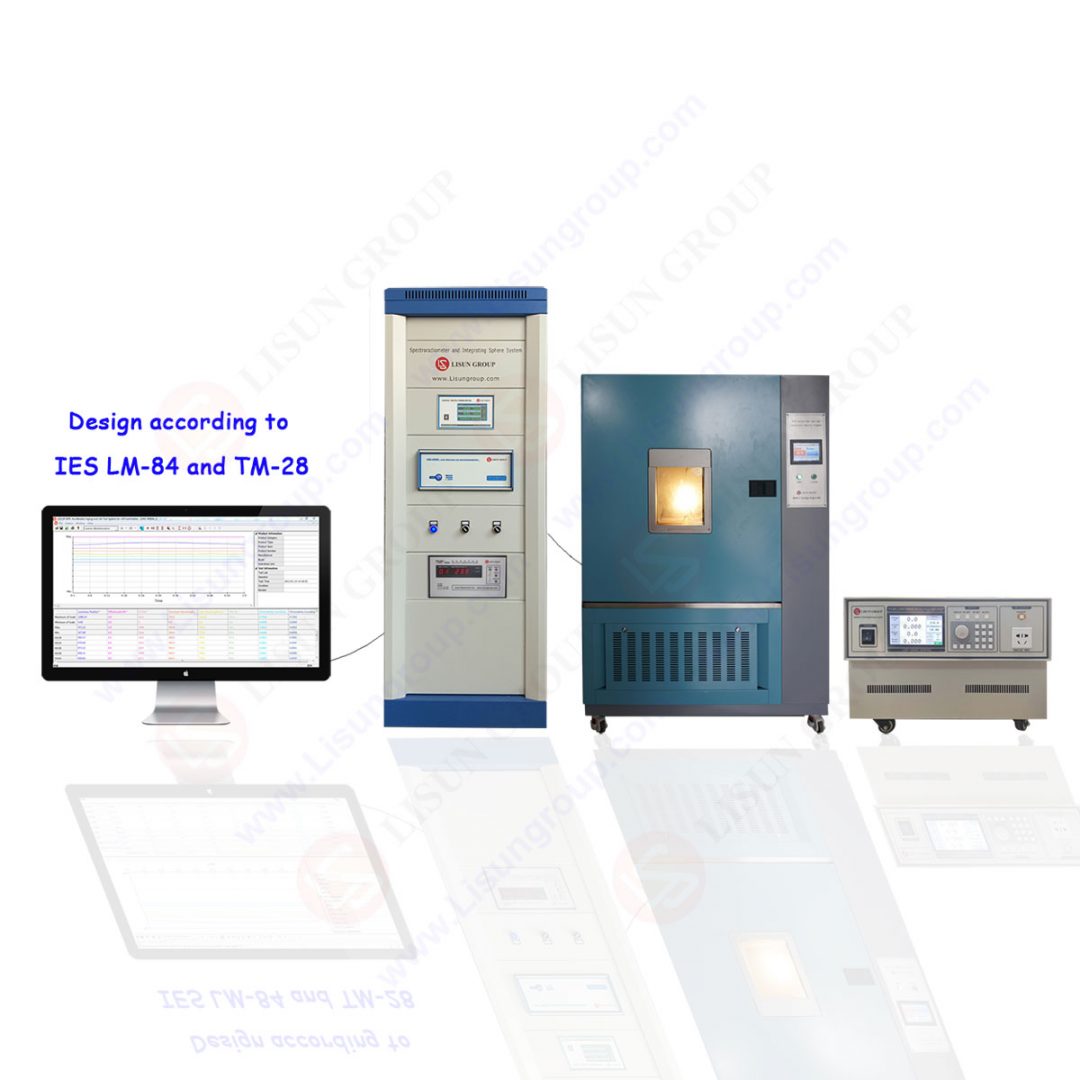
The LISUN instrument series is bifurcated to address two distinct testing standards. The LEDLM-80PL system is tailored for IES LM-80-08 and TM-21 extrapolation, commonly used for mid-power and high-power LEDs. Conversely, the LEDLM-84PL system is designed for the newer IES LM-84-14 standard, which focuses on LED lamp and luminaire assemblies. While both share a 6,000-hour base requirement, LM-84 allows for alternative test durations depending on the product type, making the instrument’s flexibility in temperature control—supporting up to three connected chambers—essential for simultaneous batch testing.
2.1 Environmental Chamber Integration
A core feature of the LISUN system is its ability to interface with up to three independent temperature chambers. This configuration is not arbitrary; it is mandatory for multi-temperature testing per IES LM-80-08, which requires at least one temperature point at 55°C, one at 85°C, and one user-defined point (often 105°C). Each chamber can maintain a thermal stability of ±2°C, crucial for preventing thermal drift that skews photometric data. The chambers are equipped with independent control loops for the sample heat sink temperature and the ambient air temperature, ensuring precise thermal stress application.
2.2 Optical Measurement Modules
The instrument utilizes a high-precision photometric detector head, calibrated against reference sources traceable to CIE 127 standards. For the 6000-hour test, the system employs a dual-mode measurement architecture:
- Continuous Monitoring Mode: Low current, non-invasive measurement for ongoing trend analysis.
- Full-Scale Measurement Mode: High-accuracy sampling with spectral intensity distribution capture at fixed intervals (e.g., every 300 hours).
Furthermore, the integrating sphere options allow for both total flux and angular color shift measurements, critical for evaluating chromaticity maintenance alongside lumen maintenance.
3.1 Standardized Data Processing
The LISUN proprietary software automates the entire data reduction process from raw photometric readings to a validated lifespan prediction. Using the dataset generated from the LED Optical Aging Test Instrument: 6000-Hour Lumen Maintenance Test, the software applies the Arrhenius equation to model the activation energy of the lumen degradation mechanism. This is the mathematical backbone of TM-21, which requires a minimum of 5,000 hours of actual test data with a strong correlation coefficient (R² > 0.9) to extrapolate to L70 or L50.
3.2 Visualizing Degradation Curves
The software provides a real-time graphical interface showing illuminance (lx) decay against time. It automatically calculates the projected time to failure (Lp) for each tested temperature. The system flags data points that deviate from the exponential decay model, indicating potential out-of-specification samples. This feature is vital for third-party testing laboratories that need to certify results with high statistical confidence, as it prevents extrapolation based on erroneous data points.
4.1 Sample Selection and Preconditioning
A valid 6000-hour lumen maintenance test begins with rigorous sample preparation. The LISUN instrument is designed to accommodate multiple form factors, from small SMD packages (per CIE 127) to larger COB arrays. Samples must be pre-burned for 100 hours to stabilize the phosphor layer. The instrument’s software logs the initial luminous flux for each test sample at a controlled ambient temperature of 25°C ± 1°C. This baseline is the reference from which all future percent lumen maintenance values are calculated.
4.2 Testing Protocol and Data Collection
During the 6000-hour period, the instrument performs forced turn-off cycles for electrical measurement, ensuring minimal electrical stress during the photometric capture. The specific test sequence includes:
- Initial Measurement: Flux at 0 hours and 100 hours (burn-in).
- Periodic Measurement: At 300, 600, 1000, 2000, 3000, 4000, 5000, and 6000 hours.
- Thermal Equilibrium: Ensuring the temperature chamber reaches the setpoint before each measurement.
Each measurement is time-stamped and stored in a tamper-proof database, as required by ISO 17025 accreditation for many third-party labs.
5.1 Calculating Lumen Maintenance
The primary output of the LED Optical Aging Test Instrument: 6000-Hour Lumen Maintenance Test is the lumen maintenance factor (LM). The system calculates this as (Flux at time t) / (Initial Flux) * 100%. The software then performs a non-linear regression of the data points (excluding the first 1000 hours to remove the early burn-in stabilization zone) to fit the TM-21 exponential decay model. The accuracy of this fit is highly dependent on the thermal control stability enforced by the LISUN chamber.
5.2 Projected Lifespan (L70/B50)
The system calculates the L70 (time to 70% lumen output) and L50 (time to 50% lumen output) for each sample. A critical technical nuance is the differentiation between the median (B50) and the average (L70). The LISUN software presents both metrics:
- L70 (Average Life): Based on the mean of the sample set.
- L70 (B50): Based on the median; 50% of the population must reach this time.
The software also provides a 90% confidence interval on the extrapolation, a requirement for TM-21 compliance. Without this confidence interval, the extrapolated life is considered a prediction, not a validated statistic.
6.1 System Configurations
The two primary variants of the LISUN instrument are optimized for different testing scopes. The LEDLM-80PL focuses on LED packages, modules, and arrays (LM-80), while the LEDLM-84PL focuses on complete luminaires and lamps (LM-84). The table below details their key specification differences.
| Feature | LEDLM-80PL (LM-80/TM-21) | LEDLM-84PL (LM-84/TM-28) |
|---|---|---|
| Primary Standard | IES LM-80-08 | IES LM-84-14 |
| TM-21 Compatibility | Yes – Extrapolation to 5x base test time | Yes – Extrapolation to 5x base test time |
| Max Sample Size per Chamber | High (e.g., 30+ packages/tubes) | Low (e.g., 1-4 luminaires) |
| Temperature Uniformity | ±1.5°C (on board) | ±2.0°C (ambient) |
| Power Supply Type | Constant Current / Constant Voltage | AC Mains / Constant Voltage |
| Measurement Mode | Photometric head / Integrating sphere | Goniophotometer / Sphere |
| Typical Test Duration | 6,000 hours (minimum) | 6,000 hours (minimum) |
| Max Temp Chambers | 3 | 3 |
Table 1: Key specification differences between the LISUN LEDLM-80PL and LEDLM-84PL systems.
6.2 Test Mode and Fixture Design
The hardware flexibility extends to different test modes (Constant Current or Constant Voltage). For the LEDLM-80PL, the instrument supports up to 3 independent test channels, each with programmable drive current for the LEDs under test. For the LEDLM-84PL, the system supports switching power supplies for AC input fluctuations simulating real-world grid conditions. The fixtures are designed to hold samples in a vertical orientation without obscuring the optical measurement path of the photometric detector.
7.1 IES LM-79-19 & CIE 084
While the aging test is performed inside the chamber, the photometric measurements must be taken in a controlled environment that meets the conditions of IES LM-79-19 (Electrical and Photometric Measurements of Solid-State Lighting Products) and CIE 084 (Measurement of Luminous Flux). The LISUN instrument’s measurement module is designed to shut off the chamber temperature control during the precise photometric measurement to avoid thermal radiation interference, thereby maintaining the absolute accuracy required by these standards.
7.2 CIE 127:197 and TM-28
For LED components, CIE 127:2007 provides specific guidelines on the measurement of LED optical flux with a specific mechanical setup. The LISUN instrument incorporates a standardized mechanical stage that aligns precisely with the CIE 127 reference geometry. Furthermore, for the LEDLM-84PL, the software incorporates TM-28 extrapolation parameters, which use a similar exponential decay model but with specific factor adjustments for lamp assemblies that include electronic drivers. This dual-standard compliance (TM-21 for packages, TM-28 for lamps) is a unique value proposition of the LISUN system.
The LED Optical Aging Test Instrument: 6000-Hour Lumen Maintenance Test is a critical non-negotiable process for any manufacturer seeking to guarantee the reliability of their LED products. The LISUN LEDLM-80PL and LEDLM-84PL series provide an unparalleled technical solution, combining superior thermal control, flexible hardware architecture supporting up to 3 temperature chambers, and advanced software leveraging the Arrhenius Model for data extrapolation. By rigorously adhering to standards such as IES LM-80, LM-84, TM-21, and CIE 127, this instrument transforms raw photometric data into statistically validated lifespan predictions (L70/L50). For engineers, this means confidence in product warranties; for third-party labs, it means compliance with ISO standards. The integration of dual testing modes and multi-system configuration allows for parallel testing, significantly reducing time-to-market for new LED technologies. Ultimately, the LISUN instrument does not just measure light; it validates longevity.
Q1: What is the minimum data requirement for a valid TM-21 extrapolation from the 6000-hour test?
A: According to IES TM-21-19, a valid extrapolation requires a minimum of 6,000 hours of actual test data for the recommended projection (times five, up to 30,000 hours). However, the LISUN software can generate preliminary projections after 5,000 hours, though these are considered less reliable. The data must exhibit a monotonic decay with no more than 200-hour gaps between readings. The software automatically checks for these criteria. For a full L70 projection, the 6,000-hour dataset must have a strong statistical fit (R-squared > 0.9) to the exponential decay model. The LISUN instrument’s high-precision photometry ensures that the noise in the data is minimal, which helps achieve this fit more consistently than lower-grade instruments.
Q2: Can the LISUN LED Optical Aging Test Instrument test both COB (Chip-on-Board) LEDs and discreet SMD LEDs simultaneously?
A: Yes, but with specific configuration requirements. The LISUN LEDLM-80PL system supports multiple test board interfaces. For a single chamber, you can mix SMD and COB samples provided they share the same drive current or voltage profile. However, because COB LEDs generate significantly more heat than SMDs, they often require dedicated heat sinks. The test fixture for the LISUN system has adjustable mounting plates that allow for different thermal management pads. It is recommended to use separate test channels for high-power COBs to avoid thermal interaction with smaller SMD samples. The software allows you to group samples by type for separate data analysis, even if they are tested in the same environmental chamber.
Q3: How does the LISUN system handle the mandatory “off” frame for electrical measurement during the 6000-hour test?
A: The LISUN system uses a high-speed relay switching matrix to turn off the test power supply for a precise 10-millisecond window during the photometric measurement. This “off” period is required by IES LM-80 to measure the electrical parameters (forward voltage, current) under the exact condition of the light measurement. The power supply recovers to the setpoint within 5 milliseconds, ensuring that the LED’s junction temperature does not fluctuate. This is critical because a long “off” period would cause the LED to cool, skewing the lumen measurement. The LISUN controller synchronizes the photometric sensor capture with this power-off window, ensuring accurate electrical and optical readings at the same instant, a key requirement for calculating luminous efficacy.