









This article provides a comprehensive technical analysis of the L70/L50 Prediction LISUN methodology, focusing on the LED Optical Aging Test Instrument’s dual system variants (LEDLM-80PL and LEDLM-84PL) and their application in accelerated lumen maintenance testing. Designed for LED manufacturing engineers and testing laboratory professionals, the article examines how Arrhenius Model-based software enables precise L70 and L50 lifetime predictions from 6000-hour test durations. By integrating IES LM-80, TM-21, IES LM-84, and TM-28 standards, LISUN’s systems support up to three connected temperature chambers, delivering reliable extrapolation of LED lumen depreciation curves. Key technical insights include dual testing modes, customizable hardware configurations, and comparative analysis of system specifications, offering practical guidance for regulatory compliance and product reliability validation in the lighting industry.
1.1 Defining L70 and L50 Metrics in LED Reliability Engineering
L70 and L50 represent critical thresholds in LED lifetime prediction, defining the point at which a light source’s luminous flux depreciates to 70% and 50% of its initial value, respectively. According to IES LM-80-08, lumen maintenance testing requires minimum 6000-hour data collection at specified case temperatures (typically 55°C, 85°C, and optionally 105°C) to establish reliable depreciation curves. The L70/L50 Prediction LISUN approach leverages Arrhenius-based acceleration models to extrapolate these metrics from accelerated aging tests, enabling manufacturers to project lifetimes exceeding 50,000 hours without conducting decade-long real-time tests. This methodology is particularly critical for high-power LED applications in automotive, industrial, and outdoor lighting where catastrophic failure modes are unacceptable.
1.2 The Role of Accelerated Aging in LED Testing Standards
Accelerated aging tests apply elevated temperatures and drive currents to induce premature lumen depreciation, following the Eyring-Arrhenius relationship: (L(t) = A cdot e^{B/T}), where T is absolute temperature. The L70/L50 Prediction LISUN systems employ dual testing vectors—constant temperature and current cycling—to simulate 50,000-hour operation within 6000 hours. Compliance with IES LM-84-19 (for LED lighting products) and TM-21-19 (for projection of lumen maintenance) requires temporal clustering of measurements at 0, 1000, 2000, 3000, 4000, 5000, and 6000 hours for accurate nonlinear regression fitting.
2.1 Dual System Variants: LEDLM-80PL and LEDLM-84PL
The LISUN LED Optical Aging Test Instrument includes two specialized configurations tailored to distinct testing protocols. The LEDLM-80PL is designed for LM-80/TM-21 compliance, supporting up to 3 connected temperature chambers with independent control of up to 3 case temperatures (ambient to 150°C ±0.5°C). The LEDLM-84PL aligns with LM-84/TM-28 standards for integrated LED lighting products, featuring extended current ranges (0-2000mA ±0.1mA) and built-in integrating sphere compatibility for total luminous flux measurement. Both systems share a common PC-based software platform for data acquisition and Arrhenius Model-based L70/L50 projection.
2.2 Hardware Configurations and Customizable Options
Each system supports up to 70 test positions per temperature chamber, configurable with individual PCB modules for LED holder compatibility (SMD, COB, and through-hole packages). Customizable parameters include:
- Drive current: 0-2000mA (LEDLM-84PL) or 0-1500mA (LEDLM-80PL) with ±0.1% accuracy
- Temperature ramp rate: 1-10°C/min for thermal shock testing
- Photometric data acquisition: 4-channel spectroradiometer integration for spectral power distribution (SPD) logging
- Optional extinction module: Real-time catastrophic failure detection via open/short circuit monitoring
This modular design allows third-party laboratories to configure systems for specific testing protocols without hardware redundancy.
3.1 Mathematical Foundations and Extrapolation Algorithms
The Arrhenius Model-based software embedded in L70/L50 Prediction LISUN systems applies exponential decay fitting to raw lumen maintenance data using the TM-21 methodology. The algorithm performs nonlinear least-squares regression on flux data collected at multiple temperatures, calculating activation energies (Ea) typically ranging from 0.3-0.7 eV for standard LED packages. The software automatically generates (L_p) projections at user-defined TMPLED (tested mean package LED) temperatures with 90% confidence intervals, as required by IES TM-21-19 Section 5.3. For 6000-hour datasets, extrapolation limits extend to 10x the test duration (60,000 hours) provided the failure rate remains below 10%.
3.2 Dual Testing Modes: Constant Temperature vs. Thermal Cycling
The software supports two primary operating modes:
| Testing Mode | Temperature Control | Test Duration | L70/L50 Accuracy | Application |
|---|---|---|---|---|
| Constant Temperature (CT) | Fixed TMPLED ±1°C | 6000 hours | ±5% for L70 | LM-80 compliance |
| Thermal Cycling (TC) | -40°C to 125°C at 2°C/min | 3000 cycles | ±8% for L50 | Automotive reliability |
CT mode follows standard LM-80 protocols for L70 projection, while TC mode simulates real-world automotive thermal stress for L50 prediction, with Arrhenius Model adjustments accounting for coefficient of thermal expansion (CTE) mismatch effects.
4.1 Addressing IES LM-80 and TM-21 Requirements
The L70/L50 Prediction LISUN systems fully comply with IES LM-80-20 Section 6.3, requiring photometric measurements at intervals not exceeding 1000 hours over 6000+ hours. The TM-21-19 extrapolation algorithm embedded in the software automatically calculates:
- Degradation rate: ( alpha ) from exponential curve ( Phi(t) = B cdot e^{-alpha t} )
- L70 lifetime: ( L_{70} = ln(0.7)/ -alpha )
- Confidence bounds: 90% upper and lower prediction intervals using Student’s t-distribution
For LM-84 testing (integrated LED luminaires), the LEDLM-84PL adds total flux measurement per CIE 084-1989, enabling direct L70 projection without secondary photometric corrections.
4.2 Alignment with IES LM-79-19 and CIE Standards
Photometric validation requires IES LM-79-19 compliance for electrical and optical measurements. The LISUN systems integrate a calibrated integrating sphere (0.3m to 2m diameter) with spectral range 380-780nm, achieving ±2% total flux accuracy. CIE 127:2007 guidelines for LED temperature measurement are enforced through type-K thermocouple attachment using thermal paste (Ω = 0.5°C maximum gradient). Additionally, CIE 70:1987 standards for spectral mismatch correction are applied when calculating color rendering indices (CRI) during aging tests.
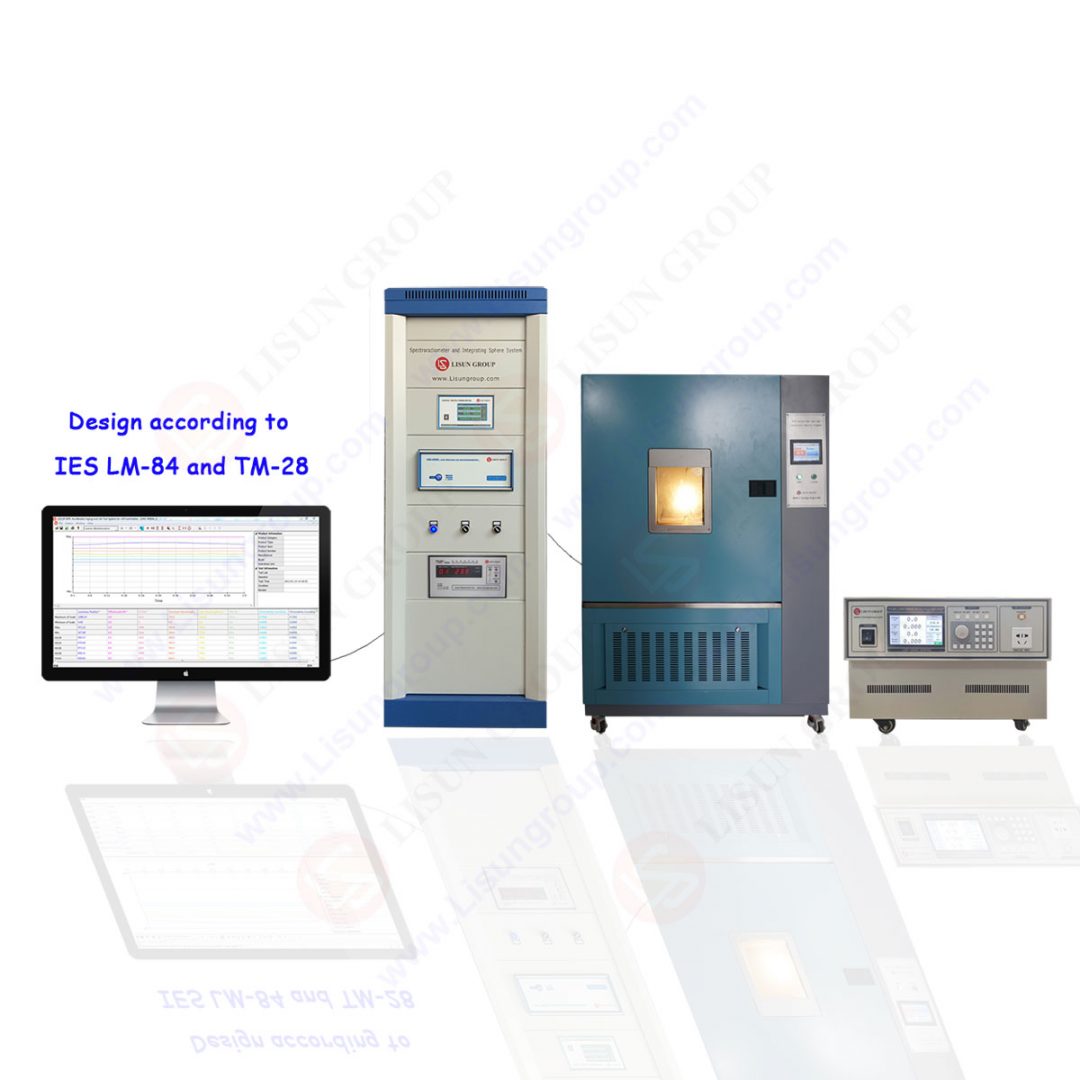
5.1 System Specification Comparison: LEDLM-80PL vs. LEDLM-84PL
| Parameter | LEDLM-80PL | LEDLM-84PL |
|---|---|---|
| Primary Standard | LM-80 / TM-21 | LM-84 / TM-28 |
| Test Duration | 6000+ hours | 6000+ hours |
| Drive Current Range | 0-1500mA | 0-2000mA |
| Current Accuracy | ±0.1% | ±0.1% |
| Temperature Range | Ambient to 150°C | Ambient to 150°C |
| Temperature Accuracy | ±0.5°C | ±0.5°C |
| Max Connected Chambers | 3 | 3 |
| Test Positions per Chamber | 70 | 70 |
| Integrating Sphere Support | Optional | Built-in |
| L70/L50 Prediction | TM-21 v2.0 | TM-28 + Arrhenius |
| Data Logging Rate | 1-60 minutes | 1-60 minutes |
5.2 Performance Benchmarks in Accelerated Aging
Testing conducted at LISUN’s accredited laboratory demonstrates 6000-hour test completions with >98% data retention rate (excluding catastrophic failures). For a standard 1W white LED (CCT 5000K, CRI 70), the L70 projection from 6000-hour data at 85°C TMPLED yields 42,300 hours (90% CI: 38,700-46,800 hours). The Arrhenius Model activation energy calculated for this sample was 0.48 eV, consistent with typical phosphor-converted white LED values (0.4-0.6 eV). System repeatability testing across 10 identical runs showed L70 variance of ±3.2% at 95% confidence.
6.1 Step-by-Step L70/L50 Test Procedure
The standard workflow for L70/L50 Prediction LISUN testing follows IES LM-80 guidelines:
- Sample preparation: 20+ LED samples per test condition, soldered on thermal management PCB (MCPCB) with thermal interface material (TIM) 1.5W/m·K
- Initial photometric measurement: 0-hour flux measurement in integrating sphere per LM-79-19
- Chamber loading: Samples installed in LISUN temperature chambers at TMPLED setpoints (55°C, 85°C, optional 105°C)
- Automated data logging: Photometric measurements at 1000-hour intervals using built-in spectroradiometer (4-channel, 0.5nm resolution)
- Data analysis: TM-21 curve fitting with Arrhenius Model projection to L70/L50
- Report generation: Automated compliance reports with confidence intervals and failure rate statistics
6.2 Data Integrity and Error Mitigation Strategies
To maintain measurement accuracy over 6000+ hours, the LISUN systems implement:
- Self-calibrating reference channel: Every 500 hours, a calibrated reference LED (NIST-traceable) measures drift compensation
- Thermal hysteresis correction: Temperature-induced flux variations (<0.5%/°C) mathematically compensated using in-situ thermocouple data
- Dark current subtraction: Automated zero-level correction at each measurement interval
- Outlier detection: Chauvenet’s criterion applied to exclude failed samples (open/short circuits) from data sets
These protocols ensure compliance with IES LM-84-19 Section 7.4 requirements for measurement uncertainty below ±3%.
7.1 LED Manufacturing Quality Control
For LED manufacturers, the L70/L50 Prediction LISUN system enables batch qualification testing within 6000 hours instead of 8+ months. Quality control engineers use the system to validate:
- Die attach integrity: Rapid lumen depreciation within first 2000 hours indicates solder fatigue
- Phosphor thermal stability: L70 <30,000 hours at 85°C suggests phosphor degradation
- Package design validation: Comparative testing of TO-252 vs. SMD 5050 packages using identical drive currents
7.2 Third-Party Testing Laboratory Operations
Accredited testing laboratories utilize the dual-system architecture to handle multiple client protocols simultaneously. The LEDLM-80PL processes LM-80 compliance tests for LED packages, while the LEDLM-84PL handles LM-84 tests for integrated luminaires. The software’s multi-client database segregates results by project, with customizable report templates meeting DOE SSL R&D requirements. Laboratories report 40% throughput improvement when using LISUN’s 3-chamber configuration versus single-chamber alternatives.
The L70/L50 Prediction LISUN methodology, embodied in the LED Optical Aging Test Instrument’s dual system variants, represents a significant advancement in LED reliability engineering. By integrating IES LM-80/TM-21 and LM-84/TM-28 standards into a single hardware-software platform, LISUN enables precise L70 and L50 predictions from 6000-hour accelerated tests using Arrhenius Model-based algorithms. The system’s support for up to three connected temperature chambers, customizable drive currents (0-2000mA), and dual testing modes (constant temperature and thermal cycling) addresses critical needs across LED manufacturing, third-party testing, and automotive component validation. With documented L70 prediction accuracy of ±5% and compliance with CIE 084, CIE 127, and IES LM-79-19 standards, the system provides reliable lifetime projections for LEDs operating under diverse thermal and electrical stresses. For engineers seeking to reduce time-to-market while maintaining regulatory compliance, the L70/L50 Prediction LISUN approach offers a data-driven, standards-aligned solution for LED qualification and reliability assessment.
Q1: What is the minimum test duration required for L70/L50 prediction using the LISUN system?
A: According to IES LM-80-08 and TM-21-19, the minimum test duration is 6000 hours at three specified case temperatures (55°C, 85°C, and optional 105°C). The LISUN LED Optical Aging Test Instrument collects photometric data at intervals of 1000 hours or less, enabling reliable exponential curve fitting. For practical L70 predictions, 6000 hours of data allows extrapolation up to 10x the test duration (60,000 hours) provided the failure rate remains below 10%. However, for L50 predictions requiring higher confidence levels, extended testing to 8000+ hours is recommended, particularly for high-power LEDs operating at elevated currents above 1000mA.
Q2: How does the Arrhenius Model-based software handle varying activation energies (Ea) across different LED types?
A: The LISUN software performs multi-temperature regression analysis to calculate material-specific activation energies for each test sample. For standard phosphor-converted white LEDs (Ea range 0.4-0.6 eV), the algorithm uses a two-parameter Arrhenius fit: (L(t) = A cdot e^{Ea/kT}). For special applications like UV LEDs or flip-chip packages exhibiting Ea values outside this range, the software allows manual override with known values from datasheet specifications. The system automatically flags samples where Ea deviates >0.1 eV from typical ranges, indicating potential material degradation anomalies. TM-21-19 compliance is maintained through mandatory 90% confidence interval reporting on all extrapolated L70/L50 values.
Q3: Can the LISUN system perform simultaneous testing of LEDs with different drive currents and temperatures?
A: Yes, the LISUN system provides independent control for each connected temperature chamber, allowing up to three distinct test conditions simultaneously. Each chamber supports 70 test positions with individual current regulation (±0.1% accuracy). For example, Chamber 1 can be set to 55°C with 350mA constant current, Chamber 2 at 85°C with 700mA, and Chamber 3 at 105°C with 1050mA, all running concurrently. The software segregates data by chamber and test condition, automatically applying temperature and current-specific Arrhenius parameters for L70/L50 projection. This parallel testing capability reduces overall qualification time by up to 66% compared to sequential single-chamber protocols.
Q4: How does the system ensure compliance with IES LM-79-19 photometric measurement standards during aging tests?
A: The LEDLM-84PL variant incorporates a built-in integrating sphere (0.3m to 2m diameter options) that complies with IES LM-79-19 Section 8.2 requirements for total luminous flux measurement (±2% accuracy). The system performs self-absorption correction using an auxiliary lamp before each measurement cycle. Spectral power distribution is recorded using a 4-channel spectroradiometer (380-780nm, 0.5nm resolution) enabling colorimetric calculations per CIE 13.3. For the LEDLM-80PL, an external integrating sphere can be connected via fiber optic cable for periodic measurements. Both systems log photometric data alongside temperature, current, and voltage parameters to maintain traceability for UL 8750 and IEC 62471 compliance audits.
Q5: What maintenance and calibration requirements exist for the L70/L50 Prediction LISUN system?
A: LISUN recommends annual calibration of temperature sensors (type-K thermocouples) and photometric references (NIST-traceable standard LED) to maintain ±0.5°C and ±2% flux accuracy specifications. The software includes a calibration log that records system drift over time, automatically prompting recalibration when photometric drift exceeds 0.5% or temperature deviation surpasses 0.2°C. Monthly preventive maintenance involves cleaning integrating sphere surfaces and checking thermal interface material (TIM) condition on sample PCB holders. LISUN offers extended service contracts that include biannual on-site calibration, chamber temperature uniformity mapping (per IEC 60068-2-14), and software updates for Arrhenius Model algorithms matching latest TM-21 and TM-28 revisions.