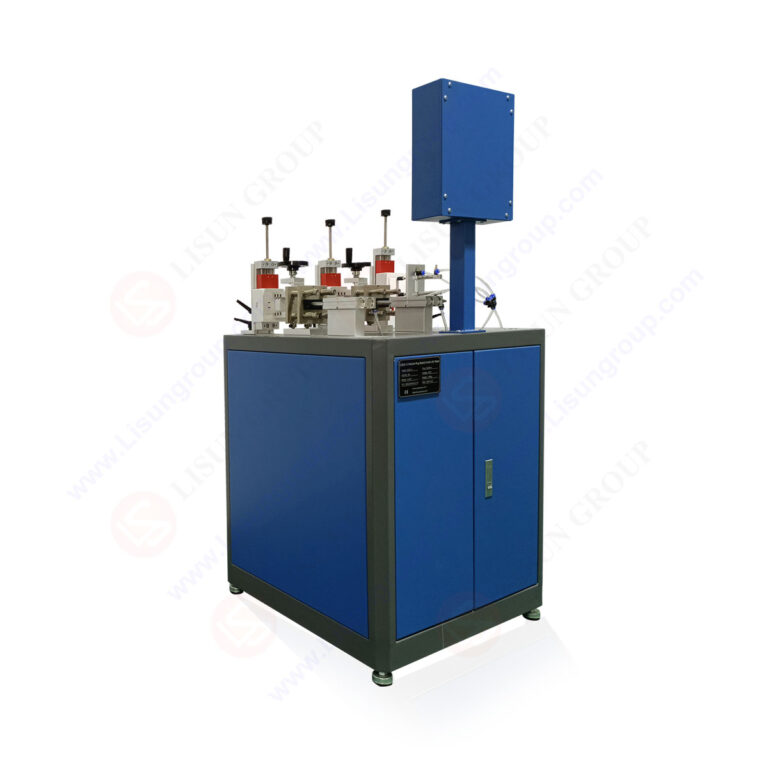
This article provides a comprehensive technical overview of the LISUN Three-Station Switch Socket Tester for Compliance Testing, a specialized automated test system designed for evaluating the electrical durability and mechanical endurance of plugs, sockets, switches, and connectors. The LISUN Three-Station Switch Socket Tester enables simultaneous testing of three specimens under programmable load conditions, supporting compliance verification against international standards including IEC 60884-1, IEC 60669-1, IEC 61058-1, and GB/T 2099.1. The system integrates PLC control, cylinder-driven actuation, and real-time parameter monitoring to simulate electrical fatigue failure scenarios such as contact adhesion, arcing degradation, and mechanical wear. This article examines the instrument’s technical architecture, operational parameters, application scenarios across household and automotive electronics, and comparative performance data across the CZKS-3 series variants. Detailed test methodologies, standard compliance pathways, and calibration procedures are discussed to guide quality control engineers and testing laboratory professionals in deploying this equipment for rigorous product validation.
1.1 System Design and Actuation Mechanism
The LISUN Three-Station Switch Socket Tester employs a modular three-station configuration that allows simultaneous testing of up to three devices under test (DUTs) with independent control loops. Each test station integrates a pneumatic cylinder-driven actuation system with adjustable stroke length and insertion force parameters. The cylinder actuation is governed by a programmable logic controller (PLC) that executes predefined test sequences based on standard-specific requirements. The CZKS-3 series achieves repeatable positioning accuracy within ±0.1 mm, critical for evaluating contact insertion and withdrawal forces in socket and plug assemblies.
The actuation mechanism supports both linear insertion-extraction cycles for plug/socket testing and rotational switching actions for switch durability evaluation. For rotary switch testing, the system incorporates a stepper motor-driven rotation stage with torque sensing capabilities, enabling precise measurement of actuation force degradation over extended cycle counts. The LISUN Three-Station Switch Socket Tester accommodates DUTs with rated currents up to 32 A and rated voltages up to 440 V AC, covering the full range of household and light industrial applications.
1.2 Electrical Load and Measurement Systems
Each test station in the LISUN Three-Station Switch Socket Tester integrates an independent electrical load circuit capable of resistive, inductive, or combined loading profiles. The load system applies test currents ranging from 0.1 A to 32 A with resolution of 0.01 A, while voltage monitoring covers 0 V to 500 V AC/DC. Contact resistance measurement is performed using a four-wire Kelvin sensing method with resolution of 0.1 mΩ, enabling detection of gradual degradation in electrical contact quality.
The measurement system records key parameters for every test cycle, including contact voltage drop, temperature rise at critical interfaces, and actuation force profiles. Data acquisition occurs at sampling rates up to 1000 Hz, allowing detailed characterization of transient phenomena such as arcing during contact separation. The CZKS-3P variant adds phase-angle controlled switching capability for evaluating contact performance under worst-case electrical conditions.
2.1 IEC 60884-1 Compliance for Plugs and Sockets
The LISUN Three-Station Switch Socket Tester is engineered to execute all mechanical endurance tests specified in IEC 60884-1 for plugs and socket-outlets. Clause 21 of IEC 60884-1 requires 10,000 mechanical operations without electrical load for normal service testing, followed by 10,000 operations under rated current conditions. The CZKS-3 series automates this sequence with programmable cycle counts, insertion speeds, and dwell times at fully inserted and withdrawn positions.
For breaking capacity testing per IEC 60884-1 Clause 20, the system applies rated voltage with a power factor of 0.6 ± 0.05 for inductive loads, verifying that contacts can interrupt currents up to 1.25 times the rated value without sustained arcing or contact welding. The LISUN Three-Station Switch Socket Tester monitors arc duration and energy during each breaking event, providing quantitative data for failure analysis.
2.2 IEC 60669-1 Compliance for Switches
Switch durability testing per IEC 60669-1 requires 20,000 to 40,000 mechanical operations depending on switch classification. The CZKS-3S variant is specifically configured for switch testing, incorporating a dual-actuation mechanism that can perform both linear push-button operations and rotational toggle actions. Clause 19 of IEC 60669-1 specifies test conditions including 100% rated current for resistive loads and 70% rated current for inductive loads at 0.6 power factor.
The system automatically adjusts load parameters between test phases, alternating between no-load mechanical endurance cycles and full-load electrical endurance cycles. Temperature rise measurements are recorded every 1,000 cycles to track thermal degradation patterns. The LISUN Three-Station Switch Socket Tester’s PLC program includes pre-loaded test sequences for common switch types including single-pole, double-pole, and intermediate switches.
2.3 IEC 61058-1 Compliance for Appliance Switches
Appliance switch testing per IEC 61058-1 requires evaluation under both normal operating conditions and abnormal fault conditions. The CZKS-3A variant addresses Clause 17 endurance testing with programmable current profiles that simulate typical appliance load patterns, including motor start-up inrush currents and resistive heating element cycles. The system supports test currents up to 16 A at 250 V AC for appliance switches.
For Clause 18 abnormal operation testing, the LISUN Three-Station Switch Socket Tester applies overcurrent conditions up to 1.5 times rated current while monitoring contact temperature and voltage drop. The system can automatically terminate tests if contact resistance exceeds predefined thresholds, preventing catastrophic failure that could damage test fixtures.
3.1 Model Specifications and Capabilities
The CZKS-3 series comprises four variants designed for specific testing applications while maintaining a common core platform. The base model CZKS-3 provides universal plug and socket testing capability. The CZKS-3P adds phase-angle controlled switching for precise timing of contact separation relative to AC waveform zero-crossing points. The CZKS-3S is optimized for switch durability testing with enhanced rotational actuation. The CZKS-3A extends capability to automotive and appliance connector testing with higher current ratings.
| Parameter | CZKS-3 | CZKS-3P | CZKS-3S | CZKS-3A |
|---|---|---|---|---|
| Max Test Current (A) | 32 | 32 | 16 | 50 |
| Max Test Voltage (V AC) | 440 | 440 | 250 | 440 |
| Test Stations | 3 | 3 | 3 | 3 |
| Actuation Type | Pneumatic | Pneumatic | Pneumatic + Stepper Motor | Pneumatic + Stepper Motor |
| Phase-Angle Control | No | Yes (1° resolution) | Yes (1° resolution) | No |
| Contact Resistance Range (mΩ) | 0.1 – 1000 | 0.1 – 1000 | 0.1 – 500 | 0.1 – 1000 |
| Max Cycle Rate (cycles/min) | 15 | 12 | 10 | 12 |
| Force Sensor Range (N) | 0 – 200 | 0 – 200 | 0 – 100 | 0 – 500 |
| Temperature Channels | 6 | 6 | 9 | 6 |
| Data Logging Rate (Hz) | 100 | 1000 | 1000 | 100 |
3.2 Application-Specific Configuration Options
The LISUN Three-Station Switch Socket Tester supports interchangeable test fixtures that accommodate different plug types including Schuko, BS 1363, NEMA, and universal sockets. Fixture changeover requires less than 15 minutes, enabling rapid reconfiguration between test campaigns. For the CZKS-3P variant, the phase-angle control module synchronizes contact separation with the AC mains waveform at 1° resolution, critical for evaluating worst-case arcing conditions specified in IEC 60884-1 Clause 20.
The CZKS-3S variant includes a dedicated torque sensor for switch actuation force measurement, calibrated to 0.1 N·m resolution. This capability is essential for verifying compliance with IEC 60669-1 Clause 20 force requirements for rocker switches and rotary dimmers. The CZKS-3A variant features high-current contactors and reinforced wiring for 50 A continuous testing, accommodating heavy-duty automotive and industrial connectors.
4.1 Contact Adhesion and Welding Mechanisms
Electrical fatigue failure in switches and sockets frequently manifests as contact adhesion, where microscopic welding occurs between mating surfaces due to high current density during closure and opening operations. The LISUN Three-Station Switch Socket Tester detects adhesion events through continuous monitoring of actuation force profiles. When contact welding occurs, the required opening force increases measurably above baseline values. The system records each adhesion event with timestamp, cycle number, and force magnitude data.
Analysis of contact resistance trends provides early warning of impending failure. A gradual increase in contact resistance of more than 50% from initial values typically precedes catastrophic adhesion. The CZKS-3 series algorithms automatically flag test stations showing resistance drift exceeding user-defined thresholds, allowing engineers to halt destructive testing and examine contact surfaces before complete failure.
4.2 Arcing Degradation and Material Transfer
Arcing during contact separation causes material transfer between anode and cathode surfaces, progressively altering contact geometry and increasing contact resistance. The CZKS-3P variant’s phase-angle control capability enables systematic evaluation of arcing under worst-case conditions, defined as contact separation occurring at peak AC voltage. Testing under these conditions accelerates failure mechanisms, reducing test duration for qualification programs.
The LISUN Three-Station Switch Socket Tester records arc duration, arc energy, and arc current for each switching event. Statistical analysis of these parameters across multiple test stations reveals degradation patterns specific to contact material combinations. Silver alloy contacts typically show progressive material transfer over 5,000 to 10,000 cycles under inductive loads, while silver-tungsten composites demonstrate superior arc resistance with stable performance beyond 20,000 cycles.
5.1 Programmable Test Sequences
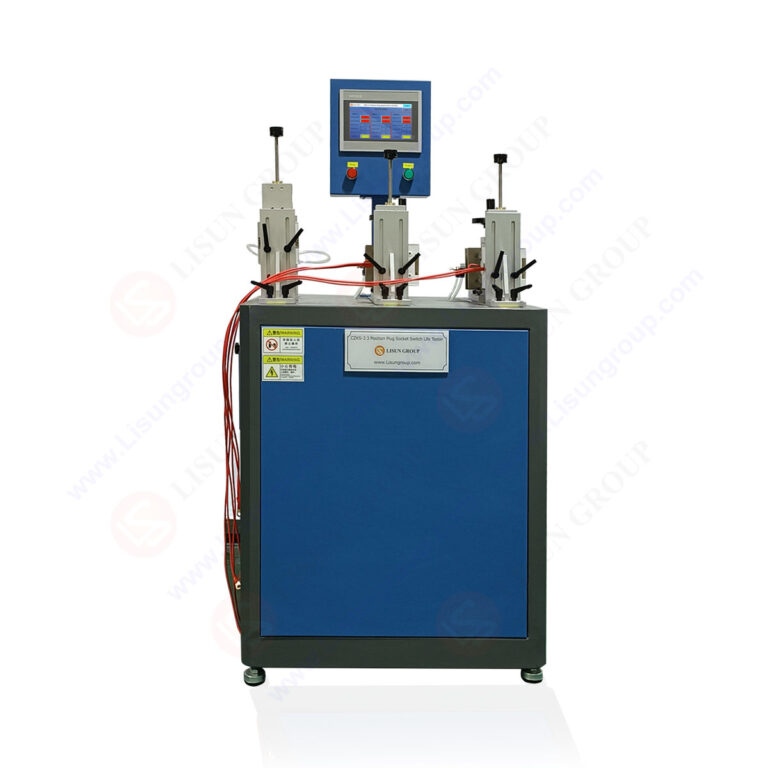
The PLC-based control system in the LISUN Three-Station Switch Socket Tester supports fully automated test execution with user-defined sequences. Operators can program complex test profiles combining multiple phases, including no-load mechanical endurance, full-load electrical endurance, breaking capacity tests, and abnormal operation conditions. Each phase can specify cycle count, actuation speed, dwell time, applied voltage and current, power factor, and acceptance criteria.
A typical compliance test sequence for IEC 60884-1 includes 10,000 no-load cycles followed by 10,000 cycles at rated current, with intermediate measurements of contact resistance, temperature rise, and actuation force every 1,000 cycles. The system automatically pauses between phases for DUT inspection, providing visual and audible alerts to operators. Data logging occurs continuously throughout the test duration, with automatic backup to network-attached storage.
5.2 Real-Time Monitoring and Alarm Systems
The LISUN Three-Station Switch Socket Tester incorporates multiple safety interlocks and alarm conditions to protect both the DUT and test equipment. Overcurrent protection circuits trip within 5 ms of detecting current exceeding 120% of setpoint. Temperature monitoring uses Type K thermocouples with sampling rate of 10 Hz, triggering alarms if DUT temperature exceeds 150°C. Force sensors detect mechanical jams or binding, automatically halting actuation to prevent fixture damage.
Real-time visualization displays all monitored parameters for each test station on a 12-inch industrial touchscreen. Operators can view trend graphs of contact resistance, temperature, and actuation force over the test duration. The system generates pass/fail reports automatically at test completion, with detailed cycle-by-cycle data available for export in CSV and PDF formats.
6.1 Traceable Calibration Procedures
The CZKS-3 series measurement systems require periodic calibration to maintain traceability to national standards. Contact resistance measurements are calibrated using precision shunt resistors with 0.01% tolerance at 1 mΩ, 10 mΩ, and 100 mΩ reference points. Force sensors are calibrated using certified dead weights traceable to NIST or equivalent standards. The LISUN Three-Station Switch Socket Tester includes automated calibration routines that guide operators through the process and generate calibration certificates.
Calibration intervals depend on usage intensity, with recommendations for annual full calibration and quarterly verification checks. The system logs all calibration data in non-volatile memory, providing complete traceability for audit purposes. Measurement uncertainty for contact resistance is ±(0.5% + 0.1 mΩ) across the operating range, meeting the requirements of ISO 17025 for testing laboratories.
6.2 Measurement System Validation
Validation of the LISUN Three-Station Switch Socket Tester measurement system involves comparison testing against reference instruments and known artifacts. Monthly verification checks using a reference plug with stable contact resistance of 5.0 mΩ confirm measurement accuracy within specified tolerance. Temperature measurement channels are verified against a calibrated reference thermometer at 25°C and 100°C.
The CZKS-3 series provides automated data integrity checks, including parity verification for logged data and timestamp synchronization across test stations. Each test result includes metadata recording the instrument calibration status, environmental conditions (temperature and humidity), and operator identification, ensuring complete data traceability for quality management systems.
7.1 Household Appliance Component Testing
Manufacturers of household appliances including washing machines, refrigerators, air conditioners, and kitchen appliances utilize the LISUN Three-Station Switch Socket Tester for qualification testing of power cords, appliance inlets, and control switches. A typical test protocol for a washing machine power cord involves 10,000 insertion-extraction cycles under 10 A resistive load, followed by breaking capacity testing at 1.25 times rated current with inductive load.
The three-station configuration enables accelerated testing of multiple product variants simultaneously, reducing qualification timelines from weeks to days. Environmental chambers can be integrated with the CZKS-3 series for temperature-humidity cycling tests specified in IEC 60068-2, evaluating contact performance under extreme conditions from -40°C to +85°C.
7.2 Automotive Connector and Switch Testing
Automotive electronics components require testing under higher current loads and vibration conditions compared to household applications. The CZKS-3A variant supports testing of automotive connectors rated up to 50 A, including sealed connector systems used in engine compartments and high-voltage connectors for electric vehicle charging systems. Test protocols follow LV 214 and USCAR-2 standards for connector durability.
The LISUN Three-Station Switch Socket Tester can be configured with vibration fixtures that apply mechanical shock during electrical endurance testing, simulating real-world automotive operating conditions. Contact resistance measurements are performed under vibration to detect intermittent connection failures that could affect vehicle safety systems. The system has been used in validation programs for electric vehicle charging connectors requiring 10,000 mating cycles under 32 A continuous load.
The LISUN Three-Station Switch Socket Tester represents a comprehensive solution for automated compliance testing of plugs, sockets, switches, and connectors against international standards including IEC 60884-1, IEC 60669-1, IEC 61058-1, and GB/T 2099.1. The CZKS-3 series variants (CZKS-3, CZKS-3P, CZKS-3S, CZKS-3A) provide tailored capabilities for specific application domains while maintaining a consistent platform architecture based on PLC control, pneumatic actuation, and precision measurement systems. Key technical capabilities include simultaneous three-station testing with independent load control, contact resistance measurement at 0.1 mΩ resolution, and real-time monitoring of temperature, force, and electrical parameters. The system’s phase-angle control capability in the CZKS-3P variant enables accelerated evaluation of worst-case arcing conditions, while the CZKS-3A variant addresses high-current automotive and industrial connector requirements. Automated test execution with programmable sequences and comprehensive data logging supports efficient qualification programs for manufacturers, testing laboratories, and quality control departments. The measurement assurance system with traceable calibration and validation procedures ensures compliance with ISO 17025 requirements. By enabling accurate simulation of electrical fatigue failure mechanisms including contact adhesion, arcing degradation, and mechanical wear, the LISUN Three-Station Switch Socket Tester provides the technical evidence necessary for product certification and continuous improvement in electrical component reliability.
Q1: What standards does the LISUN Three-Station Switch Socket Tester support for testing household plugs and sockets?
A: The CZKS-3 series supports full compliance testing per IEC 60884-1 for plugs and socket-outlets, including Clause 20 breaking capacity tests and Clause 21 mechanical endurance tests. For household switches, the system supports IEC 60669-1 with endurance testing per Clause 19 and force measurement per Clause 20. For appliance switches, compliance with IEC 61058-1 is supported, covering Clause 17 normal endurance and Clause 18 abnormal operation conditions. The system also supports GB/T 2099.1 and GB/T 16915.1 for Chinese national standard compliance. Each standard’s specific test parameters including cycle counts, load conditions, and acceptance criteria are pre-programmed in the PLC control software.
Q2: How does the three-station configuration improve testing efficiency compared to single-station testers?
A: The three-station configuration enables simultaneous testing of three DUTs under identical or different test conditions, reducing qualification timelines by up to 67% compared to sequential single-station testing. Each station operates independently with dedicated load circuits, measurement channels, and actuation systems. This configuration is particularly valuable for statistical analysis, allowing testing of multiple production samples in parallel to assess manufacturing consistency. The CZKS-3 series also supports independent start and stop times for each station, enabling staggered test initiation for efficient laboratory scheduling.
Q3: What electrical fatigue failure mechanisms can the LISUN Three-Station Switch Socket Tester detect?
A: The system monitors three primary fatigue failure mechanisms: contact adhesion detected through increased actuation force during contact opening, arcing degradation monitored through arc duration and energy measurement during switching events, and material transfer tracked through progressive changes in contact resistance. The force sensors detect adhesion events at 1 N resolution, while the high-speed data acquisition captures arc characteristics at 1000 Hz sampling rate. The CZKS-3P variant’s phase-angle control enables systematic evaluation of arcing under worst-case conditions for accelerated aging studies.
Q4: What calibration procedures are required for the CZKS-3 series measurement systems?
A: Annual full calibration is recommended using traceable reference standards for contact resistance (0.01% precision shunts at 1 mΩ, 10 mΩ, 100 mΩ), force sensors (certified dead weights), and temperature channels (reference thermometer at 25°C and 100°C). Quarterly verification checks using a stable reference plug with known contact resistance are recommended between full calibrations. The system includes automated calibration routines that guide operators through procedures and generate calibration certificates with measurement uncertainty analysis. All calibration data is logged in non-volatile memory for audit traceability.
Q5: Can the LISUN Three-Station Switch Socket Tester be integrated with environmental chambers for temperature-humidity testing?
A: Yes, the CZKS-3 series supports integration with environmental chambers for combined temperature-humidity and electrical endurance testing. The test stations feature extended cables and pneumatic lines for remote operation, allowing the test head to be positioned inside the environmental chamber while control electronics remain outside. The system supports testing across temperature ranges from -40°C to +85°C and humidity levels from 10% to 95% relative humidity. This capability is essential for automotive component testing per LV 214 and USCAR-2 standards, as well as household appliance testing per IEC 60068-2.