









Here is the comprehensive technical article generated based on your instructions.
Abstract
Accurate lumen maintenance prediction is critical for LED product reliability and warranty validation. The LISUN IES TM-21 LED Optical Aging Test Instrument for Lumen Maintenance Prediction provides a dedicated hardware-software solution to meet IES LM-80 and TM-21 standards. This article explores the instrument’s dual-system architecture (LEDLM-80PL for LM-80/TM-21 and LEDLM-84PL for LM-84/TM-28), its Arrhenius Model-based software for L70/L50 projections, and its capability to manage up to three connected temperature chambers. Technical professionals will gain insights into how this system streamlines 6000-hour aging tests, ensures compliance with CIE 127 and IES LM-79-19, and offers customizable configurations for laboratory-grade reliability.
1.1 The Importance of Lumen Depreciation Testing
LEDs exhibit gradual light output reduction over time, a phenomenon known as lumen depreciation. Accurate measurement of this decay is essential for establishing product lifetime claims, typically stated as L70 (time to 70% initial lumens) or L50 (time to 50% initial lumens). Without standardized testing, manufacturers risk overstating lifespan, leading to field failures and liability issues.
1.2 Overview of Key Standards: IES LM-80, TM-21, LM-84, and TM-28
The Illuminating Engineering Society (IES) provides the framework for this testing. IES LM-80 defines the method for measuring lumen maintenance of LED packages, arrays, and modules at specified case temperatures (e.g., 55°C, 85°C) over a minimum of 6,000 hours. TM-21-19 then provides the statistical extrapolation method to project long-term performance beyond the test duration. For integrated LED lamps and luminaires, IES LM-84 and TM-28 offer similar protocols. The LISUN IES TM-21 LED Optical Aging Test Instrument for Lumen Maintenance Prediction is engineered to execute these exact standards.
2.1 Dual-System Variants: LEDLM-80PL and LEDLM-84PL
The instrument comprises two primary systems tailored to specific test objects. The LEDLM-80PL is designed for components (LED packages, modules, and arrays) in compliance with IES LM-80 and TM-21. Conversely, the LEDLM-84PL targets complete luminaires and integrated lamps, adhering to IES LM-84 and TM-28. This dual-architecture ensures that a single manufacturer can test both components and finished products using a unified platform.
2.2 Hardware Configuration and Customization
Each variant supports a modular, customizable hardware setup. The system can control up to three connected temperature chambers simultaneously, allowing for multi-temperature stress testing as required by IES LM-80 (typically three temperatures, including 55°C and 85°C). The standard configuration includes:
- Multiple aging test racks with independent channel control.
- Thermal management systems with ±1°C stability.
- Auxiliary power supplies for constant current/voltage operation.
2.3 Integrating Sphere and Spectroradiometer Integration
For data collection, the system seamlessly integrates with LISUN’s high-precision integrating spheres and spectroradiometers. This setup, per IES LM-79-19, enables simultaneous measurement of total luminous flux, color temperature (CCT), and chromaticity coordinates (x, y) during aging intervals, ensuring that the optical data used for TM-21 extrapolation is accurate and traceable.
3.1 Real-Time Data Acquisition and Monitoring
The instrument’s software provides real-time graphical monitoring of luminous flux degradation over up to 6,000 hours (or longer for extended tests). Data logging intervals are user-configurable, allowing for high-resolution tracking of early-life failures and long-term trends.
3.2 Arrhenius Model Implementation for Life Prediction
Central to the software is the Arrhenius Model. By testing samples at multiple temperature points (e.g., T1=55°C, T2=85°C, T3=105°C), the software calculates the activation energy (Ea) of the LED’s degradation mechanism. This thermodynamic model is then used to accelerate predictions, extrapolating to lower, more realistic operating temperatures. The software directly computes L70 and L50 metrics based on the TM-21 projection curve.
3.3 Comparison of LM-80/TM-21 and LM-84/TM-28 Test Modes
| Feature | LEDLM-80PL (LM-80/TM-21) | LEDLM-84PL (LM-84/TM-28) |
|---|---|---|
| Primary Standard | IES LM-80, TM-21-19 | IES LM-84, TM-28-19 |
| Test Object | LED Packages, Arrays, Modules | Integrated LED Lamps, Luminaires |
| Min. Test Duration | 6,000 hours (per LM-80) | 6,000 hours (per LM-84) |
| Required Temperatures | Typically 3 (e.g., 55, 85, 105°C) | Typically 1 or 2 (in-situ temp) |
| Extrapolation Output | L70, L50, L90 (via TM-21) | L70, L50 (via TM-28) |
| Driver Influence | External, controlled source | Internal driver is part of test |
| Connections | Up to 3 Temp. Chambers | Up to 2 Temp. Chambers |
This table clarifies the distinct application fields, ensuring users select the correct variant for their compliance needs.
4.1 Chamber and Thermal Control Capabilities
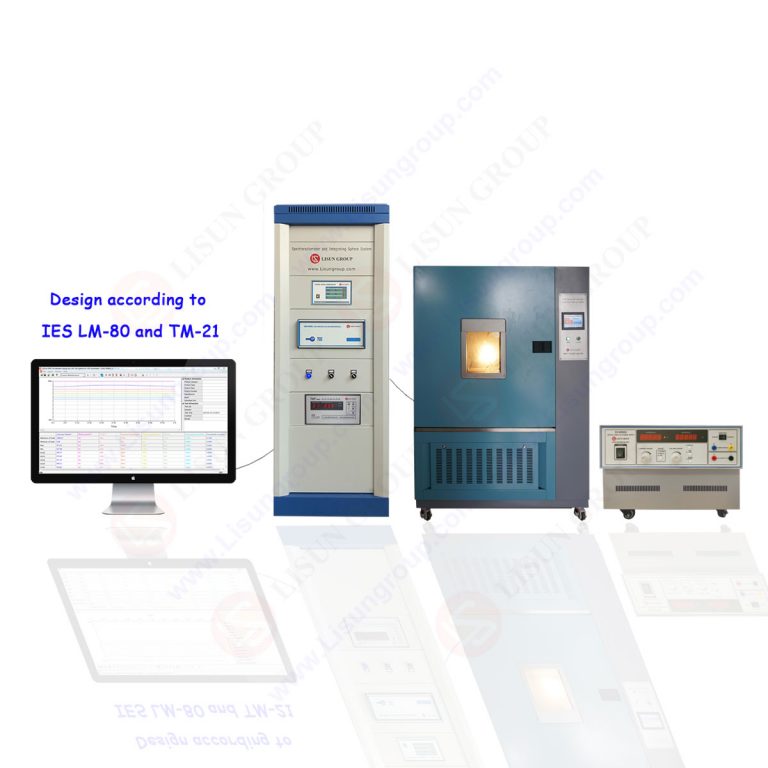
The instrument supports integration with standard bench-top or walk-in chambers. Temperature range is typically -40°C to +150°C, with a uniformity of ±0.5°C. The control system maintains a 0.1°C resolution, crucial for accurate Arrhenius analysis.
4.2 Electrical and Photometric Measurement Accuracy
- Constant Current Drive: Accuracy ±0.1% (for LEDLM-80PL).
- Luminous Flux Measurement: Uncertainty < 3% (k=2) when used with certified sphere system.
- Color Measurement: Chromaticity coordinate uncertainty ±0.0015 (for x, y) per CIE 127.
4.3 Data Handling and Reporting
The system automates TM-21 reporting, generating PDF reports containing raw data, exponential decay curves, and the final extrapolated L70 value at the use temperature. It supports data export in CSV format for further statistical analysis.
5.1 Adherence to CIE 084 and CIE 70 for Photometric Measurement
The measurement methodology aligns with CIE 084 (Measurement of Luminous Flux) and CIE 70 (Distribution Temperature and Color Temperature). The instrument’s integrating sphere design follows the substitution method, ensuring absolute photometry is performed correctly.
5.2 Alignment with CIE 127 for LED Testing
CIE 127 provides guidelines for LED testing conditions, including operating conditions and measurement geometry. LISUN’s instrument complies with these guidelines, specifically regarding the measurement of average LED intensity and total flux, which are critical for consistent data input into the TM-21 model.
6.1 Standardized 6000-Hour Protocol Execution
The operator sets the sample temperature, current, and measurement intervals (e.g., every 1000 hours). The system continuously cycles power and records data. A typical LM-80 test requires at least 6,000 hours of data, after which the software processes the last 5,000 hours for the TM-21 projection.
6.2 Ensuring Data Integrity and Traceability
The system employs a “lights-off” measurement protocol to eliminate temperature drift during optical measurement. Photometric measurements are taken at 25°C ±1°C ambient, ensuring repeatability. All raw data is time-stamped and stored in a secure database, essential for audit trails.
7.1 Quality Control and Supplier Validation
LED manufacturers can use the LISUN IES TM-21 LED Optical Aging Test Instrument for Lumen Maintenance Prediction to qualify incoming LED bins. By running a 6,000-hour test on a sample from each supplier, they can validate the manufacturer’s claimed L70 life and reject batches showing abnormal depreciation.
7.2 Accelerated Aging for New Product Development
R&D teams can leverage the Arrhenius Model to predict the lifetime of new phosphor technologies or chip designs. Testing at a high accelerated temperature (e.g., 125°C) allows for a preliminary life estimate within weeks, significantly shortening the development cycle for high-reliability products like automotive headlamps or medical lighting.
7.3 Support for Third-Party Certification Labs
Independent testing laboratories can utilize this instrument to offer accredited LM-80/TM-21 testing services. The system’s multi-chamber capability allows for high throughput, handling multiple client projects simultaneously while maintaining full traceability to IES standards.
The LISUN IES TM-21 LED Optical Aging Test Instrument for Lumen Maintenance Prediction is a robust, standards-compliant solution for the critical task of LED life projection. By integrating dual-system variants for both components (LM-80/TM-21) and luminaires (LM-84/TM-28), it provides end-to-end testing capability. The incorporation of the Arrhenius Model for accelerated data analysis, combined with support for up to three temperature chambers and high-accuracy photometric measurement per CIE 127 and IES LM-79-19, positions this instrument as an essential tool for any serious LED quality assurance program. It moves beyond simple data collection to deliver validated, extrapolated performance metrics, enabling manufacturers to confidently claim product lifetimes and meet regulatory demands. The ability to customize hardware and manage 6,000-hour tests with automated data handling ensures that engineers can focus on analysis rather than process management.
Q1: What is the minimum test duration required to get a valid TM-21 prediction from the LISUN instrument?
A: According to the IES TM-21-19 standard, a minimum of 6,000 hours of test data is required for a valid extrapolation. The LISUN instrument is designed to facilitate this protocol. Importantly, TM-21 typically uses the last 5,000 hours of data for its exponential curve fitting. Therefore, data collected from hour 1,000 to hour 6,000 is used for the projection. The system’s software automatically excludes the initial stabilization period and applies the correct statistical model to compute L70 or L50. Running tests longer than 6,000 hours (e.g., 10,000 hours) can improve confidence intervals but is not required for standard compliance.
Q2: How does the Arrhenius model in the software handle the activation energy when testing different LED chemistries?
A: The Arrhenius Model software within the LISUN instrument is not a fixed-parameter calculator; it dynamically calculates the activation energy (Ea) based on the test data provided. To generate a valid model, the user must test samples at a minimum of two distinct case temperatures (typically 55°C and 85°C), though three are recommended. The software plots the decay rate (alpha) for each temperature against the inverse of absolute temperature (1/K). The slope of this Arrhenius plot directly yields the activation energy. For common InGaN LEDs, Ea typically ranges from 0.3 eV to 0.7 eV, but for AlInGaP LEDs, it can be higher. The instrument handles this variability by performing a non-linear regression on the actual data, ensuring the projection is chemistry-specific, not generic.
Q3: Can the LEDLM-84PL system test luminaires with internal drivers that have power factor correction?
A: Yes, the LEDLM-84PL variant is specifically designed for integrated lamps and luminaires. It includes programmable AC power sources that can simulate mains voltage and frequency variations (e.g., 100-277V AC, 50/60Hz). The system measures the entire assembly, including the driver, so parameters like power factor, input power, and total harmonic distortion (THD) are recorded alongside optical data. However, for TM-28 extrapolation, the luminaire is aged under its specified operating conditions (in situ). The software tracks both the driver’s electrical performance and the LED module’s light output, which is critical because driver failure often masks the actual LED lumen maintenance projection.