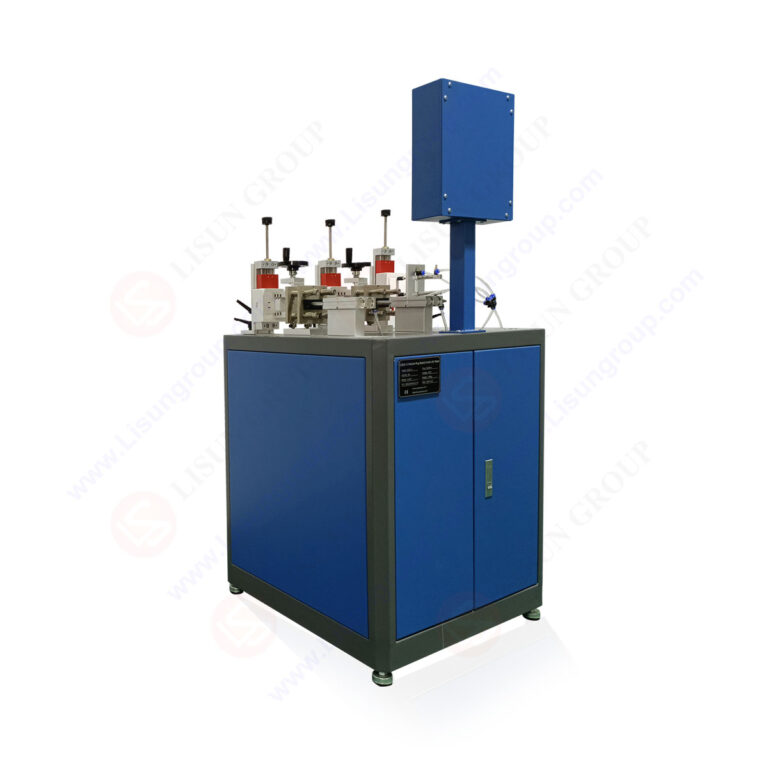
This article provides a comprehensive technical analysis of the LISUN CZKS-3 series plug and socket durability test equipment, focusing on its role in ensuring compliance with GB/T 2099.1-2021 and related international standards. The LISUN CZKS-3 series, including variants CZKS-3P, CZKS-3S, and CZKS-3A, is designed for rigorous electrical durability testing, switch life cycle verification, and socket breaking capacity assessment. The equipment integrates PLC-controlled pneumatic actuation systems to simulate mechanical insertion, withdrawal, and rotational forces during repeated test cycles. This article examines the technical specifications, standard compliance mechanisms, and application scenarios for household and automotive electronics components. Detailed analysis covers test parameter ranges, failure mode detection, and data acquisition accuracy. The article also includes a comparative table of model specifications and addresses frequently asked questions regarding calibration, maintenance, and standard alignment.
1.1 The Regulatory Landscape for Plugs and Sockets
The standard GB/T 2099.1-2021, which aligns with IEC 60884-1, specifies technical requirements for plugs and socket-outlets for household and similar purposes. Compliance verification demands precise mechanical and electrical testing under controlled conditions. The LISUN CZKS-3 series addresses the critical need for automated, repeatable testing of insertion forces, withdrawal forces, and electrical continuity during mechanical stress. Testing laboratories must demonstrate that products withstand specified numbers of operational cycles without mechanical failure or electrical discontinuity exceeding defined thresholds.
1.2 Core Testing Parameters Defined by the Standard
GB/T 2099.1-2021 clause 20 and 21 outline mechanical endurance and breaking capacity requirements. The standard mandates that plug-socket combinations undergo 5,000 to 10,000 cycles of insertion and withdrawal, followed by electrical load testing. The CZKS-3 series replicates these cycles using cylinder-driven actuators with adjustable stroke length and force control. Electrical parameters include rated voltage up to 250V AC and rated current up to 16A, with provisions for inductive load testing per clause 21.2.
2.1 Mechanical Design and Actuation System
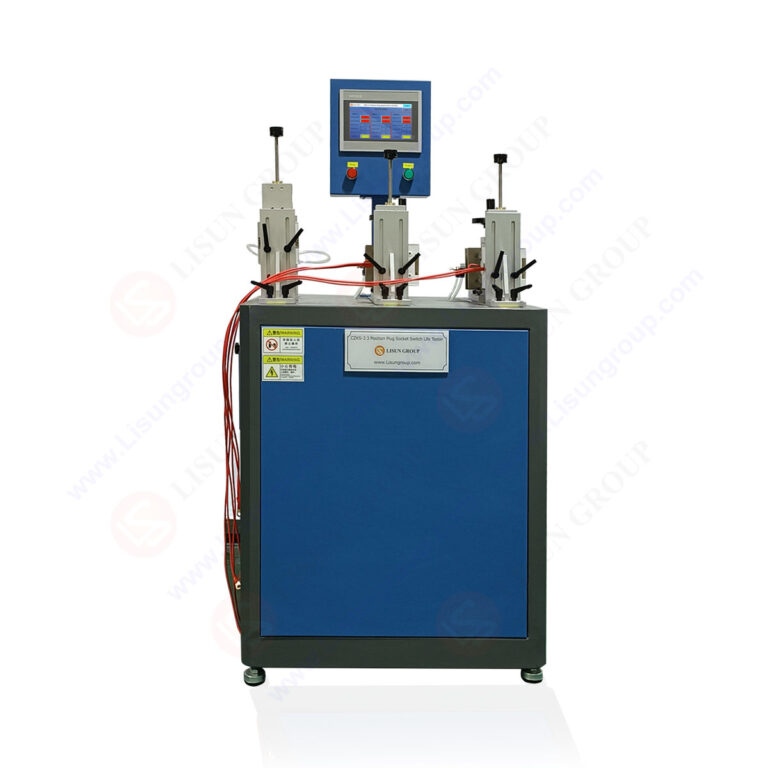
The LISUN CZKS-3 test system employs a modular frame construction with pneumatic cylinders providing linear and rotational motion. The CZKS-3 base model offers single-station operation, while the CZKS-3P variant incorporates parallel testing capabilities for increased throughput. The actuation system achieves insertion speeds between 0.5 and 3.0 m/s, adjustable in increments of 0.1 m/s, to simulate both normal and abusive handling conditions. Mechanical force sensors integrated into the test head provide real-time feedback with accuracy within ±2% of full scale.
2.2 Electrical Measurement and Data Acquisition
The CZKS-3 series integrates a multichannel data acquisition system sampling voltage, current, and contact resistance at 1 kHz per channel. Contact resistance measurements utilize a four-wire Kelvin configuration, achieving resolution down to 0.1 mΩ. The CZKS-3A variant adds accelerated aging capabilities, including temperature cycling from -10°C to +85°C during mechanical testing. This enables simultaneous assessment of thermal and mechanical endurance per IEC 60884-1 clause 22.
3.1 Alignment with GB/T 2099.1-2021 Clauses
The CZKS-3 series directly addresses GB/T 2099.1-2021 clause 19 (mechanical strength), clause 20 (mechanical endurance), and clause 21 (breaking capacity). The equipment executes predefined test sequences that automatically adjust load parameters based on the product under test rating. For breaking capacity testing, the CZKS-3P model applies rated current while performing full insertion and withdrawal cycles, measuring arcing duration and contact adhesion. Test results are automatically compared against acceptance criteria defined in clause 21.1.
3.2 Certification Path for IEC 60884-1 and Related Standards
Beyond GB/T 2099.1-2021, the CZKS-3 series supports compliance verification for IEC 60669-1 (switches for household appliances), IEC 61058-1 (switches for electrical appliances), and automotive connector standards. The CZKS-3S variant includes a dedicated switch actuation module capable of testing toggle, push-button, and rotary switches. This module applies specified operating forces while monitoring contact bounce duration and electrical life cycles per IEC 61058-1 clause 17.
4.1 Technical Comparison Table
| Parameter | CZKS-3 | CZKS-3P | CZKS-3S | CZKS-3A |
|---|---|---|---|---|
| Test Stations | 1 | 2 (parallel) | 1 (switch focus) | 1 (accelerated) |
| Insertion Speed Range | 0.5–3.0 m/s | 0.5–3.0 m/s | 0.5–2.5 m/s | 0.5–3.0 m/s |
| Force Measurement Range | 0–200 N | 0–200 N per station | 0–150 N | 0–200 N |
| Contact Resistance Resolution | 0.1 mΩ | 0.1 mΩ | 0.1 mΩ | 0.1 mΩ |
| Temperature Cycling Range | N/A | N/A | N/A | -10°C to +85°C |
| Rated Voltage Testing | Up to 250V AC | Up to 250V AC | Up to 250V AC | Up to 250V AC |
| Rated Current Testing | Up to 16A | Up to 16A per station | Up to 10A | Up to 16A |
| Data Logging Frequency | 1 kHz | 1 kHz per station | 1 kHz | 2 kHz |
4.2 Selection Criteria for Different Applications
Laboratories focused on high-throughput production testing benefit from the CZKS-3P parallel testing capability. For switch-specific durability assessment, the CZKS-3S variant provides specialized fixturing and actuation profiles. The CZKS-3A accelerated model is essential for R&D environments requiring combined thermal and mechanical stress testing. All variants share common PLC control software with customizable test sequences stored in non-volatile memory.
5.1 Household Plug and Socket Breaking Capacity Testing
The primary application of the CZKS-3 series involves breaking capacity testing for household plugs and sockets per GB/T 2099.1-2021 clause 21. The equipment performs 5,000 to 10,000 insertion-withdrawal cycles while maintaining electrical load. The breaking capacity test measures the ability to interrupt rated current without excessive arcing or contact welding. The LISUN CZKS-3 tests both two-pole and three-pole configurations, including earth pin engagement verification. Failure modes detected include contact adhesion, excessive arc duration exceeding 30 ms, and mechanical jamming.
5.2 Switch Durability Testing for Appliances
The CZKS-3S variant addresses IEC 60669-1 and IEC 61058-1 compliance for appliance switches. Test sequences include 10,000 to 100,000 operational cycles at rated load, with intermediate measurements of contact resistance and dielectric strength. The switch actuation module applies forces between 5 N and 50 N at adjustable angles to simulate real-world usage. The system records contact bounce duration and verifies that bounce does not exceed 5 ms for silver-alloy contacts per IEC 61058-1 clause 17.2.
5.3 Automotive Electronics Connector Validation
Automotive connector testing requires evaluation of insertion forces, electrical continuity under vibration, and thermal endurance. The CZKS-3A accelerated variant provides the necessary temperature cycling capability to test connectors at extremes of -10°C and +85°C. The equipment applies 5,000 to 50,000 mating cycles while measuring contact resistance stability. Automotive standards ISO 8092 and SAE/USCAR-2 require contact resistance changes below 5 mΩ after environmental exposure, which the CZKS-3A verifies with high resolution.
6.1 Real-Time Monitoring and Threshold Alarms
The CZKS-3 series data acquisition system continuously monitors contact resistance, insertion force, and electrical continuity during each test cycle. Threshold alarms activate when contact resistance exceeds 100 mΩ or when insertion force deviates more than 20% from baseline values. The system logs timestamps for each event, enabling post-test analysis of failure progression. The PLC control unit interfaces with external software for custom alarm thresholds based on product specifications.
6.2 Statistical Analysis of Test Results
Post-test analysis software included with the CZKS-3 series generates Weibull distribution plots for time-to-failure analysis. The system calculates mean cycles to failure, standard deviation, and confidence intervals for contact resistance degradation. The CZKS-3P parallel testing capability enables statistical comparison between multiple test samples simultaneously. Reports include pass/fail determination per GB/T 2099.1-2021 acceptance criteria, with graphical representation of force and resistance trends over the test duration.
7.1 Calibration Procedures and Traceability
The CZKS-3 series force sensors require annual calibration per ISO 10012 standards, using certified force gauges with accuracy within ±0.5% of reading. Contact resistance measurement circuits require verification against precision resistors traceable to national standards. The LISUN CZKS-3 includes self-diagnostic routines that check transducer linearity and zero offset before each test sequence. Calibration certificates are stored electronically and exported with test reports for audit compliance.
7.2 Preventive Maintenance for Extended Operational Life
Regular maintenance includes pneumatic system inspection for cylinder seal wear, lubrication of linear bearings every 500 operating hours, and electrical contact cleaning using isopropyl alcohol. The CZKS-3A variant’s temperature chamber requires periodic calibration of thermocouples and verification of ramp rates. LISUN provides maintenance schedules based on cycle count, with major servicing recommended after 500,000 cycles. The modular design allows quick replacement of test station modules without system downtime.
The LISUN CZKS-3 series represents a comprehensive solution for GB/T 2099.1-2021 compliance testing, offering precise mechanical actuation, high-resolution electrical measurement, and flexible configuration for diverse application scenarios. The CZKS-3, CZKS-3P, CZKS-3S, and CZKS-3A variants address the specific needs of household plug testing, switch durability verification, and automotive connector validation. By integrating PLC-controlled automation with real-time data acquisition, the equipment enables laboratories to execute standardized test sequences with repeatability and traceability. The system’s ability to detect contact adhesion, excessive arcing, and mechanical failure modes supports quality assurance throughout product development and certification processes. For manufacturers and testing laboratories seeking to demonstrate compliance with IEC 60884-1, IEC 60669-1, and IEC 61058-1, the CZKS-3 series provides the technical capabilities necessary for rigorous and reliable electrical component testing.
Q1: What are the key differences between the CZKS-3 and CZKS-3P models for high-throughput testing?
A: The CZKS-3 operates as a single-station tester, suitable for laboratory environments where individual product validation is required. The CZKS-3P variant includes two independent test stations operating in parallel, each with its own pneumatic actuation system and data acquisition channel. This configuration doubles testing throughput for production quality control applications. Both models maintain identical force measurement accuracy of ±2% and contact resistance resolution of 0.1 mΩ. The CZKS-3P requires approximately 40% more floor space due to the parallel station layout. For laboratories processing more than 100 samples per week, the CZKS-3P offers significant time savings without compromising test accuracy.
Q2: How does the CZKS-3 series ensure compliance with GB/T 2099.1-2021 clause 21 breaking capacity requirements?
A: The CZKS-3 series executes breaking capacity tests by applying rated voltage and current during the withdrawal phase of each operational cycle. The system synchronizes electrical load application with mechanical motion to simulate real-world plug disconnection under load. Contact resistance monitoring detects momentary arcing events, while the data acquisition system captures arc duration, peak voltage, and current waveforms. Per GB/T 2099.1-2021 clause 21.1, the equipment verifies that no sustained arc exceeding 30 ms occurs and that contacts remain free from welding after each breaking operation. The test sequence automatically adjusts for resistive and inductive load types, with inductive testing requiring power factor correction to 0.6 as specified.
Q3: What maintenance procedures are recommended for the pneumatic actuation system of the CZKS-3 series?
A: The pneumatic actuation system requires quarterly inspection of cylinder seals for wear and tear, with replacement recommended every 2,000 operating hours. Air filters should be cleaned monthly to prevent moisture contamination, and lubricators must be refilled with ISO VG 32 pneumatic oil every 500 cycles. The linear guide rails on the actuation carriage require lubrication with lithium-based grease every 1,000 operating hours. Force sensors should be zero-calibrated before each test sequence, and full calibration verification using certified weights is recommended every six months. The LISUN CZKS-3 control software includes a maintenance reminder system that tracks cycle count and elapsed time since last service.
Q4: Can the CZKS-3 series test products with non-standard dimensions or custom connectors?
A: Yes, the CZKS-3 series modular fixturing system accommodates custom connector dimensions through interchangeable test heads and adjustable clamping mechanisms. The standard fixture supports plug diameters from 10 mm to 30 mm and socket depths up to 50 mm. For non-standard connectors, LISUN provides custom fixture design services with typical lead times of four to six weeks. The CZKS-3P variant offers independent fixture adjustment per station, allowing simultaneous testing of different connector types. Force measurement ranges can be scaled by replacing the load cell, with options from 10 N to 500 N. The control software accepts user-defined stroke length and speed profiles for specialized test protocols.
Q5: How does the temperature cycling capability of the CZKS-3A variant affect test validity for automotive connectors?
A: The CZKS-3A temperature cycling feature enables combined mechanical and thermal stress testing in accordance with automotive standards such as USCAR-2 and ISO 8092. The temperature chamber achieves ramp rates of 5°C per minute and maintains stability within ±1°C during dwell periods. Testing at -10°C evaluates connector performance in cold environments where plastic components become brittle and insertion forces increase. Testing at +85°C assesses contact spring relaxation and insulation degradation. The CZKS-3A performs mechanical mating cycles while cycling temperature, providing data on contact resistance changes under simultaneous thermal and mechanical stress. This capability is critical for validating connector reliability in automotive applications where temperature extremes are common.