









Abstract
The LISUN RFCI61000-6 series RF Conducted Immunity Test System provides a comprehensive solution for CDN for IEC 61000-4-6 testing requirements across regulated industries. This guide examines the system’s integrated architecture combining signal source, power amplifier, and power meter modules into a single platform capable of generating RF interference injection from 150 kHz to 230 MHz. Designed for conducted disturbance compliance validation, the system supports multiple coupling-decoupling networks (CDN) and offers dual power variants (35W and 85W). Technical professionals in LED manufacturing, medical devices, power equipment, industrial control, new energy charging stations, and communications will find this analysis relevant for selecting appropriate RF immunity test infrastructure.
1.1 IEC 61000-4-6 Standard Framework
IEC 61000-4-6 establishes the immunity requirements for equipment exposed to conducted RF disturbances in the frequency range of 150 kHz to 230 MHz. The standard defines test levels, injection methods, and performance criteria for evaluating equipment under test (EUT) susceptibility. Emission testing has historically received more attention, yet conducted immunity validation is equally critical for ensuring product reliability in real-world electromagnetic environments.
1.2 Injection Methods and CDN Selection
Coupling-decoupling networks (CDN) serve as the primary injection method per IEC 61000-4-6 Clause 7.2. The standard specifies multiple CDN types: CDN-M1/M2/M3 for mains power lines, CDN-AF2/AF3 for signal and control lines, and CDN-T for telecom ports. Proper CDN selection depends on the EUT cable configuration, impedance requirements, and frequency range of interest. Impedance mismatches between the CDN and EUT can introduce measurement uncertainties exceeding 6 dB.
1.3 Test Level Definitions for Industry Applications
IEC 61000-4-6 defines test levels from Level 1 (1 Vrms) for benign electromagnetic environments through Level 4 (10 Vrms) for harsh industrial settings. Medical devices typically require Level 2 (3 Vrms) per EN 61000-4-6 harmonized standards, while automotive components may demand higher levels. GB/T 17626.6 adopts identical test levels for the Chinese market, creating global consistency for multinational compliance programs.
2.1 Integrated Module Design for Conducted Immunity
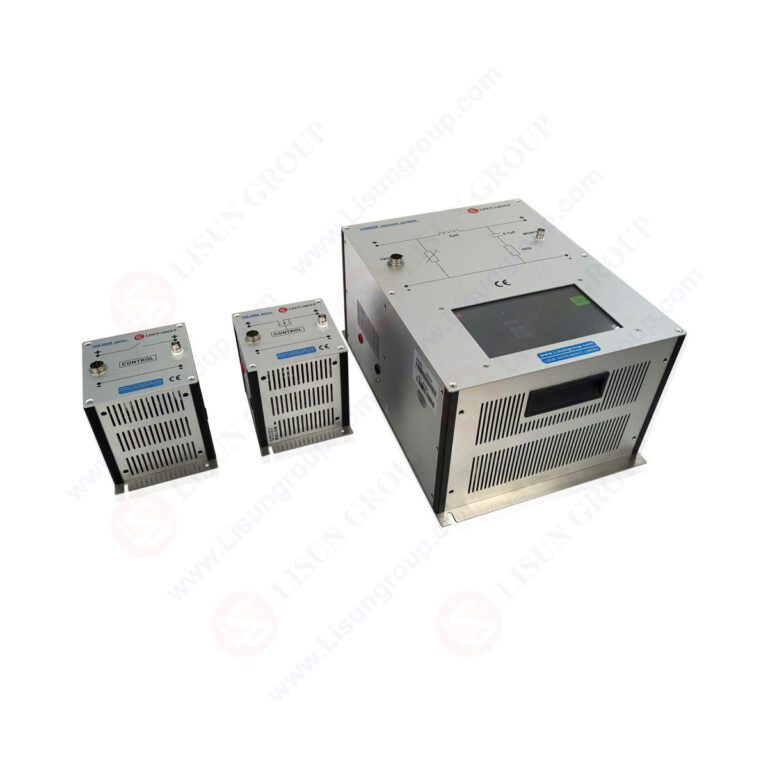
The RFCI61000-6 series integrates the RF signal source, power amplifier, and power meter into a single enclosure. This design eliminates inter-cabinet cabling losses and reduces system footprint by approximately 60% compared to modular solutions. The integrated architecture maintains stable output impedance across the full frequency range, critical for achieving repeatable conducted disturbance compliance results.
2.2 Dual Power Variants: 35W and 85W Configurations
| Model Variant | Output Power | Voltage Capability | CDN Compatibility | Typical Applied Standard |
|---|---|---|---|---|
| RFCI61000-6-35W | 35W | 0.1-10 Vrms | CDN-M1/M2/M3, CDN-AF2 | IEC 61000-4-6 Level 3 |
| RFCI61000-6-85W | 85W | 0.1-20 Vrms | Full CDN family | IEC 61000-4-6 Level 4 |
| System Resolution | ±0.1 dB | 0.01 Vrms steps | 50 Ω standardized | All injection methods |
3.1 Amplitude Modulation and Pulse Modulation Implementation
The RFCI61000-6 series supports amplitude modulation at 1 kHz with 80% depth as required by IEC 61000-4-6 Clause 6.2.1. The system generates pulse modulation with adjustable duty cycles from 10% to 90%, enabling testing against custom waveforms defined in product-family standards. Modulation accuracy stays within ±1% across the entire frequency range, ensuring test repeatability.
3.2 Frequency Sweep and Level Control Mechanisms
Automated frequency sweeps operate in linear, logarithmic, or user-defined step sequences. The touchscreen interface provides real-time visualization of forward power, reflected power, and voltage standing wave ratio (VSWR) during sweeps. Level control algorithms adjust output power dynamically to maintain the target voltage at the EUT port, compensating for CDN insertion loss variations across frequency.
4.1 Supported CDN Types and Impedance Matching
The RFCI61000-6 series interfaces with all standard CDN types from multiple manufacturers. The system monitors VSWR at each frequency point and alerts operators when impedance mismatch exceeds 2.0:1. Low VSWR is maintained through precision calibration stored in non-volatile memory. Switching between CDN-M1 (mains) and CDN-AF2 (signal lines) requires no hardware reconfiguration except cable connection changes.
4.2 Calibration Verification and Quality Assurance
Built-in calibration verification routines perform automated checks against internal reference standards. The system measures forward power, reflected power, and actual voltage at the CDN output port, storing calibration curves for each CDN type. This data enables traceability to national standards per ISO 17025 requirements, essential for accredited testing laboratories.
5.1 LED Lighting and Driver Immunity Validation
LED power drivers face conducted disturbances from switching power supplies in adjacent fixtures. The RFCI61000-6-35W variant provides sufficient power for testing single-phase LED drivers per EN 61000-4-6 requirements. Testing with CDN-M1 simulates real-world mains-borne interference, while CDN-AF2 validates DALI or 0-10V dimming control line immunity.
5.2 Medical Device Compliance to EN 60601-1-2
Medical electrical equipment requires conducted immunity testing per EN 60601-1-2 Edition 4.1, referencing IEC 61000-4-6 test methods. The RFCI61000-6-85W supports testing life-support and critical care equipment needing Level 4 test levels. Integrated reporting functions generate compliance documentation matching IEC 61000-4-6 Clause 9 reporting requirements.
5.3 Industrial Control and New Energy Charging Infrastructure
Programmable logic controllers (PLCs) and variable frequency drives require conducted immunity testing across multiple port types. The RFCI61000-6 series supports sequential testing of power, signal, and control ports without manual cable swaps through the intelligent switching interface. For EV charging stations per GB/T 18487, the system validates conducted immunity up to 80 MHz per GB/T 17626.6.
6.1 Output Power Stability and Linearity
Output power stability remains within ±0.5 dB over 8-hour test periods. Linearity across the 150 kHz to 230 MHz band stays within ±1.5 dB after calibration. The power meter measures forward and reflected power with ±0.3 dB accuracy traceable to national standards.
6.2 Spurious Emissions and Harmonic Distortion
Harmonic distortion remains below -30 dBc across the operating frequency range. Spurious emissions outside the measurement bandwidth are suppressed below -40 dBc, preventing interference with co-located test equipment. These specifications meet IEC 61000-4-6 Annex A requirements for test equipment performance.
7.1 Integrated Versus Modular Test System Evaluation
| Parameter | RFCI61000-6 Series | Modular Replacements |
|---|---|---|
| System Setup Time | 15 minutes | 45-90 minutes |
| Calibration Stability | 12-month cycle | 3-6 month cycle |
| Inter-cabinet Cabling | Not applicable | Multiple RF cables |
| Touchscreen Interface | 7-inch color display | Separate controllers |
| Total System Cost | Single purchase | 3-4 component purchases |
7.2 Frequency Range Extensions and Upgrade Paths
The base 150 kHz to 230 MHz range covers all IEC 61000-4-6 required frequencies. Optional filter modules extend operation to 300 MHz for emerging standards. Firmware updates enable new modulation schemes and test routines without hardware changes, protecting capital investment as standards evolve.
The LISUN RFCI61000-6 series delivers a complete conducted immunity test solution spanning 150 kHz to 230 MHz with dual power variants meeting Levels 1-4 requirements. The integrated signal source, power amplifier, and power meter design reduces setup complexity while maintaining ±0.5 dB power stability. Support for all CDN types ensures compatibility with existing test fixtures for LED, medical, industrial, and new energy applications. Compliance with IEC 61000-4-6, EN 61000-4-6, and GB/T 17626.6 makes this system suitable for global regulatory programs. The calibrated VSWR monitoring and automated sweep functions provide the repeatability required for accredited laboratories, while the single-unit architecture reduces total cost of ownership compared to modular systems.
Q1: What CDN types are compatible with the LISUN RFCI61000-6 series for conducted immunity testing?
A: The RFCI61000-6 series supports all standard CDN types listed in IEC 61000-4-6 Clause 7.2, including CDN-M1, M2, M3 for mains power lines, CDN-AF2 and AF3 for signal lines, and CDN-T for telecom ports. The system maintains 50 Ω output impedance matching with any CDN exhibiting VSWR below 2.0:1. Calibration curves can be stored for up to 10 different CDN types, allowing rapid switching between test configurations without recalibration. The integrated power meter measures actual voltage at the CDN output port, compensating for insertion loss variations across the 150 kHz to 230 MHz frequency range. This compatibility ensures the system can upgrade existing test facilities without replacing expensive CDN hardware.
Q2: How does the RFCI61000-6-35W differ from the RFCI61000-6-85W in practical testing scenarios?
A: The primary difference lies in output power capability, which directly affects the achievable test voltage levels and CDN compatibility. The 35W variant generates up to 10 Vrms, sufficient for IEC 61000-4-6 Level 3 testing of most commercial and light industrial equipment. The 85W variant reaches 20 Vrms, supporting Level 4 for harsh industrial environments and medical life-support equipment per EN 60601-1-2. The 85W model also maintains lower harmonic distortion at high output levels, important for testing EUTs with sensitive front-end filters. Both variants share the same frequency range, modulation capabilities, and touchscreen interface, allowing laboratories to select based on maximum test level requirements.
Q3: What calibration procedures are recommended for maintaining RFCI61000-6 series accuracy?
A: The system includes automated calibration verification routines that should be performed before each test session. Full calibration per ISO 17025 guidelines is recommended annually, with temperature-compensated internal references maintaining stability between service intervals. The built-in calibration procedure measures forward power, reflected power, and actual voltage at the CDN interface, comparing results against stored reference data. Operators should verify VSWR at each test frequency before commencing formal certification testing. The system automatically logs calibration dates and provides expiration warnings, supporting quality management system requirements for accredited EMC laboratories.
Q4: Can the LISUN RFCI61000-6 series be used for testing equipment with multiple cable ports simultaneously?
A: The system is designed for single-port injection per IEC 61000-4-6 Clause 7.3, which requires testing each port independently. The intelligent switching interface allows automated sequential testing of up to six ports without manual cable changes. For equipment with power, signal, and control ports, the system can run a complete test sequence for each port, storing results separately. The touchscreen interface displays per-port test progress and generates combined reports. Future firmware updates may extend simultaneous multi-port capability, but current best practice follows the standard’s sequential approach to ensure repeatable coupling conditions at each injection point.