









Abstract
The High-Accuracy AC & DC Power Meter for EMC Harmonic Current Testing represents a critical advancement in precision electrical measurement for compliance-driven industries. This article examines the technical architecture, measurement capabilities, and regulatory alignment of LISUN’s LS2050 series digital power meters, designed specifically for EMC harmonic current analysis per EN/IEC61000-3-2 and LM-79 standards. These instruments combine digital sampling waveform analysis with automatic range switching to deliver accurate power measurements across AC and DC systems from 0.5Hz to 100kHz. Targeting electrical testing engineers, quality control managers, and R&D professionals in LED manufacturing and automotive electronics, the LS2050 series offers model-specific accuracy grades—from standard (LS2050B) to high-accuracy (LS2050C) and full EMC harmonic compliance (LS2050C-IEC). This article provides a comprehensive technical evaluation of measurement principles, compliance capabilities, hardware specifications, and practical application considerations for professionals requiring validated power quality data.
1. Technical Foundation of High-Accuracy AC/DC Power Measurement
1.1 Digital Sampling Waveform Analysis
The core measurement engine of the High-Accuracy AC & DC Power Meter for EMC Harmonic Current Testing employs digital sampling waveform analysis, a methodology that captures instantaneous voltage and current values at high sampling rates. Unlike analog averaging methods, digital sampling reconstructs the actual waveform shape, enabling precise calculation of true RMS values, active power, and apparent power even under highly distorted conditions. This approach is essential for EMC harmonic testing, where non-sinusoidal waveforms containing significant harmonic content must be analyzed accurately. The sampling architecture processes up to 50 harmonic orders using the IEC/CSA calculation method, ensuring compliance with international distortion measurement protocols.
1.2 Automatic Range Switching Technology
Automatic range switching eliminates manual intervention when measuring variable loads, a critical feature for production testing environments where load characteristics change rapidly. The LS2050 series continuously monitors input signals and switches voltage and current ranges within microseconds, maintaining optimal resolution and preventing saturation errors. The system supports instantaneous maximum voltage of 1600V and maximum current of 50A, providing substantial headroom for transient events without compromising measurement accuracy. This capability is particularly valuable for LED driver testing, where inrush currents and dynamic load variations require robust range management.
1.3 AC/DC Compatibility and Wide Frequency Range
A defining characteristic of the LS2050 series is simultaneous AC and DC measurement capability, eliminating the need for separate instruments when testing mixed-signal systems. The frequency measurement range extends from 0.5Hz to 100kHz, covering power line frequencies, intermediate harmonics, and high-frequency switching components found in modern power electronics. This wide bandwidth enables accurate characterization of PWM drives, switch-mode power supplies, and automotive electrical systems where DC components coexist with AC ripple and harmonic distortion. The instrument automatically detects signal type and applies appropriate measurement algorithms without user configuration.
2. Model Variations and Accuracy Specifications
2.1 LS2050B: Standard Accuracy for Production Testing
The LS2050B model targets high-volume production environments requiring reliable, cost-effective power measurement. With standard accuracy specifications sufficient for pass/fail testing of LED luminaires and consumer electronics, this variant performs harmonic analysis up to the 50th order while maintaining measurement uncertainty within typical production tolerance bands. The LS2050B includes RS232 and RS485 communication ports for integration with automated test systems, supporting continuous data logging and remote parameter configuration. Its automatic range switching capability ensures uninterrupted testing across varying load conditions without operator intervention.
2.2 LS2050C: High Accuracy for Research and Validation
The LS2050C model upgrades measurement precision for R&D laboratories and quality validation centers where tighter uncertainty budgets are required. Enhanced analog front-end components and refined calibration algorithms reduce measurement errors in power factor, displacement factor, and harmonic magnitude calculations. This model is particularly suited for characterizing prototype LED drivers, automotive inverters, and industrial power supplies where small efficiency improvements or harmonic reduction designs must be verified with statistical confidence. The LS2050C maintains the same frequency range and communication interfaces while offering improved signal-to-noise ratio at low power levels.
2.3 LS2050C-IEC: Full EMC Harmonic Compliance
The LS2050C-IEC variant is specifically configured for mandatory EMC harmonic current compliance testing per EN/IEC61000-3-2. This model incorporates pre-programmed test sequences, automatic limit evaluation, and reporting functions aligned with international regulatory requirements. Built-in reference impedance networks and calibrated current shunts ensure traceability to national standards, reducing the risk of non-compliance due to measurement uncertainty. The LS2050C-IEC also supports the LM-79 testing protocol for solid-state lighting products, providing a unified compliance platform for manufacturers exporting to multiple regulated markets.
| Specification | LS2050B | LS2050C | LS2050C-IEC |
|---|---|---|---|
| Voltage Accuracy | ±0.2% reading ±0.1% range | ±0.1% reading ±0.05% range | ±0.1% reading ±0.05% range |
| Current Accuracy | ±0.2% reading ±0.1% range | ±0.1% reading ±0.05% range | ±0.1% reading ±0.05% range |
| Power Accuracy | ±0.3% reading ±0.1% range | ±0.15% reading ±0.05% range | ±0.15% reading ±0.05% range |
| Harmonic Analysis | Up to 50th order | Up to 50th order | Up to 50th order |
| Compliance Features | Basic | Enhanced | Full EN/IEC61000-3-2 |
| Communication Ports | RS232, RS485 | RS232, RS485 | RS232, RS485 |
| Frequency Range | 0.5Hz – 100kHz | 0.5Hz – 100kHz | 0.5Hz – 100kHz |
| Maximum Transient Voltage | 1600V instantaneous | 1600V instantaneous | 1600V instantaneous |
| Maximum Transient Current | 50A instantaneous | 50A instantaneous | 50A instantaneous |
3. Harmonic Analysis and EMC Compliance
3.1 Harmonic Measurement Methodology
The High-Accuracy AC & DC Power Meter for EMC Harmonic Current Testing implements discrete Fourier transform (DFT)-based harmonic analysis according to IEC 61000-4-7 guidelines. The instrument samples input waveforms over integer cycles of the fundamental frequency, then decomposes the signal into individual harmonic components up to the 50th order. For each harmonic order, the meter calculates magnitude, phase angle, and contribution to total harmonic distortion (THD). The IEC/CSA method applies a rectangular window with synchronous sampling, ensuring that spectral leakage is minimized and that each harmonic bin contains only the intended frequency component. This approach produces repeatable results essential for compliance documentation.
3.2 EN/IEC61000-3-2 Compliance Testing
EN/IEC61000-3-2 imposes strict limits on harmonic current emissions for equipment connected to public low-voltage distribution systems. The LS2050C-IEC model automates the compliance process by applying the appropriate limit class (A, B, C, or D) based on equipment type and input current waveform characteristics. For Class C lighting equipment, the instrument evaluates harmonic current limits relative to the fundamental current, applying the displacement factor corrections required by the standard. The integrated reporting function generates test reports containing measured harmonic magnitudes, limit values, pass/fail status, and measurement uncertainty calculations—directly supporting quality documentation for certification bodies.
3.3 LM-79 Testing for Solid-State Lighting
LM-79, the approved method for electrical and photometric measurements of solid-state lighting products, requires precise AC power measurement under controlled conditions. The LS2050C-IEC satisfies LM-79 requirements by providing stabilized power measurement averaging over multiple line cycles, reducing the impact of mains voltage fluctuations. The instrument simultaneously measures voltage, current, power, power factor, and displacement factor, enabling calculation of luminous efficacy when combined with photometric data. Compliance with both EN/IEC61000-3-2 and LM-79 from a single instrument reduces test setup complexity and measurement uncertainty correlations between electrical and photometric parameters.
4. Hardware Architecture and Overload Protection
4.1 High Overload Capacity Design
Industrial testing environments subject instruments to unpredictable transient events, including inrush currents, switching surges, and accidental overloads. The LS2050 series incorporates robust input protection rated for 1600V instantaneous maximum voltage and 50A instantaneous maximum current. This overload capacity protects sensitive measurement circuits without requiring external protection devices that could introduce measurement errors or response delays. The input stages use metal oxide varistors (MOVs), transient voltage suppression (TVS) diodes, and self-resetting thermal fuses arranged in a hierarchical protection scheme that responds within microseconds to overvoltage or overcurrent events.
4.2 Communication and System Integration
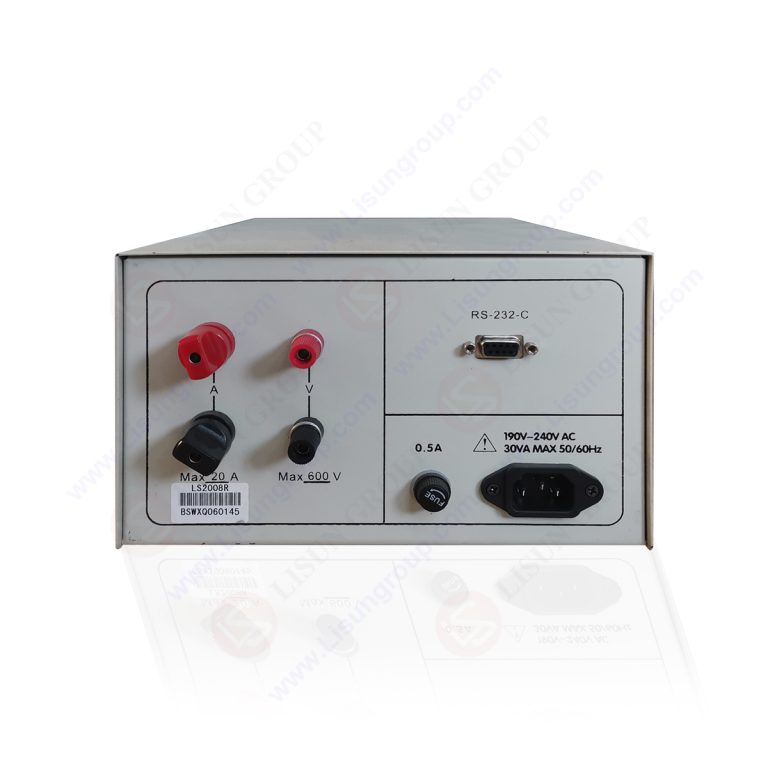
RS232 and RS485 communication ports provide flexibility for integrating the LS2050 series into automated test systems, data acquisition networks, and manufacturing execution systems. RS232 offers simple point-to-point connectivity for bench-top use or direct connection to a single computer, supporting baud rates up to 115200 bps for real-time data streaming. RS485 enables multi-drop configurations where up to 32 instruments share a single communication bus, suitable for production lines with multiple test stations. Both interfaces support MODBUS RTU protocol, allowing compatibility with PLCs, SCADA systems, and industrial controllers without custom driver development.
5. Application-Specific Measurement Capabilities
5.1 Power Factor and Displacement Factor Analysis
The LS2050 series measures both power factor (true PF) and displacement factor (cos φ), providing comprehensive characterization of power quality. Power factor represents the ratio of active power to apparent power, incorporating both phase displacement and harmonic distortion effects. Displacement factor isolates the phase angle between fundamental voltage and current, excluding harmonic contributions. This distinction is critical for evaluating power factor correction circuits, where the fundamental displacement factor indicates correction effectiveness while the true power factor reveals harmonic-related losses. The instrument displays both values simultaneously, enabling engineers to differentiate between phase-shift and distortion-related power quality issues.
5.2 Frequency Measurement and Power Quality Assessment
Frequency measurement from 0.5Hz to 100kHz supports applications ranging from mains frequency stability analysis to switching frequency characterization of power converters. For mains-connected equipment, the instrument tracks line frequency variations and reports minimum, maximum, and average values over user-defined intervals. In variable frequency drive testing, the wide bandwidth captures PWM carrier frequencies and their harmonic sidebands, enabling assessment of output filter effectiveness and motor winding stress. The frequency measurement function operates continuously without interrupting power calculations, ensuring uninterrupted data collection for long-duration validation tests.
6. Compliance Standards and Certification
6.1 IEC 61010 Safety Compliance
The LS2050 series is designed and tested in accordance with IEC 61010, the safety standard for electrical measurement, control, and laboratory equipment. This certification ensures that the instrument provides adequate protection against electric shock, mechanical hazards, and fire under normal and single-fault conditions. The input terminals are rated for measurement category II (CAT II) applications, suitable for testing equipment connected to mains power outlets. Internal isolation barriers separate the measurement circuits from communication interfaces and power supplies, maintaining safety integrity even during transient overvoltage events. Compliance with IEC 61010 is verified through independent testing laboratories and documented in the product certification package.
6.2 UL 1989 Recognition
UL 1989, the standard for measurement instruments intended for industrial and laboratory use, addresses additional requirements for electromagnetic compatibility, environmental resistance, and construction quality. The LS2050 series achieves UL recognition by demonstrating immunity to electrostatic discharge, radiated electromagnetic fields, and conducted disturbances at levels specified for industrial environments. This recognition is particularly important for automotive electronics testing facilities and manufacturing plants where electromagnetic noise from welding equipment, motor drives, and switching power supplies could otherwise cause measurement errors. UL 1989 compliance provides assurance that the instrument maintains specified accuracy under realistic industrial conditions.
6.3 CIE and International Standards Alignment
The LS2050 series aligns with CIE (International Commission on Illumination) standards for photometric and colorimetric measurement systems, ensuring that electrical measurements are traceable to the same metrological framework as photometric measurements. This alignment is essential for LED manufacturers who must correlate electrical input power with luminous output to calculate efficacy values for regulatory submissions. The instrument’s calibration is traceable to national standards through accredited laboratories, with calibration certificates documenting measurement uncertainty at each test point. Users can request recalibration services that maintain this traceability chain, supporting ISO 17025 laboratory accreditation requirements.
7. Target Industry Applications
7.1 LED Manufacturing Testing
LED manufacturing facilities require high-throughput testing of drivers, modules, and luminaires while maintaining traceability to regulatory standards. The LS2050B model serves production lines where rapid pass/fail decisions are made based on power consumption, power factor, and harmonic current limits. The LS2050C-IEC model supports engineering validation labs where detailed harmonic characterization is performed during product development and compliance certification. Automatic range switching eliminates test delays when switching between product types with different power ratings, while RS485 communication enables centralized data collection from multiple test stations.
7.2 Automotive Electronics Validation
Automotive electronics operate under stringent electrical environment requirements, including conducted emissions limits specified in CISPR 25 and ISO 7637. The LS2050C model provides the measurement accuracy needed to characterize DC-DC converters, inverters, and battery management systems during design validation. The 100kHz frequency bandwidth captures switching harmonics from modern SiC and GaN power devices, while the harmonic analysis function identifies problematic frequency components before EMC pre-compliance testing. The AC/DC capability supports testing of hybrid and electric vehicle components that combine battery DC power with AC motor drive circuits.
8. Conclusion
The High-Accuracy AC & DC Power Meter for EMC Harmonic Current Testing series from LISUN delivers precise, compliant electrical measurement for demanding industrial applications. The LS2050B, LS2050C, and LS2050C-IEC models provide graded accuracy levels suited to production testing, R&D validation, and full EMC compliance certification, respectively. Core technologies including digital sampling waveform analysis, automatic range switching, and harmonic analysis up to the 50th order ensure accurate characterization of distorted waveforms found in modern power electronics. The instruments support multiple industry standards simultaneously—EN/IEC61000-3-2 for harmonic emissions, LM-79 for solid-state lighting, IEC 61010 for safety, and UL 1989 for industrial environment recognition. Hardware features such as 1600V overload protection, 100kHz bandwidth, and RS232/RS485 communication enable robust integration into automated test systems. For electrical testing engineers, quality control managers, and R&D professionals in LED manufacturing and automotive electronics, the LS2050 series provides the measurement confidence required to validate products for regulated markets worldwide.
FAQ
Q1: What is the difference between power factor and displacement factor, and why does the LS2050 series measure both?
A: Power factor (PF) represents the ratio of active power (real power consumed by the load) to apparent power (product of RMS voltage and RMS current). Displacement factor (cos φ) isolates the phase angle between the fundamental voltage and fundamental current waveforms, excluding harmonic components. The LS2050 series measures both parameters because they diagnose different power quality issues. In a linear load, PF equals cos φ. However, in non-linear loads such as LED drivers or switching power supplies, harmonic currents reduce PF while cos φ may remain near unity. This distinction helps engineers determine whether power factor correction should target phase displacement (through capacitor banks or active front ends) or harmonic mitigation (through filters or improved rectifier designs). The LS2050 series displays both values in real time, enabling informed design decisions.
Q2: How does the LS2050C-IEC automate EN/IEC61000-3-2 harmonic current compliance testing?
A: The LS2050C-IEC model incorporates pre-programmed test routines that automatically identify the applicable equipment class (A, B, C, or D) based on input current waveform analysis and user-defined equipment type. During testing, the instrument samples voltage and current over the specified measurement interval (typically 1.5 minutes for Class C lighting equipment), captures harmonic magnitudes up to the 50th order, and compares each harmonic to the standard’s limit values. The instrument applies the appropriate formulas for each class—for example, Class C limits are expressed as percentages of fundamental current with displacement factor adjustments. Test results are displayed as pass/fail for each harmonic order, with an overall compliance verdict. The system generates comprehensive reports containing measured values, limit values, test conditions, and measurement uncertainty, which can be exported via RS232 or RS485 for integration into compliance documentation packages.
Q3: Can the LS2050 series measure real-time power consumption of variable loads such as dimmable LED systems?
A: Yes, the LS2050 series is designed to measure dynamic loads with automatically varying power consumption. The digital sampling waveform analysis continuously captures instantaneous voltage and current values, updating power calculations at the instrument’s internal sampling rate (typically several kilohertz). This enables accurate tracking of dimming curves, warm-up transients, and load modulation effects. The automatic range switching function adjusts voltage and current ranges during measurement without interrupting data continuity, ensuring that both low-level dimmed operation and full-power operation are measured with optimal resolution. For statistical analysis, the instrument can log minimum, maximum, and average power values over user-defined integration periods. This capability is essential for characterizing LED drivers that implement pulse-width modulation dimming or phase-cut dimmer compatibility, where instantaneous power varies significantly within each line cycle.
Q4: What considerations should be made when integrating the LS2050 series into an automated production test system?
A: When integrating LS2050 instruments into automated test systems, consider communication protocol selection (RS232 for single-point or RS485 for multi-drop), electrical isolation requirements, and synchronization with other test equipment. The RS485 multi-drop configuration supports up to 32 instruments on a single bus, with each unit assigned a unique MODBUS address. Ensure that cable length and termination resistors comply with RS485 standards (typically 1200 meters maximum with proper termination). For production environments with electromagnetic interference, use shielded twisted-pair cables and route communication lines separately from power cables. The instrument’s MODBUS RTU protocol provides direct access to measurement registers, allowing programmable logic controllers or test executive software to read voltage, current, power, harmonic magnitudes, and status flags without parsing ASCII strings. For high-speed testing, minimize latency by configuring the instrument to output data at the fastest supported baud rate and by requesting only the registers required for pass/fail decisions.