









Here is the technical article on the LISUN HSCD Series Portable Color Spectrophotometer, structured according to your specifications.
Abstract
Precise color analysis is a critical parameter for quality control across manufacturing, ensuring brand consistency and product conformity. The LISUN HSCD Series Portable Color Spectrophotometer for Precise Color Analysis offers a robust solution for professionals needing high-accuracy, portable measurement. This series, featuring models like the HSCD-780, HSCD-800, and HSCD-860, utilizes advanced grating spectroscopy and a dual-beam optical design to deliver reliable data. This article details the core technologies, application scenarios, and compliance with international standards that make the HSCD series a vital tool for R&D and QC laboratories.
1.1 Grating Spectroscopy and Image Sensor Technology
The LISUN HSCD series employs a high-resolution diffraction grating system to separate polychromatic white light into its constituent spectral components. Unlike traditional filter-based colorimeters, this spectroscopic method provides full spectral reflectance data across the visible range (400-700 nm). The instrument couples this with a high-sensitivity, dual-row 256-pixel CMOS image sensor array. This configuration allows for wavelength resolution at a pitch of 10 nm, enabling the detection of subtle color differences—essential for evaluating complex materials like metallic coatings or fluorescent textiles.
1.2 Dual-Beam Optical Design for Stability
Thermal drift and lamp aging are common error sources in portable color measurement. The HSCD series mitigates this through a dual-beam optical path. One beam measures the sample’s spectral reflectance (sample beam), while the second monitors the light source output (reference beam). By continuously comparing these two signals, the instrument corrects for fluctuations in real-time. This architecture ensures measurement repeatability of ( Delta E{ab}^* leq 0.03 ) (white tile) and inter-instrument agreement of ( Delta E{ab}^* leq 0.15 ), granting confidence for multi-site production facilities.
1.3 Illuminant and Observer Compliance
The spectrophotometer is engineered to simulate multiple standard CIE illuminants (D65, A, C, and F series). It supports standard observer angles of ( 2^circ ) and ( 10^circ ). This flexibility allows users to compute color coordinates under conditions that best match their product’s end-use environment. The optical geometry uses ( d/8^circ ) (diffuse illumination, ( 8^circ ) viewing), which includes a specular component trap to switch between SCI (Specular Component Included) and SCE (Specular Component Excluded) modes, critical for distinguishing gloss from true color.
2.1 Model Comparison: HSCD-780, HSCD-800, and HSCD-860
The series is differentiated by measurement apertures and repeatability grades. The following table provides a direct comparison.
| Feature | Model HSCD-780 | Model HSCD-800 | Model HSCD-860 |
|---|---|---|---|
| Measurement Aperture | Φ20mm / Φ10mm / Φ6mm | Φ20mm / Φ10mm / Φ6mm / Φ4mm | Φ20mm / Φ10mm / Φ6mm / Φ4mm |
| Repeatability (White Tile) | ( Delta E_{ab}^* leq 0.03 ) | ( Delta E_{ab}^* leq 0.02 ) | ( Delta E_{ab}^* leq 0.01 ) |
| Inter-Instrument Agreement | ( Delta E_{ab}^* leq 0.20 ) | ( Delta E_{ab}^* leq 0.15 ) | ( Delta E_{ab}^* leq 0.12 ) |
| Light Source | LED Array + UV LED | LED Array + UV LED | Xenon Arc (Pulsed) |
| Wavelength Range | 400-700nm / 360-780nm | 400-700nm / 360-780nm | 360-780nm |
| Connectivity | USB, Bluetooth 5.0 | USB, Wi-Fi, Bluetooth 5.0 | USB, Wi-Fi, Bluetooth 5.0, RS-232 |
2.2 Aperture Selection for Diverse Materials
The ability to switch between Φ4mm and Φ20mm apertures is critical for sample heterogeneity. For textured plastics or textiles, a larger aperture (Φ20mm) averages surface irregularities. For printed ink dots or small automotive interior parts, the Φ4mm aperture isolates specific areas. The HSCD-800 and HSCD-860 offer the full set of four apertures, making them suitable for laboratories handling a wide range of sample sizes.
3.1 Nano-Integrated Optical Devices
The HSCD series incorporates nano-integrated optical components in its light mixing chamber. This technology involves the precise layering of optical coatings to enhance light diffusion uniformity. The result is a Lambertian-like illumination plane over the sample port, ensuring that the measurement angle of incidence is consistent across the entire aperture. This reduces measurement variance caused by sample texture or orientation, a common flaw in lower-cost portable units.
3.2 Zirconium Calibration Whiteboard Stability
Traditional calibration whiteboards often degrade over time due to UV exposure or oxidation. The HSCD series uses a zirconium-based ceramic whiteboard for baseline calibration. Zirconium oxide (( text{ZrO}_2 )) provides high reflectance (>97%) across the spectrum and exceptional chemical and thermal stability. This ensures that the instrument’s reference standard remains stable over years of use, and periodic calibration against national standards (NIST traceable) is valid for longer intervals, reducing downtime for QC labs.
3.3 Compliance with International Standards
The LISUN HSCD series is designed to meet strict global standards for color measurement.
- CIE No.15: Defines the standard colorimetric observers and color spaces used (CIELAB, CIELUV).
- ASTM E1164: Specifies procedures for obtaining spectrophotometric data for color evaluation.
- ISO 7724-1 & DIN 5033 Teil7: Govern the principles and methods for color measurement in paints and plastics.
- GB/T 3978: The Chinese national standard for standard illuminants and geometric conditions, ensuring compatibility with domestic manufacturing.
4.1 Plastics and Coatings Manufacturing
In the plastics industry, color consistency across masterbatch batches is critical. The HSCD series measures the yellowness index (ASTM E313) and whiteness index (ISO 2470). For coatings, the instrument can evaluate hiding power by measuring reflectance over black and white substrates. The dual SCI/SCE mode allows a lab technician to determine whether a color mismatch is due to pigment dispersion (SCI) or surface gloss (SCE).
4.2 Textiles and Automotive Interiors
Textile color measurement is challenging due to fiber weave and pile direction. The HSCD’s multi-orientation measurement averaging (automatic 5-15 second measuring mode) can capture data from multiple angles in a single cycle. For automotive interiors, materials must match across leather, plastic, and fabric components. The instrument’s high inter-instrument agreement (( Delta E_{ab}^* leq 0.15 )) ensures that a supplier in one region can match the color standard of a primary manufacturer in another.
5.1 Real-Time Spectrophotometric Analysis Software
LISUN provides proprietary software that displays spectral reflectance curves, color strength (K/S values), and pass/fail tolerances. The software calculates multiple color difference formulas (CIE76, CIE94, CIEDE2000) and metamerism indices. This allows users to evaluate how colors will appear under different light sources, a key function for retail packaging that must look consistent under fluorescent, incandescent, and natural light.
5.2 Connectivity for Industry 4.0 Workflows
Data transfer is facilitated via USB-C for wired connection and Bluetooth 5.0 or Wi-Fi for wireless operation. The HSCD-860 model includes an RS-232 port for integration with PLC systems, allowing automated sorting rejection. QC managers can export data directly to CSV or PDF, bypassing manual transcription errors. The software supports PC and Android platforms, making field measurements as easy to record as lab measurements.
6.1 Color Analysis for Safety and Signage
For manufacturers of safety signs and reflective clothing, the instrument complies with GB 2893 (safety colors) and GB/T 18833 (reflective films). It measures the chromaticity coordinates and luminance factor (Y) to verify that safety yellows and oranges fall within the required CIE trapezoids. This ensures visibility and compliance before products reach regulatory testing.
6.2 Evaluating Degradation and Aging
The HSCD series is used to quantify UV aging in paints and polymers. By measuring the change in ( Delta E_{ab}^* ) and the Yellowness Index (ASTM D1925) before and after accelerated weathering, R&D engineers can predict service life. The instrument’s UV LED or Xenon source helps capture degradation in the 360-400 nm range, providing data on how materials yellow or fade without subjective visual assessment.
7.1 Automatic Calibration and Ergonomic Design
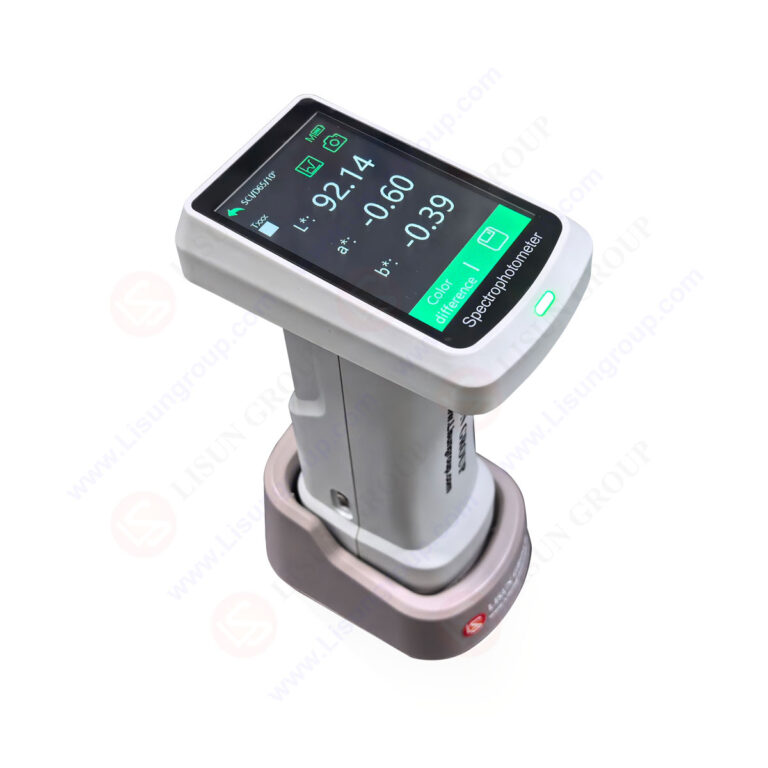
The series features a black trap and automatic white calibration routine that completes in under 10 seconds. The handheld design includes a large 3.5-inch touch screen with a live camera preview to aid accurate sample positioning. This reduces operator learning time significantly.
7.2 Battery Life and Environmental Durability
Equipped with a high-capacity lithium battery, the HSCD series supports over 10,000 continuous measurements on a single charge. It operates in a temperature range of 0°C to 45°C and non-condensing humidity up to 85%. This durability is essential for field inspectors moving between a warehouse and a production floor.
The LISUN HSCD Series Portable Color Spectrophotometer for Precise Color Analysis delivers laboratory-grade accuracy in a mobile form factor. Its dual-beam drift correction, multi-aperture system, and zirconium-based calibration ensure repeatability that rivals bench-top instruments. By supporting a wide range of global standards—from CIE and ASTM to GB/T and ISO—the HSCD series provides the versatility needed for plastics, textiles, automotive, and safety industries. For quality control managers and R&D engineers seeking to minimize color variation and guarantee product visual quality, the LISUN HSCD series is a technically sound investment in production consistency.
*Q1: How does the LISUN HSCD-860 achieve a measurement repeatability of ( Delta E_{ab}^ leq 0.01 )?*
A: The HSCD-860 achieves this high level of repeatability through a combination of a pulsed Xenon arc lamp and a dual-beam optical feedback system. The Xenon source provides a continuous spectrum from 360-780nm with high stability, while the dual-beam channel monitors the lamp’s output in real-time. Simultaneously, a high-resolution grating and a precision image sensor reduce signal noise. This configuration, coupled with automatic black/white calibration, eliminates the effects of lamp aging and thermal drift, ensuring that multiple measurements of the same white tile yield a color difference of less than ( Delta E_{ab}^ leq 0.01 ).
Q2: What is the difference between SCI and SCE measurement modes, and when should I use them?
A: SCI (Specular Component Included) measures total color, including light reflected off the surface (gloss). It is preferred for pigment formulation and color quality pass/fail. SCE (Specular Component Excluded) measures only the diffuse reflected light, ignoring gloss. Use SCE to evaluate the true color of a surface independent of its finish, or when matching colors between matte and glossy materials. The d/8° geometry of the HSCD series allows easy switching between these modes.
Q3: Can the HSCD series measure the metamerism index of a sample?
A: Yes. The HSCD series software can calculate a Metamerism Index (MI). The instrument measures the spectral reflectance curve of the sample. The software then computes the color difference (( Delta E_{ab}^* )) under two different illuminants (e.g., D65 and A). A high MI indicates that two samples may match under fluorescent light but appear mismatched under incandescent light. This is critical for automotive and textiles where color consistency across light sources is required.
Q4: How does the instrument handle calibration for different aperture sizes?
A: The HSCD series uses a dynamic calibration algorithm. When the user manually selects the measurement aperture (via the touch screen), the instrument references a specific calibration file stored on the device. Each aperture position (Φ4mm, Φ6mm, Φ10mm, Φ20mm) has a unique correction matrix derived from the master white reference. The user must perform a standard white calibration after switching apertures to ensure the photometric scale is accurate for that specific beam geometry. The zirconium whiteboard ensures this baseline is stable.