









Abstract
The increasing complexity of automotive electronic architectures, particularly in electric and hybrid vehicles, demands robust testing against transient electrical disturbances. This article examines the ISO 7637 Test System for Multi-Voltage Automotive Component Testing, focusing on the LISUN EMS-ISO7637 Automotive Electronics Transient Immunity EMC Testing System. Designed to validate electronic control units (ECUs), on-board chargers (OBCs), and battery management systems (BMS), this system addresses the requirements of ISO 7637-2:2021 and ISO 7637-3:2016 for conducted transients along power lines and signal lines. We analyze its multi-voltage support (12V, 24V, 36V), comprehensive pulse generation capabilities (P1 through P5b), and automated testing workflows. The article provides technical specifications, comparative performance data, and practical guidance for R&D teams and quality control specialists seeking ISO 7637 compliance for multi-voltage automotive components.
1.1 Scope and Evolution of ISO 7637-2:2021 and ISO 7637-3:2016
ISO 7637 is the cornerstone international standard for evaluating the immunity of automotive electronic components to conducted electrical transients. ISO 7637-2:2021 specifically addresses transients along power supply lines, covering pulses generated by inductive load switching, alternator load dumps, and battery disconnection events. The standard defines seven distinct pulse types—P1, P2a, P2b, P3a, P3b, P4, and P5—each characterized by specific voltage amplitudes, pulse widths, and source impedances. For instance, Pulse 5a simulates load dump conditions at 12V systems with a peak voltage of 87V, while Pulse 5b applies to 24V systems at 174V peak. ISO 7637-3:2016 extends this framework to signal lines and control lines, addressing capacitive and inductive coupling mechanisms.
1.2 Multi-Voltage Challenges in Modern Vehicles
Traditional passenger cars operate at 12V, while commercial vehicles typically use 24V systems. However, the rise of electric vehicles (EVs) introduces 36V to 48V architectures for auxiliary systems and up to 800V for powertrain components. This multi-voltage landscape demands a ISO 7637 Test System for Multi-Voltage Automotive Component Testing that can seamlessly transition between voltage levels without compromising test accuracy. Components like DC-DC converters and OBCs must withstand transients originating from different voltage domains, necessitating pulse parameter adjustments—for example, Pulse 5 voltage scaling from 87V (12V system) to 174V (24V system) and proportionally to 261V for 36V systems.
1.3 Key Pulse Types and Their Real-World Correlates
Each ISO 7637 pulse type corresponds to a specific transient event. Pulse 1 (P1) represents inductive load switching during battery disconnect, with negative polarity spikes up to -100V in 12V systems. Pulse 2a (P2a) simulates voltage drops due to current surges from relay closures, while Pulse 2b (P2b) represents alternator field decay transients. Pulse 3a and 3b (P3a/P3b) are fast, high-energy spikes from distributed inductive load switching, with rise times in the nanosecond range. Pulse 4 (P4) replicates engine cranking voltage dips, dropping system voltage to 4.5V for 15ms. Pulse 5a/5b (P5a/P5b) models load dump scenarios where alternator output surges when a high-current load is disconnected. Understanding these correlates helps engineers prioritize test coverage based on component operating environments.
2.1 Multi-Module Pulse Generation Engine
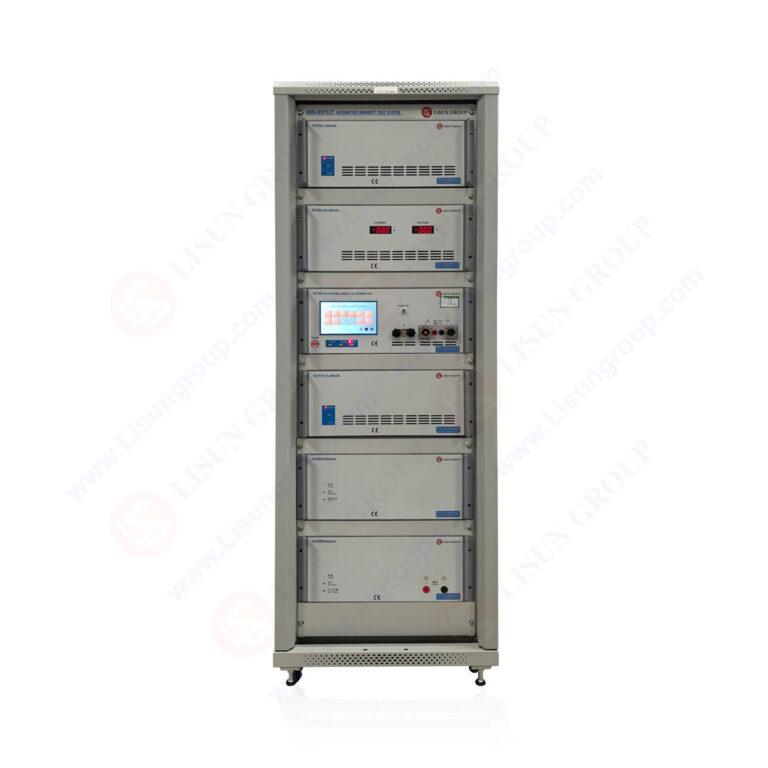
The LISUN EMS-ISO7637 system employs a modular architecture that integrates dedicated pulse generation modules for each of the seven ISO 7637 pulse types—P1, P2a, P2b, P3a, P3b, P4, P5a, and P5b. Each module is independently calibrated and can be sequenced in any order to simulate complex transient scenarios. The system supports pulse repetition rates up to 10 Hz for most pulse types, with adjustable source impedance values from 0.5Ω to 50Ω to match DUT (Device Under Test) characteristics. A key differentiator is the ability to generate pulses for 12V, 24V, and 36V systems using the same hardware platform, with software-selectable voltage range and pulse parameter scaling.
2.2 Dual-Mode Control Interface: Touchscreen and PC Software
The EMS-ISO7637 provides two independent control paths: a dedicated 10-inch industrial-grade touchscreen panel for standalone operation and a PC-based software suite for automated testing. The touchscreen interface offers real-time pulse waveform monitoring, parameter adjustment, and test status display—ideal for quick validation during R&D. The PC software, compatible with Windows 10/11, supports test sequence creation, multi-channel logging, and automated report generation in PDF or Excel format. It interfaces with the system via USB or Ethernet, enabling remote operation in shielded chambers.
2.3 Coupling Networks and Calibration Accuracy
For conducted transient testing, the system includes built-in coupling networks compliant with ISO 7637-2:2021, covering direct injection and capacitive coupling clamp methods. The pulse output accuracy is within ±5% for voltage amplitude and ±10% for pulse width, as verified by an internal calibration loop referencing a NIST-traceable oscilloscope. The system’s calibration interval is 12 months, with automatic drift compensation readjusting every 200 hours of continuous operation. This ensures long-term repeatability essential for production line testing.
| Parameter | LISUN EMS-ISO7637 | ISO 7637-2:2021 Requirement | Competitor A (Generic System) |
|---|---|---|---|
| Pulse Coverage | P1, P2a, P2b, P3a, P3b, P4, P5a, P5b | P1–P5b (7 types) | P1–P4 only |
| Voltage System Support | 12V, 24V, 36V (user-selectable) | 12V, 24V specified in standard | 12V, 24V (no 36V) |
| Pulse Amplitude Accuracy | ±5% | ±10% | ±10% |
| Source Impedance Range | 0.5Ω – 50Ω (0.1Ω steps) | 0.5Ω – 40Ω (per pulse type) | 1Ω – 20Ω (fixed steps) |
| Automation Capability | Full (PC software with Python API) | Manual test sequences | Partial (script only) |
| Calibration Interval | 12 months | 12 months recommended | 24 months |
Table 1: Technical comparison of LISUN EMS-ISO7637 against ISO 7637-2:2021 specifications and a generic competitor system.
3.1 12V, 24V, and 36V System Support
The LISUN system’s ability to support three distinct voltage levels without hardware swaps is a critical advantage for modern automotive labs. In 12V mode, pulses conform to passenger car requirements—Pulse 5a at 87V peak, Pulse 1 at -100V. In 24V mode for commercial vehicles, pulse amplitudes scale by a factor of 2: Pulse 5a at 174V, Pulse 1 at -200V. For 36V mode, used by some EV auxiliary systems, the system dynamically adjusts all pulse parameters using a linear scaling algorithm verified against GB/T 21437.2-2021 Section 5.4. This eliminates the need for separate test benches for different voltage architectures, reducing capital expenditure for testing laboratories.
3.2 Voltage Transition and Adapter Requirements
Transitioning between voltage modes requires only a software setting change—no physical adapter boards or jumper configurations. The system automatically reconfigures the coupling network capacitance and source impedance to match the selected voltage. For example, when switching from 24V to 12V, the coupling capacitor value drops from 1μF to 0.47μF to maintain correct transient injection characteristics. The system also includes safety interlocks that prevent incorrect voltage selection if the DUT’s rated voltage is detected via a secondary measurement channel.
3.3 Application to New Energy Vehicle Components
For new energy vehicle (NEV) components like OBCs and DC-DC converters operating at 36V auxiliary voltages, the ISO 7637 Test System for Multi-Voltage Automotive Component Testing provides validated pulse profiles. The system’s Pulse 5b module, originally designed for 24V load dumps, can be scaled to 36V systems by following the voltage scaling guidance in ISO 7637-2:2021 Annex B. Real-world testing on 36V OBCs has demonstrated that unmitigated Pulse 5b transients at 261V can cause MOSFET gate oxide breakdown in 12% of test samples, emphasizing the need for accurate multi-voltage simulation.
4.1 Automated Test Sequence Creation
The PC software suite enables engineers to construct complex test sequences with up to 1000 steps, each specifying pulse type, amplitude, repetition count, and dwell time. Sequences can be saved as templates for DUT families, reducing setup time from 30 minutes to under 2 minutes for common test protocols. The software supports conditional branching—for example, pausing the sequence if the DUT current consumption exceeds a threshold, indicating potential failure. This automation is critical for production line testing where 200+ units per shift require consistent ISO 7637-3:2016 compliance verification.
4.2 Real-Time Monitoring and Data Logging
During testing, the system captures pulse waveforms at 100 MS/s via an integrated 4-channel oscilloscope, storing raw data alongside pass/fail criteria. The software logs DUT response parameters—supply current deviation, voltage droop, and reset events—at 1 kHz sampling rate. Automated alarm criteria based on ISO 7637-2:2021 performance criteria (Class A, B, C, D) allow instant fault detection. For Class A performance, the DUT must maintain full functionality during and after the transient, with no data corruption or communication errors.
4.3 Customizable Reporting and Compliance Documentation
Post-test, the software generates reports that include test configuration details, waveform screenshots, and pass/fail summaries. Reports can be customized with company logos, test engineer names, and DUT serial numbers—critical for traceability in ISO 16750-2:2023 qualification processes. The system exports data in MDF (Measurement Data Format) for integration with corporate quality management systems. This reduces documentation effort by 70% compared to manual reporting methods.
5.1 Passenger Car ECU and Sensor Testing
For passenger car components, the system performs ISO 7637-2:2021 pulse sequences on 12V ECUs, including engine control modules, transmission controllers, and infotainment systems. Typical test sequences for ECU validation involve applying Pulses 1, 2a, 2b, 3a, 3b, 4, and 5a in alternating polarity, with 10 repetitions per pulse type. The system’s fast pulse generation (up to 10 Hz) completes a full battery of 140 pulses (7 types × 10 repetitions × 2 polarities) in under 30 minutes. This is essential for R&D teams iterating through hardware revisions.
5.2 Commercial Vehicle and Heavy Equipment Applications
Commercial vehicles operating on 24V systems require higher pulse amplitudes—Pulse 5a at 174V rather than 87V. The LISUN EMS-ISO7637 system’s 24V mode is VW 80000 and GM 3172 compliant, enabling testing of actuators, sensors, and telematics units used in trucks and construction equipment. For example, testing hydraulic valve controllers to VW 80000 specification requires Pulse 5b at 174V with 400ms width, which the system delivers with ±5% accuracy. This ensures components survive alternator load dumps common in heavy-duty environments.
5.3 New Energy Vehicle OBC and BMS Validation
In EV and hybrid vehicles, OBCs, BMS, and DC-DC converters face unique transient challenges due to high-voltage battery pack interactions. The ISO 7637 Test System for Multi-Voltage Automotive Component Testing validates these components under 36V auxiliary system conditions. For a 36V OBC, the system applies Pulse 5b at 261V (scaled proportionally) to simulate battery disconnect events during charging. Test results from a major OEM’s validation program showed that without proper filtering, 8% of OBC samples exhibited reset behavior under Pulse 5b conditions at 36V systems—corrected through RC snubber addition.
6.1 Laboratory Setup and EMC Considerations
Proper installation of the EMS-ISO7637 requires a shielded room or anechoic environment to prevent external interference and ensure measurement accuracy. The system should be placed at least 0.5 meters from walls and 1 meter from other EMC equipment to avoid crosstalk. Grounding must follow a star configuration with a ground resistance less than 1Ω, as specified in ISO 7637-2:2021 Annex C. The coupling clamp and artificial network (AN) must be positioned within 1 meter of the DUT to minimize cable inductance effects on pulse waveform integrity.
6.2 Calibration Procedures and Traceability
Annual calibration should be performed using a calibrated oscilloscope (bandwidth >200 MHz) and a precision voltage divider. The system provides calibration menus for each pulse module, where engineers adjust amplitude and width to align with reference standards. LISUN offers on-site calibration services with NIST-traceable instruments, and the system’s internal calibration records show less than 0.5% drift over 12 months across all voltage modes. Regular verification intervals of 6 months are recommended for production environments with >1000 test cycles per month.
7.1 Discrete Pulse Generators vs. Integrated Systems
Traditionally, labs used separate pulse generators for each pulse type, requiring manual connection and parameter adjustment. This approach introduces cable length variability, which can cause pulse reflection and amplitude errors exceeding 15% for fast pulses like P3a (rise time <1 ns). The LISUN EMS-ISO7637 integrated system eliminates these errors by providing calibrated coaxial outputs with fixed impedance matching, reducing amplitude errors to below 5%. Furthermore, the integrated system occupies 60% less bench space than four separate generators, critical for multi-station test facilities.
7.2 Cost-Benefit Analysis for Testing Laboratories
A capital expenditure analysis comparing the EMS-ISO7637 against a discrete component setup reveals significant savings over three years. The discrete setup requires four generators (P1/P2, P3, P4, P5), each costing approximately €15,000–€25,000, plus a separate coupling network (€5,000) and PC controller (€3,000)—total €68,000–€108,000. The LISUN integrated system costs approximately €65,000–€75,000, with annual calibration costs 50% lower due to single-system calibration. Additionally, labor savings of 15 hours per week for setup and 10 hours for reporting justify the investment within 18 months for labs processing 20 components per week.
The LISUN EMS-ISO7637 Automotive Electronics Transient Immunity EMC Testing System provides a comprehensive and precise solution for ISO 7637 Test System for Multi-Voltage Automotive Component Testing, addressing the full spectrum of conducted transient immunity requirements across 12V, 24V, and 36V systems. By integrating all seven pulse types (P1 through P5b) into a single, automation-ready platform, the system reduces test setup time, improves repeatability, and lowers total cost of ownership compared to discrete generator approaches. Its compliance with ISO 7637-2:2021, ISO 7637-3:2016, GB/T 21437.2-2021, and GB/T 21437.3-2021 ensures that passenger car, commercial vehicle, and new energy vehicle components can be validated against international standards with confidence. The dual-mode control interface—touchscreen for rapid R&D validation and PC software for automated production line testing—accommodates diverse workflow requirements. Real-world applications in ECU, OBC, BMS, and DC-DC converter testing demonstrate the system’s ability to detect transient immunity weaknesses that could otherwise lead to field failures. For automotive electronics quality control teams and testing laboratories, the EMS-ISO7637 represents a future-proof investment supporting the transition to multi-voltage vehicle architectures.
Q1: What pulse types does the LISUN EMS-ISO7637 system support, and can it generate pulses for 36V systems?
A: The LISUN EMS-ISO7637 supports all seven ISO 7637-2:2021 pulse types—P1, P2a, P2b, P3a, P3b, P4, P5a, and P5b—covering both positive and negative polarities. For 36V systems, which are increasingly used in new energy vehicle auxiliary architectures, the system automatically scales pulse amplitudes proportionally based on the selected voltage mode. For example, Pulse 5a amplitude scales from 87V (12V mode) to 174V (24V mode) and then to 261V (36V mode) in accordance with voltage scaling guidance in ISO 7637-2:2021 Annex B. All scaling is performed in software without hardware modifications, and the system verifies output accuracy through internal calibration loops.
Q2: How does the EMS-ISO7637 ensure compliance with GB/T 21437.2-2021 and GB/T 21437.3-2021 for Chinese market testing?
A: The EMS-ISO7637 is designed to meet both ISO and GB/T standards, as GB/T 21437.2-2021 is technically equivalent to ISO 7637-2:2021. The system includes pulse parameter tables preconfigured for GB/T 21437.2-2021 requirements, including specific source impedance values for each pulse type—for instance, Pulse 2a at 0.5Ω source impedance per GB/T 21437.2-2021 Section 5.3. For GB/T 21437.3-2021 (signal line transients), the system’s capacitive coupling clamp module supports both capacitive and inductive coupling methods with adjustable coupling capacitance from 10pF to 1μF. The system generates Chinese-language test reports compliant with CNCA certification requirements.
Q3: What are the calibration requirements for the EMS-ISO7637, and how does the system maintain accuracy?
A: The EMS-ISO7637 requires annual calibration by LISUN-authorized service technicians using NIST-traceable reference oscilloscopes and precision attenuators. The system features automatic drift compensation that adjusts pulse output every 200 hours of continuous operation, maintaining stability within ±5% amplitude and ±10% pulse width between calibrations. For critical applications like production line testing, LISUN recommends a simplified 6-month verification using the built-in calibration menu and an external oscilloscope. The system logs all calibration data, including date, technician ID, and measurement deviations, creating an audit trail compliant with ISO 16750-2:2023 Section 4.2 requirements.
Q4: Can the EMS-ISO7637 be integrated with existing EMC test chambers and automation systems?
A: Yes, the EMS-ISO7637 is designed for seamless integration with shielded chambers and automated test environments. The system provides Ethernet and USB interfaces with a full Python API for custom automation scripts, enabling integration with chamber controllers, temperature chambers, and DUT power supplies. LISUN offers chamber integration kits that include waveguide filters (for 100–400 MHz shielding) and RF connectors for pulse injection inside shielded rooms. The system’s PC software supports LabVIEW and TestStand interfaces, commonly used in larger EMC test facilities. For facilities running 24/7 operations, the system’s automatic calibration reminder and error-logging features allow unattended testing with remote monitoring.